To download the entire book in DOC format (I can't get
the uploader to insert any other formats),
click on the link at the bottom of this excerpt.
This is one of the top 3 most inspiring and influential
books I have ever read.
This translation is by the author.
This is a public domain work- save a tree and read it online.
 Bio:
Bio:
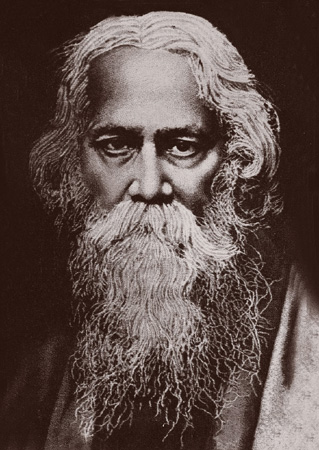
Greatest writer in modern Indian literature, Bengali poet, novelist, educator, and an early advocate of Independence for India. Tagore won the Nobel Prize for Literature in 1913. Two years later he was awarded the knighthood, but he surrendered it in 1919 as a protest against the Massacre of Amritsar, where British troops killed some 400 Indian demonstrators. Tagore’s influence over Gandhi and the founders of modern India was enormous, but his reputation in the West as a mystic has perhaps mislead his Western readers to ignore his role as a reformer and critic of colonialism.
“When one knows thee, then alien there is none, then no door is shut. Oh, grant me my prayer that I may never lose touch of the one in the play of the many.” (from Gitanjali)
Rabindranath Tagore was born in Calcutta into a wealthy and prominent family. His father was Maharishi Debendranath Tagore, a religious reformer and scholar. His mother, Sarada Devi, died when Tagore was very young – he realized that she will never come back was when her body was carried through a gate to a place where it was burned. Tagore’s grandfather had established a huge financial empire for himself. He helped a number of public projects, such as Calcutta Medical College.
The Tagores tried to combine traditional Indian culture with Western ideas; all the children contributed significantly to Bengali literature and culture. However, in My Reminiscences Tagore mentions that it was not until the age of ten when he started to use socks and shoes. And servants beat the children regularly. Tagore, the youngest, started to compose poems at the age of eight. Tagore’s first book, a collection of poems, appeared when he was 17; it was published by Tagore’s friend who wanted to surprise him.
Tagore received his early education first from tutors and then at a variety of schools. Among them were Bengal Academy where he studied history and culture. At University College, London, he studied law but left after a year – he did not like the weather. Once he gave a beggar a cold coin – it was more than the beggar had expected and he returned it. In England Tagore started to compose the poem ‘Bhagna Hridaj’ (a broken heart).
In 1883 Tagore married Mrinalini Devi Raichaudhuri, with whom he had two sons and three daughters. In 1890 Tagore moved to East Bengal (now Bangladesh), where he collected local legends and folklore. Between 1893 and 1900 he wrote seven volumes of poetry, including SONAR TARI (The Golden Boat), 1894 and KHANIKA, 1900. This was highly productive period in Tagore’s life, and earned him the rather misleading epitaph ‘The Bengali Shelley.’ More important was that Tagore wrote in the common language of the people. This also was something that was hard to accept among his critics and scholars.
Tagore was the first Indian to bring an element of psychological realism to his novels. Among his early major prose works are CHOCHER BALI (1903, Eyesore) and NASHTANIR (1901, The Broken Nest), published first serially. Between 1891 and 1895 he published forty-four short stories in Bengali periodical, most of them in the monthly journal Sadhana.
Especially Tagore’s short stories influenced deeply Indian Literature. ‘Punishment’, a much anthologized work, was set in a rural village. It describes the oppression of women through the tragedy of the low-caste Rui family. Chandara is a proud, beautiful woman, “buxom, well-rounded, compact and sturdy,” her husband, Chidam, is a farm-laborer, who works in the fields with his brother Dukhiram. One day when they return home after whole day of toil and humiliation, Dukhiram kills in anger his sloppy and slovenly wife because his food was not ready. To help his brother, Chidam’s tells to police that his wife struck her sister-in-law with the farm-knife. Chandara takes the blame on to herself. ‘In her thoughts, Chandara was saying to her husband, “I shall give my youth to the gallows instead of you. My final ties in this life will be with them.”‘ Afterwards both Chidam and Dukhiram try to confess that they were quilty but Chandara is convicted. Just before the hanging, the doctor says that her husband wants to see her. “To hell with him,” says Chandara.
In 1901 Tagore founded a school outside Calcutta, Visva-Bharati, which was dedicated to emerging Western and Indian philosophy and education. It become a university in 1921. He produced poems, novels, stories, a history of India, textbooks, and treatises on pedagogy. Tagore’s wife died in 1902, next year one of his daughters died, and in 1907 Tagore lost his younger son.
Tagore’s reputation as a writer was established in the United States and in England after the publication of GITANJALI: SONG OFFERINGS, about divine and human love. The poems were translated into English by the author himself. In the introduction from 1912 William Butler Yates wrote: “These lyrics – which are in the original, my Indians tell me, full of subtlety of rhythm, of untranslatable delicacies of colour, of metrical invention – display in their thought a world I have dreamed of all my life long.” Tagore’s poems were also praised by Ezra Pound, and drew the attention of the Nobel Prize committee. “There is in him the stillness of nature. The poems do not seem to have been produced by storm or by ignition, but seem to show the normal habit of his mind. He is at one with nature, and finds no contradictions. And this is in sharp contrast with the Western mode, where man must be shown attempting to master nature if we are to have “great drama.” (Ezra Pound in Fortnightly Review, 1 March 1913) However, Tagore also experimented with poetic forms and these works have lost much in translations into other languages.
Much of Tagore’s ideology come from the teaching of the Upahishads and from his own beliefs that God can be found through personal purity and service to others. He stressed the need for new world order based on transnational values and ideas, the “unity consciousness.” “The soil, in return for her service, keeps the tree tied to her; the sky asks nothing and leaves it free.” Politically active in India, Tagore was a supporter of Gandhi, but warned of the dangers of nationalistic thought. Unable to gain ideological support to his views, he retired into relative solitude. Between the years 1916 and 1934 he travelled widely. From his journey to Japan in 1916 he produced articles and books. In 1927 he toured in Southeast Asia. Letters from Java, which first was serialized in Vichitra, was issued as a book, JATRI, in 1929. His Majesty, Riza Shah Pahlavi, invited Tagore to Iran in 1932. On his journeys and lecture tours Tagore attempted to spread the ideal of uniting East and West. While in Japan he wrote: “The Japanese do not waste their energy in useless screaming and quarreling, and because there is no waste of energy it is not found wanting when required. This calmness and fortitude of body and mind is part of their national self-realization.”
Tagore wrote his most important works in Bengali, but he often translated his poems into English. At the age of 70 Tagore took up painting. He was also a composer, settings hundreds of poems to music. Many of his poems are actually songs, and inseparable from their music. Tagore’s ‘Our Golden Bengal’ became the national anthem of Bangladesh. Only hours before he died on August 7, in 1941, Tagore dictated his last poem. His written production, still not completely collected, fills nearly 30 substantial volumes. Tagore remained a well-known and popular author in the West until the end of the 1920s, but nowadays he is not so much read.
SADHANA
THE REALISATION OF LIFE
By
Rabindranath Tagore
Author of 'Gitanjali'
1916
To
Ernest Rhys
Author's Preface
Perhaps it is well for me to explain that the subject-matter of
the papers published in this book has not been philosophically
treated, nor has it been approached from the scholar's point of
view. The writer has been brought up in a family where texts of
the Upanishads are used in daily worship; and he has had before
him the example of his father, who lived his long life in the
closest communion with God, while not neglecting his duties to
the world, or allowing his keen interest in all human affairs to
suffer any abatement. So in these papers, it may be hoped,
western readers will have an opportunity of coming into touch
with the ancient spirit of India as revealed in our sacred texts
and manifested in the life of to-day.
All the great utterances of man have to be judged not by the
letter but by the spirit--the spirit which unfolds itself with
the growth of life in history. We get to know the real meaning
of Christianity by observing its living aspect at the present
moment--however different that may be, even in important
respects, from the Christianity of earlier periods.
For western scholars the great religious scriptures of India seem
to possess merely a retrospective and archaelogical interest; but
to us they are of living importance, and we cannot help thinking
that they lose their significance when exhibited in labelled
cases--mummied specimens of human thought and aspiration,
preserved for all time in the wrappings of erudition.
The meaning of the living words that come out of the experiences
of great hearts can never be exhausted by any one system of
logical interpretation. They have to be endlessly explained by
the commentaries of individual lives, and they gain an added
mystery in each new revelation. To me the verses of the
Upanishads and the teachings of Buddha have ever been things of
the spirit, and therefore endowed with boundless vital growth;
and I have used them, both in my own life and in my preaching, as
being instinct with individual meaning for me, as for others, and
awaiting for their confirmation, my own special testimony, which
must have its value because of its individuality.
I should add perhaps that these papers embody in a connected
form, suited to this publication, ideas which have been culled
from several of the Bengali discourses which I am in the habit of
giving to my students in my school at Bolpur in Bengal; and I
have used here and there translations of passages from these done
by my friends, Babu Satish Chandra Roy and Babu Ajit Kumar
Chakravarti. The last paper of this series, "Realisation in
Action," has been translated from my Bengali discourse on "Karma-
yoga" by my nephew, Babu Surendra Nath Tagore.
I take this opportunity of expressing my gratitude to Professor
James H. Woods, of Harvard University, for his generous
appreciation which encouraged me to complete this series of
papers and read most of them before the Harvard University. And
I offer my thanks to Mr. Ernest Rhys for his kindness in helping
me with suggestions and revisions, and in going through the
proofs.
A word may be added about the pronouncing of Sadhana: the accent
falls decisively on the first a, which has the broad sound of the
letter.
CONTENTS
I. THE RELATION OF THE INDIVIDUAL TO THE UNIVERSE
II. SOUL CONSCIOUSNESS
III. THE PROBLEM OF EVIL
IV. THE PROBLEM OF SELF
V. REALISATION IN LOVE
VI. REALISATION IN ACTION
VII. THE REALISATION OF BEAUTY
VIII. THE REALISATION OF THE INFINITE
I
THE RELATION OF THE INDIVIDUAL TO THE UNIVERSE
The civilisation of ancient Greece was nurtured within city
walls. In fact, all the modern civilisations have their cradles
of brick and mortar.
These walls leave their mark deep in the minds of men. They set
up a principle of "divide and rule" in our mental outlook, which
begets in us a habit of securing all our conquests by fortifying
them and separating them from one another. We divide nation and
nation, knowledge and knowledge, man and nature. It breeds in us
a strong suspicion of whatever is beyond the barriers we have
built, and everything has to fight hard for its entrance into our
recognition.
When the first Aryan invaders appeared in India it was a vast
land of forests, and the new-comers rapidly took advantage of
them. These forests afforded them shelter from the fierce heat
of the sun and the ravages of tropical storms, pastures for
cattle, fuel for sacrificial fire, and materials for building
cottages. And the different Aryan clans with their patriarchal
heads settled in the different forest tracts which had some
special advantage of natural protection, and food and water in
plenty.
Thus in India it was in the forests that our civilisation had its
birth, and it took a distinct character from this origin and
environment. It was surrounded by the vast life of nature, was
fed and clothed by her, and had the closest and most constant
intercourse with her varying aspects.
Such a life, it may be thought, tends to have the effect of
dulling human intelligence and dwarfing the incentives to
progress by lowering the standards of existence. But in ancient
India we find that the circumstances of forest life did not
overcome man's mind, and did not enfeeble the current of his
energies, but only gave to it a particular direction. Having
been in constant contact with the living growth of nature, his
mind was free from the desire to extend his dominion by erecting
boundary walls around his acquisitions. His aim was not to
acquire but to realise, to enlarge his consciousness by growing
with and growing into his surroundings. He felt that truth is
all-comprehensive, that there is no such thing as absolute
isolation in existence, and the only way of attaining truth is
through the interpenetration of our being into all objects. To
realise this great harmony between man's spirit and the spirit of
the world was the endeavour of the forest-dwelling sages of
ancient India.
In later days there came a time when these primeval forests gave
way to cultivated fields, and wealthy cities sprang up on all
sides. Mighty kingdoms were established, which had
communications with all the great powers of the world. But even
in the heyday of its material prosperity the heart of India ever
looked back with adoration upon the early ideal of strenuous
self-realisation, and the dignity of the simple life of the
forest hermitage, and drew its best inspiration from the wisdom
stored there.
The west seems to take a pride in thinking that it is subduing
nature; as if we are living in a hostile world where we have to
wrest everything we want from an unwilling and alien arrangement
of things. This sentiment is the product of the city-wall habit
and training of mind. For in the city life man naturally directs
the concentrated light of his mental vision upon his own life and
works, and this creates an artificial dissociation between
himself and the Universal Nature within whose bosom he lies.
But in India the point of view was different; it included the
world with the man as one great truth. India put all her
emphasis on the harmony that exists between the individual and
the universal. She felt we could have no communication whatever
with our surroundings if they were absolutely foreign to us.
Man's complaint against nature is that he has to acquire most of
his necessaries by his own efforts. Yes, but his efforts are not
in vain; he is reaping success every day, and that shows there is
a rational connection between him and nature, for we never can
make anything our own except that which is truly related to us.
We can look upon a road from two different points of view. One
regards it as dividing us from the object of our desire; in that
case we count every step of our journey over it as something
attained by force in the face of obstruction. The other sees it
as the road which leads us to our destination; and as such it is
part of our goal. It is already the beginning of our attainment,
and by journeying over it we can only gain that which in itself
it offers to us. This last point of view is that of India with
regard to nature. For her, the great fact is that we are in
harmony with nature; that man can think because his thoughts are
in harmony with things; that he can use the forces of nature for
his own purpose only because his power is in harmony with the
power which is universal, and that in the long run his purpose
never can knock against the purpose which works through nature.
In the west the prevalent feeling is that nature belongs
exclusively to inanimate things and to beasts, that there is a
sudden unaccountable break where human-nature begins. According
to it, everything that is low in the scale of beings is merely
nature, and whatever has the stamp of perfection on it,
intellectual or moral, is human-nature. It is like dividing the
bud and the blossom into two separate categories, and putting
their grace to the credit of two different and antithetical
principles. But the Indian mind never has any hesitation in
acknowledging its kinship with nature, its unbroken relation with
all.
The fundamental unity of creation was not simply a philosophical
speculation for India; it was her life-object to realise this
great harmony in feeling and in action. With mediation and
service, with a regulation of life, she cultivated her
consciousness in such a way that everything had a spiritual
meaning to her. The earth, water and light, fruits and flowers,
to her were not merely physical phenomena to be turned to use and
then left aside. They were necessary to her in the attainment of
her ideal of perfection, as every note is necessary to the
completeness of the symphony. India intuitively felt that the
essential fact of this world has a vital meaning for us; we have
to be fully alive to it and establish a conscious relation with
it, not merely impelled by scientific curiosity or greed of
material advantage, but realising it in the spirit of sympathy,
with a large feeling of joy and peace.
The man of science knows, in one aspect, that the world is not
merely what it appears to be to our senses; he knows that earth
and water are really the play of forces that manifest themselves
to us as earth and water--how, we can but partially apprehend.
Likewise the man who has his spiritual eyes open knows that the
ultimate truth about earth and water lies in our apprehension of
the eternal will which works in time and takes shape in the
forces we realise under those aspects. This is not mere
knowledge, as science is, but it is a preception of the soul by
the soul. This does not lead us to power, as knowledge does, but
it gives us joy, which is the product of the union of kindred
things. The man whose acquaintance with the world does not lead
him deeper than science leads him, will never understand what it
is that the man with the spiritual vision finds in these natural
phenomena. The water does not merely cleanse his limbs, but it
purifies his heart; for it touches his soul. The earth does not
merely hold his body, but it gladdens his mind; for its contact
is more than a physical contact--it is a living presence. When a
man does not realise his kinship with the world, he lives in a
prison-house whose walls are alien to him. When he meets the
eternal spirit in all objects, then is he emancipated, for then
he discovers the fullest significance of the world into which he
is born; then he finds himself in perfect truth, and his harmony
with the all is established. In India men are enjoined to be
fully awake to the fact that they are in the closest relation to
things around them, body and soul, and that they are to hail the
morning sun, the flowing water, the fruitful earth, as the
manifestation of the same living truth which holds them in its
embrace. Thus the text of our everyday meditation is the
_Gayathri_, a verse which is considered to be the epitome of all
the Vedas. By its help we try to realise the essential unity of
the world with the conscious soul of man; we learn to perceive
the unity held together by the one Eternal Spirit, whose power
creates the earth, the sky, and the stars, and at the same time
irradiates our minds with the light of a consciousness that moves
and exists in unbroken continuity with the outer world.
It is not true that India has tried to ignore differences of
value in different things, for she knows that would make life
impossible. The sense of the superiority of man in the scale of
creation has not been absent from her mind. But she has had her
own idea as to that in which his superiority really consists. It
is not in the power of possession but in the power of union.
Therefore India chose her places of pilgrimage wherever there was
in nature some special grandeur or beauty, so that her mind could
come out of its world of narrow necessities and realise its place
in the infinite. This was the reason why in India a whole
people who once were meat-eaters gave up taking animal food to
cultivate the sentiment of universal sympathy for life, an event
unique in the history of mankind.
India knew that when by physical and mental barriers we violently
detach ourselves from the inexhaustible life of nature; when we
become merely man, but not man-in-the-universe, we create
bewildering problems, and having shut off the source of their
solution, we try all kinds of artificial methods each of which
brings its own crop of interminable difficulties. When man
leaves his resting-place in universal nature, when he walks on
the single rope of humanity, it means either a dance or a fall
for him, he has ceaselessly to strain every nerve and muscle to
keep his balance at each step, and then, in the intervals of his
weariness, he fulminates against Providence and feels a secret
pride and satisfaction in thinking that he has been unfairly
dealt with by the whole scheme of things.
But this cannot go on for ever. Man must realise the wholeness
of his existence, his place in the infinite; he must know that
hard as he may strive he can never create his honey within the
cells of his hive; for the perennial supply of his life food is
outside their walls. He must know that when man shuts himself
out from the vitalising and purifying touch of the infinite, and
falls back upon himself for his sustenance and his healing, then
he goads himself into madness, tears himself into shreds, and
eats his own substance. Deprived of the background of the whole,
his poverty loses its one great quality, which is simplicity, and
becomes squalid and shamefaced. His wealth is no longer
magnanimous; it grows merely extravagant. His appetites do not
minister to his life, keeping to the limits of their purpose;
they become an end in themselves and set fire to his life and
play the fiddle in the lurid light of the conflagration. Then it
is that in our self-expression we try to startle and not to
attract; in art we strive for originality and lose sight of truth
which is old and yet ever new; in literature we miss the complete
view of man which is simple and yet great, but he appears as a
psychological problem or the embodiment of a passion that is
intense because abnormal and because exhibited in the glare of a
fiercely emphatic light which is artificial. When man's
consciousness is restricted only to the immediate vicinity of his
human self, the deeper roots of his nature do not find their
permanent soil, his spirit is ever on the brink of starvation,
and in the place of healthful strength he substitutes rounds of
stimulation. Then it is that man misses his inner perspective
and measures his greatness by its bulk and not by its vital link
with the infinite, judges his activity by its movement and not by
the repose of perfection--the repose which is in the starry
heavens, in the ever-flowing rhythmic dance of creation.
Like this so far> Read the rest. You won't be disappointed.
All of Sadhana in DOC format
sadhana-the-realization-of-life-by-r-tagore-english
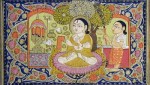
While Tagore was primarily known for his writing and music, in his
later years he became an accomplished artists. Most of his paintings
were considered to be abstract.
A couple reproductions I could find- and one more portrait:


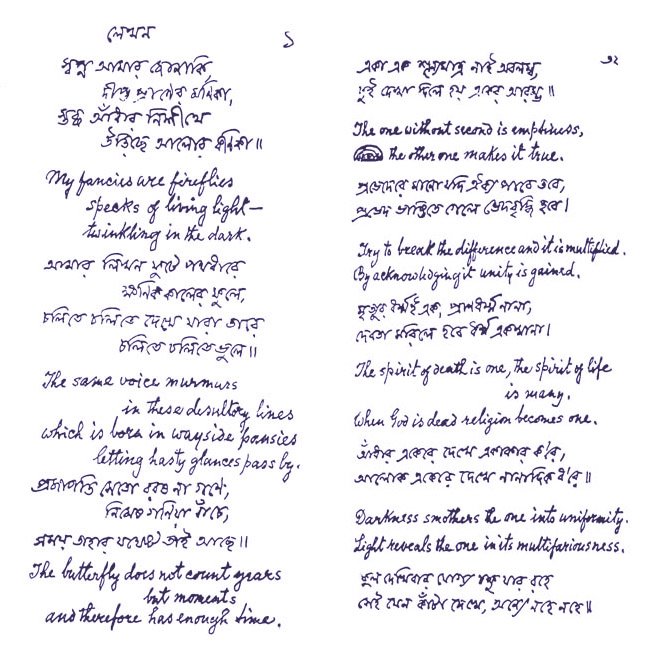
 A sample of his writing-
 Bye for now,
Rick
Bye for now,
Rick
























































































 moon soup