Tag Archives: Spirituality

Spirit Heart Sound

Swami Sarvagananda & Party

guru

spirit-heart

Parvardigar- Pete Townsend

09-parvardigar

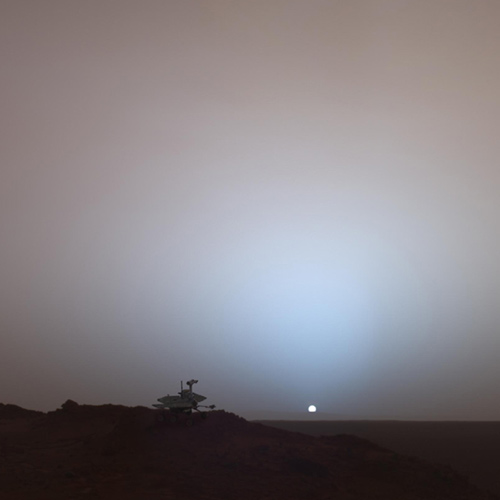
spirit_sunset_on_mars

Innocence mission

the-innocence-mission-23-prayer-of-st-francis-the-lakes-of-canada-ep

healing-hands

Ah- nee mah: Spirit of the Southwest

01-spirit-dance

love_heart2

Blind Faith

blind-faith-blind-faith-deluxe-edition-cd-1-04-presence-of-the-lord-450

sleeping_buddha

3 Comments

Filed under Free Music, mp3, Music, Spirituality

Mostly the teachings of a Mad Man

looneymoon

Moon not exactly full

Last nights show was great, though a week late. I’ll get the MP3 up as soon as possible for the archives. Only 3 callers who hung on (several hang-ups when lines were busy). Enough on that topic.

psychiatry346185227_std

My Friend, Senor Ref. C. on Ward 34D

Yesterday I saw a man at the “hospital” where I work. Of course, the term hospital is not a true description of what happens to people there. So much suffering, so much torment. but enough of that- this is the story:

(For those of you who are unfamiliar with my work, I am a loose cannon patient support person at a “Forensic Mental Health Facility”- read: a place where people are kept who have been judged by the courts of Oregon to be “Guilty but Insane”.)

So, this guy, I’ll call him “Mr. Castle” for the purpose of confidentiality; I met him the first couple weeks I was there at a time I was doing Hospital Improvement Surveys as a tool for getting to know the place and it’s people. He live in a gero ward, 34D, with other older and physically limited folks. I really enjoyed talking with him. He is smart and very thoughtful, insightful (despite his current diagnosis of dementia and organic brain disease). He is a deeply spiritual man.

bodymindspirit1

He transferred from the Oregon State Prison a few years back when they could no longer care for him adequately. He is serving a life sentence, convicted of a “terrible mis-deed”  (his words), or, conversely, “Murder” according to his chart. (I once asked him about his treatment in prison compared to the Hospital- he said that Prison was where God had opened his eyes to the world of the spirit and the true purpose of his life. Here he was just surviving and trying to keep devotion to “God and The Mystery” while watching what he realized was a progressive condition that will eventually take away his mind.) In his former life he was a father of 9 children, a US war veteran and a social worker. He has studied psychology and is extremely smart. His memory sometimes fails him. He has had strokes that have affected his mobility. He has PTSD and traumatic brain injury from his military service.

I used to go see him every week the first few months I was working there- I enjoyed our talks. His religious devotion along with a penetrating insight is a joy. Lately I haven’t seen him in at least 2 months. I’ve been busy as I’ve had to work toward a balance in my efforts to be useful to the over 600 patients who live in that island of  Mental Hell Treatment.

rose_opens2

I decided to go see Mr. Castle yesterday in the morning after I finished some paperwork. I didn’t think he would remember me. I did not call ahead. I walked to 34D, across “campus” about a quarter mile or more from my office.

I walked into the downstairs lobby. Mr. Castle was with a small group of staff and patients waiting for the elevator to go back to the ward from “crafts class”. He saw me with a puzzled look. I said, “You might not remember me. Can you recall my name?”

He said, “Of course, Mr. Rick. You have arrived just in time. I will only need a small amount of your attention. We can be through in about 20 minutes.” I had a very strong feeling he was seeing me for what he considered an appointment and that he was glad I was not late. “This will work well because I have lunch in about a half an hour from now,” he added.

daytime_moon

We went up the elevator, through the locked doors that get us eventually into 34D. He said, “It will only take me a few minutes to get my papers together.” He walked down the hall (with his walker) and gestured for me to follow him.

In his room, he rummaged through papers he had been keeping, seemingly for his anticipated discussion with me. The papers included print-outs from a group he had attended and some writings of his own (in Spanish, but he translated).

owdm-a-lucky-break

First he read to me the key points in his recent writings. Part had to do with a topic we had discussed before- the “purpose of Man in God’s plan and the Ultimate Penetration of the Holy Mystery”. As he translated his own writing he came to several places where he could not find an English equivalent. The most simplistic summary would be: Man is composed of 3 principles- Spirit, Soul (to this he included mind, emotion, habits, attachments) and Body (simply the physical form and it’s basic needs for survival- not the physical desires, which he insists are attributes of Mind). “So, these 3 things make a man. They are all required for Man to fulfill his purpose and promise in the world. One can not outweigh the others or there will be problems, illness and “mis-deeds”.

Then he pulled out a handout from a group he had attended on the ward. He said, “I am a college graduate with much training in psychology. So, you see, I am capable of focusing my mind in the study of this information. I have applied my concentration to understanding what is here.” He had marked up the pages in various parts- mostly underlines and asterisk.

psychwardart-mycraftproject

“Psychology is a great and powerful science”, he said, “but it is flawed and does not have a complete understanding of who we are and why we are.” He went on to critique the handouts, respectfully but completely. I won’t go into detail.

In summary, Mr. Castle explained that too much emphasis on the mind and it’s needs and habits is detrimental to a Man in the fulfillment of God’s purpose. The Spirit and the Body must receive appropriate nourishment. Without proper sustenance of each element of our being we cannot penetrate the mystery. He told me a story from his life, the gist of which was that his mind had led him into “terrible misdeeds”. His eyes became red and he began to cry. “I have been locked up for 30 years and suffered great remorse because I did not know the proper balance of my whole being”.

maid

Then he stopped crying. His eyes cleared. He said that everything that had happened was part of his education. He said, “Man always wants to blame God or blame anyone else for their own mistakes. Adam blamed Eve and God, Eve blamed the serpent and God. Ever since then all Man wants to do is place the blame on someone else.”

Then he said it was time for me to go. His lunch would be arriving soon.

1162407703lunch_tray

Leave a comment

Filed under animated gif, personal story, pictures, Spirituality

No information

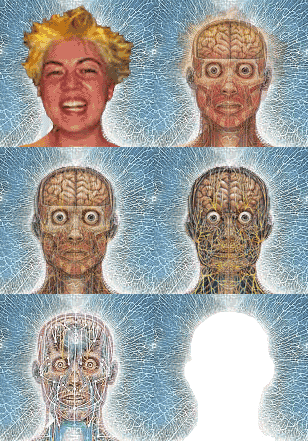
11brain2axx__1231575167_0544click for size

lord-buckley-8-people-epilogue

tricycle_backflipa-century-of-recorded-poetry-vol-4-32-li-young-lee-my-father-in-heaven-is-reading-out-loud

10-round-dance

bucket-of-owlseugenecash_relaxreleaserelish

ani-catching-up-on-some-readingwernher-von-braun

ani-dramatic-cupcake-dogdianawinston_sevenreasonsnottohate

ajahnamaro_metta

lewisrichmond_vimalakirtisutra

sta50014birdsongs-a-beautiful-mix-31-mins

sta50201

Leave a comment

Filed under buddhism, comedy relief, Family pictures, mp3, Music, sound bite

The Art of Happiness: Audio by HH Dalai Lama

Download, share:

art-of-happiness-dalai-lama-1of-2-share-me-self-help-audio-book1

art-of-happiness-dalai-lama-2-of-2-share-me-self-help-audio-book

7 Comments

Filed under buddhism, Free Audio Books, mp3, Spirituality, wellness and systems change

Dip deeply into the Dao, Soup Sippers of the Moon

An assortment of audio and doc format translations of the Tao Te Ching.

What more can I say?

It’s the way.

tao-2The Tao Te Ching

Translation by Gia Fu Feng & Jane English
Comments and layout by Thomas Knierim

E-Book, Doc Format, download here:

the-tao-te-ching

Audio Book download of the same translation, read by Jacob Needleman:

tao-te-ching-read-by-jacob-needleman

sch_g_taoMore well known, The James Legge version is next- this is the classic English translation

seen most often in quotes from Lao Tsu:

Download the E-Book, Doc format:

tao-te-ching-leggetrans

Here is the Audio Book, in chapters, of the James Legge version

read by Eric Piotrowski:

01-tao_teh_king_01-09_lao-tze

02-tao_teh_king_10-18_lao-tze

03-tao_teh_king_19-27_lao-tze

04-tao_teh_king_28-37_lao-tze

05-tao_teh_king_38-45_lao-tze

06-tao_teh_king_46-54_lao-tze

07-tao_teh_king_55-63_lao-tze

08-tao_teh_king_64-72_lao-tze

09-tao_teh_king_73-81_lao-tze

laozi

The Tao Te Ching
by Lao Tzu

Translated by Stephen Mitchell

1
The tao that can be told
is not the eternal Tao
The name that can be named
is not the eternal Name. The unnamable is the eternally real.
Naming is the origin
of all particular things. Free from desire, you realize the mystery.
Caught in desire, you see only the manifestations. Yet mystery and manifestations
arise from the same source.
This source is called darkness. Darkness within darkness.
The gateway to all understanding.

2
When people see some things as beautiful,
other things become ugly.
When people see some things as good,
other things become bad. Being and non-being create each other.
Difficult and easy support each other.
Long and short define each other.
High and low depend on each other.
Before and after follow each other. Therefore the Master
acts without doing anything
and teaches without saying anything.
Things arise and she lets them come;
things disappear and she lets them go.
She has but doesn’t possess,
acts but doesn’t expect.
When her work is done, she forgets it.
That is why it lasts forever.

3
If you overesteem great men,
people become powerless.
If you overvalue possessions,
people begin to steal. The Master leads
by emptying people’s minds
and filling their cores,
by weakening their ambition
and toughening their resolve.
He helps people lose everything
they know, everything they desire,
and creates confusion
in those who think that they know. Practice not-doing,
and everything will fall into place.

4
The Tao is like a well:
used but never used up.
It is like the eternal void:
filled with infinite possibilities. It is hidden but always present.
I don’t know who gave birth to it.

It is older than God.

5
The Tao doesn’t take sides;
it gives birth to both good and evil.
The Master doesn’t take sides;
she welcomes both saints and sinners. The Tao is like a bellows:
it is empty yet infinitely capable.
The more you use it, the more it produces;
the more you talk of it, the less you understand. Hold on to the center.

6
The Tao is called the Great Mother:
empty yet inexhaustible,
it gives birth to infinite worlds. It is always present within you.
You can use it any way you want.

7
The Tao is infinite, eternal.
Why is it eternal?
It was never born;
thus it can never die.
Why is it infinite?
It has no desires for itself;
thus it is present for all beings. The Master stays behind;
that is why she is ahead.
She is detached from all things;
that is why she is one with them.
Because she has let go of herself,
she is perfectly fulfilled.

8
The supreme good is like water,
which nourishes all things without trying to.
It is content with the low places that people disdain.
Thus it is like the Tao. In dwelling, live close to the ground.
In thinking, keep to the simple.
In conflict, be fair and generous.
In governing, don’t try to control.
In work, do what you enjoy.
In family life, be completely present. When you are content to be simply yourself
and don’t compare or compete,
everybody will respect you.

9
Fill your bowl to the brim
and it will spill.
Keep sharpening your knife
and it will blunt.
Chase after money and security
and your heart will never unclench.
Care about people’s approval
and you will be their prisoner. Do your work, then step back.
The only path to serenity.

10
Can you coax your mind from its wandering
and keep to the original oneness?

Can you let your body become
supple as a newborn child’s?
Can you cleanse your inner vision
until you see nothing but the light?
Can you love people and lead them
without imposing your will?
Can you deal with the most vital matters
by letting events take their course?
Can you step back from you own mind
and thus understand all things? Giving birth and nourishing,
having without possessing,
acting with no expectations,
leading and not trying to control:
this is the supreme virtue.

11
We join spokes together in a wheel,
but it is the center hole
that makes the wagon move. We shape clay into a pot,
but it is the emptiness inside
that holds whatever we want. We hammer wood for a house,
but it is the inner space
that makes it livable. We work with being,
but non-being is what we use.

12
Colors blind the eye.
Sounds deafen the ear.
Flavors numb the taste.
Thoughts weaken the mind.
Desires wither the heart. The Master observes the world
but trusts his inner vision.
He allows things to come and go.
His heart is open as the sky.

13
Success is as dangerous as failure.
Hope is as hollow as fear. What does it mean that success is a dangerous as failure?
Whether you go up the ladder or down it,
you position is shaky.
When you stand with your two feet on the ground,
you will always keep your balance. What does it mean that hope is as hollow as fear?
Hope and fear are both phantoms
that arise from thinking of the self.
When we don’t see the self as self,
what do we have to fear? See the world as your self.
Have faith in the way things are.
Love the world as your self;
then you can care for all things.

14
Look, and it can’t be seen.
Listen, and it can’t be heard.
Reach, and it can’t be grasped. Above, it isn’t bright.
Below, it isn’t dark.
Seamless, unnamable,
it returns to the realm of nothing.

Form that includes all forms,
image without an image,
subtle, beyond all conception. Approach it and there is no beginning;
follow it and there is no end.
You can’t know it, but you can be it,
at ease in your own life.
Just realize where you come from:
this is the essence of wisdom.

15
The ancient Masters were profound and subtle.
Their wisdom was unfathomable.
There is no way to describe it;
all we can describe is their appearance. They were careful
as someone crossing an iced-over stream.
Alert as a warrior in enemy territory.
Courteous as a guest.
Fluid as melting ice.
Shapable as a block of wood.
Receptive as a valley.
Clear as a glass of water. Do you have the patience to wait
till your mud settles and the water is clear?
Can you remain unmoving
till the right action arises by itself? The Master doesn’t seek fulfillment.
Not seeking, not expecting,
she is present, and can welcome all things.

16
Empty your mind of all thoughts.
Let your heart be at peace.
Watch the turmoil of beings,
but contemplate their return. Each separate being in the universe
returns to the common source.
Returning to the source is serenity. If you don’t realize the source,
you stumble in confusion and sorrow.
When you realize where you come from,
you naturally become tolerant,
disinterested, amused,
kindhearted as a grandmother,
dignified as a king.
Immersed in the wonder of the Tao,
you can deal with whatever life brings you,
and when death comes, you are ready.

17
When the Master governs, the people
are hardly aware that he exists.
Next best is a leader who is loved.
Next, one who is feared.
The worst is one who is despised. If you don’t trust the people,
you make them untrustworthy. The Master doesn’t talk, he acts.
When his work is done,
the people say, “Amazing: we did it, all by ourselves!”

18
When the great Tao is forgotten,
goodness and piety appear.

When the body’s intelligence declines,
cleverness and knowledge step forth.
When there is no peace in the family,
filial piety begins.
When the country falls into chaos,
patriotism is born.

19
Throw away holiness and wisdom,
and people will be a hundred times happier.
Throw away morality and justice,
and people will do the right thing.
Throw away industry and profit,
and there won’t be any thieves. If these three aren’t enough,
just stay at the center of the circle
and let all things take their course.

20
Stop thinking, and end your problems.
What difference between yes and no?
What difference between success and failure?
Must you value what others value,
avoid what others avoid?
How ridiculous! Other people are excited,
as though they were at a parade.
I alone don’t care,
I alone am expressionless,
like an infant before it can smile. Other people have what they need;
I alone possess nothing.
I alone drift about,
like someone without a home.
I am like an idiot, my mind is so empty. Other people are bright;
I alone am dark.
Other people are sharper;
I alone am dull.
Other people have a purpose;
I alone don’t know.
I drift like a wave on the ocean,
I blow as aimless as the wind. I am different from ordinary people.
I drink from the Great Mother’s breasts.

21
The Master keeps her mind
always at one with the Tao;
that is what gives her her radiance. The Tao is ungraspable.
How can her mind be at one with it?
Because she doesn’t cling to ideas. The Tao is dark and unfathomable.
How can it make her radiant?
Because she lets it. Since before time and space were,
the Tao is.
It is beyond is and is not.
How do I know this is true?
I look inside myself and see.

22
If you want to become whole,
let yourself be partial.

If you want to become straight,
let yourself be crooked.
If you want to become full,
let yourself be empty.
If you want to be reborn,
let yourself die.
If you want to be given everything,
give everything up. The Master, by residing in the Tao,
sets an example for all beings.
Because he doesn’t display himself,
people can see his light.
Because he has nothing to prove,
people can trust his words.
Because he doesn’t know who he is,
people recognize themselves in him.
Because he has no goad in mind,
everything he does succeeds. When the ancient Masters said,
“If you want to be given everything, give everything up,”
they weren’t using empty phrases.
Only in being lived by the Tao can you be truly yourself.

23
Express yourself completely,
then keep quiet.
Be like the forces of nature:
when it blows, there is only wind;
when it rains, there is only rain;
when the clouds pass, the sun shines through. If you open yourself to the Tao,
you are at one with the Tao
and you can embody it completely.
If you open yourself to insight,
you are at one with insight
and you can use it completely.
If you open yourself to loss,
you are at one with loss
and you can accept it completely. Open yourself to the Tao,
then trust your natural responses;
and everything will fall into place.

24
He who stands on tiptoe
doesn’t stand firm.
He who rushes ahead
doesn’t go far.
He who tries to shine
dims his own light.
He who defines himself
can’t know who he really is.
He who has power over others
can’t empower himself.
He who clings to his work
will create nothing that endures. If you want to accord with the Tao, just do your job,
then let go.

25
There was something formless and perfect
before the universe was born.

It is serene. Empty.
Solitary. Unchanging.
Infinite. Eternally present.
It is the mother of the universe.
For lack of a better name,
I call it the Tao. It flows through all things,
inside and outside, and returns
to the origin of all things. The Tao is great.
The universe is great.
Earth is great.
Man is great.
These are the four great powers. Man follows the earth.
Earth follows the universe.
The universe follows the Tao.
The Tao follows only itself.

26
The heavy is the root of the light.
The unmoved is the source of all movement. Thus the Master travels all day
without leaving home.
However splendid the views,
she stays serenely in herself. Why should the lord of the country
flit about like a fool?
If you let yourself be blown to and fro,
you lose touch with your root.
If you let restlessness move you,
you lose touch with who you are.

27
A good traveler has no fixed plans
and is not intent upon arriving.
A good artist lets his intuition
lead him wherever it wants.
A good scientist has freed himself of concepts
and keeps his mind open to what is. Thus the Master is available to all people
and doesn’t reject anyone.
He is ready to use all situations
and doesn’t waste anything.
This is called embodying the light. What is a good man but a bad man’s teacher?
What is a bad man but a good man’s job?
If you don’t understand this, you will get lost,
however intelligent you are.
It is the great secret.

28
Know the male,
yet keep to the female:
receive the world in your arms.
If you receive the world,
the Tao will never leave you
and you will be like a little child. Know the white,
yet keep to the black:
be a pattern for the world.
If you are a pattern for the world,
the Tao will be strong inside you
and there will be nothing you can’t do. Know the personal,
yet keep to the impersonal:

accept the world as it is.
If you accept the world,
the Tao will be luminous inside you
and you will return to your primal self. The world is formed from the void,
like utensils from a block of wood.
The Master knows the utensils,
yet keeps to the the block:
thus she can use all things.

29
Do you want to improve the world?
I don’t think it can be done. The world is sacred.
It can’t be improved.
If you tamper with it, you’ll ruin it.
If you treat it like an object, you’ll lose it. There is a time for being ahead,
a time for being behind;
a time for being in motion,
a time for being at rest;
a time for being vigorous,
a time for being exhausted;
a time for being safe,
a time for being in danger. The Master sees things as they are,
without trying to control them.
She lets them go their own way,
and resides at the center of the circle.

30
Whoever relies on the Tao in governing men
doesn’t try to force issues
or defeat enemies by force of arms.
For every force there is a counterforce.
Violence, even well intentioned,
always rebounds upon oneself. The Master does his job
and then stops.
He understands that the universe
is forever out of control,
and that trying to dominate events
goes against the current of the Tao.
Because he believes in himself,
he doesn’t try to convince others.
Because he is content with himself,
he doesn’t need others’ approval.
Because he accepts himself,
the whole world accepts him.

31
Weapons are the tools of violence;
all decent men detest them. Weapons are the tools of fear;
a decent man will avoid them
except in the direst necessity
and, if compelled, will use them
only with the utmost restraint.
Peace is his highest value.
If the peace has been shattered,
how can he be content?
His enemies are not demons,
but human beings like himself.

He doesn’t wish them personal harm.
Nor does he rejoice in victory.
How could he rejoice in victory
and delight in the slaughter of men? He enters a battle gravely,
with sorrow and with great compassion,
as if he were attending a funeral.

32
The Tao can’t be perceived.
Smaller than an electron,
it contains uncountable galaxies. If powerful men and women
could remain centered in the Tao,
all things would be in harmony.
The world would become a paradise.
All people would be at peace,
and the law would be written in their hearts. When you have names and forms,
know that they are provisional.
When you have institutions,
know where their functions should end.
Knowing when to stop,
you can avoid any danger. All things end in the Tao
as rivers flow into the sea.

33
Knowing others is intelligence;
knowing yourself is true wisdom.
Mastering others is strength;
mastering yourself is true power. If you realize that you have enough,
you are truly rich.
If you stay in the center
and embrace death with your whole heart,
you will endure forever.

34
The great Tao flows everywhere.
All things are born from it,
yet it doesn’t create them.
It pours itself into its work,
yet it makes no claim.
It nourishes infinite worlds,
yet it doesn’t hold on to them.
Since it is merged with all things
and hidden in their hearts,
it can be called humble.
Since all things vanish into it
and it alone endures,
it can be called great.
It isn’t aware of its greatness;
thus it is truly great.

35
She who is centered in the Tao
can go where she wishes, without danger.
She perceives the universal harmony,
even amid great pain,
because she has found peace in her heart. Music or the smell of good cooking
may make people stop and enjoy.

But words that point to the Tao
seem monotonous and without flavor.
When you look for it, there is nothing to see.
When you listen for it, there is nothing to hear.
When you use it, it is inexhaustible.

36
If you want to shrink something,
you must first allow it to expand.
If you want to get rid of something,
you must first allow it to flourish.
If you want to take something,
you must first allow it to be given.
This is called the subtle perception
of the way things are. The soft overcomes the hard.
The slow overcomes the fast.
Let your workings remain a mystery.
Just show people the results.

37
The Tao never does anything,
yet through it all things are done. If powerful men and women
could venter themselves in it,
the whole world would be transformed
by itself, in its natural rhythms.
People would be content
with their simple, everyday lives,
in harmony, and free of desire. When there is no desire,
all things are at peace.

38
The Master doesn’t try to be powerful;
thus he is truly powerful.
The ordinary man keeps reaching for power;
thus he never has enough. The Master does nothing,
yet he leaves nothing undone.
The ordinary man is always doing things,
yet many more are left to be done. The kind man does something,
yet something remains undone.
The just man does something,
and leaves many things to be done.
The moral man does something,
and when no one responds
he rolls up his sleeves and uses force. When the Tao is lost, there is goodness.
When goodness is lost, there is morality.
When morality is lost, there is ritual.
Ritual is the husk of true faith,
the beginning of chaos. Therefore the Master concerns himself
with the depths and not the surface,
with the fruit and not the flower.
He has no will of his own.
He dwells in reality,
and lets all illusions go.

39
In harmony with the Tao,
the sky is clear and spacious,

the earth is solid and full,
all creature flourish together,
content with the way they are,
endlessly repeating themselves,
endlessly renewed. When man interferes with the Tao,
the sky becomes filthy,
the earth becomes depleted,
the equilibrium crumbles,
creatures become extinct. The Master views the parts with compassion,
because he understands the whole.
His constant practice is humility.
He doesn’t glitter like a jewel
but lets himself be shaped by the Tao,
as rugged and common as stone.

40
Return is the movement of the Tao.
Yielding is the way of the Tao. All things are born of being.
Being is born of non-being.

41
When a superior man hears of the Tao,
he immediately begins to embody it.
When an average man hears of the Tao,
he half believes it, half doubts it.
When a foolish man hears of the Tao,
he laughs out loud.
If he didn’t laugh,
it wouldn’t be the Tao. Thus it is said:
The path into the light seems dark,
the path forward seems to go back,
the direct path seems long,
true power seems weak,
true purity seems tarnished,
true steadfastness seems changeable,
true clarity seems obscure,
the greatest are seems unsophisticated,
the greatest love seems indifferent,
the greatest wisdom seems childish. The Tao is nowhere to be found.
Yet it nourishes and completes all things.

42
The Tao gives birth to One.
One gives birth to Two.
Two gives birth to Three.
Three gives birth to all things. All things have their backs to the female
and stand facing the male.
When male and female combine,
all things achieve harmony. Ordinary men hate solitude.
But the Master makes use of it,
embracing his aloneness, realizing
he is one with the whole universe.

43
The gentlest thing in the world
overcomes the hardest thing in the world.
That which has no substance

enters where there is no space.
This shows the value of non-action. Teaching without words,
performing without actions:
that is the Master’s way.

44
Fame or integrity: which is more important?
Money or happiness: which is more valuable?
Success of failure: which is more destructive? If you look to others for fulfillment,
you will never truly be fulfilled.
If your happiness depends on money,
you will never be happy with yourself. Be content with what you have;
rejoice in the way things are.
When you realize there is nothing lacking,
the whole world belongs to you.

45
True perfection seems imperfect,
yet it is perfectly itself.
True fullness seems empty,
yet it is fully present. True straightness seems crooked.
True wisdom seems foolish.
True art seems artless. The Master allows things to happen.
She shapes events as they come.
She steps out of the way
and lets the Tao speak for itself.

46
When a country is in harmony with the Tao,
the factories make trucks and tractors.
When a country goes counter to the Tao,
warheads are stockpiled outside the cities. There is no greater illusion than fear,
no greater wrong than preparing to defend yourself,
no greater misfortune than having an enemy. Whoever can see through all fear
will always be safe.

47
Without opening your door,
you can open your heart to the world.
Without looking out your window,
you can see the essence of the Tao. The more you know,
the less you understand. The Master arrives without leaving,
sees the light without looking,
achieves without doing a thing.

48
In pursuit of knowledge,
every day something is added.
In the practice of the Tao,
every day something is dropped.
Less and less do you need to force things,
until finally you arrive at non-action.
When nothing is done,
nothing is left undone. True mastery can be gained
by letting things go their own way.
It can’t be gained by interfering.

49

The Master has no mind of her own.
She works with the mind of the people. She is good to people who are good.
She is also good to people who aren’t good.
This is true goodness. She trusts people who are trustworthy.
She also trusts people who aren’t trustworthy.
This is true trust. The Master’s mind is like space.
People don’t understand her.
They look to her and wait. She treats them like her own children.

50
The Master gives himself up
to whatever the moment brings.
He knows that he is going to die,
and her has nothing left to hold on to:
no illusions in his mind,
no resistances in his body.
He doesn’t think about his actions;
they flow from the core of his being.
He holds nothing back from life;
therefore he is ready for death,
as a man is ready for sleep
after a good day’s work.

51
Every being in the universe
is an expression of the Tao.
It springs into existence,
unconscious, perfect, free,
takes on a physical body,
lets circumstances complete it.
That is why every being
spontaneously honors the Tao. The Tao gives birth to all beings,
nourishes them, maintains them,
cares for them, comforts them, protects them,
takes them back to itself,
creating without possessing,
acting without expecting,
guiding without interfering.
That is why love of the Tao
is in the very nature of things.

52
In the beginning was the Tao.
All things issue from it;
all things return to it. To find the origin,
trace back the manifestations.
When you recognize the children
and find the mother,
you will be free of sorrow. If you close your mind in judgements
and traffic with desires,
your heart will be troubled.
If you keep your mind from judging
and aren’t led by the senses,
your heart will find peace. Seeing into darkness is clarity.
Knowing how to yield is strength.
Use your own light
and return to the source of light.

This is called practicing eternity.

53
The great Way is easy,
yet people prefer the side paths.
Be aware when things are out of balance.
Stay centered within the Tao. When rich speculators prosper
While farmers lose their land;
when government officials spend money
on weapons instead of cures;
when the upper class is extravagant and irresponsible
while the poor have nowhere to turn-
all this is robbery and chaos.
It is not in keeping with the Tao.

54
Whoever is planted in the Tao
will not be rooted up.
Whoever embraces the Tao
will not slip away.
Her name will be held in honor
from generation to generation. Let the Tao be present in your life
and you will become genuine.
Let it be present in your family
and your family will flourish.
Let it be present in your country
and your country will be an example
to all countries in the world.
Let it be present in the universe
and the universe will sing. How do I know this is true?
By looking inside myself.

55
He who is in harmony with the Tao
is like a newborn child.
Its bones are soft, its muscles are weak,
but its grip is powerful.
It doesn’t know about the union
of male and female,
yet its penis can stand erect,
so intense is its vital power.
It can scream its head off all day,
yet it never becomes hoarse,
so complete is its harmony. The Master’s power is like this.
He lets all things come and go
effortlessly, without desire.
He never expects results;
thus he is never disappointed.
He is never disappointed;
thus his spirit never grows old.

56
Those who know don’t talk.
Those who talk don’t know. Close your mouth,
block off your senses,
blunt your sharpness,
untie your knots,

soften your glare,
settle your dust.
This is the primal identity. Be like the Tao.
It can’t be approached or withdrawn from,
benefited or harmed,
honored or brought into disgrace.
It gives itself up continually.
That is why it endures.

57
If you want to be a great leader,
you must learn to follow the Tao.
Stop trying to control.
Let go of fixed plans and concepts,
and the world will govern itself. The more prohibitions you have,
the less virtuous people will be.
The more weapons you have,
the less secure people will be.
The more subsidies you have,
the less self-reliant people will be. Therefore the Master says:
I let go of the law,
and people become honest.
I let go of economics,
and people become prosperous.
I let go of religion,
and people become serene.
I let go of all desire for the common good,
and the good becomes common as grass.

58
If a country is governed with tolerance,
the people are comfortable and honest.
If a country is governed with repression,
the people are depressed and crafty. When the will to power is in charge,
the higher the ideals, the lower the results.
Try to make people happy,
and you lay the groundwork for misery.
Try to make people moral,
and you lay the groundwork for vice. Thus the Master is content
to serve as an example
and not to impose her will.
She is pointed, but doesn’t pierce.
Straightforward, but supple.
Radiant, but easy on the eyes.

59
For governing a country well
there is nothing better than moderation. The mark of a moderate man
is freedom from his own ideas.
Tolerant like the sky,
all-pervading like sunlight,
firm like a mountain,
supple like a tree in the wind,
he has no destination in view
and makes use of anything
life happens to bring his way. Nothing is impossible for him.
Because he has let go,

he can care for the people’s welfare
as a mother cares for her child.

60
Governing a large country
is like frying a small fish.
You spoil it with too much poking. Center your country in the Tao
and evil will have no power.
Not that it isn’t there,
but you’ll be able to step out of its way. Give evil nothing to oppose
and it will disappear by itself.

61
When a country obtains great power,
it becomes like the sea:
all streams run downward into it.
The more powerful it grows,
the greater the need for humility.
Humility means trusting the Tao,
thus never needing to be defensive. A great nation is like a great man:
When he makes a mistake, he realizes it.
Having realized it, he admits it.
Having admitted it, he corrects it.
He considers those who point out his faults
as his most benevolent teachers.
He thinks of his enemy
as the shadow that he himself casts. If a nation is centered in the Tao,
if it nourishes its own people
and doesn’t meddle in the affairs of others,
it will be a light to all nations in the world.

62
The Tao is the center of the universe,
the good man’s treasure,
the bad man’s refuge. Honors can be bought with fine words,
respect can be won with good deeds;
but the Tao is beyond all value,
and no one can achieve it. Thus, when a new leader is chosen,
don’t offer to help him
with your wealth or your expertise.
Offer instead
to teach him about the Tao. Why did the ancient Masters esteem the Tao?
Because, being one with the Tao,
when you seek, you find;
and when you make a mistake, you are forgiven.
That is why everybody loves it.

63
Act without doing;
work without effort.
Think of the small as large
and the few as many.
Confront the difficult
while it is still easy;
accomplish the great task
by a series of small acts. The Master never reaches for the great;
thus she achieves greatness.

When she runs into a difficulty,
she stops and gives herself to it.
She doesn’t cling to her own comfort;
thus problems are no problem for her.

64
What is rooted is easy to nourish.
What is recent is easy to correct.
What is brittle is easy to break.
What is small is easy to scatter. Prevent trouble before it arises.
Put things in order before they exist.
The giant pine tree
grows from a tiny sprout.
The journey of a thousand miles
starts from beneath your feet. Rushing into action, you fail.
Trying to grasp things, you lose them.
Forcing a project to completion,
you ruin what was almost ripe. Therefore the Master takes action
by letting things take their course.
He remains as calm
at the end as at the beginning.
He has nothing,
thus has nothing to lose.
What he desires is non-desire;
what he learns is to unlearn.
He simply reminds people
of who they have always been.
He cares about nothing but the Tao.
Thus he can care for all things.

65
The ancient Masters
didn’t try to educate the people,
but kindly taught them to not-know. When they think that they know the answers,
people are difficult to guide.
When they know that they don’t know,
people can find their own way. If you want to learn how to govern,
avoid being clever or rich.
The simplest pattern is the clearest.
Content with an ordinary life,
you can show all people the way
back to their own true nature.

66
All streams flow to the sea
because it is lower than they are.
Humility gives it its power. If you want to govern the people,
you must place yourself below them.
If you want to lead the people,
you must learn how to follow them. The Master is above the people,
and no one feels oppressed.
She goes ahead of the people,
and no one feels manipulated.
The whole world is grateful to her.
Because she competes with no one,
no one can compete with her.

67
Some say that my teaching is nonsense.
Others call it lofty but impractical.
But to those who have looked inside themselves,
this nonsense makes perfect sense.
And to those who put it into practice,
this loftiness has roots that go deep. I have just three things to teach:
simplicity, patience, compassion.
These three are your greatest treasures.
Simple in actions and in thoughts,
you return to the source of being.
Patient with both friends and enemies,
you accord with the way things are.
Compassionate toward yourself,
you reconcile all beings in the world.

68
The best athlete
wants his opponent at his best.
The best general
enters the mind of his enemy.
The best businessman
serves the communal good.
The best leader
follows the will of the people. All of the embody
the virtue of non-competition.
Not that they don’t love to compete,
but they do it in the spirit of play.
In this they are like children
and in harmony with the Tao.

69
The generals have a saying:
“Rather than make the first move
it is better to wait and see.
Rather than advance an inch
it is better to retreat a yard.” This is called
going forward without advancing,
pushing back without using weapons. There is no greater misfortune
than underestimating your enemy.
Underestimating your enemy
means thinking that he is evil.
Thus you destroy your three treasures
and become an enemy yourself. When two great forces oppose each other,
the victory will go
to the one that knows how to yield.

70
My teachings are easy to understand
and easy to put into practice.
Yet your intellect will never grasp them,
and if you try to practice them, you’ll fail. My teachings are older than the world.
How can you grasp their meaning? If you want to know me,
look inside your heart.

71
Not-knowing is true knowledge.

Presuming to know is a disease.
First realize that you are sick;
then you can move toward health. The Master is her own physician.
She has healed herself of all knowing.
Thus she is truly whole.

72
When they lose their sense of awe,
people turn to religion.
When they no longer trust themselves,
they begin to depend upon authority. Therefore the Master steps back
so that people won’t be confused.
He teaches without a teaching,
so that people will have nothing to learn.

73
The Tao is always at ease.
It overcomes without competing,
answers without speaking a word,
arrives without being summoned,
accomplishes without a plan. Its net covers the whole universe.
And though its meshes are wide,
it doesn’t let a thing slip through.

74
If you realize that all things change,
there is nothing you will try to hold on to.
If you aren’t afraid of dying,
there is nothing you can’t achieve. Trying to control the future
is like trying to take the master carpenter’s place.
When you handle the master carpenter’s tools, chances are that you’ll cut your hand.

75
When taxes are too high,
people go hungry.
When the government is too intrusive,
people lose their spirit. Act for the people’s benefit.
Trust them; leave them alone.

76
Men are born soft and supple;
dead, they are stiff and hard.
Plats are born tender and pliant;
dead, they are brittle and dry. Thus whoever is stiff and inflexible
is a disciple of death.
Whoever is soft and yielding
is a disciple of life. The hard and stiff will be broken.
The soft and supple will prevail.

77
As it acts in the world, the Tao
is like the bending of a bow.
The top is bent downward;
the bottom is bent up.
It adjusts excess and deficiency
so that there is perfect balance.
It takes from what is too much
and give to what isn’t enough. Those who try to control,

who use force to protect their power,
go against the direction of the Tao.
They take from those who don’t have enough
and give to those who have far too much. The Master can keep giving
because there is no end to her wealth.
She acts without expectation,
succeeds without taking credit,
and doesn’t think that she is better
than anyone else.

78
Nothing in the world
is as soft and yielding as water.
Yet for dissolving the hard and inflexible,
nothing can surpass it. The soft overcomes the hard;
the gentle overcomes the rigid.
Everyone knows this is true,
but few can put it into practice. Therefore the Master remains
serene in the midst of sorrow.
Evil cannot enter his heart.
Because he has given up helping,
he is people’s greatest help. True words seem paradoxical.

79
Failure is an opportunity.
If you blame someone else,
there is no end to the blame. Therefore the Master
fulfills her own obligations
and corrects her own mistakes.
She does what she needs to do
and demands nothing of others.

80
If a country is governed wisely,
its inhabitants will be content.
They enjoy the labor of their hands
and don’t waste time inventing
labor-saving machines.
Since they dearly love their homes,
they aren’t interested in travel.
There may be a few wagons and boats,
but these don’t go anywhere.
There may be an arsenal of weapons,
but nobody ever uses them.
People enjoy their food,
take pleasure in being with their families,
spend weekends working in their gardens,
delight in the doings of the neighborhood.
And even though the next country is so close
that people can hear its roosters crowing and its dogs barking,
they are content to die of old age
without ever having gone to see it.

81
True words aren’t eloquent;
eloquent words aren’t true.
Wise men don’t need to prove their point;

men who need to prove their point aren’t wise. The Master has no possessions.
The more he does for others,
the happier he is.
The more he gives to others,
the wealthier he is. The Tao nourishes by not forcing.
By not dominating, the Master leads.

cat-bucky-ball

Leave a comment

Filed under Chinese poetry, Free Audio Books, Free E-Books, mp3, Mystic Poetry, Spirituality

J. Krisnamurti- Free E-Book- Freedom from the Known

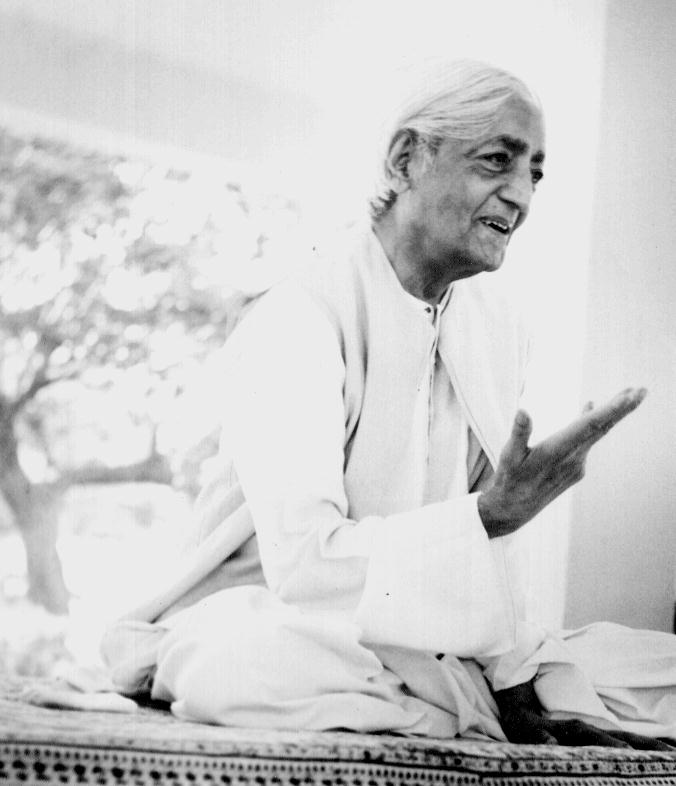
krishnamurti

k-1

Jiddu Krishnamurti background:

(from Wikipedia article)

Jiddu Krishnamurti (Telugu: జిడ్డు కృష్ణ మూర్తి) or J. Krishnamurti (Telugu: జే . కృష్ణ మూర్తి), (May 12, 1895February 17, 1986) was a well known writer and speaker on philosophical and spiritual subjects. His subject matter included: the purpose of meditation, human relationships, the nature of the mind, and how to enact positive change in global society.

Krishnamurti was born into a Telugu Brahmin family in what was then colonial India. In early adolescence, he had a chance encounter with prominent occultist and high-ranking theosophistC.W. Leadbeater in the grounds of the Theosophical Society headquarters at Adyar in Madras (now Chennai). He was subsequently raised under the tutelage of Annie Besant and C.W. Leadbeater, leaders of the Society at the time, who believed him to be a “vehicle” for an expected World Teacher. As a young man, he disavowed this idea and dissolved the worldwide organization (the Order of the Star) established to support it. He claimed allegiance to no nationality, caste, religion, or philosophy, and spent the rest of his life traveling the world as an individual speaker, speaking to large and small groups, as well as with interested individuals. He authored a number of books, among them The First and Last Freedom, The Only Revolution, and Krishnamurti’s Notebook. In addition, a large collection of his talks and discussions have been published. At age 90, he addressed the United Nations on the subject of peace and awareness, and was awarded the 1984 UN Peace Medal. His last public talk was in Madras, India, in January 1986, a month before his death at home in Ojai, California.

His supporters, working through several non-profit foundations, oversee a number of independent schools centered on his views on education – in India, Great Britain and the United States – and continue to transcribe and distribute many of his thousands of talks, group and individual discussions, and other writings, publishing them in a variety of formats including print, audio, video and digital formats as well as online, in many languages.

Download entire book (public domain), doc format:

jkrishnamurti-freedomfromtheknown

Excerpt: Chaper 1

Chapter 1

Man has throughout the ages been seeking something beyond himself, beyond material welfare – something we call truth or God or reality, a timeless state – something that cannot be disturbed by circumstances, by thought or by human corruption.

Man has always asked the question: what is it all about? Has life any meaning at all? He sees the enormous confusion of life, the brutalities, the revolt, the wars, the endless divisions of religion, ideology and nationality, and with a sense of deep abiding frustration he asks, what is one to do, what is this thing we call living, is there anything beyond it?

And not finding this nameless thing of a thousand names which he has always sought, he has cultivated faith – faith in a saviour or an ideal – and faith invariably breeds violence.

In this constant battle which we call living, we try to set a code of conduct according to the society in which we are brought up, whether it be a Communist society or a so-called free society; we accept a standard of behaviour as part of our tradition as Hindus or Muslims or Christians or whatever we happen to be. We look to someone to tell us what is right or wrong behaviour, what is right or wrong thought, and in following this pattern our conduct and our thinking become mechanical, our responses automatic. We can observe this very easily in ourselves.

For centuries we have been spoon-fed by our teachers, by our authorities, by our books, our saints. We say, ‘Tell me all about it – what lies beyond the hills and the mountains and the earth?’ and we are satisfied with their descriptions, which means that we live on words and our life is shallow and empty. We are secondhand people. We have lived on what we have been told, either guided by our inclinations, our tendencies, or compelled to accept by circumstances and environment. We are the result of all kinds of influences and there is nothing new in us, nothing that we have discovered for ourselves; nothing original, pristine, clear.

Throughout theological history we have been assured by religious leaders that if we perform certain rituals, repeat certain prayers or mantras, conform to certain patterns, suppress our desires, control our thoughts, sublimate our passions, limit our appetites and refrain from sexual indulgence, we shall, after sufficient torture of the mind and body, find something beyond this little life. And that is what millions of so-called religious people have done through the ages, either in isolation, going off into the desert or into the mountains or a cave or wandering from village to village with a begging bowl, or, in a group, joining a monastery, forcing their minds to conform to an established pattern. But a tortured mind, a broken mind, a mind which wants to escape from all turmoil, which has denied the outer world and been made dull through dis- cipline and conformity – such a mind, however long it seeks, will find only according to its own distortion.

So to discover whether there actually is or is not something beyond this anxious, guilty, fearful, competitive existence, it seems to me that one must have a completely different approach altogether. The traditional approach is from the periphery inwards, and through time, practice and renunciation, gradually to come upon that inner flower, that inner beauty and love – in fact to do everything to make oneself narrow, petty and shoddy; peel off little by little; take time; tomorrow will do, next life will do – and when at last one comes to the centre one finds there is nothing there, because one’s mind has been made incapable, dull and insensitive.

Having observed this process, one asks oneself, is there not a different approach altogether – that is, is it not possible to explode from the centre?

The world accepts and follows the traditional approach. The primary cause of disorder in ourselves is the seeking of reality promised by another; we mechanically follow somebody who will assure us a comfortable spiritual life. It is a most extraordinary thing that although most of us are opposed to political tyranny and dictatorship, we inwardly accept the authority, the tyranny, of another to twist our minds and our way of life. So fl we completely reject, not intellectually but actually, all so-called spiritual authority, all ceremonies, rituals and dogmas, it means that we stand alone and are already in conflict with society; we cease to be respectable human beings. A respectable human being cannot possibly come near to that infinite, immeasurable, reality.

You have now started by denying something absolutely false – the traditional approach – but if you deny it as a reaction you will have created another pattern in which you will be trapped; if you tell yourself intellectually that this denial is a very good idea but do nothing about it, you cannot go any further. If you deny it however, because you understand the stupidity and immaturity of it, if you reject it with tremendous intelligence, because you are free and not frightened, you will create a great disturbance in yourself and around you but you will step out of the trap of respectability. Then you will find that you are no longer seeking. That is the first thing to learn – not to seek. When you seek you are really only window-shopping.

The question of whether or not there is a God or truth or reality, or whatever you like to call it, can never be answered by books, by priests, philosophers or saviours. Nobody and nothing can answer the question but you yourself and that is why you must know yourself. Immaturity lies only in total ignorance of self. To understand yourself is the beginning of wisdom.

And what is yourself, the individual you? I think there is a difference between the human being and the individual. The individual is a local entity, living in a particular country, belonging to a particular culture, particular society, particular religion. The human being is not a local entity. He is everywhere. If the individual merely acts in a particular corner of the vast field of life, then his action is totally unrelated to the whole. So one has to bear in mind that we are talking of the whole not the part, because in the greater the lesser is, but in the lesser the greater is not. The individual is the little conditioned, miserable, frustrated entity, satisfied with his little gods and his little traditions, whereas a human being is concerned with the total welfare, the total misery and total confusion of the world.

We human beings are what we have been for millions of years – -colossally greedy, envious, aggressive, jealous, anxious and despairing, with occasional flashes of joy and affection. We are a strange mixture of hate, fear and gentleness; we are both violence and peace. There has been outward progress from the bullock cart to the jet plane but psychologically the individual has not changed at all, and the structure of society throughout the world has been created by individuals. The outward social structure is the result of the inward psychological structure of our human relationships, for the individual is the result of the total experience, knowledge and conduct of man. Each one of us is the storehouse of all the past. The individual is the human who is all mankind. The whole history of man is written in ourselves.

Do observe what is actually taking place within yourself and outside yourself in the competitive culture in which you live with its desire for power, position, prestige, name, success and all the rest of it – observe the achievements of which you are so proud, this whole field you call living in which there is conflict in every form of relationship, breeding hatred, antagonism, brutality and endless wars. This field, this life, is all we know, and being unable to understand the enormous battle of existence we are naturally afraid of it and find escape from it in all sorts of subtle ways. And we are frightened also of the unknown – frightened of death, frightened of what lies beyond tomorrow. So we are afraid of the known and afraid of the unknown. That is our daily life and in that there is no hope, and therefore every form of philosophy, every form of theo- logical concept, is merely an escape from the actual reality of what is.

All outward forms of change brought about by wars, revolutions, reformations, laws and ideologies have failed completely to change the basic nature of man and therefore of society. As human beings living in this monstrously ugly world, let us ask ourselves, can this society, based on competition, brutality and fear, come to an end? Not as an intellectual conception, not as a hope, but as an actual fact, so that the mind is made fresh, new and innocent and can bring about a different world altogether? It can only happen, I think, if each one of us recognises the central fact that we, as individuals, as human beings, in whatever part of the world we happen to live or whatever culture we happen to belong to, are totally responsible for the whole state of the world.

We are each one of us responsible for every war because of the aggressiveness of our own lives, because of our nationalism, our selfishness, our gods, our prejudices, our ideals, all of which divide us. And only when we realize, not intellectually but actually, as actually as we would recognise that we are hungry or in pain, that you and I are responsible for all this existing chaos, for all the misery throughout the entire world because we have contributed to it in our daily lives and are part of this monstrous society with its wars, divisions, its ugliness, brutality and greed – only then will we act.

But what can a human being do – what can you and I do – to create a completely different society? We are asking ourselves a very serious question. Is there anything to be done at all? What can we do? Will somebody tell us? People have told us. The so-called spiritual leaders, who are supposed to understand these things better than we do, have told us by trying to twist and mould us into a new pattern, and that hasn’t led us very far; sophisticated and learned men have told us and that has led us no further. We have been told that all paths lead to truth – you have your path as a Hindu and someone else has his path as a Christian and another as a Muslim, and they all meet at the same door – which is, when you look at it, so obviously absurd. Truth has no path, and that is the beauty of truth, it is living. A dead thing has a path to it because it is static, but when you see that truth is something living, moving, which has no resting place, which is in no temple, mosque or church, which no religion, no teacher, no philosopher, nobody can lead you to – then you will also see that this living thing is what you actually are – your anger, your brutality, your violence, your despair, the agony and sorrow you live in. In the understanding of all this is the truth, and you can understand it only if you know how to look at those things in your life. And you cannot look through an ideology, through a screen of words, through hopes and fears.

So you see that you cannot depend upon anybody. There is no guide, no teacher, no authority. There is only you – your relationship with others and with the world – there is nothing else. When you realize this, it either brings great despair, from which comes cynicism and bitterness, or, in facing the fact that you and nobody else is responsible for the world and for yourself, for what you think, what you feel, how you act, all self-pity goes. Normally we thrive on blaming others, which is a form of self-pity.

Can you and I, then, bring about in ourselves without any outside influence, without any persuasion, without any fear of punishment – can we bring about in the very essence of our being a total revolution, a psychological mutation, so that we are no longer brutal, violent, competitive, anxious, fearful, greedy, envious and all the rest of the manifestations of our nature which have built up the rotten society in which we live our daily lives?

It is important to understand from the very beginning that I am not formulating any philosophy or any theological structure of ideas or theological concepts. It seems to me that all ideologies are utterly idiotic. What is important is not a philosophy of life but to observe what is actually taking place in our daily life, inwardly and outwardly. If you observe very closely what is taking place and examine it, you will see that it is based on an intellectual conception, and the intellect is not the whole field of existence; it is a fragment, and a fragment, however cleverly put together, however ancient and traditional, is still a small part of existence whereas we have to deal with the totality of life. And when we look at what is taking place in the world we begin to understand that there is no outer and inner process; there is only one unitary process, it is a whole, total movement, the inner movement expressing itself as the outer and the outer reacting again on the inner. To be able to look at this seems to me all that is needed, because if we know how to look, then the whole thing becomes very clear, and to look needs no philosophy, no teacher. Nobody need tell you how to look. You just look.

Can you then, seeing this whole picture, seeing it not verbally but actually, can you easily, spontaneously, transform yourself? That is the real issue. Is it possible to bring about a complete revolution in the psyche?

I wonder what your reaction is to such a question? You may say, ‘I don’t want to change’, and most people don’t, especially those who are fairly secure socially and economically or who hold dogmatic beliefs and are content to accept themselves and things as they are or in a slightly modified form. With those people we are not concerned. Or you may say more subtly, ‘Well, it’s too difficult, it’s not for me’, in which case you will have already blocked yourself, you will have ceased to enquire and it will be no use going any further. Or else you may say, ‘I see the necessity for a fundamental inward change in myself but how am I to bring it about? Please show me the way, help me towards it.’ If you say that, then what you are concerned with is not change itself; you are not really interested in a fundamental revolution: you are merely searching for a method, a system, to bring about change.

If I were foolish enough to give you a system and if you were foolish enough to follow it, you would merely be copying, imitating, conforming, accepting, and when you do that you have set up in yourself the authority of another and hence there is conflict between you and that authority. You feel you must do such and such a thing because you have been told to do it and yet you are incapable of doing it. You have your own particular inclinations, tendencies and pressures which conflict with the system you think you ought to follow and therefore there is a contradiction. So you will lead a double life between the ideology of the system and the actuality of your daily existence. In trying to conform to the ideology, you suppress yourself – whereas what is actually true is not the ideology but what you are. If you try to study yourself according to another you will always remain a secondhand human being.

A man who says, ‘I want to change, tell me how to’, seems very earnest, very serious, but he is not. He wants an authority whom he hopes will bring about order in himself. But can authority ever bring about inward order? Order imposed from without must always breed disorder. You may see the truth of this intellectually but can you actually apply it so that your mind no longer projects any authority, the authority of a book, a teacher, a wife or husband, a parent, a friend or of society? Because we have always functioned within the pattern of a formula, the formula becomes the ideology and the authority; but the moment you really see that the question, ‘How can I change?’ sets up a new authority, you have finished with authority for ever.

Let us state it again clearly: I see that I must change completely from the roots of my being; I can no longer depend on any tradition because tradition has brought about this colossal laziness, acceptance and obedience; I cannot possibly look to another to help me to change, not to any teacher, any God, any belief, any system, any outside pressure or influence. What then takes place?

First of all, can you reject all authority? If you can it means that you are no longer afraid. Then what happens? When you reject something false which you have been carrying about with you for generations, when you throw off a burden of any kind, what takes place? You have more energy, haven’t you? You have more capacity, more drive, greater intensity and vitality. If you do not feel this, then you have not thrown off the burden, you have not discarded the dead weight of authority.

But when you have thrown it off and have this energy in which there is no fear at all – no fear of making a mistake, no fear of doing right or wrong – then is not that energy itself the mutation? We need a tremendous amount of energy and we dissipate it through fear but when there is this energy which comes from throwing off every form of fear, that energy itself produces the radical inward revolution. You do not have to do a thing about it.

So you are left with yourself, and that is the actual state for a man to be who is very serious about all this; and as you are no longer looking to anybody or anything for help, you are already free to discover. And when there is freedom, there is energy; and when there is freedom it can never do anything wrong. Freedom is entirely different from revolt. There is no such thing as doing right or wrong when there is freedom. You are free and from that centre you act. And hence there is no fear, and a mind that has no fear is capable of great love. And when there is love it can do what it will.

What we are now going to do, therefore, is to learn about ourselves, not according to me or to some analyst or philosopher – because if we learn about ourselves according to someone else, we learn about them, not ourselves – we are going to learn what we actually are.

Having realized that we can depend on no outside authority in bringing about a total revolution within the structure of our own psyche, there is the immensely greater difficulty of rejecting our own inward authority, the authority of our own particular little experiences and accumulated opinions, knowledge, ideas and ideals. You had an experience yesterday which taught you something and what it taught you becomes a new authority – and that authority of yesterday is as destructive as the authority of a thousand years. To understand ourselves needs no authority either of yesterday or of a thousand years because we are living

things, always moving, flowing, never resting. When we look at ourselves with the dead authority of yesterday, we will fail to understand the living movement and the beauty and quality of that movement.

To be free of all authority, of your own and that of another, is to die to everything of yesterday, so that your mind is always fresh, always young, innocent, full of vigour and passion. It is only in that state that one learns and observes. And for this a great deal of awareness is required, actual awareness of what is going on inside yourself, without correcting it or telling it what it should or should not be, because the moment you correct it you have established another authority, a censor.

So now we are going to investigate ourselves together – not one person explaining while you read, agreeing or disagreeing with him as you follow the words on the page, but taking a journey together, a journey of discovery into the most secret corners of our minds. And to take such a journey we must travel light; we cannot be burdened with opinions, prejudices and conclusions – all that old furniture we have collected for the last two thousand years and more. Forget all you know about yourself; forget all you have ever thought about yourself; we are going to start as if we knew nothing.

It rained last night heavily, and now the skies are beginning to clear; it is a new fresh day. Let us meet that fresh day as if it were the only day. Let us start on our journey together with all the remembrance of yesterday left behind – and begin to understand ourselves for the first time.

k

20 Comments

Filed under Free E-Books, pictures, Spirituality

Sadhana- The Realization of Life by Rabindranath Tagore

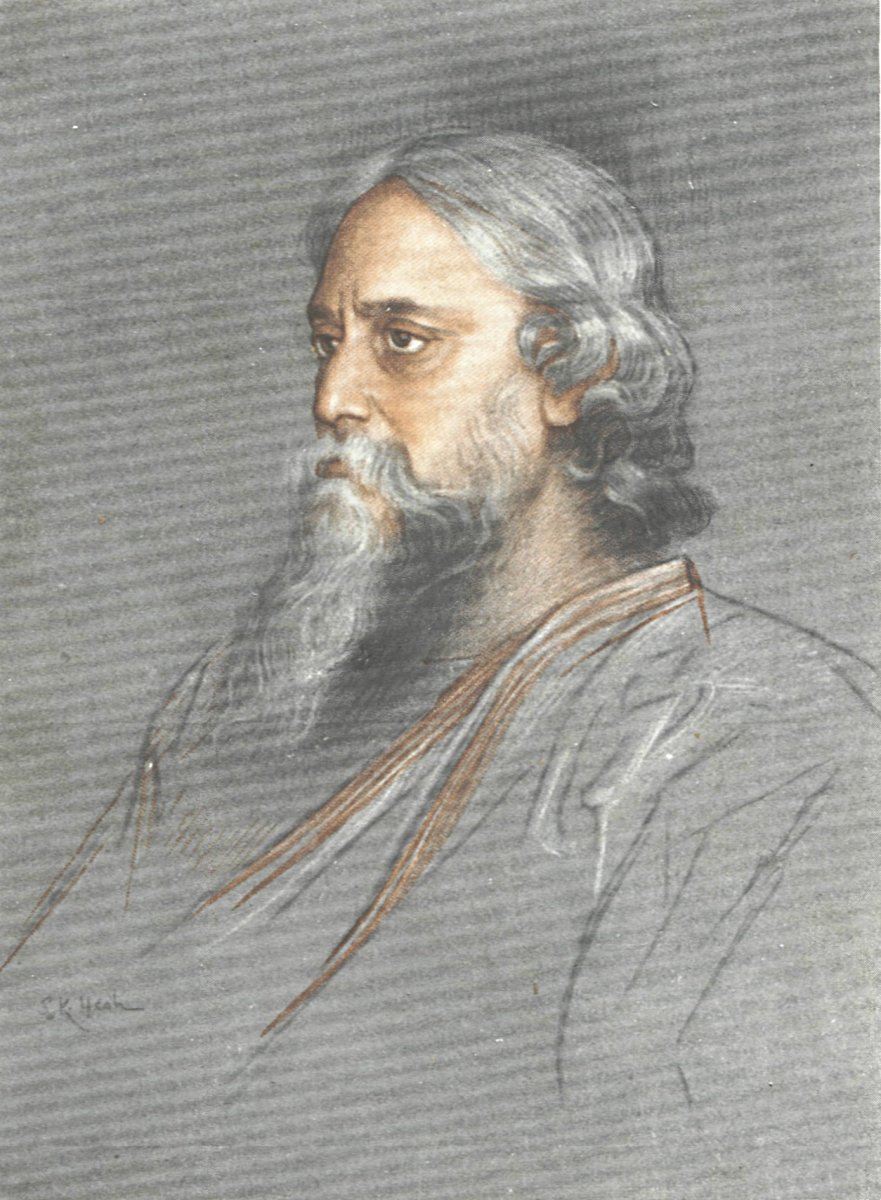
rabindranath_tagore

At long last, I’ve come across an audio of

Sadhana- The Realization of Life

by Rabindranath Tagore

(the most popular post ever on this blog-

go here for the complete e-book download).

Now, I have the LibriVox, public domain audio book-

easier to read than a computer monitor.

sadhana_01_tagore

sadhana_02_tagore

sadhana_03_tagore

sadhana_04_tagore

sadhana_05_tagore

sadhana_06_tagore

sadhana_07_tagore

sadhana_08_tagore

Special Bonus! Multi-lingual Tagore Poetry Jam!

bengali_banshi_tagore

rabi140028viLook around on this site- I have many complete downloads of Tagore’s work-

including Gitanjali, my personal favorite poetry collection.

rabtagore

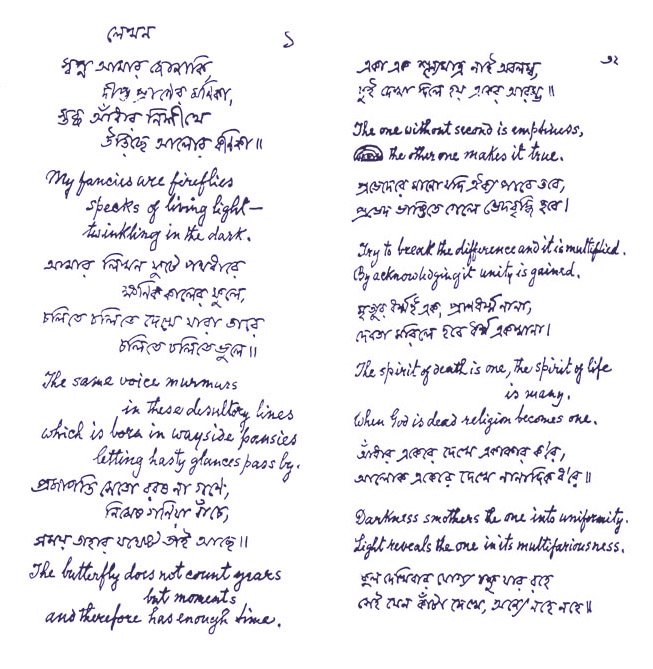
tagore-straybirds(above- Stray Birds poem in the author’s hand. Stray Birds is available elsewhere on this site)

tagore2

tagore1912

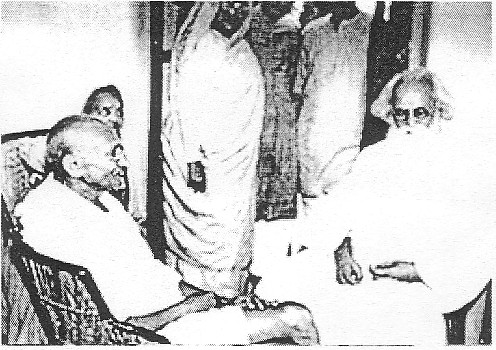
tagore-and-ghandi

tagore_einstien

tagoreletterfront

5 Comments

Filed under Free Audio Books, Free E-Books, mp3, Mystic Poetry, pictures, poetry, Spirituality

Not Dalai Lama- Maha Mrityunjaya Mantra

It has been brought to my attention- a comment below is re-printed here- that this is not Dalai Lama. So, ignore all reference to Dalai Lama. The rest is okay, I think.

Michael Robinson

Sorry to say, but this was not the Dalai Lama chanting, but was a recording done by a Dutch performer called Hein Braat, and the original can be bought as a CD. It’s an urban myth which has been doing the tour for 20 years (but you’re by all means not alone in believing it!).

That doesn’t take away from just how special a piece of music it is, but the chant is from the Veda, which is not buddhist, but hindu. Tri-ambaka-m is the three-eyed one e.g. Lord Shiva.

The original recording by Hein Braat can be heard at the following link. Credit where it’s due, as he has an amazing voice.

http://heinbraat.com/27/discography-cds/

Instructions:

Close your eyes, listen. Feel your heart beating,

your breath rising and falling. Do nothing.

dahli-lama-maha-mrityunjaya-mantra

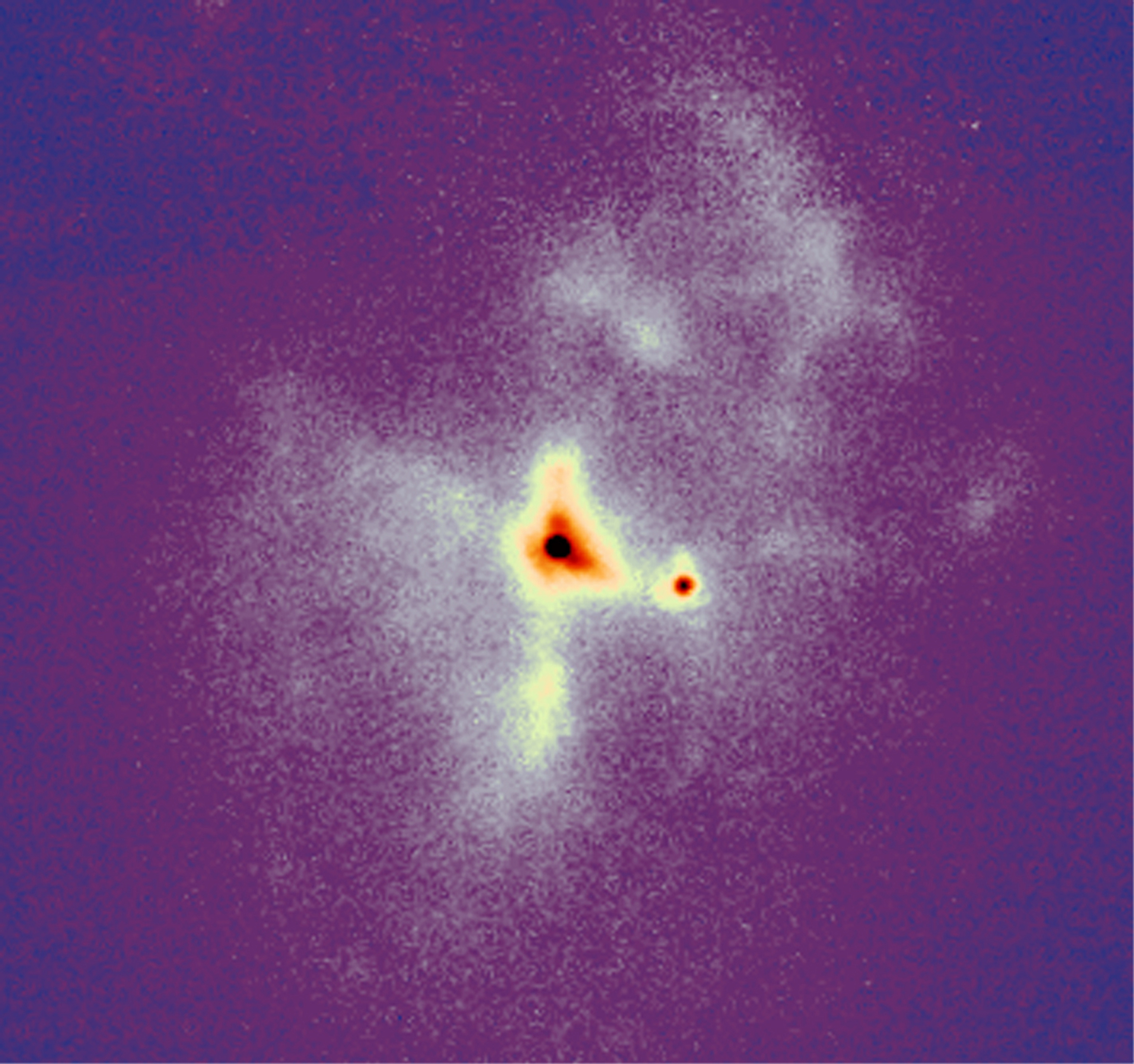
cygnus_a_by_keck


Maha Mritvuniava Mantra

Om Tryambakam yajamah

Sugandhim pushti vardhanam

Urvarukamiva bondhanan

Mrityor mukshiya mamritat


Translation: I meditate on, and surrender myself to, the Divine Being who embodies the power of will, the power of knowledge, and the power of action. I pray to the Divine Being who manifests in the form of fragrance in the flower of life and is the eternal nourisher of the plant of life. like a skillful gardener, may the Lord of Life disentangle me from the binding forces of my physical, psychological, and spiritual foes. May the lord of Immortality residing within me free me from death, decay and sickness and unite me with immortality.


Explanation: This is a healing and nourishing mantra and is in a sense, “the Heart of Vedas.” The healing force awakened by this mantra sends forth its

ripples from body to psyche and from psyche to soul. It strengthens our powers of will, knowledge and action, thus unblocking the flow of enthusiasm, courage and determination. The vibration of this mantra awakens the internal healing force while attracting nature’s healing agents, creating an environment where the forces from both origins converge. This mantra connects us to the healer within and helps us receive the full nourishment from food, herbs, or any discipline undertaken for our total well being.

12 Comments

Filed under Free Music, mp3, Spirituality

Part 3- Poems of the T’ang Dynasty (Han Shan)

I’ve talked myself into doing chunks of this that  have some commonality. Today I’ve culled poems attributed to Han Shan, poet-mystic of the early T’ang. First, excerpts from the wikipedia article about Han Shan (for the full article go here):

Hanshan (Chinese: 寒山; pinyin: Hánshān; literally “Cold Mountain”, fl. 9th century) was a legendary figure associated with a collection of poems from the Chinese Tang Dynasty in the Taoist and Chan tradition. He is honored as an incarnation of the Bodhisattva -figure Manjusri in Zen lore. In Japanese and Chinese paintings he is often depicted together with his sidekick ShideFenggan another monk with legendary attributes.

The collection of poems attributed to Hanshan may span the entire Tang Dynasty as Edwin G. Pulleyblank asserts in his study Linguistic Evidence for the Date of Hanshan.[1] identifies him as the monk Chiyan (智岩, 577 – 654), but that has been disputed by Paul Demiéville among others. The Encyclopedia of China gives his date as around 712 and after 793. Jia Jinhua came to the conclusion, after a study of Chan phrases in some 50 of the poems, that this particular group of poems may be attributable to the Chan monk Caoshan Benji (840-901).

Personally, I think a great place to start is the collection of Cold Mountain Poems by Gary Snyder, one of the great beatnik era poets often associated with other poets and writers of that cultural phenomenon. Snyder was a very complimentary voice to bring Han Shan to America. Without further ado, I’ll just insert the Snyder Cold Mountain Poems here:

HAN SHAN, THE COLD MOUNTAIN POEMS, tr. Gary Snyder

Preface to the Poems of Han-shan

by Lu Ch’iu-yin, Governor of T’ai Prefecture

No one knows what sort of man Han-shan was. There are old people who knew him: they say he was a poor man, a crazy character. He lived alone seventy Li (23 miles) west of the T’ang-hsing district of T’ien-t’ai at a place called Cold Mountain. He often went down to the Kuo-ch’ing Temple. At the temple lived Shih’te, who ran the dining hall. He sometimes saved leftovers for Han-shan, hiding them in a bamboo tube. Han-shan would come and carry it away; walking the long veranda, calling and shouting happily, talking and laughing to himself. Once the monks followed him, caught him, and made fun of him. He stopped, clapped his hands, and laughed greatly – Ha Ha! – for a spell, then left.

He looked like a tramp. His body and face were old and beat. Yet in every word he breathed was a meaning in line with the subtle principles of things, if only you thought of it deeply. Everything he said had a feeling of Tao in it, profound and arcane secrets. His hat was made of birch bark, his clothes were ragged and worn out, and his shoes were wood. Thus men who have made it hide their tracks: unifying categories and interpenetrating things. On that long veranda calling and singing, in his words of reply Ha Ha! – the three worlds revolve. Sometimes at the villages and farms he laughed and sang with cowherds. Sometimes intractable, sometimes agreeable, his nature was happy of itself. But how could a person without wisdom recognize him?

I once received a position as a petty official at Tan-ch’iu. The day I was to depart, I had a bad headache. I called a doctor, but he couldn’t cure me and it turned worse. Then I met a Buddhist Master named Feng-kan, who said he came from the Kuo-ch’ing Temple of T’ien-t’ai especially to visit me. I asked him to rescue me from my illness. He smiled and said, “The four realms are within the body; sickness comes from illusion. If you want to do away with it, you need pure water.” Someone brought water to the Master, who spat it on me. In a moment the disease was rooted out. He then said, “There are miasmas in T’ai prefecture, when you get there take care of yourself.” I asked him, “Are there any wise men in your area I could look on as Master?” He replied, “When you see him you don’t recognize him, when you recognize him you don’t see him. If you want to see him, you can’t rely on appearances. Then you can see him. Han-shan is a Manjusri (one who has attained enlightenment and, in a future incarnation, will become Buddha) hiding at Kuo-sh’ing. Shih-te is a Samantabbhadra (Bodhisattva of love). They look like poor fellows and act like madmen. Sometimes they go and sometimes they come. They work in the kitchen of the Kuo-ch’ing dining hall, tending the fire.” When he was done talking he left.

I proceeded on my journey to my job at T’ai-chou, not forgetting this affair. I arrived three days later, immediately went to a temple, and questioned an old monk. It seemed the Master had been truthful, so I gave orders to see if T’ang-hsing really contained a Han-shan and Shih-te. The District Magistrate reported to me: “In this district, seventy li west, is a mountain. People used to see a poor man heading from the cliffs to stay awhile at Kuo-ch’ing. At the temple dining hall is a similar man named Shih-te.” I made a bow, and went to Kuo-ch’ing. I asked some people around the temple, “There used to be a Master named Feng-kan here, Where is his place? And where can Han-shan and Shih-te be seen?” A monk named T’ao-ch’iao spoke up: “Feng-kan the Master lived in back of the library. Nowadays nobody lives there; a tiger often comes and roars. Han-shan and Shih-te are in the kitchen.” The monk led me to Feng-kan’s yard. Then he opened the gate: all we saw was tiger tracks. I asked the monks Tao-ch’iao and Pao-te, “When Feng-kan was here, what was his job?” The monks said, :He pounded and hulled rice. At night he sang songs to amuse himself.” Then we went to the kitchen, before the stoves. Two men were facing the fire, laughing loudly. I made a bow. The two shouted Ho! at me. They struck their hands together -Ha Ha! – great laughter. They shouted. Then they said, “Feng-kan – loose-tounged, loose-tounged. You don’t recognize Amitabha, (the Bodhisattva of mercy) why be courteous to us?” The monks gathered round, surprise going through them. “”Why has a big official bowed to a pair of clowns?” The two men grabbed hands and ran out of the temple. I cried, “Catch them” – but they quickly ran away. Han-shan returned to Cold Mountain. I asked the monks, “Would those two men be willing to settle down at this temple?” I ordered them to find a house, and to ask Han-shan and Shih-te to return and live at the temple.

I returned to my district and had two sets of clean clothes made, got some incense and such, and sent it to the temple – but the two men didn’t return. So I had it carried up to Cold Mountain. The packer saw Han-shan, who called in a loud voice, “Thief! Thief!” and retreated into a mountain cave. He shouted, “I tell you man, strive hard” – entered the cave and was gone. The cave closed of itself and they weren’t able to follow. Shih-te’s tracks disappeared completely..

I ordered Tao-ch’iao and the other monks to find out how they had lived, to hunt up the poems written on bamboo, wood, stones, and cliffs – and also to collect those written on the walls of people’s houses. There were more than three hundred. On the wall of the Earth-shrine Shih-te had written some gatha (Buddhist verse or song). It was all brought together and made into a book.

I hold to the principle of the Buddha-mind. It is fortunate to meet with men of Tao, so I have made this eulogy.

song-ma-yuen-1
(big picture- click for full size)

THE COLD MOUNTAIN POEMS, tr. Gary Snyder

1

The path to Han-shan’s place is laughable,

A path, but no sign of cart or horse.

Converging gorges – hard to trace their twists

Jumbled cliffs – unbelievably rugged.

A thousand grasses bend with dew,

A hill of pines hums in the wind.

And now I’ve lost the shortcut home,

Body asking shadow, how do you keep up?

2

In a tangle of cliffs, I chose a place –

Bird paths, but no trails for me.

What’s beyond the yard?

White clouds clinging to vague rocks.

Now I’ve lived here – how many years –

Again and again, spring and winter pass.

Go tell families with silverware and cars

“What’s the use of all that noise and money?”

3

In the mountains it’s cold.

Always been cold, not just this year.

Jagged scarps forever snowed in

Woods in the dark ravines spitting mist.

Grass is still sprouting at the end of June,

Leaves begin to fall in early August.

And here I am, high on mountains,

Peering and peering, but I can’t even see the sky.

4

I spur my horse through the wrecked town,

The wrecked town sinks my spirit.

High, low, old parapet walls

Big, small, the aging tombs.

I waggle my shadow, all alone;

Not even the crack of a shrinking coffin is heard.

I pity all those ordinary bones,

In the books of the Immortals they are nameless.

5

I wanted a good place to settle:

Cold Mountain would be safe.

Light wind in a hidden pine –

Listen close – the sound gets better.

Under it a gray haired man

Mumbles along reading Huang and Lao.

For ten years I havn’t gone back home

I’ve even forgotten the way by which I came.

6

Men ask the way to Cold Mountain

Cold Mountain: there’s no through trail.

In summer, ice doesn’t melt

The rising sun blurs in swirling fog.

How did I make it?

My heart’s not the same as yours.

If your heart was like mine

You’d get it and be right here.

7

I settled at Cold Mountain long ago,

Already it seems like years and years.

Freely drifting, I prowl the woods and streams

And linger watching things themselves.

Men don’t get this far into the mountains,

White clouds gather and billow.

Thin grass does for a mattress,

The blue sky makes a good quilt.

Happy with a stone under head

Let heaven and earth go about their changes.

8

Clambering up the Cold Mountain path,

The Cold Mountain trail goes on and on:

The long gorge choked with scree and boulders,

The wide creek, the mist blurred grass.

The moss is slippery, though there’s been no rain

The pine sings, but there’s no wind.

Who can leap the word’s ties

And sit with me among the white clouds?

9

Rough and dark – the Cold Mountain trail,

Sharp cobbles – the icy creek bank.

Yammering, chirping – always birds

Bleak, alone, not even a lone hiker.

Whip, whip – the wind slaps my face

Whirled and tumbled – snow piles on my back.

Morning after morning I don’t see the sun

Year after year, not a sign of spring.

10

I have lived at Cold Mountain

These thirty long years.

Yesterday I called on friends and family:

More than half had gone to the Yellow Springs.

Slowly consumed, like fire down a candle;

Forever flowing, like a passing river.

Now, morning, I face my lone shadow:

Suddenly my eyes are bleared with tears.

11

Spring water in the green creek is clear

Moonlight on Cold Mountain is white

Silent knowledge – the spirit is enlightened of itself

Contemplate the void: this world exceeds stillness.

12

In my first thirty years of life

I roamed hundreds and thousands of miles.

Walked by rivers through deep green grass

Entered cities of boiling red dust.

Tried drugs, but couldn’t make Immortal;

Read books and wrote poems on history.

Today I’m back at Cold Mountain:

I’ll sleep by the creek and purify my ears.

13

I can’t stand these bird songs

Now I’ll go rest in my straw shack.

The cherry flowers are scarlet

The willow shoots up feathery.

Morning sun drives over blue peaks

Bright clouds wash green ponds.

Who knows that I’m out of the dusty world

Climbing the southern slope of Cold Mountain?

14

Cold Mountain has many hidden wonders,

People who climb here are always getting scared.

When the moon shines, water sparkles clear

When the wind blows, grass swishes and rattles.

On the bare plum, flowers of snow

On the dead stump, leaves of mist.

At the touch of rain it all turns fresh and live

At the wrong season you can’t ford the creeks.

15

There’s a naked bug at Cold Mountain

With a white body and a black head.

His hand holds two book scrolls,

One the Way and one its Power.

His shack’s got no pots or oven,

He goes for a long walk with his shirt and pants askew.

But he always carries the sword of wisdom:

He means to cut down sensless craving.

16

Cold Mountain is a house

Without beans or walls.

The six doors left and right are open

The hall is sky blue.

The rooms all vacant and vague

The east wall beats on the west wall

At the center nothing.

Borrowers don’t bother me

In the cold I build a little fire

When I’m hungry I boil up some greens.

I’ve got no use for the kulak

With hs big barn and pasture –

He just sets uo a prison for himself.

Once in he can’t get out.

Think it over –

You know it might happen to you.

17

If I hide out at Cold Mountain

Living off mountain plants and berries –

All my lifetime, why worry?

One follows his karma through.

Days and months slip by like water,

Time is like sparks knocked off flint.

Go ahead and let the world change –

I’m happy to sit among these cliffs.

18

Most T’ien-t’ai men

Don’t know Han-shan

Don’t know his real thought

And call it silly talk.

19

Once at Cold Mountain, troubles cease –

No more tangled, hung up mind.

I idly scribble poems on the rock cliff,

Taking whatever comes, like a drifting boat.

20

Some critic tried to put me down –

“Your poems lack the Basic Truth of Tao.”

And I recall the old timers

Who were poor and didn’t care.

I have to laugh at him,

He misses the point entirely,

Men like that

Ought to stick to making money.

21

I’ve lived at Cold Mountain – how many autumns.

Alone, I hum a song – utterly without regret.

Hungry, I eat one grain of Immortal medicine

Mind solid and sharp; leaning on a stone.

22

On top of Cold Mountain the lone round moon

Lights the whole clear cloudless sky.

Honor this priceless natural treasure

Concealed in five shadows, sunk deep in the flesh.

23

My home was at Cold Mountain from the start,

Rambling among the hills, far from trouble.

Gone, and a million things leave no trace

Loosed, and it flows through galaxies

A fountain of light, into the very mind –

Not a thing, and yet it appears before me:

Now I know the pearl of the Buddha nature

Know its use: a boundless perfect sphere.

24

When men see Han-shan

They all say he’s crazy

And not much to look at –

Dressed in rags and hides.

They don’t get what I say

And I don’t talk their language.

All I can say to those I meet:

“Try and make it to Cold Mountain.”

snydergary

Next, here are some different translations, some have slight differences from the same ones translated by Snyder. You can decide what resonates the most for you. I’m not sure where I found these and can’t identify the translator. Maybe somebody will sue me and I’ll know then.

Introduction

Han-shan, the Master of Cold Mountain, and his friend Shi-te, lived in the late-eighth to early-ninth century AD, in the sacred T’ien-t’ai Mountains of Chekiang Province, south of the bay of Hangchow. The two laughing friends, holding hands, come and go, but mostly go, dashing into the wild, careless of others’ reality, secure in their own. As Han-shan himself says, his Zen is not in the poems. Zen is in the mind.


The Poems

1.

Don’t you know the poems of Han-shan?

They’re better for you than scripture-reading.

Cut them out and paste them on a screen,

Then you can gaze at them from time to time.

han-shan

2.

Where’s the trail to Cold Mountain?

Cold Mountain? There’s no clear way.

Ice, in summer, is still frozen.

Bright sun shines through thick fog.

You won’t get there following me.

Your heart and mine are not the same.

If your heart was like mine,

You’d have made it, and be there!

3.

Cold Mountain’s full of strange sights.

Men who go there end by being scared.

Water glints and gleams in the moon,

Grasses sigh and sing in the wind.

The bare plum blooms again with snow,

Naked branches have clouds for leaves.

When it rains, the mountain shines –

In bad weather you’ll not make this climb.

4.

A thousand clouds, ten thousand streams,

Here I live, an idle man,

Roaming green peaks by day,

Back to sleep by cliffs at night.

One by one, springs and autumns go,

Free of heat and dust, my mind.

Sweet to know there’s nothing I need,

Silent as the autumn river’s flood.

hanshan003

5.

High, high, the summit peak,

Boundless the world to sight!

No one knows I am here,

Lone moon in the freezing stream.

In the stream, where’s the moon?

The moon’s always in the sky.

I write this poem: and yet,

In this poem there is no Zen.

6

Thirty years in this world

I wandered ten thousand miles,

By rivers, buried deep in grass,

In borderlands, where red dust flies.

Tasted drugs, still not Immortal,

Read books, wrote histories.

Now I’m back at Cold Mountain,

Head in the stream, cleanse my ears.

7.

Bird-song drowns me in feeling.

Back to my shack of straw to sleep.

Cherry-branches burn with crimson flower,

Willow-boughs delicately trail.

Morning sun flares between blue peaks,

Bright clouds soak in green ponds.

Who guessed I’d leave that dusty world,

Climbing the south slope of Cold Mountain?

8.

I travelled to Cold Mountain:

Stayed here for thirty years.

Yesterday looked for family and friends.

More than half had gone to Yellow Springs.

Slow-burning, life dies like a flame,

Never resting, passes like a river.

Today I face my lone shadow.

Suddenly, the tears flow down.

coldmountain

9.

Alive in the mountains, not at rest,

My mind cries for passing years.

Gathering herbs to find long life,

Still I’ve not achieved Immortal.

My field’s deep, and veiled in cloud,

But the wood’s bright, the moon’s full.

Why am I here? Can’t I go?

Heart still tied to enchanted pines!

10.

If there’s something good, delight!

Seize the moment while it flies!

Though life can last a hundred years,

Who’s seen their thirty thousand days?

Just an instant then you’re gone.

Why sit whining over things?

When you’ve read the Classics through,

You’ll know quite enough of death.

11.

The peach petals would like to stay,

But moon and wind blow them on.

You won’t find those ancient men,

Those dynasties are dead and gone.

Day by day the blossoms fall,

Year by year the people go.

Where the dust blows through these heights,

There once shone a silent sea.

12.

Men who see the Master

Of Cold Mountain, say he’s mad.

A nothing face,

Body clothed in rags.

Who dare say what he says?

When he speaks we can’t understand.

Just one word to you who pass –

Take the trail to Cold Mountain!
upcoldmountain-hanshan

13.

Han-shan has his critics too:

‘Your poems, there’s nothing in them!’

I think of men of ancient times,

Poor, humble, but not ashamed.

Let him laugh at me and say:

‘It’s all foolishness, your work!’

Let him go on as he is,

All his life lost making money.

14.

Cold Mountain holds a naked bug,

Its body’s white, its head is black.

In its hands a pair of scrolls,

One the Way and one its Power.

It needs no pots or stove.

Without clothes it wanders on,

But it carries Wisdom’s blade,

To cut down mindless craving.

15.

I’m on the trail to Cold Mountain.

Cold Mountain trail never ends.

Long clefts thick with rock and stones,

Wide streams buried in dense grass.

Slippery moss, but there’s been no rain,

Pine trees sigh, but there’s no wind.

Who can leap the world’s net,

Sit here in the white clouds with me?

16.

Men ask the way through the clouds,

The cloud way’s dark, without a sign.

High summits are of naked rock.

In deep valleys sun never shines.

Behind you green peaks, and in front,

To east the white clouds, and to west –

Want to know where the cloud way lies?

It’s there, in the centre of the Void!

17.

Sitting alone by folded rocks,

Mist swirling even at noon,

Here, inside my room, it’s dark.

Mind is bright, clear of sound.

Through the shining gate in dream.

Back by the stone bridge, mind returns.

Where now the things that troubled me?

Wind-blown gourd rattling in the tree.

18.

Far-off is the place I chose to live.

High hills make for silent tongues.

Gibbons screech in valley cold

My gate of grass blends with the cliff.

A roof of thatch among the pines,

I dig a pool, feed it from the stream.

No time now to think about the world,

The years go by, shredding ferns.

19.

Level after level, falls and hills,

Blue-green mist clasped by clouds.

Fog wets my flimsy cap,

Dew soaks my coat of straw.

A pilgrim’s sandals on my feet,

An old stick grasped in my hand.

Gazing down towards the land of dust,

What is that world of dreams to me?

20.

What a road the Cold Mountain road!

Not a sign of horse or cart.

Winding gorges, tricky to trace.

Massive cliffs, who knows how high?

Where the thousand grasses drip with dew,

Where the pine trees hum in the wind.

Now the path’s lost, now it’s time

For body to ask shadow: ‘Which way home?’

21.

Always it’s cold on this mountain!

Every year, and not just this.

Dense peaks, thick with snow.

Black pine-trees breathing mist.

It’s summer before the grass grows,

Not yet autumn when the leaves fall.

Full of illusions, I roam here,

Gaze and gaze, but can’t see the sky.

22.

No knowing how far it is,

This place where I spend my days.

Tangled vines move without a breeze,

Bamboo in the light shows dark.

Streams down-valley sob for whom?

Mists cling together, who knows why?

Sitting in my hut at noon,

Suddenly, I see the sun has risen.

23.

The everyday mind: that is the way.

Buried in vines and rock-bound caves,

Here it’s wild, here I am free,

Idling with the white clouds, my friends.

Tracks here never reach the world;

No-mind, so what can shift my thought?

I sit the night through on a bed of stone,

While the moon climbs Cold Mountain.

24.

I was off to the Eastern Cliff.

Planned that trip for how long?

Dragged myself up by hanging vines,

Stopped halfway, by wind and fog.

Thorn snatched my arm on narrow tracks,

Moss so deep it drowned my feet,

So I stopped, under this red pine.

Head among the clouds, I’ll sleep.

25.

Bright water shimmers like crystal,

Translucent to the furthest depth.

Mind is free of every thought

Unmoved by the myriad things.

Since it can never be stirred

It will always stay like this.

Knowing, this way, you can see,

There is no within, no without.

fioredilotorosso

26.

Are you looking for a place to rest?

Cold Mountain’s good for many a day.

Wind sings here in the black pines,

Closer you are, the better it sounds.

There’s an old man sitting by a tree,

Muttering about the things of Tao.

Ten years now, it’s been so long

This one’s forgotten his way home.

27.

Cold rock, no one takes this road.

The deeper you go, the finer it is.

White clouds hang on high crags.

On Green Peak a lone gibbon’s cry.

What friends do I need?

I do what pleases me, and grow old.

Let face and body alter with the years,

I’ll hold to the bright path of mind.

A few more, various translators. I ask myself: What is the true heart of Han Shan? I studies Chinese to get a better idea but it only made me more confused. These other poets do a much better job of reading than I do.

Birth and Death. Day and Night.
Running water, stagnant pool.
Bud and fading flower.
Can I find the point at which they change
From one into the other?
Can my nostrils turn upwards?

When the mind keeps tumbling
How can vision be anything but blurred?
Stop the mind even for a moment
And all becomes transparently clear!
The moving mind is polishing mud bricks.
In stillness find the mirror!

–   Han Shan Te’-Ch’ing, 1600
Selected Poems by Han-Shan (Silly Mountain)

I laugh at my failing strength in old age,
Yet still dote on pines and crags, to wander there in solitude.
How I regret that in all these past years until today,
I’ve let things run their course like an unanchored boat.

–   Shih-te, 750
Translated by James Hargett

after late spring rain the falling petals swirl
weightlessly celestial scent covers my patched robe
a simple vacant mind has no place to go
resting on the peak I watch the clouds return

–  Han Shan Te’-Ch’ing, 1600
Translated by Red Pine
Echoes of Eternity

Thirty years ago I was born into the world.
A thousand, ten thousand miles I’ve roamed,
By rivers where the green grass lies thick,
Beyond the border where the red sands fly.
I brewed potions in a vain search for life everlasting,
I read books, I sang songs of history,
And today I’ve come home to Cold Mountain
To pillow my head on the stream and wash my ears.

–   Han Shan, 750
Translated by Burton Watson
Cold Mountain: One Hundred Poems

Mountains in China

I think of the past twenty years,
When I used to walk home quietly from the Kuo-ch’ing;
All the people in the Kuo-ch’ing monastery-
They say, “Han-shan is an idiot.”
“Am I really an idiot:” I reflect.
But my reflections fail to solve the question:
for I myself do not know who the self is,
And how can others know who I am?

–   Han Shan, 750
Translated by D. T. Suzuki
Essays in Zen Buddhism, Third Series, 1953

Great accomplishments are composed of minute details.
Those who succeed in attaining the Whole
have attended carefully to each tiny part.
Those who fail have ignored or taken too lightly
what they deemed to be insignificant.
The enlightened person overlooks nothing.

–   Han Shan Te’-ch’ing, 1600
The Maxims of Master Han Shan Te’-Ch’ing
Translated by Grandmaster Jy Din Shakya

Ha ha ha.
If I show joy and ease my troubled mind,
Worldly troubles into joy transform.
Worry for others–it does no good in the end.
The great Dao, all amid joy, is reborn.
In a joyous state, ruler and subject accord,
In a joyous home, father and son get along.
If brothers increase their joy, the world will flourish.
If husband and wife have joy, it’s worthy of song.
What guest and host can bear a lack of joy?
Both high and low, in joy, lose their woe before long.
Ha ha ha.

–   Han Shan, 750
Translated by Mary Jacob

outside my door
blue mountains bouquet
before the window
yellow leaves rustle
I sit in meditation
without the least word
and look back to see
my illusions completely gone

–   Han Shan Te’-Ch’ing, 1600
Translated by J. P. Seaton
Mountain Living

Hanshan came specially to see me,
Shihte too, a rare visitor.
We spoke unaffectedly and with without reserve
of the Mind,
How vast and free the Great Emptinesss,
How boundless the universe,
Each thing containing within itself all things.

–   Feng Kan (Big Stick), 750
Translated by R. H. Blyth
Zen and Zen Classics, p 131

This is my resting place;
Now that I know the best retreat.
The breeze blows through the pines,
Sounding better the nearer it is.
Under a tree I’m reading
Lao-tzu, quietly perusing.
Ten years not returning,
I forgot the way I had come.

–   Han Shan, 750
Translated by Katsuki Sekida

Kyozan asked a monk,
“Where are you from?”
“Cold Mountain,” answered the monk.
“Have you reached the Five Peaks of Cold Mountain?”
“No, not yet,” said the monk.
Kyozan said, “You are not from Cold Mountain.”

Later, Ummon said, “This talk of Kyozan was
falling into the weeds,
all out of kindness.”

Setcho’s Verse:

Falling or not falling, who can tell?
White clouds piling up,
Bright sun shining down,
Faultless the left, mature the right.
Don’t you know Han Shan?
He went very fast;
Ten years not returning,
He forgot the way he had come.

–   The Blue Cliff Records, Case 34
Two Zen Classics: Mumonkan and Hekiganroku (1977)
Translated by Katsuki Sekida

cm-hanshan_


good night


3 Comments

Filed under buddhism, Chinese poetry, Mystic Poetry, pictures, poetry, Spirituality

St. John of the Cross- The Dark Night of the Soul


Excerpt:

STANZAS OF THE SOUL
 
1. On a dark night, Kindled in love with yearnings--oh, happy
chance!--
I went forth without being observed, My house being now at rest.
 
2. In darkness and secure, By the secret ladder, disguised--oh,
happy chance!--
In darkness and in concealment, My house being now at rest.
 
3. In the happy night, In secret, when none saw me,
Nor I beheld aught, Without light or guide, save that which burned
in my heart.
 
4. This light guided me More surely than the light of noonday
To the place where he (well I knew who!) was awaiting me-- A place
where none appeared.
 
5. Oh, night that guided me, Oh, night more lovely than the dawn,
Oh, night that joined Beloved with lover, Lover transformed in the
Beloved!
 
6. Upon my flowery breast, Kept wholly for himself alone,
There he stayed sleeping, and I caressed him, And the fanning of the
cedars made a breeze.
 
7. The breeze blew from the turret As I parted his locks;
With his gentle hand he wounded my neck And caused all my senses to
be suspended.
 
8. I remained, lost in oblivion; My face I reclined on the Beloved.
All ceased and I abandoned myself, Leaving my cares forgotten among
the lilies.
ascent_of_mount_carmel_

Download the complete e-book:
dark-night-of-the-soul

1 Comment

Filed under Free E-Books, Mystic Poetry, poetry