Tag Archives: spirit

Thought Relics- Tagore

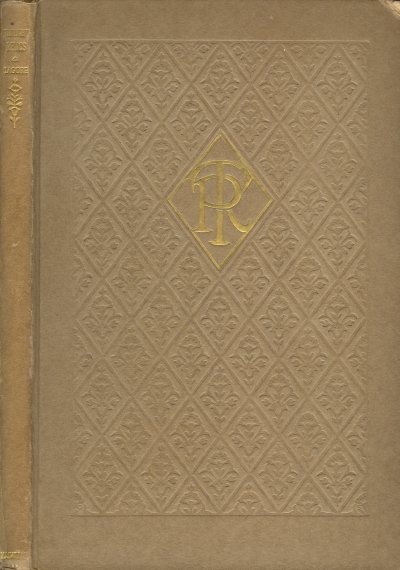
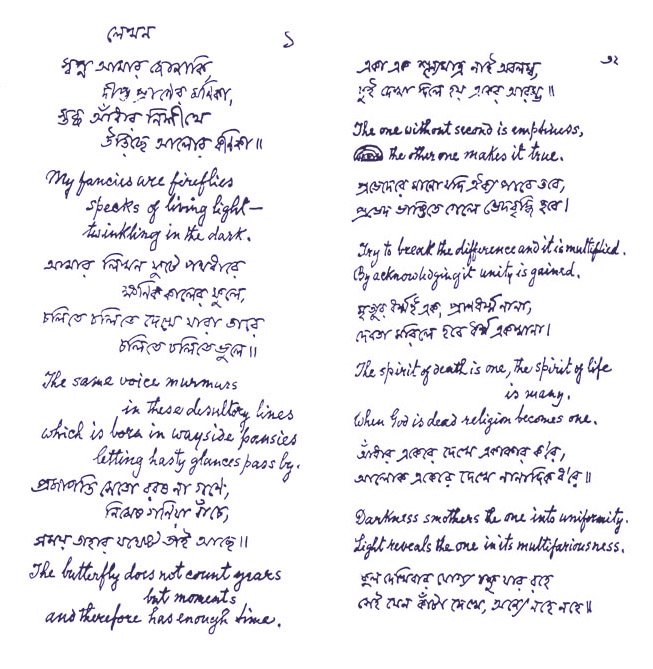
Today’s offering is another book by Rabindranath Tagore, Thought Relics, which he also translated into English.

cover-thoughtrelics

It is in the public domain and the full download is at the bottom of this post as a Word Document.

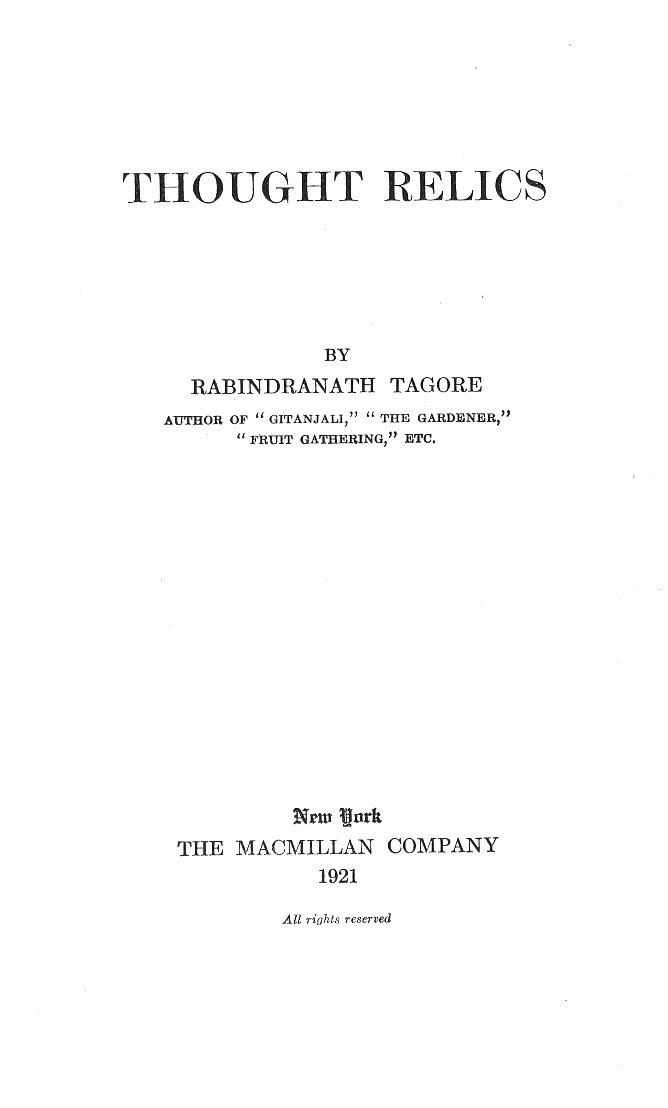
title-thoughtrelics

First, some excerpts:

SPIRITUAL life is the emancipation of consciousness. Through it we find immediate response of soul everywhere. Before we attain this life, we see men through the medium of self-interest, prejudice or classification, because of the perpetual remoteness around us which we cannot cross over. When the veil is removed, we not only see the fleeting forms of the world, but come close to its eternal being, which is ineffable beauty.

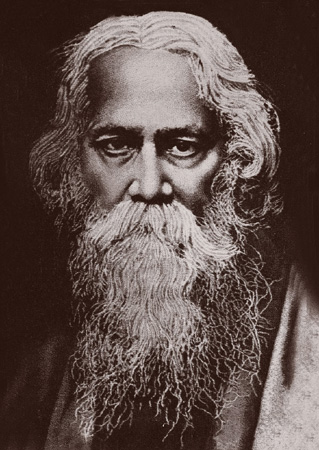
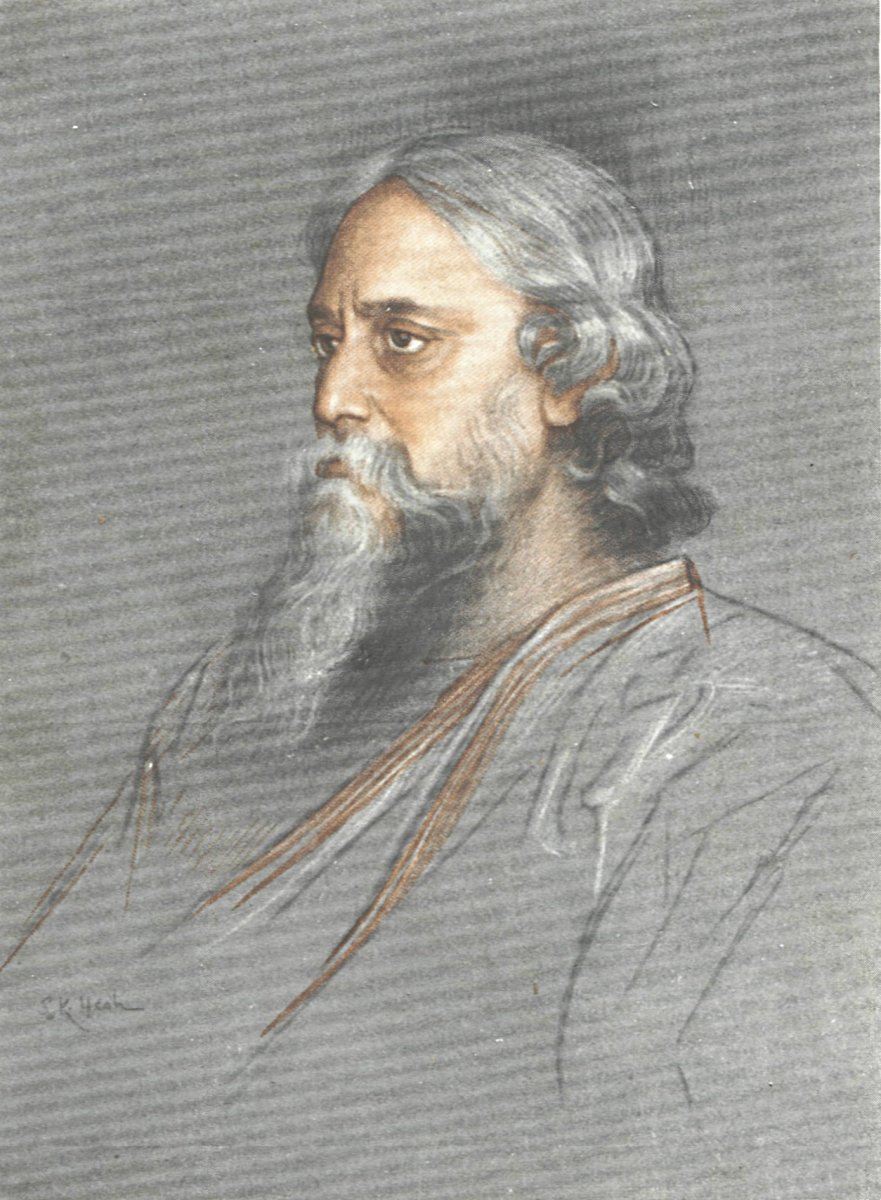
rabindranath-tagore

THE day breaks in the east, like a bud bursting its sheath to come out in flower. But if this fact belonged only to the outside world of events, however could we find our entrance into it? It is a sunrise in the sky of our consciousness; it is a new creation, fresh in bloom, in our life.

Open your eyes and see. Feel this world as a living flute might feel the breath of music passing through it, feel the meeting of creative joy in the depth of your consciousness. Meet this morning light in the majesty of your existence, where it is one with you. But if you sit with your face turned away, you build a separating barrier in the undivided sphere of creation, where events and the creative consciousness meet.

DARKNESS is that which isolates our consciousness within our own self. It hides the great truth of our unity with the world, giving rise to doubt and contention. Groping in the dark, we stumble against objects to which we cling, believing them to be the only things we have. When light comes we slacken our hold, finding them to be mere parts of the all to which we are related. This is freedom–freedom from the isolation of self, from the isolation of things which impart fierce intensity to our sense of possession. Our God is that freedom, for He is Light, and in that light we find out truth, which is our perfect relationship with all.

FEAR assumes unlimited dimensions in the dark, because it is the shadow of the self which has lost its foothold in the all; the self which is a doubter, an unbeliever, which puts its emphasis upon negation, exaggerating detached facts into fearful distortions. In the light we find the harmony of things and know that our world is great and therefore we are great; we know that, with more and more extensive realization of truth, conflicts will vanish, for existence itself is harmony.

Here is the download:

thought-relics

2 Comments

Filed under Free E-Books, Spirituality

Rig Veda

The best place I’ve found on the web for Vedic scriptures with both English translations and Sanskrit originals, access to commentary, etc. is http://www.sacred-texts.com/hin/index.htm

For a taste, offered here are the first 30 hymns of the Rig Veda, the oldest written scripture in the world.

om

Rig Veda Book 1


Hymn 1

1 I Laud Agni, the chosen Priest, God, minister of sacrifice,
The hotar, lavishest of wealth.
2 Worthy is Agni to be praised by living as by ancient seers.
He shall bring hitherward the Gods.
3 Through Agni man obtaineth wealth, yea, plenty waxing day by day,
Most rich in heroes, glorious.
4 Agni, the perfect sacrifice which thou encompassest about
Verily goeth to the Gods.
5 May Agni, sapient-minded Priest, truthful, most gloriously great,
The God, come hither with the Gods.
6 Whatever blessing, Agni, thou wilt grant unto thy worshipper,
That, A
giras, is indeed thy truth.
7 To thee, dispeller of the night, O Agni, day by day with prayer
Bringing thee reverence, we come
8 Ruler of sacrifices, guard of Law eternal, radiant One,
Increasing in thine own abode.
9 Be to us easy of approach, even as a father to his son:
Agni, be with us for our weal.

Hymn 2

1 BEAUTIFUL Vāyu, come, for thee these Soma drops have been prepared:
Drink of them, hearken to our call.
2 Knowing the days, with Soma juice poured forth, the singers glorify
Thee, Vāyu, with their hymns of praise.
3 Vāyu, thy penetrating stream goes forth unto the worshipper,
Far-spreading for the Soma draught.
4 These, Indra-Vāyu, have been shed; come for our offered dainties’ sake:
The drops are yearning for you both.
5 Well do ye mark libations, ye Vāyu and Indra, rich in spoil!
So come ye swiftly hitherward.
6 Vāyu and Indra, come to what the Soma-presser hath prepared:
Soon, Heroes, thus I make my prayer.
7 Mitra, of holy strength, I call, and foe-destroying Varu
a,
Who make the oil-fed rite complete.
8 Mitra and Varu
a, through Law, lovers and cherishers of Law,
Have ye obtained your might power
9 Our Sages, Mitra-Varu
a, wide dominion, strong by birth,
Vouchsafe us strength that worketh well.

Hymn 3

1 YE Aśvins, rich in treasure, Lords of splendour, having nimble hands,
Accept the sacrificial food.
2 Ye Aśvins, rich in wondrous deeds, ye heroes worthy of our praise,
Accept our songs with mighty thought.
3 Nāsatyas, wonder-workers, yours are these libations with clipt grass:
Come ye whose paths are red with flame.
4 O Indra marvellously bright, come, these libations long for thee,
Thus by fine fingers purified.
5 Urged by the holy singer, sped by song, come, Indra, to the prayers,
Of the libation-pouring priest.
6 Approach, O Indra, hasting thee, Lord of Bay Horses, to the prayers.
In our libation take delight.
7 Ye Viśvedevas, who protect, reward, and cherish men, approach
Your worshipper’s drink-offering.
8 Ye Viśvedevas, swift at work, come hither quickly to the draught,
As milch-kine hasten to their stalls.
9 The Viśvedevas, changing shape like serpents, fearless, void of guile,
Bearers, accept the sacred draught
10 Wealthy in spoil, enriched with hymns, may bright
Sarasvatī desire,
With eager love, our sacrifice.
11 Inciter of all pleasant songs, inspirer of all gracious thought,
Sarasvatī accept our rite
12 Sarasvatī, the mighty flood,—she with her light illuminates,
She brightens every pious thought.

Hymn 4

1 As a good cow to him who milks, we call the doer of fair deeds,
To our assistance day by day.
2 Come thou to our libations, drink of Soma; Soma-drinker thou!
The rich One’s rapture giveth kine.
3 So may we be acquainted with thine innermost benevolence:
Neglect us not, come hitherward.
4 Go to the wise unconquered One, ask thou of Indra, skilled in song,
Him who is better than thy friends.
5 Whether the men who mock us say, Depart unto another place,
Ye who serve Indra and none else;
6 Or whether, God of wondrous deeds, all our true people call us blest,
Still may we dwell in Indra’s care.
7 Unto the swift One bring the swift, man-cheering, grace of sacrifice,
That to the Friend gives wings and joy.
8 Thou, Śatakratu, drankest this and wast the V
tras’ slayer; thou
Helpest the warrior in the fray.
9 We strengthen, Śatakratu, thee, yea, thee the powerful in fight,
That, Indra, we may win us wealth.
10 To him the mighty stream of wealth, prompt friend of him who pours the juice,
Yea, to this Indra sing your song.

Hymn 5

1 O COME ye hither, sit ye down: to Indra sing ye forth, your song,
companions, bringing hymns of praise.
2 To him the richest of the rich, the Lord of treasures excellent,
Indra, with Soma juice outpoured.
3 May he stand by us in our need and in abundance for our wealth:
May he come nigh us with his strength.
4 Whose pair of tawny horses yoked in battles foemen challenge not:
To him, to Indra sing your song.
5 Nigh to the Soma-drinker come, for his enjoyment, these pure drops,
The Somas mingled with the curd.
6 Thou, grown at once to perfect strength, wast born to drink the Soma juice,
Strong Indra, for preëminence.
7 O Indra, lover of the song, may these quick Somas enter thee:
May they bring bliss to thee the Sage.
8 Our chants of praise have strengthened thee, O Śatakratu, and our lauds
So strengthen thee the songs we sing.
9 Indra, whose succour never fails, accept these viands thousandfold,
Wherein all manly powers abide.
10 O Indra, thou who lovest song, let no man hurt our bodies, keep
Slaughter far from us, for thou canst.

Hymn 6

1 They who stand round him as he moves harness the bright, the ruddy Steed
The lights are shining in the sky.
2 On both sides to the car they yoke the two bay coursers dear to him,
Bold, tawny, bearers of the Chief.
3 Thou, making light where no light was, and form, O men: where form was not,
Wast born together with the Dawns.
4 Thereafter they, as is their wont, threw off the state of babes unborn,
Assuming sacrificial names.
5 Thou, Indra, with the Tempest-Gods, the breakers down of what is firm,
Foundest the kine even in the cave.
6 Worshipping even as they list, singers laud him who findeth wealth,
The far-renowned, the mighty One.
7 Mayest thou verily be seen coming by fearless Indra’s side:
Both joyous, equal in your sheen.
8 With Indra’s well beloved hosts, the blameless, hastening to heaven,
The sacrificer cries aloud.
9 Come from this place, O Wanderer, or downward from the light of heaven:
Our songs of praise all yearn for this.
10 Indra we seek to give us help, from here, from heaven above the earth,
Or from the spacious firmament.

Hymn 7

1 INDRA the singers with high praise, Indra reciters with their lauds,
Indra the choirs have glorified.
2 Indra hath ever close to him his two bay steeds and word-yoked car,
Indra the golden, thunder-armed.
3 Indra hath raised the Sun on high in heaven, that he may see afar:
He burst the mountain for the kine.
4 Help us, O Indra, in the frays, yea, frays, where thousand spoils are gained,
With awful aids, O awful One.
5 In mighty battle we invoke Indra, Indra in lesser fight,
The Friend who bends his bolt at fiends.
6 Unclose, our manly Hero, thou for ever bounteous, yonder cloud,
For us, thou irresistible.
7 Still higher, at each strain of mine, thunder-armed Indra’s praises rise:
I find no laud worthy of him.
8 Even as the bull drives on the herds, he drives the people with his might,
The Ruler irresistible:
9 Indra who rules with single sway men, riches, and the fivefold race
Of those who dwell upon the earth.
10 For your sake from each side we call Indra away from other men:
Ours, and none others’, may he be.

Hymn 8

1 INDRA, bring wealth that gives delight, the victor’s ever-conquering wealth,
Most excellent, to be our aid;
2 By means of which we may repel our foes in battle hand to hand,
By thee assisted with the car.
3 Aided by thee, the thunder-armed, Indra, may we lift up the bolt,
And conquer all our foes in fight.
4 With thee, O India, for ally with missile-darting heroes, may
We conquer our embattled foes.
5 Mighty is Indra, yea supreme; greatness be his, the Thunderer:
Wide as the heaven extends his power
6 Which aideth those to win them sons, who come as heroes to the fight,
Or singers loving holy thoughts.
7 His belly, drinking deepest draughts of Soma, like an ocean swells,
Like wide streams from the cope of heaven.
8 So also is his excellence, great, vigorous, rich in cattle, like
A ripe branch to the worshipper.
9 For verily thy mighty powers, Indra, are saving helps at once
Unto a worshipper like me.
10 So are his lovely gifts; let lauds and praises be to Indra sung,
That he may drink the Soma juice.

Hymn 9

1 COME, Indra, and delight thee with the juice at all the Soma feasts,
Protector, mighty in thy strength.
2 To Indra pour ye forth the juice, the active gladdening juice to him
The gladdening, omnific God.
3 O Lord of all men, fair of cheek, rejoice thee in the gladdening lauds,
Present at these drink-offerings.
4 Songs have outpoured themselves to thee, Indra, the strong, the guardian Lord,
And raised themselves unsatisfied.
5 Send to us bounty manifold, O Indra, worthy of our wish,
For power supreme is only thine.
6 O Indra, stimulate thereto us emulously fain for wealth,
And glorious, O most splendid One.
7 Give, Indra, wide and lofty fame, wealthy in cattle and in strength,
Lasting our life-time, failing not.
8 Grant us high fame, O Indra, grant riches bestowing thousands, those
Fair fruits of earth borne home in wains.
9 Praising with songs the praise-worthy who cometh to our aid, we call
Indra, the Treasure-Lord of wealth.
10 To lofty Indra, dweller by each libation, the pious man
Sings forth aloud a strengthening hymn.

Hymn 10

1 THE chanters hymn thee, they who say the word of praise magnify thee.
The priests have raised thee up on high, O Śatakratu, like a pole.
2 As up he clomb from ridge to ridge and looked upon the toilsome task,
Indra observes this wish of his, and the Rain hastens with his troop.
3 Harness thy pair of strong bay steeds, long-maned, whose bodies fill the girths,
And, Indra, Soma-drinker, come to listen to our songs of praise.
4 Come hither, answer thou the song, sing in approval, cry aloud.
Good Indra, make our prayer succeed, and prosper this our sacrifice.
5 To Indra must a laud be said, to strengthen him who freely gives,
That Śakra may take pleasure in our friendship and drink-offerings.
6 Him, him we seek for friendship, him for riches and heroic might.
For Indra, he is Śakra, he shall aid us while he gives us wealth.
7 Easy to turn and drive away, Indra, is spoil bestowed by thee.
Unclose the stable of the kine, and give us wealth O Thunder-armed
8 The heaven and earth contain thee not, together, in thy wrathful mood.
Win us the waters of the sky, and send us kine abundantly.
9 Hear, thou whose ear is quick, my call; take to thee readily my songs
O Indra, let this laud of mine come nearer even than thy friend.
10 We know thee mightiest of all, in battles hearer of our cry.
Of thee most mighty we invoke the aid that giveth thousandfold.
11 O Indra, Son of Kuśika, drink our libation with delight.
Prolong our life anew, and cause the seer to win a thousand gifts.
12 Lover of song, may these our songs on every side encompass thee:
Strengthening thee of lengthened life, may they be dear delights to thee.

Hymn 11

1 ALL sacred songs have magnified Indra expansive as the sea,
The best of warriors borne on cars, the Lord, the very Lord of strength.
2 Strong in thy friendship, Indra, Lord of power and might, we have no fear.
We glorify with praises thee, the never-conquered conqueror.
3 The gifts of Indra from of old, his saving succours, never fail,
When to the praise-singers he gives the boon of substance rich in kine.
4 Crusher of forts, the young, the wise, of strength unmeasured, was he born
Sustainer of each sacred rite, Indra, the Thunderer, much-extolled.
5 Lord of the thunder, thou didst burst the cave of Vala rich in cows.
The Gods came pressing to thy side, and free from terror aided thee,
6 I, Hero, through thy bounties am come to the flood addressing thee.
Song-lover, here the singers stand and testify to thee thereof.
7 The wily Śu
ṣṇa, Indra! thou o’erthrewest with thy wondrous powers.
The wise beheld this deed of thine: now go beyond their eulogies.
8 Our songs of praise have glorified Indra who ruleth by his might,
Whose precious gifts in thousands come, yea, even more abundantly.

Hymn 12

1 WE choose Agni the messenger, the herald, master of all wealth,
Well skilled in this our sacrifice.
2 With callings ever they invoke Agni, Agni, Lord of the House,
Oblation-bearer, much beloved.
3 Bring the Gods hither, Agni, born for him who strews the sacred grass:
Thou art our herald, meet for praise.
4 Wake up the willing Gods, since thou, Agni, performest embassage:
Sit on the sacred grass with Gods.
5 O Agni, radiant One, to whom the holy oil is poured, burn up
Our enemies whom fiends protect.
6 By Agni Agni is inflamed, Lord of the House, wise, young, who bears
The gift: the ladle is his mouth.
7 Praise Agni in the sacrifice, the Sage whose ways are ever true,
The God who driveth grief away.
8 God, Agni, be his strong defence who lord of sacrificial gifts,
Worshippeth thee the messenger.
9 Whoso with sacred gift would fain call Agni to the feast of Gods,
O Purifier, favour him.
10 Such, Agni, Purifier, bright, bring hither to our sacrifice,
To our oblation bring the Gods.
11 So lauded by our newest song of praise bring opulence to us,
And food, with heroes for our sons.
12 O Agni, by effulgent flame, by all invokings of the Gods,
Show pleasure in this laud of ours.

Hymn 13

1 AGNI, well-kindled, bring the Gods for him who offers holy gifts.
Worship them, Purifier, Priest.
2 Son of Thyself, present, O Sage, our sacrifice to the Gods today.
Sweet to the taste, that they may feast.
3 Dear Narāśa
sa, sweet of tongue, the giver of oblations, I
Invoke to this our sacrifice.
4 Agni, on thy most easy car, glorified, hither bring the Gods:
Manu appointed thee as Priest.
5 Strew, O ye wise, the sacred grass that drips with oil, in order due,
Where the Immortal is beheld.
6 Thrown open be the Doors Divine, unfailing, that assist the rite,
For sacrifice this day and now.
7 I call the lovely Night and Dawn to seat them on the holy grass
At this our solemn sacrifice.
8 The two Invokers I invite, the wise, divine and sweet of tongue,
To celebrate this our sacrifice.
9 I
ā, Sarasvatī, Mahī, three Goddesses who bring delight,
Be seated, peaceful, on the grass.
10 Tva
ṣṭar I call, the earliest born, the wearer of all forms at will:
May he be ours and ours alone.
11 God, Sovran of the Wood, present this our oblation to the Gods,
And let the giver be renowned.
12 With Svāhā pay the sacrifice to Indra in the offerer’s house:
Thither I call the Deities.

Hymn 14

1 To drink the Soma, Agni, come, to our service and our songs.
With all these Gods; and worship them.
2 The Ka
vas have invoked thee; they, O Singer, sing thee songs of praise
Agni, come hither with the Gods;
3 Indra, Vāyu, B
haspati, Mitra, Agni, Pū
an, Bhaga,
Ādityas, and the Marut host.
4 For you these juices are poured forth that gladden and exhilarate,
The meath-drops resting in the cup.
5 The sons of Ka
va fain for help adore thee, having strewn the grass,
With offerings and all things prepared.
6 Let the swift steeds who carry thee, thought-yoked and dropping holy oil,
Bring the Gods to the Soma draught.
7 Adored, the strengtheners of Law, unite them, Agni, with their Dames:
Make them drink meath, O bright of tongue.
8 Let them, O Agni, who deserve worship and praise drink with thy tongue
The meath in solemn sacrifice.
9 Away, from the Sun’s realm of light, the wise invoking Priest shall bring
All Gods awaking with the dawn.
10 With all the Gods, with Indra, with Vāyu, and Mitra’s splendours, drink,
Agni, the pleasant Soma juice.
11 Ordained by Manu as our Priest, thou sittest, Agni, at each rite:
Hallow thou this our sacrifice.
12 Harness the Red Mares to thy car, the Bays, O God, the flaming ones:
With those bring hitherward the Gods.

Hymn 15

1 O INDRA drink the Soma juice with tu; let the cheering drops
Sink deep within, which settle there.
2 Drink from the Purifier’s cup, Maruts, with
tu; sanctify
The rite, for ye give precious gifts.
3 O Ne
ṣṭar, with thy Dame accept our sacrifice; with
tu drink,
For thou art he who giveth wealth.
4 Bring the Gods, Agni; in the three appointed places set them down:
Surround them, and with
tu drink.
5 Drink Soma after the
tus, from the Brāhma
a’s bounty: undissolved,
O Indra, is thy friendship’s bond.
6 Mitra, Varu
a, ye whose ways are firm—a Power that none deceives—,
With
tu ye have reached the rite.
7 The Soma-pressers, fain for wealth, praise the Wealth-giver in the rite,
In sacrifices praise the God.
8 May the Wealth-giver grant to us riches that shall be far renowned.
These things we gain, among the Gods.
9 He with the
tu fain would drink, Wealth-giver, from the Neṣṭ
ar’s bowl.
Haste, give your offering, and depart.
10 As we this fourth time, Wealth-giver, honour thee with the
tus, be
A Giver bountiful to us.
11 Drink ye the meath, O Aśvins bright with flames, whose acts are pure, who with
tus accept the sacrifice.
12 With
tu, through the house-fire, thou, kind Giver, guidest sacrifice:
Worship the Gods for the pious man.

Hymn 16

1 LET thy Bay Steeds bring thee, the Strong, hither to drink the Soma draught—
Those, Indra, who are bright as suns.
2 Here are the grains bedewed with oil: hither let the Bay Coursers bring
Indra upon his easiest car.
3 Indra at early morn we call, Indra in course of sacrifice,
Indra to drink the Soma juice.
4 Come hither, with thy long-maned Steeds, O Indra, to he draught we pour
We call thee when the juice is shed.
5 Come thou to this our song of praise, to the libation poured for thee
Drink of it like a stag athirst.
6 Here are the drops of Soma juice expressed on sacred grass: thereof
Drink, Indra, to increase thy might.
7 Welcome to thee be this our hymn, reaching thy heart, most excellent:
Then drink the Soma juice expressed.
8 To every draught of pressed-out juice Indra, the V
tra-slayer, comes,
To drink the Soma for delight.
9 Fulfil, O Śatakratu, all our wish with horses and with kine:
With holy thoughts we sing thy praise.

Hymn 17

1 I CRAVE help from the Imperial Lords, from Indra-Varua; may they
Both favour one of us like me.
2 Guardians of men, ye ever come with ready succour at the call
Of every singer such as I.
3 Sate you, according to your wish, O Indra-Varu
a, with wealth:
Fain would we have you nearest us.
4 May we be sharers of the powers, sharers of the benevolence
Of you who give strength bounteously.
5 Indra and Varu
a, among givers of thousands, meet for praise,
Are Powers who merit highest laud.
6 Through their protection may we gain great store of wealth, and heap it up
Enough and still to spare, be ours.
7 O Indra-Varu
a, on you for wealth in many a form I call:
Still keep ye us victorious.
8 O Indra-Varu
a, through our songs that seek to win you to ourselves,
Give us at once your sheltering help.
9 O Indra-Varu
a, to you may fair praise which I offer come,
Joint eulogy which ye dignify.

Hymn 18

1 O BRĀHMAASPATI, make him who presses Soma glorious,
Even Kak
īvān Auśija.
2 The rich, the healer of disease, who giveth wealth, increaseth store,
The prompt,—may he be with us still.
3 Let not the foeman’s curse, let not a mortal’s onslaught fall on us
Preserve us, Brahma
aspati.
4 Ne’er is the mortal hero harmed whom Indra, Brahma
aspati,
And Soma graciously inspire.
5 Do, thou, O Brahma
aspati, and Indra, Soma, Daki
ā,
Preserve that mortal from distress.
6 To the Assembly’s wondrous Lord, to Indra’s lovely Friend who gives
Wisdom, have I drawn near in prayer.
7 He without whom no sacrifice, e’en of the wise man, prospers; he
Stirs up the series of thoughts.
8 He makes the oblation prosper, he promotes the course of sacrifice:
Our voice of praise goes to the Gods.
9 I have seen Narāśasa, him most resolute, most widely famed,
As ’twere the Household Priest of heaven.

Hymn 19

1 To this fair sacrifice to drink the milky draught thou art invoked:
O Agni, with the Maruts come.
2 No mortal man, no God exceeds thy mental power, O Mighty one:
O Agni, with the Maruts come:
3 All Gods devoid of guile, who know the mighty region of mid-air:
O Agni, with those Maruts come.
4 The terrible, who sing their song, not to be overcome by might:
O Agni, with those Maruts come.
5 Brilliant, and awful in their form, mighty, devourers of their foes:
O Agni, with those Maruts come.
6 Who sit as Deities in heaven, above the sky-vault’s luminous sphere:
O Agni, with those Maruts come.
7 Who scatter clouds about the sky, away over the billowy sea:
O Agni, with those Maruts come.
8 Who with their bright beams spread them forth over the ocean in their might
O Agni, with those Maruts come.
9 For thee, to be thine early draught, I pour the Soma-mingled meath:
O Agni, with the Maruts come.

Hymn 20

1 FOR the Celestial Race this song of praise which gives wealth lavishly
Was made by singers with their lips.
2 They who for Indra, with their mind, formed horses harnessed by a word,
Attained by works to sacrifice.
3 They for the two Nāsatyas wrought a light car moving every way:
They formed a nectar-yielding cow.
4 The
bhus with effectual prayers, honest, with constant labour, made
Their Sire and Mother young again.
5 Together came your gladdening drops with Indra by the Maruts girt,
With the Ādityas, with the Kings.
6 The sacrificial ladle, wrought newly by the God Tva
ṣṭar’s hand—
Four ladles have ye made thereof.
7 Vouchsafe us wealth, to him who pours thrice seven libations, yea, to each
Give wealth, pleased with our eulogies.
8 As ministering Priests they held, by pious acts they won themselves,
A share in sacrifice with Gods.

Hymn 21

1 INDRA and Agni I invoke fain are we for their song of praise:
Chief Soma-drinkers are they both.
2 Praise ye, O men, and glorify Indra-Agni in the holy rites:
Sing praise to them in sacred songs.
3 Indra and Agni we invite, the Soma-drinkers, for the fame
Of Mitra, to the Soma-draught.
4 Strong Gods, we bid them come to this libation that stands ready here:
Indra and Agni, come to us.
5 Indra and Agni, mighty Lords of our assembly, crush the fiends:
Childless be the devouring ones.
6 Watch ye, through this your truthfulness, there in the place of spacious view
Indra and Agni, send us bliss.

Hymn 22

1 WAKEN the Aśvin Pair who yoke their car at early morn: may they
Approach to drink this Soma juice.
2 We call the Aśvins Twain, the Gods borne in a noble car, the best
Of charioteers, who reach the heavens.
3 Dropping with honey is your whip, Aśvins, and full of pleasantness
Sprinkle therewith the sacrifice.
4 As ye go thither in your car, not far, O Aśvins, is the home
Of him who offers Soma juice.
5 For my protection I invoke the golden-handed Savitar.
He knoweth, as a God, the place.
6 That he may send us succour, praise the Waters’ Offspring Savitar:
Fain are we for his holy ways.
7 We call on him, distributer of wondrous bounty and of wealth,
On Savitar who looks on men.
8 Come hither, friends, and seat yourselves Savitar, to be praised by us,
Giving good gifts, is beautiful.
9 O Agni, hither bring to us the willing Spouses of the Gods,
And Tva
ṣṭ
ar, to the Soma draught.
10 Most youthful Agni, hither bring their Spouses, Hotrā, Bhāratī,
Varūtrī, Dhi
a
ā, for aid.
11 Spouses of Heroes, Goddesses, with whole wings may they come to us
With great protection and with aid.
12 Indrāī, Varu
ānī, and Agnāyī hither I invite,
For weal, to drink the Soma juice.
13 May Heaven and Earth, the Mighty Pair, bedew for us our sacrifice,
And feed us full with nourishments.
14 Their water rich with fatness, there in the Gandharva’s steadfast place,
The singers taste through sacred songs.
15 Thornless be thou, O Earth, spread wide before us for a dwelling-place:
Vouchsafe us shelter broad and sure.
16 The Gods be gracious unto us even from the place whence Vi
ṣṇ
u strode
Through the seven regions of the earth!
17 Through all this world strode Vi
ṣṇ
u; thrice his foot he planted, and the whole
Was gathered in his footstep’s dust.
18 Vi
ṣṇ
u, the Guardian, he whom none deceiveth, made three steps; thenceforth
Establishing his high decrees.
19 Look ye on Vi
ṣṇ
u’s works, whereby the Friend of Indra, close-allied,
Hath let his holy ways be seen.
20 The princes evermore behold that loftiest place where Vi
ṣṇ
u is,
Laid as it were an eye in heaven.
21 This, Vi
ṣṇu’s station most sublime, the singers, ever vigilant,
Lovers of holy song, light up.

Hymn 23

1 STRONG are the Somas; come thou nigh; these juices have been mixt with milk:
Drink, Vāyu, the presented draughts.
2 Both Deities who touch the heaven, Indra and Vāyu we invoke
To drink of this our Soma juice.
3 The singers’ for their aid, invoke Indra and Vāyu, swift as mind,
The thousand-eyed, the Lords of thought.
4 Mitra and Varu
a, renowned as Gods of consecrated might,
We call to drink the Soma juice.
5 Those who by Law uphold the Law, Lords of the shining light of Law,
Mitra I call, and Varu
a.
6 Let Varu
a be our chief defence, let Mitra guard us with all aids
Both make us rich exceedingly.
7 Indra, by Maruts girt, we call to drink the Soma juice: may he
Sate him in union with his troop.
8 Gods, Marut hosts whom Indra leads, distributers of Pū
an’s gifts,
Hearken ye all unto my cry.
9 With conquering Indra for ally, strike V
tra down, ye bounteous Gods
Let not the wicked master us.
10 We call the Universal Gods, and Maruts to the Soma draught,
For passing strong are P
śni’s Sons.
11 Fierce comes the Maruts’ thundering voice, like that of conquerors, when ye go
Forward to victory, O Men.
12 Born of the laughing lightning. may the Maruts guard us everywhere
May they be gracious unto Us.
13 Like some lost animal, drive to us, bright Pū
an, him who bears up heaven,
Resting on many-coloured grass.
14 Pū
an the Bright has found the King, concealed and hidden in a cave,
Who rests on grass of many hues.
15 And may he. duly bring to me the six bound closely, through these drops,
As one who ploughs with steers brings corn.
16 Along their paths the Mothers go, Sisters of priestly ministrants,
Mingling their sweetness with the milk.
17 May Waters gathered near the Sun, and those wherewith the Sun is joined,
Speed forth this sacrifice of ours.
18 I call the Waters, Goddesses, wherein our cattle quench their thirst;
Oblations to the Streams be given.
19 Amrit is in the Waters in the Waters there is healing balm
Be swift, ye Gods, to give them praise.
20 Within the Waters—Soma thus hath told me—dwell all balms that heal,
And Agni, he who blesseth all. The Waters hold all medicines.
21 O Waters, teem with medicine to keep my body safe from harm,
So that I long may see the Sun.
22 Whatever sin is found in me, whatever evil I have wrought.
If I have lied or falsely sworn, Waters, remove it far from me.
23 The Waters I this day have sought, and to their moisture have we come:
O Agni, rich in milk, come thou, and with thy splendour cover me.
24 Fill me with splendour, Agni; give offspring and length of days; the Gods
Shall know me even as I am, and Indra with the
Ṛṣis, know.

Hymn 24

1 WHO now is he, what God among Immortals, of whose auspicious name we may bethink us?
Who shall to mighty Aditi restore us, that I may see my Father and my Mother?
2 Agni the God the first among the Immortals,—of his auspicious name let us bethink us.
He shall to mighty Aditi restore us, that I may see my Father and my Mother.
3 To thee, O Savitar, the Lord of precious things, who helpest us
Continually, for our share we come—
4 Wealth, highly lauded ere reproach hath fallen on it, which is laid,
Free from all hatred, in thy hands
5 Through thy protection may we come to even the height of affluence
Which Bhaga hath dealt out to us.
6 Ne’er have those birds that fly through air attained to thy high dominion or thy might or spirit;
Nor these the waters that flow on for ever, nor hills, abaters of the wind’s wild fury.
7 Varu
a, King, of hallowed might, sustaineth erect the Tree’s stem in the baseless region.
Its rays, whose root is high above, stream downward. Deep may they sink within us, and be hidden.
8 King Varu
a hath made a spacious pathway, a pathway for the Sun wherein to travel.
Where no way was he made him set his footstep, and warned afar whate’er afflicts the spirit.
9 A hundred balms are thine, O King, a thousand; deep and wide-reaching also be thy favours.
Far from us, far away drive thou Destruction. Put from us e’en the sin we have committed.
10 Whither by day depart the constellations that shine at night, set high in heaven above us?
Varu
a’s holy laws remain unweakened, and through the night the Moon moves on in splendor
11 I ask this of thee with my prayer adoring; thy worshipper craves this with his oblation.
Varu
a, stay thou here and be not angry; steal not our life from us, O thou Wide-Ruler.
12 Nightly and daily this one thing they tell me, this too the thought of mine own heart repeateth.
May he to whom prayed fettered Śuna
śepa, may he the Sovran Varu
a release us.
13 Bound to three pillars captured Śuna
śepa thus to the Āditya made his supplication.
Him may the Sovran Varu
a deliver, wise, ne’er deceived, loosen the bonds that bind him.
14 With bending down, oblations, sacrifices, O Varu
a, we deprecate thine anger:
Wise Asura, thou King of wide dominion, loosen the bonds of sins by us committed.
15 Loosen the bonds, O Varu
a, that hold me, loosen the bonds above, between, and under.
So in thy holy law may we made sinless belong to Aditi, O thou Āditya.

Hymn 25

1 WHATEVER law of thine, O God, O Varua, as we are men,
Day after day we violate.
2 give us not as a prey to death, to be destroyed by thee in wrath,
To thy fierce anger when displeased.
3 To gain thy mercy, Varu
a, with hymns we bind thy heart, as binds
The charioteer his tethered horse.
4 They flee from me dispirited, bent only on obtaining wealth,
As to their nests the birds of air.
5 When shall we bring, to be appeased, the Hero, Lord of warrior might,
Him, the far-seeing Varu
a?
6 This, this with joy they both accept in common: never do they fail
The ever-faithful worshipper.
7 He knows the path of birds that fly through heaven, and, Sovran of the sea,
He knows the ships that are thereon.
8 True to his holy law, he knows the twelve moons with their progeny:
He knows the moon of later birth.
9 He knows the pathway of the wind, the spreading, high, and mighty wind:
He knows the Gods who dwell above.
10 Varu
a, true to holy law, sits down among his people; he,
Most wise, sits there to govern all.
11 From thence
perceiving he beholds all wondrous things, both what hath been,
And what hereafter will be done.
12 May that Āditya, very wise, make fair paths for us all our days:
May he prolong our lives for us.
13 Varu
a, wearing golden mail, hath clad him in a shining robe.
His spies are seated found about.
14 The God whom enemies threaten not, nor those who tyrannize o’er men,
Nor those whose minds are bent on wrong.
15 He who gives glory to mankind, not glory that is incomplete,
To our own bodies giving it.
16 Yearning for the wide-seeing One, my thoughts move onward unto him,
As kine unto their pastures move.
17 Once more together let us speak, because my meath is brought: priest-like
Thou eatest what is dear to thee.
18 Now saw I him whom all may see, I saw his car above the earth:
He hath accepted these my songs.
19 Varu
a, hear this call of mine: be gracious unto us this day
Longing for help I cried to thee.
20 Thou, O wise God, art Lord of all, thou art the King of earth and heaven
Hear, as thou goest on thy way.
21 Release us from the upper bond, untie the bond between, and loose
The bonds below, that I may live.

Hymn 26

1 O WORTHY of oblation, Lord of prospering powers, assume thy robes,
And offer this our sacrifice.
2 Sit ever to be chosen, as our Priest, most youthful, through our hymns,
O Agni, through our heavenly word.
3 For here a Father for his son, Kinsman for kinsman worshippeth,
And Friend, choice-worthy, for his friend.
4 Here let the foe-destroyers sit, Varu
a, Mitra, Aryaman,
Like men, upon our sacred grass.
5 O ancient Herald, be thou glad in this our rite and fellowship:
Hearken thou well to these our songs.
6 Whate’er in this perpetual course we sacrifice to God and God,
That gift is offered up in thee
7 May he be our dear household Lord, Priest, pleasant and, choice-worthy may
We, with bright fires, be dear to him.
8 The Gods, adored with brilliant fires. have granted precious wealth to us
So, with bright fires, we pray to thee.
9 And, O Immortal One, so may the eulogies of mortal men
Belong to us and thee alike.
10 With all thy fires, O Agni, find pleasure in this our sacrifice,
And this our speech, O Son of Strength.

Hymn 27

1 WITH worship will I glorify thee, Agni, like a long-tailed steed,
Imperial Lord of sacred rites.
2 May the far-striding Son of Strength, bringer of great felicity,
Who pours his gifts like rain, be ours.
3 Lord of all life, from near; from far, do thou, O Agni evermore
Protect us from the sinful man.
4 O Agni, graciously announce this our oblation to the Gods,
And this our newest song of praise.
5 Give us a share of strength most high, a share of strength that is below,
A share of strength that is between.
6 Thou dealest gifts, resplendent One; nigh, as with waves of Sindhu, thou
Swift streamest to the worshipper.
7 That man is lord of endless strength whom thou protectest in the fight,
Agni, or urgest to the fray.
8 Him, whosoever he may be, no man may vanquish, mighty One:
Nay, very glorious power is his.
9 May he who dwells with all mankind bear us with war-steeds through the fight,
And with the singers win the spoil.
10 Help, thou who knowest lauds, this work, this eulogy to Rudra, him
Adorable in every house.
11 May this our God, great, limitless, smoke-bannered excellently bright,
Urge us to strength and holy thought.
12 Like some rich Lord of men may he, Agni the banner of the Gods,
Refulgent, hear us through our lauds.
13 Glory to Gods, the mighty and the lesser glory to Gods the younger and the elder!
Let us, if we have power, pay the God worship: no better prayer than this, ye Gods, acknowledge.

Hymn 28

yatra ghrāvā pthubudhna ūrdhvo bhavati sotave |
ulūkhalasutānāmaved vindra jalghula
||
yatra dvāviva jaghanādhi
avayā k
tā |
ulū… ||
yatra nāryapacyavamupacyava
ca śik
ate |
ulū… ||
yatra manthā
vibadhnate raśmīn yamitavā iva |
ulū… ||
yaccid dhi tva
ghhegh
ha ulūkhalaka yujyase |
iha dyumattama
vada yajatāmiva dundubhi
||
uta sma te vanaspate vāto vi vātyaghramit |
atho indrāya pātave sunu somamulūkhala ||
āyajī vājasātamā tā hyuccā vijarbh
ta
|
harī ivāndhā
si bapsatā ||
tā no adya vanaspatī ṛṣvāv ṛṣvebhi sotbhi
|
indrāya madhumat sutam ||
ucchi
ṣṭa camvorbhara soma pavitra ā sja |
ni dhehi ghoradhi tvaci ||

1 THERE where the broad-based stone raised on high to press the juices out,
O Indra, drink with eager thirst the droppings which the mortar sheds.
2 Where, like broad hips, to hold the juice the platters of the press are laid,
O Indra, drink with eager thirst the droppings which the mortar sheds.
3 There where the woman marks and leans the pestle’s constant rise and fall,
O Indra, drink with eager thirst the droppings which the mortar sheds.
4 Where, as with reins to guide a horse, they bind the churning-staff with cords,
O Indra, drink with eager thirst the droppings which the mortar sheds.
5 If of a truth in every house, O Mortar thou art set for work,
Here give thou forth thy clearest sound, loud as the drum of conquerors.
6 O Sovran of the Forest, as the wind blows soft in front of thee,
Mortar, for Indra press thou forth the Soma juice that he may drink.
7 Best strength-givers, ye stretch wide jaws, O Sacrificial Implements,
Like two bay horses champing herbs.
8 Ye Sovrans of the Forest, both swift, with swift pressers press to-day
Sweet Soma juice for Indra’s drink.
9 Take up in beakers what remains: the Soma on the filter pour,
and on the ox-hide set the dregs.

Hymn 29

yaccid dhi satya somapā anāśastā iva smasi |
ā tū na indra śa
saya ghovaśveu subhriu sahasreu tuvīmagha ||
śiprin vājānā
pate śacīvastava dasanā |
ā … ||
ni
vāpayā mithūdśā sastāmabudhyamāne |
ā … ||
sasantu tyā arātayo bodhantu śūra rātaya
|
ā … ||
samindra ghardabha
mṛṇa nuvanta pāpayāmuyā |
ā … ||
patāti ku
ṇḍṛṇācyā dūra vāto vanādadhi |
ā … ||
sarva
parikrośa jahi jambhayā kkadāśvam |
ā … ||

1 O SOMA DRINKER, ever true, utterly hopeless though we be,
Do thou, O Indra, give us hope of beauteous horses and of kine,
In thousands, O most wealthy One.
2 O Lord of Strength, whose jaws are strong, great deeds are thine, the powerful:
Do thou, O Indra, give us hope of beauteous horses and of kine,
In thousands, O most wealthy One.
3 Lull thou asleep, to wake no more, the pair who on each other look
Do thou, O Indra, give us hope of beauteous horses and of kine,
In thousands, O most wealthy One.
4 Hero, let hostile spirits sleep, and every gentler genius wake:
Do thou, O Indra, give us hope of beauteous horses and of kine,
In thousands, O most wealthy One.
5 Destroy this ass, O Indra, who in tones discordant brays to thee:
Do thou, O Indra, give us hope of beauteous horses and of kine,
In thousands, O most wealthy One.
6 Far distant on the forest fall the tempest in a circling course!
Do thou, O Indra, give us hope of beauteous horses and of kine,
In thousands, O most wealthy One.
7 Slay each reviler, and destroy him who in secret injures us:
Do thou, O Indra, give us hope of beauteous horses and of kine
In thousands, O most wealthy One.

Hymn 30

ā va indra krivi yathā vājayanta śatakratum |
ma
hiṣṭha siñca indubhi ||
śata
vā ya śucīnā sahasra vā samāśirām |
edu nimna
na rīyate ||
sa
yan madāya śumia enā hyasyodare |
samudro na vyaco dadhe ||
ayamu te samatasi kapota iva gharbhadhim |
vacastaccin na ohase ||
stotra
rādhānā pate ghirvāho vīra yasya te |
vibhūtirastusūn
tā ||
ūrdhvasti
ṣṭhā na ūtaye.asmin vāje śatakrato |
samanye
u bravāvahai ||
yoghe-yoghe tavastara
vāje-vāje havāmahe |
sakhāya indramūtaye ||
ā ghā ghamad yadi śravat sahasri
ībhirūtibhi |
vājebhirupa no havam ||
anu pratnasyaukaso huve tuviprati
naram |
ya
te pūrva pitā huve ||
ta
tvā vaya viśvavārā śāsmahe puruhūta |
sakhe vaso jarit
bhya ||
asmāka
śipriīnā somapā somapāvnām |
sakhe vajrin sakhīnām ||
tathā tadastu somapā
sakhe vajrin tathā kṛṇu |
yathā ta uśmasī
ṣṭaye ||
revatīrna
sadhamāda indre santu tuvivājā |
k
umanto yābhirmadema ||
ā gha tvāvān tmanāpta stot
bhyo dhṛṣṇaviyāna |
ṛṇ
oraka na cakryoh ||
ā yad duva
śatakratavā kāma jaritṝṇām |
ṛṇoraka na śacībhi ||
śaśvadindra
popruthadbhirjighāya nānadadbhi śāśvasadbhirdhanāni |
sa no hira
yaratha dasanāvān sa na sanitā sanaye sa no.adāt ||
āśvināvaśvāvatye
ā yata śavīrayā ghomad dasrā hirayavat ||
samānayojano hi vā
ratho dasrāvamartya |
samudre aśvineyate ||
vyaghnyasya mūrdhani cakra
rathasya yemathu |
pari dyāmanyadīyate ||
kasta u
a kadhapriye bhuje marto amartye |
ka
nakase vibhāvari ||
vaya
hi te amanmahyāntādā parākāt |
aśve na citre aru
i ||
tva
tyebhirā ghahi vājebhirduhitardiva |
asme rayi
nidhāraya ||

1 WE seeking strength with Soma-drops fill full your Indra like a well,
Most liberal, Lord of Hundred Powers,
2 Who lets a hundred of the pure, a thousand of the milk-blent draughts
Flow, even as down a depth, to him;
3 When for the strong, the rapturous joy he in this manner hath made room
Within his belly, like the sea.
4 This is thine own. Thou drawest near, as turns a pigeon to his mate:
Thou carest too for this our prayer.
5 O Hero, Lord of Bounties, praised in hymns, may power and joyfulness
Be his who sings the laud to thee.
6 Lord of a Hundred Powers, stand up to lend us succour in this fight
In others too let us agree.
7 In every need, in every fray we call as friends to succour us
Indra the mightiest of all.
8 If he will hear us let him come with succour of a thousand kinds,
And all that strengthens, to our call.
9 I call him mighty to resist, the Hero of our ancient home,
Thee whom my sire invoked of old.
10 We pray to thee, O much-invoked, rich in all precious gifts, O Friend,
Kind God to those who sing thy praise.
11 O Soma-drinker, Thunder-armed, Friend of our lovely-featured dames
And of our Soma-drinking friends.
12 Thus, Soma-drinker, may it be; thus, Friend, who wieldest thunder, act
To aid each wish as we desire.
13 With Indra splendid feasts be ours, rich in all strengthening things wherewith,
Wealthy in food, we may rejoice.
14 Like thee, thyself, the singers’ Friend, thou movest, as it were, besought,
Bold One, the axle of the car.
15 That, Śatakratu, thou to grace and please thy praisers, as it were,
Stirrest the axle with thy strength.
16 With champing, neighing loudly-snorting horses Indra hath ever won himself great treasures
A car of gold hath he whose deeds are wondrous received from us, and let us too receive it.
17 Come, Aśvins, with enduring strength wealthy in horses and in kine,
And gold, O ye of wondrous deeds.
18 Your chariot yoked for both alike, immortal, ye of mighty acts,
Travels, O Aśvins, in the sea.
19 High on the forehead of the Bull one chariot wheel ye ever keep,
The other round the sky revolves.
20 What mortal, O immortal Dawn, enjoyeth thee? Where lovest thou?
To whom, O radiant, dost thou go?
21 For we have had thee in our thoughts whether anear or far away,
Red-hued and like a dappled mare.
22 Hither, O Daughter of the Sky, come thou with these thy strengthenings,
And send thou riches down to us

2 Comments

Filed under Mystic Poetry, Spirituality

No information

11brain2axx__1231575167_0544click for size

lord-buckley-8-people-epilogue

tricycle_backflipa-century-of-recorded-poetry-vol-4-32-li-young-lee-my-father-in-heaven-is-reading-out-loud

10-round-dance

bucket-of-owlseugenecash_relaxreleaserelish

ani-catching-up-on-some-readingwernher-von-braun

ani-dramatic-cupcake-dogdianawinston_sevenreasonsnottohate

ajahnamaro_metta

lewisrichmond_vimalakirtisutra

sta50014birdsongs-a-beautiful-mix-31-mins

sta50201

Leave a comment

Filed under buddhism, comedy relief, Family pictures, mp3, Music, sound bite

The Art of Happiness: Audio by HH Dalai Lama

Download, share:

art-of-happiness-dalai-lama-1of-2-share-me-self-help-audio-book1

art-of-happiness-dalai-lama-2-of-2-share-me-self-help-audio-book

7 Comments

Filed under buddhism, Free Audio Books, mp3, Spirituality, wellness and systems change

Dip deeply into the Dao, Soup Sippers of the Moon

An assortment of audio and doc format translations of the Tao Te Ching.

What more can I say?

It’s the way.

tao-2The Tao Te Ching

Translation by Gia Fu Feng & Jane English
Comments and layout by Thomas Knierim

E-Book, Doc Format, download here:

the-tao-te-ching

Audio Book download of the same translation, read by Jacob Needleman:

tao-te-ching-read-by-jacob-needleman

sch_g_taoMore well known, The James Legge version is next- this is the classic English translation

seen most often in quotes from Lao Tsu:

Download the E-Book, Doc format:

tao-te-ching-leggetrans

Here is the Audio Book, in chapters, of the James Legge version

read by Eric Piotrowski:

01-tao_teh_king_01-09_lao-tze

02-tao_teh_king_10-18_lao-tze

03-tao_teh_king_19-27_lao-tze

04-tao_teh_king_28-37_lao-tze

05-tao_teh_king_38-45_lao-tze

06-tao_teh_king_46-54_lao-tze

07-tao_teh_king_55-63_lao-tze

08-tao_teh_king_64-72_lao-tze

09-tao_teh_king_73-81_lao-tze

laozi

The Tao Te Ching
by Lao Tzu

Translated by Stephen Mitchell

1
The tao that can be told
is not the eternal Tao
The name that can be named
is not the eternal Name. The unnamable is the eternally real.
Naming is the origin
of all particular things. Free from desire, you realize the mystery.
Caught in desire, you see only the manifestations. Yet mystery and manifestations
arise from the same source.
This source is called darkness. Darkness within darkness.
The gateway to all understanding.

2
When people see some things as beautiful,
other things become ugly.
When people see some things as good,
other things become bad. Being and non-being create each other.
Difficult and easy support each other.
Long and short define each other.
High and low depend on each other.
Before and after follow each other. Therefore the Master
acts without doing anything
and teaches without saying anything.
Things arise and she lets them come;
things disappear and she lets them go.
She has but doesn’t possess,
acts but doesn’t expect.
When her work is done, she forgets it.
That is why it lasts forever.

3
If you overesteem great men,
people become powerless.
If you overvalue possessions,
people begin to steal. The Master leads
by emptying people’s minds
and filling their cores,
by weakening their ambition
and toughening their resolve.
He helps people lose everything
they know, everything they desire,
and creates confusion
in those who think that they know. Practice not-doing,
and everything will fall into place.

4
The Tao is like a well:
used but never used up.
It is like the eternal void:
filled with infinite possibilities. It is hidden but always present.
I don’t know who gave birth to it.

It is older than God.

5
The Tao doesn’t take sides;
it gives birth to both good and evil.
The Master doesn’t take sides;
she welcomes both saints and sinners. The Tao is like a bellows:
it is empty yet infinitely capable.
The more you use it, the more it produces;
the more you talk of it, the less you understand. Hold on to the center.

6
The Tao is called the Great Mother:
empty yet inexhaustible,
it gives birth to infinite worlds. It is always present within you.
You can use it any way you want.

7
The Tao is infinite, eternal.
Why is it eternal?
It was never born;
thus it can never die.
Why is it infinite?
It has no desires for itself;
thus it is present for all beings. The Master stays behind;
that is why she is ahead.
She is detached from all things;
that is why she is one with them.
Because she has let go of herself,
she is perfectly fulfilled.

8
The supreme good is like water,
which nourishes all things without trying to.
It is content with the low places that people disdain.
Thus it is like the Tao. In dwelling, live close to the ground.
In thinking, keep to the simple.
In conflict, be fair and generous.
In governing, don’t try to control.
In work, do what you enjoy.
In family life, be completely present. When you are content to be simply yourself
and don’t compare or compete,
everybody will respect you.

9
Fill your bowl to the brim
and it will spill.
Keep sharpening your knife
and it will blunt.
Chase after money and security
and your heart will never unclench.
Care about people’s approval
and you will be their prisoner. Do your work, then step back.
The only path to serenity.

10
Can you coax your mind from its wandering
and keep to the original oneness?

Can you let your body become
supple as a newborn child’s?
Can you cleanse your inner vision
until you see nothing but the light?
Can you love people and lead them
without imposing your will?
Can you deal with the most vital matters
by letting events take their course?
Can you step back from you own mind
and thus understand all things? Giving birth and nourishing,
having without possessing,
acting with no expectations,
leading and not trying to control:
this is the supreme virtue.

11
We join spokes together in a wheel,
but it is the center hole
that makes the wagon move. We shape clay into a pot,
but it is the emptiness inside
that holds whatever we want. We hammer wood for a house,
but it is the inner space
that makes it livable. We work with being,
but non-being is what we use.

12
Colors blind the eye.
Sounds deafen the ear.
Flavors numb the taste.
Thoughts weaken the mind.
Desires wither the heart. The Master observes the world
but trusts his inner vision.
He allows things to come and go.
His heart is open as the sky.

13
Success is as dangerous as failure.
Hope is as hollow as fear. What does it mean that success is a dangerous as failure?
Whether you go up the ladder or down it,
you position is shaky.
When you stand with your two feet on the ground,
you will always keep your balance. What does it mean that hope is as hollow as fear?
Hope and fear are both phantoms
that arise from thinking of the self.
When we don’t see the self as self,
what do we have to fear? See the world as your self.
Have faith in the way things are.
Love the world as your self;
then you can care for all things.

14
Look, and it can’t be seen.
Listen, and it can’t be heard.
Reach, and it can’t be grasped. Above, it isn’t bright.
Below, it isn’t dark.
Seamless, unnamable,
it returns to the realm of nothing.

Form that includes all forms,
image without an image,
subtle, beyond all conception. Approach it and there is no beginning;
follow it and there is no end.
You can’t know it, but you can be it,
at ease in your own life.
Just realize where you come from:
this is the essence of wisdom.

15
The ancient Masters were profound and subtle.
Their wisdom was unfathomable.
There is no way to describe it;
all we can describe is their appearance. They were careful
as someone crossing an iced-over stream.
Alert as a warrior in enemy territory.
Courteous as a guest.
Fluid as melting ice.
Shapable as a block of wood.
Receptive as a valley.
Clear as a glass of water. Do you have the patience to wait
till your mud settles and the water is clear?
Can you remain unmoving
till the right action arises by itself? The Master doesn’t seek fulfillment.
Not seeking, not expecting,
she is present, and can welcome all things.

16
Empty your mind of all thoughts.
Let your heart be at peace.
Watch the turmoil of beings,
but contemplate their return. Each separate being in the universe
returns to the common source.
Returning to the source is serenity. If you don’t realize the source,
you stumble in confusion and sorrow.
When you realize where you come from,
you naturally become tolerant,
disinterested, amused,
kindhearted as a grandmother,
dignified as a king.
Immersed in the wonder of the Tao,
you can deal with whatever life brings you,
and when death comes, you are ready.

17
When the Master governs, the people
are hardly aware that he exists.
Next best is a leader who is loved.
Next, one who is feared.
The worst is one who is despised. If you don’t trust the people,
you make them untrustworthy. The Master doesn’t talk, he acts.
When his work is done,
the people say, “Amazing: we did it, all by ourselves!”

18
When the great Tao is forgotten,
goodness and piety appear.

When the body’s intelligence declines,
cleverness and knowledge step forth.
When there is no peace in the family,
filial piety begins.
When the country falls into chaos,
patriotism is born.

19
Throw away holiness and wisdom,
and people will be a hundred times happier.
Throw away morality and justice,
and people will do the right thing.
Throw away industry and profit,
and there won’t be any thieves. If these three aren’t enough,
just stay at the center of the circle
and let all things take their course.

20
Stop thinking, and end your problems.
What difference between yes and no?
What difference between success and failure?
Must you value what others value,
avoid what others avoid?
How ridiculous! Other people are excited,
as though they were at a parade.
I alone don’t care,
I alone am expressionless,
like an infant before it can smile. Other people have what they need;
I alone possess nothing.
I alone drift about,
like someone without a home.
I am like an idiot, my mind is so empty. Other people are bright;
I alone am dark.
Other people are sharper;
I alone am dull.
Other people have a purpose;
I alone don’t know.
I drift like a wave on the ocean,
I blow as aimless as the wind. I am different from ordinary people.
I drink from the Great Mother’s breasts.

21
The Master keeps her mind
always at one with the Tao;
that is what gives her her radiance. The Tao is ungraspable.
How can her mind be at one with it?
Because she doesn’t cling to ideas. The Tao is dark and unfathomable.
How can it make her radiant?
Because she lets it. Since before time and space were,
the Tao is.
It is beyond is and is not.
How do I know this is true?
I look inside myself and see.

22
If you want to become whole,
let yourself be partial.

If you want to become straight,
let yourself be crooked.
If you want to become full,
let yourself be empty.
If you want to be reborn,
let yourself die.
If you want to be given everything,
give everything up. The Master, by residing in the Tao,
sets an example for all beings.
Because he doesn’t display himself,
people can see his light.
Because he has nothing to prove,
people can trust his words.
Because he doesn’t know who he is,
people recognize themselves in him.
Because he has no goad in mind,
everything he does succeeds. When the ancient Masters said,
“If you want to be given everything, give everything up,”
they weren’t using empty phrases.
Only in being lived by the Tao can you be truly yourself.

23
Express yourself completely,
then keep quiet.
Be like the forces of nature:
when it blows, there is only wind;
when it rains, there is only rain;
when the clouds pass, the sun shines through. If you open yourself to the Tao,
you are at one with the Tao
and you can embody it completely.
If you open yourself to insight,
you are at one with insight
and you can use it completely.
If you open yourself to loss,
you are at one with loss
and you can accept it completely. Open yourself to the Tao,
then trust your natural responses;
and everything will fall into place.

24
He who stands on tiptoe
doesn’t stand firm.
He who rushes ahead
doesn’t go far.
He who tries to shine
dims his own light.
He who defines himself
can’t know who he really is.
He who has power over others
can’t empower himself.
He who clings to his work
will create nothing that endures. If you want to accord with the Tao, just do your job,
then let go.

25
There was something formless and perfect
before the universe was born.

It is serene. Empty.
Solitary. Unchanging.
Infinite. Eternally present.
It is the mother of the universe.
For lack of a better name,
I call it the Tao. It flows through all things,
inside and outside, and returns
to the origin of all things. The Tao is great.
The universe is great.
Earth is great.
Man is great.
These are the four great powers. Man follows the earth.
Earth follows the universe.
The universe follows the Tao.
The Tao follows only itself.

26
The heavy is the root of the light.
The unmoved is the source of all movement. Thus the Master travels all day
without leaving home.
However splendid the views,
she stays serenely in herself. Why should the lord of the country
flit about like a fool?
If you let yourself be blown to and fro,
you lose touch with your root.
If you let restlessness move you,
you lose touch with who you are.

27
A good traveler has no fixed plans
and is not intent upon arriving.
A good artist lets his intuition
lead him wherever it wants.
A good scientist has freed himself of concepts
and keeps his mind open to what is. Thus the Master is available to all people
and doesn’t reject anyone.
He is ready to use all situations
and doesn’t waste anything.
This is called embodying the light. What is a good man but a bad man’s teacher?
What is a bad man but a good man’s job?
If you don’t understand this, you will get lost,
however intelligent you are.
It is the great secret.

28
Know the male,
yet keep to the female:
receive the world in your arms.
If you receive the world,
the Tao will never leave you
and you will be like a little child. Know the white,
yet keep to the black:
be a pattern for the world.
If you are a pattern for the world,
the Tao will be strong inside you
and there will be nothing you can’t do. Know the personal,
yet keep to the impersonal:

accept the world as it is.
If you accept the world,
the Tao will be luminous inside you
and you will return to your primal self. The world is formed from the void,
like utensils from a block of wood.
The Master knows the utensils,
yet keeps to the the block:
thus she can use all things.

29
Do you want to improve the world?
I don’t think it can be done. The world is sacred.
It can’t be improved.
If you tamper with it, you’ll ruin it.
If you treat it like an object, you’ll lose it. There is a time for being ahead,
a time for being behind;
a time for being in motion,
a time for being at rest;
a time for being vigorous,
a time for being exhausted;
a time for being safe,
a time for being in danger. The Master sees things as they are,
without trying to control them.
She lets them go their own way,
and resides at the center of the circle.

30
Whoever relies on the Tao in governing men
doesn’t try to force issues
or defeat enemies by force of arms.
For every force there is a counterforce.
Violence, even well intentioned,
always rebounds upon oneself. The Master does his job
and then stops.
He understands that the universe
is forever out of control,
and that trying to dominate events
goes against the current of the Tao.
Because he believes in himself,
he doesn’t try to convince others.
Because he is content with himself,
he doesn’t need others’ approval.
Because he accepts himself,
the whole world accepts him.

31
Weapons are the tools of violence;
all decent men detest them. Weapons are the tools of fear;
a decent man will avoid them
except in the direst necessity
and, if compelled, will use them
only with the utmost restraint.
Peace is his highest value.
If the peace has been shattered,
how can he be content?
His enemies are not demons,
but human beings like himself.

He doesn’t wish them personal harm.
Nor does he rejoice in victory.
How could he rejoice in victory
and delight in the slaughter of men? He enters a battle gravely,
with sorrow and with great compassion,
as if he were attending a funeral.

32
The Tao can’t be perceived.
Smaller than an electron,
it contains uncountable galaxies. If powerful men and women
could remain centered in the Tao,
all things would be in harmony.
The world would become a paradise.
All people would be at peace,
and the law would be written in their hearts. When you have names and forms,
know that they are provisional.
When you have institutions,
know where their functions should end.
Knowing when to stop,
you can avoid any danger. All things end in the Tao
as rivers flow into the sea.

33
Knowing others is intelligence;
knowing yourself is true wisdom.
Mastering others is strength;
mastering yourself is true power. If you realize that you have enough,
you are truly rich.
If you stay in the center
and embrace death with your whole heart,
you will endure forever.

34
The great Tao flows everywhere.
All things are born from it,
yet it doesn’t create them.
It pours itself into its work,
yet it makes no claim.
It nourishes infinite worlds,
yet it doesn’t hold on to them.
Since it is merged with all things
and hidden in their hearts,
it can be called humble.
Since all things vanish into it
and it alone endures,
it can be called great.
It isn’t aware of its greatness;
thus it is truly great.

35
She who is centered in the Tao
can go where she wishes, without danger.
She perceives the universal harmony,
even amid great pain,
because she has found peace in her heart. Music or the smell of good cooking
may make people stop and enjoy.

But words that point to the Tao
seem monotonous and without flavor.
When you look for it, there is nothing to see.
When you listen for it, there is nothing to hear.
When you use it, it is inexhaustible.

36
If you want to shrink something,
you must first allow it to expand.
If you want to get rid of something,
you must first allow it to flourish.
If you want to take something,
you must first allow it to be given.
This is called the subtle perception
of the way things are. The soft overcomes the hard.
The slow overcomes the fast.
Let your workings remain a mystery.
Just show people the results.

37
The Tao never does anything,
yet through it all things are done. If powerful men and women
could venter themselves in it,
the whole world would be transformed
by itself, in its natural rhythms.
People would be content
with their simple, everyday lives,
in harmony, and free of desire. When there is no desire,
all things are at peace.

38
The Master doesn’t try to be powerful;
thus he is truly powerful.
The ordinary man keeps reaching for power;
thus he never has enough. The Master does nothing,
yet he leaves nothing undone.
The ordinary man is always doing things,
yet many more are left to be done. The kind man does something,
yet something remains undone.
The just man does something,
and leaves many things to be done.
The moral man does something,
and when no one responds
he rolls up his sleeves and uses force. When the Tao is lost, there is goodness.
When goodness is lost, there is morality.
When morality is lost, there is ritual.
Ritual is the husk of true faith,
the beginning of chaos. Therefore the Master concerns himself
with the depths and not the surface,
with the fruit and not the flower.
He has no will of his own.
He dwells in reality,
and lets all illusions go.

39
In harmony with the Tao,
the sky is clear and spacious,

the earth is solid and full,
all creature flourish together,
content with the way they are,
endlessly repeating themselves,
endlessly renewed. When man interferes with the Tao,
the sky becomes filthy,
the earth becomes depleted,
the equilibrium crumbles,
creatures become extinct. The Master views the parts with compassion,
because he understands the whole.
His constant practice is humility.
He doesn’t glitter like a jewel
but lets himself be shaped by the Tao,
as rugged and common as stone.

40
Return is the movement of the Tao.
Yielding is the way of the Tao. All things are born of being.
Being is born of non-being.

41
When a superior man hears of the Tao,
he immediately begins to embody it.
When an average man hears of the Tao,
he half believes it, half doubts it.
When a foolish man hears of the Tao,
he laughs out loud.
If he didn’t laugh,
it wouldn’t be the Tao. Thus it is said:
The path into the light seems dark,
the path forward seems to go back,
the direct path seems long,
true power seems weak,
true purity seems tarnished,
true steadfastness seems changeable,
true clarity seems obscure,
the greatest are seems unsophisticated,
the greatest love seems indifferent,
the greatest wisdom seems childish. The Tao is nowhere to be found.
Yet it nourishes and completes all things.

42
The Tao gives birth to One.
One gives birth to Two.
Two gives birth to Three.
Three gives birth to all things. All things have their backs to the female
and stand facing the male.
When male and female combine,
all things achieve harmony. Ordinary men hate solitude.
But the Master makes use of it,
embracing his aloneness, realizing
he is one with the whole universe.

43
The gentlest thing in the world
overcomes the hardest thing in the world.
That which has no substance

enters where there is no space.
This shows the value of non-action. Teaching without words,
performing without actions:
that is the Master’s way.

44
Fame or integrity: which is more important?
Money or happiness: which is more valuable?
Success of failure: which is more destructive? If you look to others for fulfillment,
you will never truly be fulfilled.
If your happiness depends on money,
you will never be happy with yourself. Be content with what you have;
rejoice in the way things are.
When you realize there is nothing lacking,
the whole world belongs to you.

45
True perfection seems imperfect,
yet it is perfectly itself.
True fullness seems empty,
yet it is fully present. True straightness seems crooked.
True wisdom seems foolish.
True art seems artless. The Master allows things to happen.
She shapes events as they come.
She steps out of the way
and lets the Tao speak for itself.

46
When a country is in harmony with the Tao,
the factories make trucks and tractors.
When a country goes counter to the Tao,
warheads are stockpiled outside the cities. There is no greater illusion than fear,
no greater wrong than preparing to defend yourself,
no greater misfortune than having an enemy. Whoever can see through all fear
will always be safe.

47
Without opening your door,
you can open your heart to the world.
Without looking out your window,
you can see the essence of the Tao. The more you know,
the less you understand. The Master arrives without leaving,
sees the light without looking,
achieves without doing a thing.

48
In pursuit of knowledge,
every day something is added.
In the practice of the Tao,
every day something is dropped.
Less and less do you need to force things,
until finally you arrive at non-action.
When nothing is done,
nothing is left undone. True mastery can be gained
by letting things go their own way.
It can’t be gained by interfering.

49

The Master has no mind of her own.
She works with the mind of the people. She is good to people who are good.
She is also good to people who aren’t good.
This is true goodness. She trusts people who are trustworthy.
She also trusts people who aren’t trustworthy.
This is true trust. The Master’s mind is like space.
People don’t understand her.
They look to her and wait. She treats them like her own children.

50
The Master gives himself up
to whatever the moment brings.
He knows that he is going to die,
and her has nothing left to hold on to:
no illusions in his mind,
no resistances in his body.
He doesn’t think about his actions;
they flow from the core of his being.
He holds nothing back from life;
therefore he is ready for death,
as a man is ready for sleep
after a good day’s work.

51
Every being in the universe
is an expression of the Tao.
It springs into existence,
unconscious, perfect, free,
takes on a physical body,
lets circumstances complete it.
That is why every being
spontaneously honors the Tao. The Tao gives birth to all beings,
nourishes them, maintains them,
cares for them, comforts them, protects them,
takes them back to itself,
creating without possessing,
acting without expecting,
guiding without interfering.
That is why love of the Tao
is in the very nature of things.

52
In the beginning was the Tao.
All things issue from it;
all things return to it. To find the origin,
trace back the manifestations.
When you recognize the children
and find the mother,
you will be free of sorrow. If you close your mind in judgements
and traffic with desires,
your heart will be troubled.
If you keep your mind from judging
and aren’t led by the senses,
your heart will find peace. Seeing into darkness is clarity.
Knowing how to yield is strength.
Use your own light
and return to the source of light.

This is called practicing eternity.

53
The great Way is easy,
yet people prefer the side paths.
Be aware when things are out of balance.
Stay centered within the Tao. When rich speculators prosper
While farmers lose their land;
when government officials spend money
on weapons instead of cures;
when the upper class is extravagant and irresponsible
while the poor have nowhere to turn-
all this is robbery and chaos.
It is not in keeping with the Tao.

54
Whoever is planted in the Tao
will not be rooted up.
Whoever embraces the Tao
will not slip away.
Her name will be held in honor
from generation to generation. Let the Tao be present in your life
and you will become genuine.
Let it be present in your family
and your family will flourish.
Let it be present in your country
and your country will be an example
to all countries in the world.
Let it be present in the universe
and the universe will sing. How do I know this is true?
By looking inside myself.

55
He who is in harmony with the Tao
is like a newborn child.
Its bones are soft, its muscles are weak,
but its grip is powerful.
It doesn’t know about the union
of male and female,
yet its penis can stand erect,
so intense is its vital power.
It can scream its head off all day,
yet it never becomes hoarse,
so complete is its harmony. The Master’s power is like this.
He lets all things come and go
effortlessly, without desire.
He never expects results;
thus he is never disappointed.
He is never disappointed;
thus his spirit never grows old.

56
Those who know don’t talk.
Those who talk don’t know. Close your mouth,
block off your senses,
blunt your sharpness,
untie your knots,

soften your glare,
settle your dust.
This is the primal identity. Be like the Tao.
It can’t be approached or withdrawn from,
benefited or harmed,
honored or brought into disgrace.
It gives itself up continually.
That is why it endures.

57
If you want to be a great leader,
you must learn to follow the Tao.
Stop trying to control.
Let go of fixed plans and concepts,
and the world will govern itself. The more prohibitions you have,
the less virtuous people will be.
The more weapons you have,
the less secure people will be.
The more subsidies you have,
the less self-reliant people will be. Therefore the Master says:
I let go of the law,
and people become honest.
I let go of economics,
and people become prosperous.
I let go of religion,
and people become serene.
I let go of all desire for the common good,
and the good becomes common as grass.

58
If a country is governed with tolerance,
the people are comfortable and honest.
If a country is governed with repression,
the people are depressed and crafty. When the will to power is in charge,
the higher the ideals, the lower the results.
Try to make people happy,
and you lay the groundwork for misery.
Try to make people moral,
and you lay the groundwork for vice. Thus the Master is content
to serve as an example
and not to impose her will.
She is pointed, but doesn’t pierce.
Straightforward, but supple.
Radiant, but easy on the eyes.

59
For governing a country well
there is nothing better than moderation. The mark of a moderate man
is freedom from his own ideas.
Tolerant like the sky,
all-pervading like sunlight,
firm like a mountain,
supple like a tree in the wind,
he has no destination in view
and makes use of anything
life happens to bring his way. Nothing is impossible for him.
Because he has let go,

he can care for the people’s welfare
as a mother cares for her child.

60
Governing a large country
is like frying a small fish.
You spoil it with too much poking. Center your country in the Tao
and evil will have no power.
Not that it isn’t there,
but you’ll be able to step out of its way. Give evil nothing to oppose
and it will disappear by itself.

61
When a country obtains great power,
it becomes like the sea:
all streams run downward into it.
The more powerful it grows,
the greater the need for humility.
Humility means trusting the Tao,
thus never needing to be defensive. A great nation is like a great man:
When he makes a mistake, he realizes it.
Having realized it, he admits it.
Having admitted it, he corrects it.
He considers those who point out his faults
as his most benevolent teachers.
He thinks of his enemy
as the shadow that he himself casts. If a nation is centered in the Tao,
if it nourishes its own people
and doesn’t meddle in the affairs of others,
it will be a light to all nations in the world.

62
The Tao is the center of the universe,
the good man’s treasure,
the bad man’s refuge. Honors can be bought with fine words,
respect can be won with good deeds;
but the Tao is beyond all value,
and no one can achieve it. Thus, when a new leader is chosen,
don’t offer to help him
with your wealth or your expertise.
Offer instead
to teach him about the Tao. Why did the ancient Masters esteem the Tao?
Because, being one with the Tao,
when you seek, you find;
and when you make a mistake, you are forgiven.
That is why everybody loves it.

63
Act without doing;
work without effort.
Think of the small as large
and the few as many.
Confront the difficult
while it is still easy;
accomplish the great task
by a series of small acts. The Master never reaches for the great;
thus she achieves greatness.

When she runs into a difficulty,
she stops and gives herself to it.
She doesn’t cling to her own comfort;
thus problems are no problem for her.

64
What is rooted is easy to nourish.
What is recent is easy to correct.
What is brittle is easy to break.
What is small is easy to scatter. Prevent trouble before it arises.
Put things in order before they exist.
The giant pine tree
grows from a tiny sprout.
The journey of a thousand miles
starts from beneath your feet. Rushing into action, you fail.
Trying to grasp things, you lose them.
Forcing a project to completion,
you ruin what was almost ripe. Therefore the Master takes action
by letting things take their course.
He remains as calm
at the end as at the beginning.
He has nothing,
thus has nothing to lose.
What he desires is non-desire;
what he learns is to unlearn.
He simply reminds people
of who they have always been.
He cares about nothing but the Tao.
Thus he can care for all things.

65
The ancient Masters
didn’t try to educate the people,
but kindly taught them to not-know. When they think that they know the answers,
people are difficult to guide.
When they know that they don’t know,
people can find their own way. If you want to learn how to govern,
avoid being clever or rich.
The simplest pattern is the clearest.
Content with an ordinary life,
you can show all people the way
back to their own true nature.

66
All streams flow to the sea
because it is lower than they are.
Humility gives it its power. If you want to govern the people,
you must place yourself below them.
If you want to lead the people,
you must learn how to follow them. The Master is above the people,
and no one feels oppressed.
She goes ahead of the people,
and no one feels manipulated.
The whole world is grateful to her.
Because she competes with no one,
no one can compete with her.

67
Some say that my teaching is nonsense.
Others call it lofty but impractical.
But to those who have looked inside themselves,
this nonsense makes perfect sense.
And to those who put it into practice,
this loftiness has roots that go deep. I have just three things to teach:
simplicity, patience, compassion.
These three are your greatest treasures.
Simple in actions and in thoughts,
you return to the source of being.
Patient with both friends and enemies,
you accord with the way things are.
Compassionate toward yourself,
you reconcile all beings in the world.

68
The best athlete
wants his opponent at his best.
The best general
enters the mind of his enemy.
The best businessman
serves the communal good.
The best leader
follows the will of the people. All of the embody
the virtue of non-competition.
Not that they don’t love to compete,
but they do it in the spirit of play.
In this they are like children
and in harmony with the Tao.

69
The generals have a saying:
“Rather than make the first move
it is better to wait and see.
Rather than advance an inch
it is better to retreat a yard.” This is called
going forward without advancing,
pushing back without using weapons. There is no greater misfortune
than underestimating your enemy.
Underestimating your enemy
means thinking that he is evil.
Thus you destroy your three treasures
and become an enemy yourself. When two great forces oppose each other,
the victory will go
to the one that knows how to yield.

70
My teachings are easy to understand
and easy to put into practice.
Yet your intellect will never grasp them,
and if you try to practice them, you’ll fail. My teachings are older than the world.
How can you grasp their meaning? If you want to know me,
look inside your heart.

71
Not-knowing is true knowledge.

Presuming to know is a disease.
First realize that you are sick;
then you can move toward health. The Master is her own physician.
She has healed herself of all knowing.
Thus she is truly whole.

72
When they lose their sense of awe,
people turn to religion.
When they no longer trust themselves,
they begin to depend upon authority. Therefore the Master steps back
so that people won’t be confused.
He teaches without a teaching,
so that people will have nothing to learn.

73
The Tao is always at ease.
It overcomes without competing,
answers without speaking a word,
arrives without being summoned,
accomplishes without a plan. Its net covers the whole universe.
And though its meshes are wide,
it doesn’t let a thing slip through.

74
If you realize that all things change,
there is nothing you will try to hold on to.
If you aren’t afraid of dying,
there is nothing you can’t achieve. Trying to control the future
is like trying to take the master carpenter’s place.
When you handle the master carpenter’s tools, chances are that you’ll cut your hand.

75
When taxes are too high,
people go hungry.
When the government is too intrusive,
people lose their spirit. Act for the people’s benefit.
Trust them; leave them alone.

76
Men are born soft and supple;
dead, they are stiff and hard.
Plats are born tender and pliant;
dead, they are brittle and dry. Thus whoever is stiff and inflexible
is a disciple of death.
Whoever is soft and yielding
is a disciple of life. The hard and stiff will be broken.
The soft and supple will prevail.

77
As it acts in the world, the Tao
is like the bending of a bow.
The top is bent downward;
the bottom is bent up.
It adjusts excess and deficiency
so that there is perfect balance.
It takes from what is too much
and give to what isn’t enough. Those who try to control,

who use force to protect their power,
go against the direction of the Tao.
They take from those who don’t have enough
and give to those who have far too much. The Master can keep giving
because there is no end to her wealth.
She acts without expectation,
succeeds without taking credit,
and doesn’t think that she is better
than anyone else.

78
Nothing in the world
is as soft and yielding as water.
Yet for dissolving the hard and inflexible,
nothing can surpass it. The soft overcomes the hard;
the gentle overcomes the rigid.
Everyone knows this is true,
but few can put it into practice. Therefore the Master remains
serene in the midst of sorrow.
Evil cannot enter his heart.
Because he has given up helping,
he is people’s greatest help. True words seem paradoxical.

79
Failure is an opportunity.
If you blame someone else,
there is no end to the blame. Therefore the Master
fulfills her own obligations
and corrects her own mistakes.
She does what she needs to do
and demands nothing of others.

80
If a country is governed wisely,
its inhabitants will be content.
They enjoy the labor of their hands
and don’t waste time inventing
labor-saving machines.
Since they dearly love their homes,
they aren’t interested in travel.
There may be a few wagons and boats,
but these don’t go anywhere.
There may be an arsenal of weapons,
but nobody ever uses them.
People enjoy their food,
take pleasure in being with their families,
spend weekends working in their gardens,
delight in the doings of the neighborhood.
And even though the next country is so close
that people can hear its roosters crowing and its dogs barking,
they are content to die of old age
without ever having gone to see it.

81
True words aren’t eloquent;
eloquent words aren’t true.
Wise men don’t need to prove their point;

men who need to prove their point aren’t wise. The Master has no possessions.
The more he does for others,
the happier he is.
The more he gives to others,
the wealthier he is. The Tao nourishes by not forcing.
By not dominating, the Master leads.

cat-bucky-ball

Leave a comment

Filed under Chinese poetry, Free Audio Books, Free E-Books, mp3, Mystic Poetry, Spirituality

Sadhana- The Realization of Life by Rabindranath Tagore

rabindranath_tagore

At long last, I’ve come across an audio of

Sadhana- The Realization of Life

by Rabindranath Tagore

(the most popular post ever on this blog-

go here for the complete e-book download).

Now, I have the LibriVox, public domain audio book-

easier to read than a computer monitor.

sadhana_01_tagore

sadhana_02_tagore

sadhana_03_tagore

sadhana_04_tagore

sadhana_05_tagore

sadhana_06_tagore

sadhana_07_tagore

sadhana_08_tagore

Special Bonus! Multi-lingual Tagore Poetry Jam!

bengali_banshi_tagore

rabi140028viLook around on this site- I have many complete downloads of Tagore’s work-

including Gitanjali, my personal favorite poetry collection.

rabtagore

tagore-straybirds(above- Stray Birds poem in the author’s hand. Stray Birds is available elsewhere on this site)

tagore2

tagore1912

tagore-and-ghandi

tagore_einstien

tagoreletterfront

5 Comments

Filed under Free Audio Books, Free E-Books, mp3, Mystic Poetry, pictures, poetry, Spirituality

Not Dalai Lama- Maha Mrityunjaya Mantra

It has been brought to my attention- a comment below is re-printed here- that this is not Dalai Lama. So, ignore all reference to Dalai Lama. The rest is okay, I think.

Michael Robinson

Sorry to say, but this was not the Dalai Lama chanting, but was a recording done by a Dutch performer called Hein Braat, and the original can be bought as a CD. It’s an urban myth which has been doing the tour for 20 years (but you’re by all means not alone in believing it!).

That doesn’t take away from just how special a piece of music it is, but the chant is from the Veda, which is not buddhist, but hindu. Tri-ambaka-m is the three-eyed one e.g. Lord Shiva.

The original recording by Hein Braat can be heard at the following link. Credit where it’s due, as he has an amazing voice.

http://heinbraat.com/27/discography-cds/

Instructions:

Close your eyes, listen. Feel your heart beating,

your breath rising and falling. Do nothing.

dahli-lama-maha-mrityunjaya-mantra

cygnus_a_by_keck


Maha Mritvuniava Mantra

Om Tryambakam yajamah

Sugandhim pushti vardhanam

Urvarukamiva bondhanan

Mrityor mukshiya mamritat


Translation: I meditate on, and surrender myself to, the Divine Being who embodies the power of will, the power of knowledge, and the power of action. I pray to the Divine Being who manifests in the form of fragrance in the flower of life and is the eternal nourisher of the plant of life. like a skillful gardener, may the Lord of Life disentangle me from the binding forces of my physical, psychological, and spiritual foes. May the lord of Immortality residing within me free me from death, decay and sickness and unite me with immortality.


Explanation: This is a healing and nourishing mantra and is in a sense, “the Heart of Vedas.” The healing force awakened by this mantra sends forth its

ripples from body to psyche and from psyche to soul. It strengthens our powers of will, knowledge and action, thus unblocking the flow of enthusiasm, courage and determination. The vibration of this mantra awakens the internal healing force while attracting nature’s healing agents, creating an environment where the forces from both origins converge. This mantra connects us to the healer within and helps us receive the full nourishment from food, herbs, or any discipline undertaken for our total well being.

12 Comments

Filed under Free Music, mp3, Spirituality

Don Miguel Ruiz

Error
This video doesn’t exist

Those who know where to look may find…

you-will-find

Leave a comment

Filed under Free Audio Books, Spirituality

Don Berry and the Darsana Mala

First, maybe you should stop reading this

and go directly to Don Berry’s website here.

Who is Don Berry? From Wikipedia:

Don Berry (1931-2001) was an American artist and author best known for his historical novels early settlers in the Oregon Country.

He was born in Minnesota but moved to Oregon as a young man and came to think of himself as a native of that state. He attended Reed College in Portland, Oregon. During college his housemates included the poet Gary Snyder, who shared Berry’s interest in Eastern metaphysics.

In 1960 he published Trask, a historical novel about Elbridge Trask, an Oregon settler in the 1840s who was the first white homesteader on Tillamook Bay. It was followed by two sequels, Moontrap and To Build a Ship. The novels have collectively become known as the “Trask novels.” His other works include A Majority of Scoundrels, a history of the fur trade in the Rocky Mountains. Besides writing, his lifelong artistic pursuits included bronze sculpture, sumi painting, and blues guitar playing.

Berry was also an early adopter of the use of the Internet for writing, creating a large body of literature that exists only in cyberspace.

berry1

My experience of Don Berry was limited to enjoying his 3 published novels set in the Oregon Territory, books he wrote early in his career. My favorite was the book Trask- a very moving and spiritually stimulating story based on the life of an Oregon trader who opened up the the area now known as Tillamook to white trade with the native people there. Grab that book and read it.

I was pleased to find recently that Berry, before he died a few years back, put up a website with all of his later work, all available for free. It is a treasure trove. To get you hooked on Berry I am going to re-print a portion of his translation of Darsana Mala- a mystical poem from India previously unavailable in the west. Berry’s rendition is beautiful, stunning and goes straight to the heart.

The poem is also a clear explanation of the philosophy of Tantra Yoga, very similar to what I was taught as a young man initiated into meditation. It resonates with me and with the teachings I received when I was 16-28 years old.

What follows is first the section titled Provenance- which explains his interest in the poem and some background. Next I will share the first 3 chapters. For more you have to go to Berry’s site, the link at the top of this post.

The Darsana Mala, or Garland of Visions, was one of the last major works of Narayana Guru, dictated about 1916. His disciple, Swami Vidyananda, transcribed the dictation and made a short commentary on each verse. The commentary was read to, and corrected by, Narayana himself, though he characterized it as being “for children.”

The original dictation was in Sanskrit, but the work was published only in the Malayalam language of Kerala State, S. India, Narayana’s home. In 1976 an English translation was included in AN ANTHOLOGY OF THE POEMS OF NARAYANA GURU, published by the Narayana Gurukula in Kerala.

natarajaguru

Narayana Guru’s successor was Nataraja Guru. At Narayana’s instigation, Nataraja received a Western education at the Sorbonne as well as his training in the ancient wisdom-school represented by Narayana himself. in 1948-49 Nataraja Guru undertook the translation of the Darsana Mala into English, and it was this translation included in the ANTHOLOGY. Nataraja Guru also made the Darsana Mala the philosophical frame-work for his own monumental work, the three- volume INTEGRATED SCIENCE OF THE ABSOLUTE, which he completed in 1968. At this writing one volume has been published in Kerala, and the other two are in preparation.

Shortly after Nataraja Guru’s death in 1973, four notebooks were discovered in his quarters at the Ooty Gurukula in the Nilgiri Hills of Tamilnadu. Nos. II & III were his working notes from 1948-49, and contained all the trial translations and corrections of the Darsana Mala, except for the first seven stanzas of Chapter VI, the Karma Darsana. These notebooks were edited and put into typescript by Mark and Judy Albert. They contain anywhere from two to fifteen variations on each stanza.

Sources used in preparing these English prose renderings were: Vol. I, INTEGRATED SCIENCE OF THE ABSOLUTE, containing word-notes, translation, and the Vidyananda Commentary on Chapters I-III. THE PSYCHOLOGY OF THE DARSANA MALA, (manuscript) by Guru Nitya Chaitanya Yati, successor to Nataraja Guru and current Guru of the Narayana Gurukula, for translation, word-notes and commentary on Chapters IV & V. For Chapters VI & VII, word-notes and translations in Nataraja’s hand, written on the back of academic papers in 1948-49. A typescript of the Vidyananda Commentary with word-notes for Chapters VIII-X. For the complete work, the Nataraja Notebooks, v. II & III as noted above.

For the most part these source materials were obtained for me through the kindness of the American sadhu/ scholar Johnny Stallings, long time student and companion to both Nataraja Guru anatarajaguruandfriendsnd Guru Nitya.

For many years I have been indebted to Guru Nitya for his unfailing friendship and generosity in making available to me his own works, as well as those of his predecessors in the parampara. My deepest gratitude to him.

These renderings were made by Don Berry in the Fall of 1979 for the meditation of his son, Duncan.


AUM TAT SAT

CHAPTER ONE

Adhyaropa Darsana / Metaphors of Creation

1

At its origin this world

existed as nothingness, dreamlike.

Thereafter the Absolute Being created

everything existent by willing.

2

At its origin this world

existed as latent function.

Thereafter the Absolute Being created everything

through his own power of MAYA,

like a magician creating an illusion.

3

At its origin this world

was latent in the Absolute Being

as a sprout is latent in a seed.

Thereafter it manifested itself of its own power.

4

This power is to be known as two kinds,

brightness and heaviness. As in the case of light and dark,

they are polar opposites,and there is no co-existence.

5

At its origin this world

was like a picture in the mind.

Thereafter the Absolute Being realized it

in all its variety, like an artist.

6

At its origin this world existed as PRAKRITI, the matrix of possibility.

Thereafter the Absolute Being worked out its powers like a Yogi.

7

When knowledge of the Absolute Self is veiled, AVIDYA (ignorance)

arises. Then the name-and-form world looms ghostlike.

8

This world is emptiness, like some ghostly city.

Thus did the Absolute Being create

this whole universe — a marvel!

9

If this world evolved in a series of stages

from the sun, then it is not at all from the Supreme Self.

But everything was manifested at a single stroke,

of its own inner vitality, as though

the universe were waking from sleep.

10

That from which all this world

is manifested like a fig tree from a seed,

That is Brahma, That is Siva, That is Vishnu.

That is the Transcendent.

Indeed, everything is That alone.

CHAPTER TWO

Apavada Darsana / Logic of Causality

1

This world, material, non-material and spiritual,

has all come to be in and from living intelligence.

When existent, everything is Real as Being (SAT).

When non-existent, everything remains Real as Intelligence (CIT).

2

An effect cannot have existence independent of its cause.

Therefore, how can there be an origination of non-Being?

And how can there be re-absorption

of something un-originated?

3

That which is not subject to origin and re-absorption

is the transcendent Absolute alone.

The idea of origin and re-absorption as present in the Self

is the veiling effect of MAYA.

4

As the effect is non-different from its cause,

how can Being arise? And in the same way,

how can there be non-Being for the cause itself?

5

Because it is an effect, this world

does not have primary reality.

The Absolute alone, as cause, is Real.

Unclear minds mistake it as un-Real.

6

The One Alone is the Real.

Where can another exist?

If we say “in existence,” it is a tautology.

If we say “in non-existence,” it is a contradiction.

7

Having carefully analyzed the component parts of existence,

one sees that the whole world is not other

than the Intelligence of the Absolute.

It is as if MAYA had been banished.

8

Pure Intelligence alone shines.

There is nothing whatever beyond Pure Intelligence.

That which does not shine is un-Real,

and that which is un-Real does not shine.

9

ANANDA indeed is the Real, and nothing else.

The whole world is of the form of ANANDA.

Apart from ANANDA, nothing else exists.

10

Indeed, everything is SAT-CIT-ANANDA.

(Being, Intelligence, Value.)

There is not a trace of plurality in this.

He who sees this as if pluralistic,

goes from death to death.

CHAPTER THREE

Asatya Darsana / The Illusion of the un-Real

1

This world is all mind-maya.

But the mind is not in any specific place.

The world is seen in the Self

as the blue is seen in the sky.

2

This apparent world is an image, created in the mind

by AVIDYA, the veiling ignorance.

When this is re-absorbed by VIDYA, the clear knowledge,

it is as though the whole world were a mere configuration.

3

To a coward, the ghost looming in the darkness seems real.

To the wise man, the wakeful state is seen

as such a dream-world.

4

This world is seen as willed images.

It is seen only when willing is present,

as when a rope is mistaken for a snake.

5

There is no difference whatever

between the willed images and the mind.

That AVIDYA-darkness state (which is the mind),

is a marvel like Indra’s magic.

6

To the wise man, this world shines in the Self like a mirage.

To an infant, by confusion, even a reflection

may seem real.

7

As milk remains milk even when churned,

The Absolute Self does not change into some other form.

Therefore, the whole world exists only as an image in the Self,

as if created by Indra’s magic. (Indriyas = the senses.)

8

MAYA herself is the fundamental cause of the apparent world.

Everything here is only the maya-maker

creating with magical, un-Real effects.

9

To the mature mind, this universe

seems like a sky-forest mirage in the Self.

But a child sees even a puppet-form as real.

10

One alone is Real, not a second.

What is un-Real seems indeed to be Real.

But the Siva-lingam is stone only,

not a second made by the mason.

2 Comments

Filed under Mystic Poetry, poetry, Spirituality

Part 3- Poems of the T’ang Dynasty (Han Shan)

I’ve talked myself into doing chunks of this that  have some commonality. Today I’ve culled poems attributed to Han Shan, poet-mystic of the early T’ang. First, excerpts from the wikipedia article about Han Shan (for the full article go here):

Hanshan (Chinese: 寒山; pinyin: Hánshān; literally “Cold Mountain”, fl. 9th century) was a legendary figure associated with a collection of poems from the Chinese Tang Dynasty in the Taoist and Chan tradition. He is honored as an incarnation of the Bodhisattva -figure Manjusri in Zen lore. In Japanese and Chinese paintings he is often depicted together with his sidekick ShideFenggan another monk with legendary attributes.

The collection of poems attributed to Hanshan may span the entire Tang Dynasty as Edwin G. Pulleyblank asserts in his study Linguistic Evidence for the Date of Hanshan.[1] identifies him as the monk Chiyan (智岩, 577 – 654), but that has been disputed by Paul Demiéville among others. The Encyclopedia of China gives his date as around 712 and after 793. Jia Jinhua came to the conclusion, after a study of Chan phrases in some 50 of the poems, that this particular group of poems may be attributable to the Chan monk Caoshan Benji (840-901).

Personally, I think a great place to start is the collection of Cold Mountain Poems by Gary Snyder, one of the great beatnik era poets often associated with other poets and writers of that cultural phenomenon. Snyder was a very complimentary voice to bring Han Shan to America. Without further ado, I’ll just insert the Snyder Cold Mountain Poems here:

HAN SHAN, THE COLD MOUNTAIN POEMS, tr. Gary Snyder

Preface to the Poems of Han-shan

by Lu Ch’iu-yin, Governor of T’ai Prefecture

No one knows what sort of man Han-shan was. There are old people who knew him: they say he was a poor man, a crazy character. He lived alone seventy Li (23 miles) west of the T’ang-hsing district of T’ien-t’ai at a place called Cold Mountain. He often went down to the Kuo-ch’ing Temple. At the temple lived Shih’te, who ran the dining hall. He sometimes saved leftovers for Han-shan, hiding them in a bamboo tube. Han-shan would come and carry it away; walking the long veranda, calling and shouting happily, talking and laughing to himself. Once the monks followed him, caught him, and made fun of him. He stopped, clapped his hands, and laughed greatly – Ha Ha! – for a spell, then left.

He looked like a tramp. His body and face were old and beat. Yet in every word he breathed was a meaning in line with the subtle principles of things, if only you thought of it deeply. Everything he said had a feeling of Tao in it, profound and arcane secrets. His hat was made of birch bark, his clothes were ragged and worn out, and his shoes were wood. Thus men who have made it hide their tracks: unifying categories and interpenetrating things. On that long veranda calling and singing, in his words of reply Ha Ha! – the three worlds revolve. Sometimes at the villages and farms he laughed and sang with cowherds. Sometimes intractable, sometimes agreeable, his nature was happy of itself. But how could a person without wisdom recognize him?

I once received a position as a petty official at Tan-ch’iu. The day I was to depart, I had a bad headache. I called a doctor, but he couldn’t cure me and it turned worse. Then I met a Buddhist Master named Feng-kan, who said he came from the Kuo-ch’ing Temple of T’ien-t’ai especially to visit me. I asked him to rescue me from my illness. He smiled and said, “The four realms are within the body; sickness comes from illusion. If you want to do away with it, you need pure water.” Someone brought water to the Master, who spat it on me. In a moment the disease was rooted out. He then said, “There are miasmas in T’ai prefecture, when you get there take care of yourself.” I asked him, “Are there any wise men in your area I could look on as Master?” He replied, “When you see him you don’t recognize him, when you recognize him you don’t see him. If you want to see him, you can’t rely on appearances. Then you can see him. Han-shan is a Manjusri (one who has attained enlightenment and, in a future incarnation, will become Buddha) hiding at Kuo-sh’ing. Shih-te is a Samantabbhadra (Bodhisattva of love). They look like poor fellows and act like madmen. Sometimes they go and sometimes they come. They work in the kitchen of the Kuo-ch’ing dining hall, tending the fire.” When he was done talking he left.

I proceeded on my journey to my job at T’ai-chou, not forgetting this affair. I arrived three days later, immediately went to a temple, and questioned an old monk. It seemed the Master had been truthful, so I gave orders to see if T’ang-hsing really contained a Han-shan and Shih-te. The District Magistrate reported to me: “In this district, seventy li west, is a mountain. People used to see a poor man heading from the cliffs to stay awhile at Kuo-ch’ing. At the temple dining hall is a similar man named Shih-te.” I made a bow, and went to Kuo-ch’ing. I asked some people around the temple, “There used to be a Master named Feng-kan here, Where is his place? And where can Han-shan and Shih-te be seen?” A monk named T’ao-ch’iao spoke up: “Feng-kan the Master lived in back of the library. Nowadays nobody lives there; a tiger often comes and roars. Han-shan and Shih-te are in the kitchen.” The monk led me to Feng-kan’s yard. Then he opened the gate: all we saw was tiger tracks. I asked the monks Tao-ch’iao and Pao-te, “When Feng-kan was here, what was his job?” The monks said, :He pounded and hulled rice. At night he sang songs to amuse himself.” Then we went to the kitchen, before the stoves. Two men were facing the fire, laughing loudly. I made a bow. The two shouted Ho! at me. They struck their hands together -Ha Ha! – great laughter. They shouted. Then they said, “Feng-kan – loose-tounged, loose-tounged. You don’t recognize Amitabha, (the Bodhisattva of mercy) why be courteous to us?” The monks gathered round, surprise going through them. “”Why has a big official bowed to a pair of clowns?” The two men grabbed hands and ran out of the temple. I cried, “Catch them” – but they quickly ran away. Han-shan returned to Cold Mountain. I asked the monks, “Would those two men be willing to settle down at this temple?” I ordered them to find a house, and to ask Han-shan and Shih-te to return and live at the temple.

I returned to my district and had two sets of clean clothes made, got some incense and such, and sent it to the temple – but the two men didn’t return. So I had it carried up to Cold Mountain. The packer saw Han-shan, who called in a loud voice, “Thief! Thief!” and retreated into a mountain cave. He shouted, “I tell you man, strive hard” – entered the cave and was gone. The cave closed of itself and they weren’t able to follow. Shih-te’s tracks disappeared completely..

I ordered Tao-ch’iao and the other monks to find out how they had lived, to hunt up the poems written on bamboo, wood, stones, and cliffs – and also to collect those written on the walls of people’s houses. There were more than three hundred. On the wall of the Earth-shrine Shih-te had written some gatha (Buddhist verse or song). It was all brought together and made into a book.

I hold to the principle of the Buddha-mind. It is fortunate to meet with men of Tao, so I have made this eulogy.

song-ma-yuen-1
(big picture- click for full size)

THE COLD MOUNTAIN POEMS, tr. Gary Snyder

1

The path to Han-shan’s place is laughable,

A path, but no sign of cart or horse.

Converging gorges – hard to trace their twists

Jumbled cliffs – unbelievably rugged.

A thousand grasses bend with dew,

A hill of pines hums in the wind.

And now I’ve lost the shortcut home,

Body asking shadow, how do you keep up?

2

In a tangle of cliffs, I chose a place –

Bird paths, but no trails for me.

What’s beyond the yard?

White clouds clinging to vague rocks.

Now I’ve lived here – how many years –

Again and again, spring and winter pass.

Go tell families with silverware and cars

“What’s the use of all that noise and money?”

3

In the mountains it’s cold.

Always been cold, not just this year.

Jagged scarps forever snowed in

Woods in the dark ravines spitting mist.

Grass is still sprouting at the end of June,

Leaves begin to fall in early August.

And here I am, high on mountains,

Peering and peering, but I can’t even see the sky.

4

I spur my horse through the wrecked town,

The wrecked town sinks my spirit.

High, low, old parapet walls

Big, small, the aging tombs.

I waggle my shadow, all alone;

Not even the crack of a shrinking coffin is heard.

I pity all those ordinary bones,

In the books of the Immortals they are nameless.

5

I wanted a good place to settle:

Cold Mountain would be safe.

Light wind in a hidden pine –

Listen close – the sound gets better.

Under it a gray haired man

Mumbles along reading Huang and Lao.

For ten years I havn’t gone back home

I’ve even forgotten the way by which I came.

6

Men ask the way to Cold Mountain

Cold Mountain: there’s no through trail.

In summer, ice doesn’t melt

The rising sun blurs in swirling fog.

How did I make it?

My heart’s not the same as yours.

If your heart was like mine

You’d get it and be right here.

7

I settled at Cold Mountain long ago,

Already it seems like years and years.

Freely drifting, I prowl the woods and streams

And linger watching things themselves.

Men don’t get this far into the mountains,

White clouds gather and billow.

Thin grass does for a mattress,

The blue sky makes a good quilt.

Happy with a stone under head

Let heaven and earth go about their changes.

8

Clambering up the Cold Mountain path,

The Cold Mountain trail goes on and on:

The long gorge choked with scree and boulders,

The wide creek, the mist blurred grass.

The moss is slippery, though there’s been no rain

The pine sings, but there’s no wind.

Who can leap the word’s ties

And sit with me among the white clouds?

9

Rough and dark – the Cold Mountain trail,

Sharp cobbles – the icy creek bank.

Yammering, chirping – always birds

Bleak, alone, not even a lone hiker.

Whip, whip – the wind slaps my face

Whirled and tumbled – snow piles on my back.

Morning after morning I don’t see the sun

Year after year, not a sign of spring.

10

I have lived at Cold Mountain

These thirty long years.

Yesterday I called on friends and family:

More than half had gone to the Yellow Springs.

Slowly consumed, like fire down a candle;

Forever flowing, like a passing river.

Now, morning, I face my lone shadow:

Suddenly my eyes are bleared with tears.

11

Spring water in the green creek is clear

Moonlight on Cold Mountain is white

Silent knowledge – the spirit is enlightened of itself

Contemplate the void: this world exceeds stillness.

12

In my first thirty years of life

I roamed hundreds and thousands of miles.

Walked by rivers through deep green grass

Entered cities of boiling red dust.

Tried drugs, but couldn’t make Immortal;

Read books and wrote poems on history.

Today I’m back at Cold Mountain:

I’ll sleep by the creek and purify my ears.

13

I can’t stand these bird songs

Now I’ll go rest in my straw shack.

The cherry flowers are scarlet

The willow shoots up feathery.

Morning sun drives over blue peaks

Bright clouds wash green ponds.

Who knows that I’m out of the dusty world

Climbing the southern slope of Cold Mountain?

14

Cold Mountain has many hidden wonders,

People who climb here are always getting scared.

When the moon shines, water sparkles clear

When the wind blows, grass swishes and rattles.

On the bare plum, flowers of snow

On the dead stump, leaves of mist.

At the touch of rain it all turns fresh and live

At the wrong season you can’t ford the creeks.

15

There’s a naked bug at Cold Mountain

With a white body and a black head.

His hand holds two book scrolls,

One the Way and one its Power.

His shack’s got no pots or oven,

He goes for a long walk with his shirt and pants askew.

But he always carries the sword of wisdom:

He means to cut down sensless craving.

16

Cold Mountain is a house

Without beans or walls.

The six doors left and right are open

The hall is sky blue.

The rooms all vacant and vague

The east wall beats on the west wall

At the center nothing.

Borrowers don’t bother me

In the cold I build a little fire

When I’m hungry I boil up some greens.

I’ve got no use for the kulak

With hs big barn and pasture –

He just sets uo a prison for himself.

Once in he can’t get out.

Think it over –

You know it might happen to you.

17

If I hide out at Cold Mountain

Living off mountain plants and berries –

All my lifetime, why worry?

One follows his karma through.

Days and months slip by like water,

Time is like sparks knocked off flint.

Go ahead and let the world change –

I’m happy to sit among these cliffs.

18

Most T’ien-t’ai men

Don’t know Han-shan

Don’t know his real thought

And call it silly talk.

19

Once at Cold Mountain, troubles cease –

No more tangled, hung up mind.

I idly scribble poems on the rock cliff,

Taking whatever comes, like a drifting boat.

20

Some critic tried to put me down –

“Your poems lack the Basic Truth of Tao.”

And I recall the old timers

Who were poor and didn’t care.

I have to laugh at him,

He misses the point entirely,

Men like that

Ought to stick to making money.

21

I’ve lived at Cold Mountain – how many autumns.

Alone, I hum a song – utterly without regret.

Hungry, I eat one grain of Immortal medicine

Mind solid and sharp; leaning on a stone.

22

On top of Cold Mountain the lone round moon

Lights the whole clear cloudless sky.

Honor this priceless natural treasure

Concealed in five shadows, sunk deep in the flesh.

23

My home was at Cold Mountain from the start,

Rambling among the hills, far from trouble.

Gone, and a million things leave no trace

Loosed, and it flows through galaxies

A fountain of light, into the very mind –

Not a thing, and yet it appears before me:

Now I know the pearl of the Buddha nature

Know its use: a boundless perfect sphere.

24

When men see Han-shan

They all say he’s crazy

And not much to look at –

Dressed in rags and hides.

They don’t get what I say

And I don’t talk their language.

All I can say to those I meet:

“Try and make it to Cold Mountain.”

snydergary

Next, here are some different translations, some have slight differences from the same ones translated by Snyder. You can decide what resonates the most for you. I’m not sure where I found these and can’t identify the translator. Maybe somebody will sue me and I’ll know then.

Introduction

Han-shan, the Master of Cold Mountain, and his friend Shi-te, lived in the late-eighth to early-ninth century AD, in the sacred T’ien-t’ai Mountains of Chekiang Province, south of the bay of Hangchow. The two laughing friends, holding hands, come and go, but mostly go, dashing into the wild, careless of others’ reality, secure in their own. As Han-shan himself says, his Zen is not in the poems. Zen is in the mind.


The Poems

1.

Don’t you know the poems of Han-shan?

They’re better for you than scripture-reading.

Cut them out and paste them on a screen,

Then you can gaze at them from time to time.

han-shan

2.

Where’s the trail to Cold Mountain?

Cold Mountain? There’s no clear way.

Ice, in summer, is still frozen.

Bright sun shines through thick fog.

You won’t get there following me.

Your heart and mine are not the same.

If your heart was like mine,

You’d have made it, and be there!

3.

Cold Mountain’s full of strange sights.

Men who go there end by being scared.

Water glints and gleams in the moon,

Grasses sigh and sing in the wind.

The bare plum blooms again with snow,

Naked branches have clouds for leaves.

When it rains, the mountain shines –

In bad weather you’ll not make this climb.

4.

A thousand clouds, ten thousand streams,

Here I live, an idle man,

Roaming green peaks by day,

Back to sleep by cliffs at night.

One by one, springs and autumns go,

Free of heat and dust, my mind.

Sweet to know there’s nothing I need,

Silent as the autumn river’s flood.

hanshan003

5.

High, high, the summit peak,

Boundless the world to sight!

No one knows I am here,

Lone moon in the freezing stream.

In the stream, where’s the moon?

The moon’s always in the sky.

I write this poem: and yet,

In this poem there is no Zen.

6

Thirty years in this world

I wandered ten thousand miles,

By rivers, buried deep in grass,

In borderlands, where red dust flies.

Tasted drugs, still not Immortal,

Read books, wrote histories.

Now I’m back at Cold Mountain,

Head in the stream, cleanse my ears.

7.

Bird-song drowns me in feeling.

Back to my shack of straw to sleep.

Cherry-branches burn with crimson flower,

Willow-boughs delicately trail.

Morning sun flares between blue peaks,

Bright clouds soak in green ponds.

Who guessed I’d leave that dusty world,

Climbing the south slope of Cold Mountain?

8.

I travelled to Cold Mountain:

Stayed here for thirty years.

Yesterday looked for family and friends.

More than half had gone to Yellow Springs.

Slow-burning, life dies like a flame,

Never resting, passes like a river.

Today I face my lone shadow.

Suddenly, the tears flow down.

coldmountain

9.

Alive in the mountains, not at rest,

My mind cries for passing years.

Gathering herbs to find long life,

Still I’ve not achieved Immortal.

My field’s deep, and veiled in cloud,

But the wood’s bright, the moon’s full.

Why am I here? Can’t I go?

Heart still tied to enchanted pines!

10.

If there’s something good, delight!

Seize the moment while it flies!

Though life can last a hundred years,

Who’s seen their thirty thousand days?

Just an instant then you’re gone.

Why sit whining over things?

When you’ve read the Classics through,

You’ll know quite enough of death.

11.

The peach petals would like to stay,

But moon and wind blow them on.

You won’t find those ancient men,

Those dynasties are dead and gone.

Day by day the blossoms fall,

Year by year the people go.

Where the dust blows through these heights,

There once shone a silent sea.

12.

Men who see the Master

Of Cold Mountain, say he’s mad.

A nothing face,

Body clothed in rags.

Who dare say what he says?

When he speaks we can’t understand.

Just one word to you who pass –

Take the trail to Cold Mountain!
upcoldmountain-hanshan

13.

Han-shan has his critics too:

‘Your poems, there’s nothing in them!’

I think of men of ancient times,

Poor, humble, but not ashamed.

Let him laugh at me and say:

‘It’s all foolishness, your work!’

Let him go on as he is,

All his life lost making money.

14.

Cold Mountain holds a naked bug,

Its body’s white, its head is black.

In its hands a pair of scrolls,

One the Way and one its Power.

It needs no pots or stove.

Without clothes it wanders on,

But it carries Wisdom’s blade,

To cut down mindless craving.

15.

I’m on the trail to Cold Mountain.

Cold Mountain trail never ends.

Long clefts thick with rock and stones,

Wide streams buried in dense grass.

Slippery moss, but there’s been no rain,

Pine trees sigh, but there’s no wind.

Who can leap the world’s net,

Sit here in the white clouds with me?

16.

Men ask the way through the clouds,

The cloud way’s dark, without a sign.

High summits are of naked rock.

In deep valleys sun never shines.

Behind you green peaks, and in front,

To east the white clouds, and to west –

Want to know where the cloud way lies?

It’s there, in the centre of the Void!

17.

Sitting alone by folded rocks,

Mist swirling even at noon,

Here, inside my room, it’s dark.

Mind is bright, clear of sound.

Through the shining gate in dream.

Back by the stone bridge, mind returns.

Where now the things that troubled me?

Wind-blown gourd rattling in the tree.

18.

Far-off is the place I chose to live.

High hills make for silent tongues.

Gibbons screech in valley cold

My gate of grass blends with the cliff.

A roof of thatch among the pines,

I dig a pool, feed it from the stream.

No time now to think about the world,

The years go by, shredding ferns.

19.

Level after level, falls and hills,

Blue-green mist clasped by clouds.

Fog wets my flimsy cap,

Dew soaks my coat of straw.

A pilgrim’s sandals on my feet,

An old stick grasped in my hand.

Gazing down towards the land of dust,

What is that world of dreams to me?

20.

What a road the Cold Mountain road!

Not a sign of horse or cart.

Winding gorges, tricky to trace.

Massive cliffs, who knows how high?

Where the thousand grasses drip with dew,

Where the pine trees hum in the wind.

Now the path’s lost, now it’s time

For body to ask shadow: ‘Which way home?’

21.

Always it’s cold on this mountain!

Every year, and not just this.

Dense peaks, thick with snow.

Black pine-trees breathing mist.

It’s summer before the grass grows,

Not yet autumn when the leaves fall.

Full of illusions, I roam here,

Gaze and gaze, but can’t see the sky.

22.

No knowing how far it is,

This place where I spend my days.

Tangled vines move without a breeze,

Bamboo in the light shows dark.

Streams down-valley sob for whom?

Mists cling together, who knows why?

Sitting in my hut at noon,

Suddenly, I see the sun has risen.

23.

The everyday mind: that is the way.

Buried in vines and rock-bound caves,

Here it’s wild, here I am free,

Idling with the white clouds, my friends.

Tracks here never reach the world;

No-mind, so what can shift my thought?

I sit the night through on a bed of stone,

While the moon climbs Cold Mountain.

24.

I was off to the Eastern Cliff.

Planned that trip for how long?

Dragged myself up by hanging vines,

Stopped halfway, by wind and fog.

Thorn snatched my arm on narrow tracks,

Moss so deep it drowned my feet,

So I stopped, under this red pine.

Head among the clouds, I’ll sleep.

25.

Bright water shimmers like crystal,

Translucent to the furthest depth.

Mind is free of every thought

Unmoved by the myriad things.

Since it can never be stirred

It will always stay like this.

Knowing, this way, you can see,

There is no within, no without.

fioredilotorosso

26.

Are you looking for a place to rest?

Cold Mountain’s good for many a day.

Wind sings here in the black pines,

Closer you are, the better it sounds.

There’s an old man sitting by a tree,

Muttering about the things of Tao.

Ten years now, it’s been so long

This one’s forgotten his way home.

27.

Cold rock, no one takes this road.

The deeper you go, the finer it is.

White clouds hang on high crags.

On Green Peak a lone gibbon’s cry.

What friends do I need?

I do what pleases me, and grow old.

Let face and body alter with the years,

I’ll hold to the bright path of mind.

A few more, various translators. I ask myself: What is the true heart of Han Shan? I studies Chinese to get a better idea but it only made me more confused. These other poets do a much better job of reading than I do.

Birth and Death. Day and Night.
Running water, stagnant pool.
Bud and fading flower.
Can I find the point at which they change
From one into the other?
Can my nostrils turn upwards?

When the mind keeps tumbling
How can vision be anything but blurred?
Stop the mind even for a moment
And all becomes transparently clear!
The moving mind is polishing mud bricks.
In stillness find the mirror!

–   Han Shan Te’-Ch’ing, 1600
Selected Poems by Han-Shan (Silly Mountain)

I laugh at my failing strength in old age,
Yet still dote on pines and crags, to wander there in solitude.
How I regret that in all these past years until today,
I’ve let things run their course like an unanchored boat.

–   Shih-te, 750
Translated by James Hargett

after late spring rain the falling petals swirl
weightlessly celestial scent covers my patched robe
a simple vacant mind has no place to go
resting on the peak I watch the clouds return

–  Han Shan Te’-Ch’ing, 1600
Translated by Red Pine
Echoes of Eternity

Thirty years ago I was born into the world.
A thousand, ten thousand miles I’ve roamed,
By rivers where the green grass lies thick,
Beyond the border where the red sands fly.
I brewed potions in a vain search for life everlasting,
I read books, I sang songs of history,
And today I’ve come home to Cold Mountain
To pillow my head on the stream and wash my ears.

–   Han Shan, 750
Translated by Burton Watson
Cold Mountain: One Hundred Poems

Mountains in China

I think of the past twenty years,
When I used to walk home quietly from the Kuo-ch’ing;
All the people in the Kuo-ch’ing monastery-
They say, “Han-shan is an idiot.”
“Am I really an idiot:” I reflect.
But my reflections fail to solve the question:
for I myself do not know who the self is,
And how can others know who I am?

–   Han Shan, 750
Translated by D. T. Suzuki
Essays in Zen Buddhism, Third Series, 1953

Great accomplishments are composed of minute details.
Those who succeed in attaining the Whole
have attended carefully to each tiny part.
Those who fail have ignored or taken too lightly
what they deemed to be insignificant.
The enlightened person overlooks nothing.

–   Han Shan Te’-ch’ing, 1600
The Maxims of Master Han Shan Te’-Ch’ing
Translated by Grandmaster Jy Din Shakya

Ha ha ha.
If I show joy and ease my troubled mind,
Worldly troubles into joy transform.
Worry for others–it does no good in the end.
The great Dao, all amid joy, is reborn.
In a joyous state, ruler and subject accord,
In a joyous home, father and son get along.
If brothers increase their joy, the world will flourish.
If husband and wife have joy, it’s worthy of song.
What guest and host can bear a lack of joy?
Both high and low, in joy, lose their woe before long.
Ha ha ha.

–   Han Shan, 750
Translated by Mary Jacob

outside my door
blue mountains bouquet
before the window
yellow leaves rustle
I sit in meditation
without the least word
and look back to see
my illusions completely gone

–   Han Shan Te’-Ch’ing, 1600
Translated by J. P. Seaton
Mountain Living

Hanshan came specially to see me,
Shihte too, a rare visitor.
We spoke unaffectedly and with without reserve
of the Mind,
How vast and free the Great Emptinesss,
How boundless the universe,
Each thing containing within itself all things.

–   Feng Kan (Big Stick), 750
Translated by R. H. Blyth
Zen and Zen Classics, p 131

This is my resting place;
Now that I know the best retreat.
The breeze blows through the pines,
Sounding better the nearer it is.
Under a tree I’m reading
Lao-tzu, quietly perusing.
Ten years not returning,
I forgot the way I had come.

–   Han Shan, 750
Translated by Katsuki Sekida

Kyozan asked a monk,
“Where are you from?”
“Cold Mountain,” answered the monk.
“Have you reached the Five Peaks of Cold Mountain?”
“No, not yet,” said the monk.
Kyozan said, “You are not from Cold Mountain.”

Later, Ummon said, “This talk of Kyozan was
falling into the weeds,
all out of kindness.”

Setcho’s Verse:

Falling or not falling, who can tell?
White clouds piling up,
Bright sun shining down,
Faultless the left, mature the right.
Don’t you know Han Shan?
He went very fast;
Ten years not returning,
He forgot the way he had come.

–   The Blue Cliff Records, Case 34
Two Zen Classics: Mumonkan and Hekiganroku (1977)
Translated by Katsuki Sekida

cm-hanshan_


good night


3 Comments

Filed under buddhism, Chinese poetry, Mystic Poetry, pictures, poetry, Spirituality