Tag Archives: poetry

Part 2, Poems of the Tang Dynasty

For introduction see Part 1. What? No illustrations. Maybe next time. I’ll throw in some unrelated pictures at the end for your consolation prize.

These are some of my favorites.

Li Bai

BIDDING A FRIEND FAREWELL AT JINGMEN FERRY


Sailing far off from Jingmen Ferry,
Soon you will be with people in the south,
Where the mountains end and the plains begin
And the river winds through wilderness….
The moon is lifted like a mirror,
Sea-clouds gleam like palaces,
And the water has brought you a touch of home
To draw your boat three hundred miles.

Li Bai

A FAREWELL TO A FRIEND


With a blue line of mountains north of the wall,
And east of the city a white curve of water,
Here you must leave me and drift away
Like a loosened water-plant hundreds of miles….
I shall think of you in a floating cloud;
So in the sunset think of me.
…We wave our hands to say good-bye,
And my horse is neighing again and again.

Li Bai

ON HEARING JUN THE BUDDHIST MONK
FROM SHU PLAY HIS LUTE


The monk from Shu with his green silk lute-case,
Walking west down Omei Mountain,
Has brought me by one touch of the strings
The breath of pines in a thousand valleys.
I hear him in the cleansing brook,
I hear him in the icy bells;
And I feel no change though the mountain darken
And cloudy autumn heaps the sky.

Li Bai

THOUGHTS OF OLD TIME FROM A NIGHT-MOORING
UNDER MOUNT NIU-ZHU


This night to the west of the river-brim
There is not one cloud in the whole blue sky,
As I watch from my deck the autumn moon,
Vainly remembering old General Xie….
I have poems; I can read;
He heard others, but not mine.
…Tomorrow I shall hoist my sail,
With fallen maple-leaves behind me.

Du Fu

ON A MOONLIGHT NIGHT


Far off in Fuzhou she is watching the moonlight,
Watching it alone from the window of her chamber-
For our boy and girl, poor little babes,
Are too young to know where the Capital is.
Her cloudy hair is sweet with mist,
Her jade-white shoulder is cold in the moon.
…When shall we lie again, with no more tears,
Watching this bright light on our screen?

Du Fu

A SPRING VIEW


Though a country be sundered, hills and rivers endure;
And spring comes green again to trees and grasses
Where petals have been shed like tears
And lonely birds have sung their grief.
…After the war-fires of three months,
One message from home is worth a ton of gold.
…I stroke my white hair. It has grown too thin
To hold the hairpins any more.

Du Fu

A NIGHT-VIGIL IN THE LEFT COURT OF THE PALACE


Flowers are shadowed, the palace darkens,
Birds twitter by for a place to perch;
Heaven’s ten thousand windows are twinkling,
And nine cloud-terraces are gleaming in the moonlight.
…While I wait for the golden lock to turn,
I hear jade pendants tinkling in the wind….
I have a petition to present in the morning,
All night I ask what time it is.

Du Fu

TAKING LEAVE OF FRIENDS ON MY WAY TO HUAZHOU


In the second year of Zhide, I escaped from the capital through the Gate of Golden Light and went to Fengxiang. In the first year of Qianyuan, I was appointed as official to Huazhou from my former post of Censor. Friends and relatives gathered and saw me leave by the same gate. And I wrote this poem.


This is the road by which I fled,
When the rebels had reached the west end of the city;
And terror, ever since, has clutched at my vitals
Lest some of my soul should never return.
…The court has come back now, filling the capital;
But the Emperor sends me away again.
Useless and old, I rein in my horse
For one last look at the thousand gates.

Du Fu

REMEMBERING MY BROTHERS ON A MOONLIGHT NIGHT


A wanderer hears drums portending battle.
By the first call of autumn from a wildgoose at the border,
He knows that the dews tonight will be frost.
…How much brighter the moonlight is at home!
O my brothers, lost and scattered,
What is life to me without you?
Yet if missives in time of peace go wrong —
What can I hope for during war?

Du Fu

TO LI BAI AT THE SKY SEND


A cold wind blows from the far sky….
What are you thinking of, old friend?
The wildgeese never answer me.
Rivers and lakes are flooded with rain.
…A poet should beware of prosperity,
Yet demons can haunt a wanderer.
Ask an unhappy ghost, throw poems to him
Where he drowned himself in the Milo River.

Du Fu

A FAREWELL AT FENGJI STATION TO GENERAL YAN


This is where your comrade must leave you,
Turning at the foot of these purple mountains….
When shall we lift our cups again, I wonder,
As we did last night and walk in the moon?
The region is murmuring farewell
To one who was honoured through three reigns;
And back I go now to my river-village,
Into the final solitude.

Du Fu

ON LEAVING THE TOMB OF PREMIER FANG


Having to travel back now from this far place,
I dismount beside your lonely tomb.
The ground where I stand is wet with my tears;
The sky is dark with broken clouds….
I who played chess with the great Premier
Am bringing to my lord the dagger he desired.
But I find only petals falling down,
I hear only linnets answering.

Du Fu

A NIGHT ABROAD


A light wind is rippling at the grassy shore….
Through the night, to my motionless tall mast,
The stars lean down from open space,
And the moon comes running up the river.
…If only my art might bring me fame
And free my sick old age from office! —
Flitting, flitting, what am I like
But a sand-snipe in the wide, wide world!

Du Fu

ON THE GATE-TOWER AT YOUZHOU


I had always heard of Lake Dongting —
And now at last I have climbed to this tower.
With Wu country to the east of me and Chu to the south,
I can see heaven and earth endlessly floating.
…But no word has reached me from kin or friends.
I am old and sick and alone with my boat.
North of this wall there are wars and mountains —
And here by the rail how can I help crying?

Wang Wei

A MESSAGE FROM MY LODGE AT WANGCHUAN
TO PEI DI


The mountains are cold and blue now
And the autumn waters have run all day.
By my thatch door, leaning on my staff,
I listen to cicadas in the evening wind.
Sunset lingers at the ferry,
Supper-smoke floats up from the houses.
…Oh, when shall I pledge the great Hermit again
And sing a wild poem at Five Willows?

Wang Wei

AN AUTUMN EVENING IN THE MOUNTAINS


After rain the empty mountain
Stands autumnal in the evening,
Moonlight in its groves of pine,
Stones of crystal in its brooks.
Bamboos whisper of washer-girls bound home,
Lotus-leaves yield before a fisher-boat —
And what does it matter that springtime has gone,
While you are here, O Prince of Friends?

Wang Wei

BOUND HOME TO MOUNT SONG


The limpid river, past its bushes
Running slowly as my chariot,
Becomes a fellow voyager
Returning home with the evening birds.
A ruined city-wall overtops an old ferry,
Autumn sunset floods the peaks.
…Far away, beside Mount Song,
I shall close my door and be at peace.

Wang Wei

MOUNT ZHONGNAN


Its massive height near the City of Heaven
Joins a thousand mountains to the corner of the sea.
Clouds, when I look back, close behind me,
Mists, when I enter them, are gone.
A central peak divides the wilds
And weather into many valleys.
…Needing a place to spend the night,
I call to a wood-cutter over the river.

Wang Wei

ANSWERING VICE-PREFECT ZHANG


As the years go by, give me but peace,
Freedom from ten thousand matters.
I ask myself and always answer:
What can be better than coming home?
A wind from the pine-trees blows my sash,
And my lute is bright with the mountain moon.
You ask me about good and evil fortune?….
Hark, on the lake there’s a fisherman singing!

Wang Wei

TOWARD THE TEMPLE OF HEAPED FRAGRANCE


Not knowing the way to the Temple of Heaped Fragrance,
Under miles of mountain-cloud I have wandered
Through ancient woods without a human track;
But now on the height I hear a bell.
A rillet sings over winding rocks,
The sun is tempered by green pines….
And at twilight, close to an emptying pool,
Thought can conquer the Passion-Dragon.

Wang Wei

A MESSAGE TO COMMISSIONER LI AT ZIZHOU


From ten thousand valleys the trees touch heaven;
On a thousand peaks cuckoos are calling;
And, after a night of mountain rain,
From each summit come hundreds of silken cascades.
…If girls are asked in tribute the fibre they weave,
Or farmers quarrel over taro fields,
Preside as wisely as Wenweng did….
Is fame to be only for the ancients?

Wang Wei

A VIEW OF THE HAN RIVER


With its three southern branches reaching the Chu border,
And its nine streams touching the gateway of Jing,
This river runs beyond heaven and earth,
Where the colour of mountains both is and is not.
The dwellings of men seem floating along
On ripples of the distant sky —
These beautiful days here in Xiangyang
Make drunken my old mountain heart!

Wang Wei

MY RETREAT AT MOUNT ZHONGNAN


My heart in middle age found the Way.
And I came to dwell at the foot of this mountain.
When the spirit moves, I wander alone
Amid beauty that is all for me….
I will walk till the water checks my path,
Then sit and watch the rising clouds —
And some day meet an old wood-cutter
And talk and laugh and never return.

Unrelated pictures, as promised- click for full size or animation when appropriate.

mt-st-helens

cell-it-just-makes-sense

1910-cowgirl

cunning

ani-bad-day

justin_pillowdeath

eskimoburglar

tao_of_kitties

dodo

us-to-break-up

ferret-bath

poor_foke

Leave a comment

Filed under animated gif, Chinese poetry

Poems of the Tang Dynasty, Part 1 of 10

I’ve set a little project for myself- I want to post a compilation of some of the best poems/ poets of the Chinese classical period. The Tang Dynasty produced many if not most of the greatest poets in all of Chinese literature. My interest in classical Chinese poetry goes wayyy back. My Bachelors degree (1977) was in Arts and letters with my primary coursework in Chinese poetry, Chinese language (so I could learn to read the poems in their original form) and the history of Chinese literature.

I’ve already drafted a list of the poems I want to include. The number will be between 275 and 350, depending on when I get tired of it. It is unfortunate that I’m ending up including only a few  each from some of my favorite poets. This is hard because some individuals wrote hundreds of poems that have survived and almost all of them are really good. But my purpose here is to present a collection that shows the depth and variety of poetry of that period. Maybe someday I will do a comprehensive collection of just Li Bai or Wang Wei or Du Fu.

When I’m done with Part 10 I will post a download of the entire collection in MS doc format. (Always click pictures for full size or animation when applicable.)

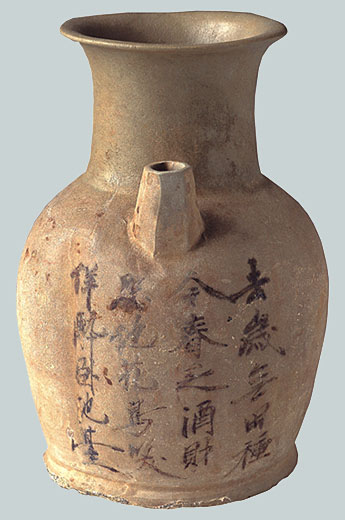
tang_pottery

First, Background, from Wikipedia, the source of many good things:

The Tang Dynasty (Chinese: 唐朝; pinyin: Táng Cháo; Middle Chinese: dhɑng)[1] (June 18, 618 – June 4, 907) was an imperial dynasty of China preceded by the Sui Dynasty and followed by the Five Dynasties and Ten Kingdoms Period. It was founded by the Li () family, who seized power during the decline and collapse of the Sui Empire. The dynasty was interrupted briefly by the Second Zhou Dynasty (October 16, 690 – March 3, 705) when Empress Wu Zetian seized the throne, becoming the first and only Chinese empress regnant, ruling in her own right.

The Tang Dynasty, with its capital at Chang’an (present-day Xi’an), the most populous city in the world at the time, is regarded by historians as a high point in Chinese civilization—equal to or surpassing that of the earlier Han Dynasty—as well as a golden age of cosmopolitan culture. Its territory, acquired through the military campaigns of its early rulers, was greater than that of the Han period, and rivaled that of the later Yuan Dynasty and Qing Dynasty. The enormous Grand Canal of China, built during the previous Sui Dynasty, facilitated the rise of new urban settlements along its route as well as increased trade between mainland Chinese markets. The canal is to this day the longest in the world. In two censuses of the 7th and 8th centuries, the Tang records stated that the population (by number of registered households) was about 50 million people.[2][3][4]a[›] However, even when the central government was breaking down and unable to compile an accurate census of the population in the 9th century, it is estimated that the population in that century had grown to the size of about 80 million people.[5][6] With its large population base, the dynasty was able to raise professional and conscripted armies of hundreds of thousands of troops to contend with nomadic powers in dominating Inner Asia and the lucrative trade routes along the Silk Road. Various kingdoms and states paid tribute to the Tang court, while the Tang also conquered or subdued several regions which it indirectly controlled through a protectorate system. Besides political hegemony, the Tang also exerted a powerful cultural influence over neighboring states such as those in Korea and Japan.

In Chinese history, the Tang Dynasty was largely a period of progress and stability, except during the An Shi Rebellion and the decline of central authority in the latter half of the dynasty. Like the previous Sui Dynasty, the Tang Dynasty maintained a civil service system by drafting officials through standardized examinations and recommendations to office. This civil order was undermined by the rise of regional military governors known as jiedushi during the 9th century. Chinese culture flourished and further matured during the Tang era; it is considered the greatest age for Chinese poetry.[7] Two of China’s most famous historical poets, Du Fu and Li Bai, belonged to this age, as well as the poets Meng Haoran, Du Mu, and Bai Juyi. Many famous visual artists lived during this era, such as the renowned painters Han Gan, Zhang Xuan, and Zhou Fang. There was a rich variety of historical literature compiled by scholars, as well as encyclopedias and books on geography. There were many notable innovations during the Tang, including the development of woodblock printing, the escapement mechanism in horology, the government compilations of materia medicas, improvements in cartography and the application of hydraulics to power air conditioning fans. The religious and philosophical ideology of Buddhism became a major aspect of Chinese culture, with native Chinese sects becoming the most prominent. However, Buddhism would eventually be persecuted by the state and would decline in influence. Although the dynasty and central government were in decline by the 9th century, art and culture continued to flourish. The weakened central government largely withdrew from managing the economy, but the country’s mercantile affairs stayed intact and commercial trade continued to thrive regardless.

The Tang period was a golden age of Chinese literature and art. There are over 48,900 poems penned by some 2,200 Tang authors that have survived until modern times.[183][184] Perfecting one’s skills in the composition of poetry became a required study for those wishing to pass imperial examinations,[185] while poetry was also heavily competitive; poetry contests amongst esteemed guests at banquets and courtiers of elite social gatherings was common in the Tang period.[186] Poetry styles that were popular in the Tang included gushi and jintishi, with the renowned Tang poet Li Bai (701–762) famous for the former style, and Tang poets like Wang Wei (701–761) and Cui Hao (704–754) famous for their use of the latter. Jintishi poetry, or regulated verse, is in the form of eight-line stanzas or seven characters per line with a fixed pattern of tones that required the second and third couplets to be antithetical (although the antithesis is often lost in translation to other languages).[187] Tang poems in particular remain the most popular out of every historical era of China. This great emulation of Tang era poetry began in the Song Dynasty period, as it was Yan Yu (active 1194–1245) who asserted that he was the first to designate the poetry of the High Tang (c. 713–766) era as the orthodox material with “canonical status within the classical poetic tradition.”[188] At the pinnacle of all the Tang poets, Yan Yu had reserved the position of highest esteem for that of Du Fu (712–770),[188] a man who would not be viewed as such in his own era of poetic competitors, and branded by his peers as an anti-traditional rebel.[189] Below is an example of Du Fu’s poetry, To My Retired Friend Wei (Chinese: 贈衛八處士). Like many other poems in the Tang it featured the theme of a long parting between friends, which was often due to officials being frequently transferred to the provinces:[183]

Written calligraphy of Emperor Taizong on a Tang stele

人生不相見, It is almost as hard for friends to meet

動如參與商。 As for the morning and evening stars.

今夕復何夕, Tonight then is a rare event,

共此燈燭光。 Joining, in the candlelight,

少壯能幾時, Two men who were young not long ago

鬢髮各已蒼。 But now are turning grey at the temples.

訪舊半為鬼, To find that half our friends are dead

驚呼熱中腸。 Shocks us, burns our hearts with grief.

焉知二十載, We little guessed it would be twenty years

重上君子堂。 Before I could visit you again.

昔別君未婚, When I went away, you were still unmarried;

兒女忽成行。 But now these boys and girls in a row

怡然敬父執, Are very kind to their father’s old friend.

問我來何方。 They ask me where I have been on my journey;

問答乃未已, And then, when we have talked awhile,

兒女羅酒漿。 They bring and show me wines and dishes,

夜雨翦春韭, Spring chives cut in the night-rain

新炊間黃粱。 And brown rice cooked freshly a special way.

主稱會面難, My host proclaims it a festival,

一舉累十觴。 He urges me to drink ten cups –

十觴亦不醉, But what ten cups could make me as drunk

感子故意長。 As I always am with your love in my heart?

明日隔山嶽, Tomorrow the mountains will separate us;

世事兩茫茫。 After tomorrow – who can say?

Du Fu[190]


Zhang Jiuling

THOUGHTS I


A lonely swan from the sea flies,
To alight on puddles it does not deign.
Nesting in the poplar of pearls
It spies and questions green birds twain:
“Don’t you fear the threat of slings,
Perched on top of branches so high?
Nice clothes invite pointing fingers,
High climbers god’s good will defy.
Bird-hunters will crave me in vain,
For I roam the limitless sky.”

Zhang Jiuling

ORCHID AND ORANGE I


Tender orchid-leaves in spring
And cinnamon- blossoms bright in autumn
Are as self- contained as life is,
Which conforms them to the seasons.
Yet why will you think that a forest-hermit,
Allured by sweet winds and contented with beauty,
Would no more ask to-be transplanted
THan Would any other natural flower?

6d0faa104647aa3e001b0f28d0019998

Zhang Jiuling

THOUGHTS III


The hermit in his lone abode
Nurses his thoughts cleansed of care,
Them he projects to the wild goose
For it to his distant Sovereign to bear.
Who will be moved by the sincerity
Of my vain day-and-night prayer?
What comfort is for my loyalty
When fliers and sinkers can compare?

Zhang Jiuling

ORCHID AND ORANGE II


Here, south of the Yangzi, grows a red orangetree.
All winter long its leaves are green,
Not because of a warmer soil,
But because its’ nature is used to the cold.
Though it might serve your honourable guests,
You leave it here, far below mountain and river.
Circumstance governs destiny.
Cause and effect are an infinite cycle.
You plant your peach-trees and your plums,
You forget the shade from this other tree.

tnc0011111fa1560626b184rz8

Li Bai

DOWN ZHONGNAN MOUNTAIN
TO THE KIND PILLOW AND BOWL OF HUSI


Down the blue mountain in the evening,
Moonlight was my homeward escort.
Looking back, I saw my path
Lie in levels of deep shadow….
I was passing the farm-house of a friend,
When his children called from a gate of thorn
And led me twining through jade bamboos
Where green vines caught and held my clothes.
And I was glad of a chance to rest
And glad of a chance to drink with my friend….
We sang to the tune of the wind in the pines;
And we finished our songs as the stars went down,
When, I being drunk and my friend more than happy,
Between us we forgot the world.

Li Bai

DRINKING ALONE WITH THE MOON


From a pot of wine among the flowers
I drank alone. There was no one with me —
Till, raising my cup, I asked the bright moon
To bring me my shadow and make us three.
Alas, the moon was unable to drink
And my shadow tagged me vacantly;
But still for a while I had these friends
To cheer me through the end of spring….
I sang. The moon encouraged me.
I danced. My shadow tumbled after.
As long as I knew, we were boon companions.
And then I was drunk, and we lost one another.
…Shall goodwill ever be secure?
I watch the long road of the River of Stars.


419850

Li Bai

IN SPRING


Your grasses up north are as blue as jade,
Our mulberries here curve green-threaded branches;
And at last you think of returning home,
Now when my heart is almost broken….
O breeze of the spring, since I dare not know you,
Why part the silk curtains by my bed?


Du Fu

A VIEW OF TAISHAN


What shall I say of the Great Peak? —
The ancient dukedoms are everywhere green,
Inspired and stirred by the breath of creation,
With the Twin Forces balancing day and night.
…I bare my breast toward opening clouds,
I strain my sight after birds flying home.
When shall I reach the top and hold
All mountains in a single glance?


10080w

Du Fu

TO MY RETIRED FRIEND WEI


It is almost as hard for friends to meet
As for the morning and evening stars.
Tonight then is a rare event,
Joining, in the candlelight,
Two men who were young not long ago
But now are turning grey at the temples.
…To find that half our friends are dead
Shocks us, burns our hearts with grief.
We little guessed it would be twenty years
Before I could visit you again.
When I went away, you were still unmarried;
But now these boys and girls in a row
Are very kind to their father’s old friend.
They ask me where I have been on my journey;
And then, when we have talked awhile,
They bring and show me wines and dishes,
Spring chives cut in the night-rain
And brown rice cooked freshly a special way.
…My host proclaims it a festival,
He urges me to drink ten cups —
But what ten cups could make me as drunk
As I always am with your love in my heart?
…Tomorrow the mountains will separate us;
After tomorrow-who can say?

Du Fu

ALONE IN HER BEAUTY


Who is lovelier than she?
Yet she lives alone in an empty valley.
She tells me she came from a good family
Which is humbled now into the dust.
…When trouble arose in the Kuan district,
Her brothers and close kin were killed.
What use were their high offices,
Not even shielding their own lives? —
The world has but scorn for adversity;
Hope goes out, like the light of a candle.
Her husband, with a vagrant heart,
Seeks a new face like a new piece of jade;
And when morning-glories furl at night
And mandarin-ducks lie side by side,
All he can see is the smile of the new love,
While the old love weeps unheard.
The brook was pure in its mountain source,
But away from the mountain its waters darken.
…Waiting for her maid to come from selling pearls
For straw to cover the roof again,
She picks a few flowers, no longer for her hair,
And lets pine-needles fall through her fingers,
And, forgetting her thin silk sleeve and the cold,
She leans in the sunset by a tall bamboo.

li_bai_du_fu_images_22

Du Fu

SEEING Li Bai IN A DREAM I


There are sobs when death is the cause of parting;
But life has its partings again and again.
…From the poisonous damps of the southern river
You had sent me not one sign from your exile —
Till you came to me last night in a dream,
Because I am always thinking of you.
I wondered if it were really you,
Venturing so long a journey.
You came to me through the green of a forest,
You disappeared by a shadowy fortress….
Yet out of the midmost mesh of your snare,
How could you lift your wings and use them?
…I woke, and the low moon’s glimmer on a rafter
Seemed to be your face, still floating in the air.
…There were waters to cross, they were wild and tossing;
If you fell, there were dragons and rivermonsters.

dufu

Du Fu

SEEING Li Bai IN A DREAM II


This cloud, that has drifted all day through the sky,
May, like a wanderer, never come back….
Three nights now I have dreamed of you —
As tender, intimate and real as though I were awake.
And then, abruptly rising to go,
You told me the perils of adventure
By river and lake-the storms, the wrecks,
The fears that are borne on a little boat;
And, here in my doorway, you rubbed your white head
As if there were something puzzling you.
…Our capital teems with officious people,
While you are alone and helpless and poor.
Who says that the heavenly net never fails?
It has brought you ill fortune, old as you are.
…A thousand years’ fame, ten thousand years’ fame-
What good, when you are dead and gone.


(This next poem, one of my favorites, I once spent a week in seclusion, writing it in the original form onto a delicate pressed leaf and gave it to a friend as a gift- he was leaving the state and I didn’t expect to see him again.)

Wang Wei

AT PARTING

247797071-395x400I dismount from my horse and I offer you wine,
And I ask you where you are going and why.
And you answer: “I am discontent
And would rest at the foot of the southern mountain.
So give me leave and ask me no questions.
White clouds pass there without end.”


Wang Wei

TO QIWU QIAN BOUND HOME
AFTER FAILING IN AN EXAMINATION


In a happy reign there should be no hermits;
The wise and able should consult together….
So you, a man of the eastern mountains,
Gave up your life of picking herbs
And came all the way to the Gate of Gold —
But you found your devotion unavailing.
…To spend the Day of No Fire on one of the southern rivers,
You have mended your spring clothes here in these northern cities.
I pour you the farewell wine as you set out from the capital —
Soon I shall be left behind here by my bosomfriend.
In your sail-boat of sweet cinnamon-wood
You will float again toward your own thatch door,
Led along by distant trees
To a sunset shining on a far-away town.
…What though your purpose happened to fail,
Doubt not that some of us can hear high music.


spring_villagesm_fsWang Wei

A GREEN STREAM


I have sailed the River of Yellow Flowers,
Borne by the channel of a green stream,
Rounding ten thousand turns through the mountains
On a journey of less than thirty miles….
Rapids hum over heaped rocks;
But where light grows dim in the thick pines,
The surface of an inlet sways with nut-horns
And weeds are lush along the banks.
…Down in my heart I have always been as pure
As this limpid water is….
Oh, to remain on a broad flat rock
And to cast a fishing-line forever!

Wang Wei

A FARM-HOUSE ON THE WEI RIVER


In the slant of the sun on the country-side,
Cattle and sheep trail home along the lane;
And a rugged old man in a thatch door
Leans on a staff and thinks of his son, the herdboy.
There are whirring pheasants? full wheat-ears,
Silk-worms asleep, pared mulberry-leaves.
And the farmers, returning with hoes on their shoulders,
Hail one another familiarly.
…No wonder I long for the simple life
And am sighing the old song, Oh, to go Back Again!

bamboo_grove_fsWang Wei

THE BEAUTIFUL XI SHI


Since beauty is honoured all over the Empire,
How could Xi Shi remain humbly at home? —
Washing clothes at dawn by a southern lake —
And that evening a great lady in a palace of the north:
Lowly one day, no different from the others,
The next day exalted, everyone praising her.
No more would her own hands powder her face
Or arrange on her shoulders a silken robe.
And the more the King loved her, the lovelier she looked,
Blinding him away from wisdom.
…Girls who had once washed silk beside her
Were kept at a distance from her chariot.
And none of the girls in her neighbours’ houses
By pursing their brows could copy her beauty.


Meng Haoran

ON CLIMBING ORCHID MOUNTAIN
IN THE AUTUMN TO ZHANG


On a northern peak among white clouds
You have found your hermitage of peace;
And now, as I climb this mountain to see you,
High with the wildgeese flies my heart.
The quiet dusk might seem a little sad
If this autumn weather were not so brisk and clear;
I look down at the river bank, with homeward-bound villagers
Resting on the sand till the ferry returns;
There are trees at the horizon like a row of grasses
And against the river’s rim an island like the moon
I hope that you will come and meet me, bringing a basket of wine —
And we’ll celebrate together the Mountain Holiday.

180px-meng_haoranMeng Haoran

IN SUMMER AT THE SOUTH PAVILION
THINKING OF XING

The mountain-light suddenly fails in the west,
In the east from the lake the slow moon rises.
I loosen my hair to enjoy the evening coolness
And open my window and lie down in peace.
The wind brings me odours of lotuses,
And bamboo-leaves drip with a music of dew….
I would take up my lute and I would play,
But, alas, who here would understand?
And so I think of you, old friend,
O troubler of my midnight dreams !

Meng Haoran

AT THE MOUNTAIN-LODGE

OF THE BUDDHIST PRIEST YE
WAITING IN VAIN FOR MY FRIEND DING


Now that the sun has set beyond the western range,
Valley after valley is shadowy and dim….
And now through pine-trees come the moon and the chill of evening,
And my ears feel pure with the sound of wind and water
Nearly all the woodsmen have reached home,
Birds have settled on their perches in the quiet mist….
And still — because you promised — I am waiting for you, waiting,
Playing lute under a wayside vine.

bz_0004

Wang Changling

WITH MY BROTHER AT THE SOUTH STUDY
THINKING IN THE MOONLIGHT OF VICE-PREFECT
CUI IN SHANYIN


Lying on a high seat in the south study,
We have lifted the curtain-and we see the rising moon
Brighten with pure light the water and the grove
And flow like a wave on our window and our door.
It will move through the cycle, full moon and then crescent again,
Calmly, beyond our wisdom, altering new to old.
…Our chosen one, our friend, is now by a limpid river —
Singing, perhaps, a plaintive eastern song.
He is far, far away from us, three hundred miles away.
And yet a breath of orchids comes along the wind.

That’s it for this installment. I will post the other 9 at a rate of at least 1 per month. Check in- I may be faster sometimes.

Happy 2009! May it not suck so very badly!

2008tc3train7_elhassan

New Year’s Gifts for You- Mississippi John Hurt

candy-man

coffee-blues

goodnight-irene

7 Comments

Filed under Chinese poetry, Free Music, mp3, Music, pictures, poetry

Three Books by Rabindranath Tagore

Tagore has had a profound influence on my life.

I have provided excerpts before from works by Tagore. Today I would like to offer these 3 complete books for you to download, free. These are all in the public domain since 1992. They are:

Gitanjali,

Stray Birds and

The Hungry Stones

If you are new to his work, you are in for a treat, also I am providing the following excerpts with the download for the entire book at the end of each section. I think you will want to read all of these, from the first word to the last.

(Note: I have already provided a download of the e-book Sadhana- The Realization of Life here. Also, I have included a free audio book of Sadhana at the end of this post.)

Gitanjali- Song Offerings

If thou speakest not I will fill my heart with thy silence and endure it. I will keep still and wait like the night with starry vigil and its head bent low with patience.

The morning will surely come, the darkness will vanish, and thy voice pour down in golden streams breaking through the sky.

Then thy words will take wing in songs from every one of my birds’ nests, and thy melodies will break forth in flowers in all my forest groves.

On the day when the lotus bloomed, alas, my mind was straying, and I knew it not. My basket was empty and the flower remained unheeded.

Only now and again a sadness fell upon me, and I started up from my dream and felt a sweet trace of a strange fragrance in the south wind.

That vague sweetness made my heart ache with longing and it seemed to me that is was the eager breath of the summer seeking for its completion.

I knew not then that it was so near, that it was mine, and that this perfect sweetness had blossomed in the depth of my own heart.

I must launch out my boat. The languid hours pass by on the shore—Alas for me!

The spring has done its flowering and taken leave. And now with the burden of faded futile flowers I wait and linger.

The waves have become clamorous, and upon the bank in the shady lane the yellow leaves flutter and fall.

What emptiness do you gaze upon! Do you not feel a thrill passing through the air with the notes of the far-away song floating from the other shore?

In the deep shadows of the rainy July, with secret steps, thou walkest, silent as night, eluding all watchers.

Today the morning has closed its eyes, heedless of the insistent calls of the loud east wind, and a thick veil has been drawn over the ever-wakeful blue sky.

The woodlands have hushed their songs, and doors are all shut at every house. Thou art the solitary wayfarer in this deserted street. Oh my only friend, my best beloved, the gates are open in my house—do not pass by like a dream.

Art thou abroad on this stormy night on thy journey of love, my friend? The sky groans like one in despair.

I have no sleep tonight. Ever and again I open my door and look out on the darkness, my friend!

I can see nothing before me. I wonder where lies thy path!

By what dim shore of the ink-black river, by what far edge of the frowning forest, through what mazy depth of gloom art thou threading thy course to come to me, my friend?

If the day is done, if birds sing no more, if the wind has flagged tired, then draw the veil of darkness thick upon me, even as thou hast wrapt the earth with the coverlet of sleep and tenderly closed the petals of the drooping lotus at dusk.

From the traveller, whose sack of provisions is empty before the voyage is ended, whose garment is torn and dustladen, whose strength is exhausted, remove shame and poverty, and renew his life like a flower under the cover of thy kindly night.

In the night of weariness let me give myself up to sleep without struggle, resting my trust upon thee.

Let me not force my flagging spirit into a poor preparation for thy worship.

It is thou who drawest the veil of night upon the tired eyes of the day to renew its sight in a fresher gladness of awakening.

He came and sat by my side but I woke not. What a cursed sleep it was, O miserable me!

He came when the night was still; he had his harp in his hands, and my dreams became resonant with its melodies.

Download:

gitanjali-by-rabindranath-tagore

The verses in Stray Birds are short but full. Each one is a meditation. Read them slowly, savor their images and find the meaning they call out from your own heart.

Stray Birds

THE mist, like love, plays upon the heart of the hills and brings out surprises of beauty.


75

WE read the world wrong and say that it deceives us.


76

THE poet wind is out over the sea and the forest to seek his own voice.


77

EVERY child comes with the message that God is not yet discouraged of man.


78

THE grass seeks her crowd in the earth.

The tree seeks his solitude of the sky.


79

MAN barricades against himself.


80

YOUR voice, my friend, wanders in my heart, like the muffled sound of the sea among these listening pines.


81

WHAT is this unseen flame of darkness whose sparks are the stars?


82

LET life be beautiful like summer flowers and death like autumn leaves.


88

HE who wants to do good knocks at the gate; he who loves finds the gate open.


84

IN death the many becomes one; in life the one becomes many.

Download:

stray-birds-by-rabindranath-tagore

The Hungry Stones and other stories

this story is titled

THE DEVOTEE

I

AT a time, when my unpopularity with a part of my readers had reached the nadir of its glory, and my name had become the central orb of the journals, to be attended through space with a perpetual rotation of revilement, I felt the necessity to retire to some quiet place and endeavour to forget my own existence.

I have a house in the country some miles away from Calcutta, where I can remain unknown and unmolested. The villagers there have not, as yet, come to any conclusion about me. They know I am no mere holiday-maker or pleasure-seeker; for I never outrage the silence of the village nights with the riotous noises of the city. Nor do they regard me as an ascetic, because the little acquaintance they have of me carries the savour of comfort about it. I am not, to them, a traveller; for, though I am a vagabond by nature, my wandering through the village fields is aimless. They are hardly even quite certain whether I am married or single; for they have never seen me with my children. So, not being able to classify me in any animal or vegetable kingdom that they know, they have long since given me up and left me stolidly alone.

But quite lately I have come to know that there is one person in the village who is deeply interested in me. Our acquaintance began on a sultry afternoon in July. There had been rain all the morning, and the air was still wet and heavy with mist, like eyelids when weeping is over.

I sat lazily watching a dappled cow grazing on the high bank of the river. The afternoon sun was playing on her glossy hide. The simple beauty of this dress of light made me wonder idly at man’s deliberate waste of money in setting up tailors’ shops to deprive his own skin of its natural clothing.

While I was thus watching and lazily musing, a woman of middle age came and prostrated herself before me, touching the ground with her forehead. She carried in her robe some bunches of flowers, one of which she offered to me with folded hands. She said to me, as she offered it: “This is an offering to my God.”

She went away. I was so taken aback as she uttered these words, that I could hardly catch a glimpse of her before she was gone. The whole incident was entirely simple, but it left a deep impression on my mind; and as I turned back once more to look at the cattle in the field, the zest of life in the cow, who was munching the lush grass with deep breaths, while she whisked off the flies, appeared to me fraught with mystery. My readers may laugh at my foolishness, but my heart was full of adoration. I offered my worship to the pure joy of living, which is God’s own life. Then, plucking a tender shoot from the mango tree, I fed the cow with it from my own hand, and as I did this I had the satisfaction of having pleased my God.

The next year when I returned to the village it was February. The cold season still lingered on. The morning sun came into my room, and I was grateful for its warmth. I was writing, when the servant came to tell me that a devotee, of the Vishnu cult, wanted to see me. I told him, in an absent way, to bring her upstairs, and went on with my writing. The Devotee came in, and bowed to me, touching my feet. I found that she was the same woman whom I had met, for a brief moment, a year ago.

I was able now to examine her more closely. She was past that age when one asks the question whether a woman is beautiful or not. Her stature was above the ordinary height, and she was strongly built; but her body was slightly bent owing to her constant attitude of veneration. Her manner had nothing shrinking about it. The most remarkable of her features were her two eyes. They seemed to have a penetrating power which could make distance near.

With those two large eyes of hers, she seemed to push me as she entered.

“What is this?” she asked. “Why have you brought me here before your throne, my God? I used to see you among the trees; and that was much better. That was the true place to meet you.”

She must have seen me walking in the garden without my seeing her. For the last few days, however, I had suffered from a cold, and had been prevented from going out. I had, perforce, to stay indoors and pay my homage to the evening sky from my terrace. After a silent pause the Devotee said to me: “O my God, give me some words of good.”

I was quite unprepared for this abrupt request, and answered her on the spur of the moment:

Good words I neither give nor receive. I simply open my eyes and keep silence, and then I can at once both hear and see, even when no sound is uttered. Now, while I am looking at you, it is as good as listening to your voice.

The Devotee became quite excited as I spoke, and exclaimed: “God speaks to me, not only with His mouth, but with His whole body.”

I said to her: “When I am silent I can listen with my whole body. I have come away from Calcutta here to listen to that sound.”

The Devotee said: “Yes, I know that, and therefore I have come here to sit by you.”

Before taking her leave, she again bowed to me, and touched my feet. I could see that she was distressed, because my feet were covered. She wished them to be bare.

Early next morning I came out, and sat on my terrace on the roof. Beyond the line of trees southward I could see the open country chill and desolate. I could watch the sun rising over the sugar-cane in the East, beyond the clump of trees at the side of the village. Out of the deep shadow of those dark trees the village road suddenly appeared. It stretched forward, winding its way to some distant villages on the horizon, till it was lost in the grey of the mist.

That morning it was difficult to say whether the sun had risen or not. A white fog was still clinging to the tops of the trees. I saw the Devotee walking through the blurred dawn, like a mist-wraith of the morning twilight. She was singing her chant to God, and sounding her cymbals.

The thick haze lifted at last; and the sun, like the kindly grandsire of the village, took his seat amid all the work that was going on in home and field.

When I had just settled down at my writing-table, to appease the hungry appetite of my editor in Calcutta, there came a sound of footsteps on the stair, and the Devotee, humming a tune to herself, entered. and bowed before me. I lifted my head from my papers.

She said to me: “My God, yesterday I took as sacred food what was left over from your meal.”

I was startled, and asked her how she could do that.

“Oh,” she said, “I waited at your door in the evening, while you were at dinner, and took some food from your plate when it was carried out.”

This was a surprise to me, for every one in the village knew that I had been to Europe, and had eaten with Europeans. I was a vegetarian, no doubt, but the sanctity of my cook would not bear investigation, and the orthodox regarded my food as polluted.

The Devotee, noticing my sign of surprise, said: “My God, why should I come to you at all, if I could not take your food?”

I asked her what her own caste people would say. She told me she had already spread the news far and wide all over the village. The caste people had shaken their heads, but agreed that she must go her own way.

I found out that the Devotee came from a good family in the country, and that her mother was well-to-do, and desired to keep her daughter. But she preferred to be a mendicant. I asked her how she made her living. She told me that her followers had given her a piece of land, and that she begged her food from door to door. She said to me: “The food which I get by begging is divine.”

After I had thought over what she said, I understood her meaning. When we get our food precariously as alms, we remember God the giver. But when we receive our food regularly at home, as a matter of course, we are apt to regard it as ours by right.

I had a great desire to ask her about her husband. But as she never mentioned him even indirectly, I did not question her.

I found out very soon that the Devotee had no respect at all for that part of the village where the people of the higher castes lived.

“They never give,” she said, “a single farthing to God’s service; and yet they have the largest share of God’s glebe. But the poor worship and starve.”

I asked her why she did not go and live among these godless people, and help them towards a better life. “That,” I said with some unction, “would be the highest form of divine worship.”

I had heard sermons of this kind from time to time, and I am rather fond of copying them myself for the public benefit, when the chance comes.

But the Devotee was not at all impressed. She raised her big round eyes, and looked straight into mine, and said:

“You mean to say that because God is with the sinners, therefore when you do them any service you do it to God? Is that so?”

“Yes,” I replied, “that is my meaning.”

“Of course,” she answered almost impatiently, “of course, God is with them: otherwise, how could they go on living at all? But what is that to me? My God is not there. My God cannot be worshipped among them; because I do not find Him there. I seek Him where I can find Him.”

As she spoke, she made obeisance to me. What she meant to say was really this. A mere doctrine of God’s omnipresence does not help us. That God is all-pervading,–this truth may be a mere intangible abstraction, and therefore unreal to ourselves. Where I can see Him, there is His reality in my soul.

I need not explain that all the while she showered her devotion on me she did it to me not as an individual. I was simply a vehicle of her divine worship. It was not for me either to receive it or to refuse it: for it was not mine, but God’s.

When the Devotee came again, she found me once more engaged with my books and papers.

“What have you been doing,” she said, with evident vexation, “that my God should make you undertake such drudgery? Whenever I come, I find you reading and writing.”

“God keeps his useless people busy,” I answered; “otherwise they would be bound to get into mischief. They have to do all the least necessary things in life. It keeps them out of trouble.”

The Devotee told me that she could not bear the encumbrances, with which, day by day, I was surrounded. If she wanted to see me, she was not allowed by the servants to come straight upstairs. If she wanted to touch my feet in worship, there were my socks always in the way. And when she wanted to have a simple talk with me, she found my mind lost in a wilderness of letters.

This time, before she left me, she folded her hands, and said: “My God! I felt your feet in my breast this morning. Oh, how cool! And they were bare, not covered. I held them upon my head for a long time in worship. That filled my very being. Then, after that, pray what was the use of my coming to you yourself? Why did I come? My Lord, tell me truly,–wasn’t it a mere infatuation?”

There were some flowers in my vase on the table. While she was there, the gardener brought some new flowers to put in their place. The Devotee saw him changing them.

“Is that all?” she exclaimed. “Have you done with the flowers? Then give them to me.”

She held the flowers tenderly in the cup of her hands, and began to gaze at them with bent head. After a few moments’ silence she raised her head again, and said to me: “You never look at these flowers; therefore they become stale to you. If you would only look into them, then your reading and writing would go to the winds.”

She tied the flowers together in the end of her robe, and placed them, in an attitude of worship, on the top of her head, saying reverently: “Let me carry my God with me.”

While she did this, I felt that flowers in our rooms do not receive their due meed of loving care at our hands. When we stick them in vases, they are more like a row of naughty schoolboys standing on a form to be punished.

The Devotee came again the same evening, and sat by my feet on the terrace of the roof.

“I gave away those flowers,” she said, “as I went from house to house this morning, singing God’s name. Beni, the head man of our village, laughed at me for my devotion, and said: ‘Why do you waste all this devotion on Him? Don’t you know He is reviled up and down the countryside?’ Is that true, my God? Is it true that they are hard upon you?”

For a moment I shrank into myself. It was a shock to find that the stains of printers’ ink could reach so far.

The Devotee went on: “Beni imagined that he could blow out the flame of my devotion at one breath! But this is no mere tiny flame: it is a burning fire. Why do they abuse you, my God?”

I said: “Because I deserved it. I suppose in my greed I was loitering about to steal people’s hearts in secret.”

The Devotee said: “Now you see for yourself how little their hearts are worth. They are full of poison, and this will cure you of your greed.”

“When a man,” I answered, “has greed in his heart, he is always on the verge of being beaten. The greed itself supplies his enemies with poison.”

“Our merciful God,” she replied, “beats us with His own hand, and drives away all the poison. He who endures God’s beating to the end is saved.”

II

That evening the Devotee told me the story of her life. The stars of evening rose and set behind the trees, as she went on to the end of her tale.

“My husband is very simple. Some people think that he is a simpleton; but I know that those who understand simply, understand truly. In business and household management he was able to hold his own. Because his needs were small, and his wants few, he could manage carefully on what we had. He would never meddle in other matters, nor try to understand them.

“Both my husband’s parents died before we had been married long, and we were left alone. But my husband always needed some one to be over him. I am ashamed to confess that he had a sort of reverence for me, and looked upon me as his superior. But I am sure that he could understand things better than I, though I had greater powers of talking.

“Of all the people in the world he held his Guru Thakur (spiritual master) in the highest veneration. Indeed it was not veneration merely but love; and such love as his is rare.

“Guru Thakur was younger than my husband. Oh! how beautiful he was!

“My husband had played games with him when he was a boy; and from that time forward he had dedicated his heart and soul to this friend of his early days. Thakur knew how simple my husband was, and used to tease him mercilessly.

“He and his comrades would play jokes upon him for their own amusement; but he would bear them all with long-suffering.

“When I married into this family, Guru Thakur was studying at Benares. My husband used to pay all his expenses. I was eighteen years old when he returned home to our village.

“At the age of fifteen I had my child. I was so young I did not know how to take care of him. I was fond of gossip, and liked to be with my village friends for hours together. I used to get quite cross with my boy when I was compelled to stay at home and nurse him. Alas! my child-God came into my life, but His playthings were not ready for Him. He came to the mother’s heart, but the mother’s heart lagged behind. He left me in anger; and ever since I have been searching for Him up and down the world.

“The boy was the joy of his father’s life. My careless neglect used to pain my husband. But his was a mute soul. He has never been able to give expression to his pain.

“The wonderful thing was this, that in spite of my neglect the child used to love me more than any one else. He seemed to have the dread that I would one day go away and leave him. So even when I was with him, he would watch me with a restless look in his eyes. He had me very little to himself, and therefore his desire to be with me was always painfully eager. When I went each day to the river, he used to fret and stretch out his little arms to be taken with me. But the bathing ghat was my place for meeting my friends, and I did not care to burden myself with the child.

“It was an early morning in August. Fold after fold of grey clouds had wrapped the mid-day round with a wet clinging robe. I asked the maid to take care of the boy, while I went down to the river. The child cried after me as I went away.

“There was no one there at the bathing ghat when I arrived. As a swimmer, I was the best among all the village women. The river was quite full with the rains. I swam out into the middle of the stream some distance from the shore.

“Then I heard a cry from the bank, ‘Mother!’ I turned my head and saw my boy coming down the steps, calling me as he came. I shouted to him to stop, but he went on, laughing and calling. My feet and hands became cramped with fear. I shut my eyes, afraid to see. When I opened them, there, at the slippery stairs, my boy’s ripple of laughter had disappeared for ever.

“I got back to the shore. I raised him from the water. I took him in my arms, my boy, my darling, who had begged so often in vain for me to take him. I took him now, but he no more looked in my eyes and called ‘Mother.’

“My child-God had come. I had ever neglected Him. I had ever made Him cry. And now all that neglect began to beat against my own heart, blow upon blow, blow upon blow. When my boy was with me, I had left him alone. I had refused to take him with me. And now, when he is dead, his memory clings to me and never leaves me.

“God alone knows all that my husband suffered. If he had only punished me for my sin, it would have been better for us both. But he knew only how to endure in silence, not how to speak.

“When I was almost mad with grief, Guru Thakur came back. In earlier days, the relation between him and my husband had been that of boyish friendship. Now, my husband’s reverence for his sanctity and learning was unbounded. He could hardly speak in his presence, his awe of him was so great.

“My husband asked his Guru to try to give me some consolation. Guru Thakur began to read and explain to me the scriptures. But I do not think they had much effect on my mind. All their value for me lay in the voice that uttered them. God makes the draught of divine life deepest in the heart for man to drink, through the human voice. He has no better vessel in His hand than that; and He Himself drinks His divine draught out of the same vessel.

“My husband’s love and veneration for his Guru filled our house, as incense fills a temple shrine. I showed that veneration, and had peace. I saw my God in the form of that Guru. He used to come to take his meal at our house every morning. The first thought that would come to my mind on waking from sleep was that of his food as a sacred gift from God. When I prepared the things for his meal, my fingers would sing for joy.

“When my husband saw my devotion to his Guru, his respect for me greatly increased. He noticed his Guru’s eager desire to explain the scriptures to me. He used to think that he could never expect to earn any regard from his Guru himself, on account of his stupidity; but his wife had made up for it.

“Thus another five years went by happily, and my whole life would have passed like that; but beneath the surface some stealing was going on somewhere in secret. I could not detect it; but it was detected by the God of my heart. Then came a day when, in a moment our whole life was turned upside down.

“It was a morning in midsummer. I was returning home from bathing, my clothes all wet, down a shady lane. At the bend of the road, under the mango tree, I met my Guru Thakur. He had his towel on his shoulder and was repeating some Sanskrit verses as he was going to take his bath. With my wet clothes clinging all about me I was ashamed to meet him. I tried to pass by quickly, and avoid being seen. He called me by my name.

“I stopped, lowering my eyes, shrinking into myself. He fixed his gaze upon me, and said: ‘How beautiful is your body!’

“All the universe of birds seemed to break into song in the branches overhead. All the bushes in the lane seemed ablaze with flowers. It was as though the earth and sky and everything had become a riot of intoxicating joy.

“I cannot tell how I got home. I only remember that I rushed into the room where we worship God. But the room seemed empty. Only before my eyes those same gold spangles of light were dancing which had quivered in front of me in that shady lane on my way back from the river.

“Guru Thakur came to take his food that day, and asked my husband where I had gone. He searched for me, but could not find me anywhere.

“Ah! I have not the same earth now any longer. The same sunlight is not mine. I called on my God in my dismay, and He kept His face turned away from me.

“The day passed, I know not how. That night I had to meet my husband. But the night is dark and silent. It is the time when my husband’s mind comes out shining, like stars at twilight. I had heard him speak things in the dark, and I had been surprised to find how deeply he understood.

“Sometimes I am late in the evening in going to rest on account of household work. My husband waits for me, seated on the floor, without going to bed. Our talk at such times had often begun with something about our Guru.

“That night, when it was past midnight, I came to my room, and found my husband sleeping on the floor. Without disturbing him I lay down on the ground at his feet, my head towards him. Once he stretched his feet, while sleeping, and struck me on the breast. That was his last bequest.

“Next morning, when my husband woke up from his sleep, I was already sitting by him. Outside the window, over the thick foliage of the jack-fruit tree, appeared the first pale red of the dawn at the fringe of the night. It was so early that the crows had not yet begun to call.

“I bowed, and touched my husband’s feet with my forehead. He sat up, starting as if waking from a dream, and looked at my face in amazement. I said:

“‘I have made up my mind. I must leave the world. I cannot belong to you any longer. I must leave your home.’

“Perhaps my husband thought that he was still dreaming. He said not a word.

‘Ah! do hear me!’ I pleaded with infinite pain. ‘Do hear me and understand! You must marry another wife. I must take my leave.’

“My husband said: ‘What is all this wild, mad talk? Who advises you to leave the world?’

“I said: ‘My Guru Thakur.’

“My husband looked bewildered. ‘Guru Thakur!’ he cried. ‘When did he give you this advice?’

“‘In the morning,’ I answered, ‘yesterday, when I met him on my way back from the river.’

His voice trembled a little. He turned, and looked in my face, and asked me: ‘Why did he give you such a behest?’

“‘I do not know,’ I answered. ‘Ask him! He will tell you himself, if he can.’

“My husband said: ‘It is possible to leave the world, even when continuing to live in it. You need not leave my home. I will speak to my Guru about it.’

‘Your Guru,’ I said, ‘may accept your petition; but my heart will never give its consent. I must leave your home. From henceforth, the world is no more to me.’

“My husband remained silent, and we sat there on the floor in the dark. When it was light, he said to me: ‘Let us both come to him.’

“I folded my hands and said: ‘I shall never meet him again.’

“He looked into my face. I lowered my eyes. He said no more. I knew that, somehow, he had seen into my mind, and understood what was there. In this world of mine, there were only two who loved me best–my boy and my husband. That love was my God, and therefore it could brook no falsehood. One of these two left me, and I left the other. Now I must have truth, and truth alone.”

She touched the ground at my feet, rose and bowed to me, and departed.

Download:

the-hungry-stones-and-other-stories-by-rabindranath-tagore

More Tagore pictures (click small pictures for full size) –

Two pictures of Tagore with Gandhi

Tagore- Gandhi

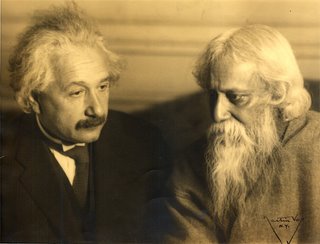
Two pictures of Tagore with Albert Einstein

A letter Tagore wrote from the Netherlands

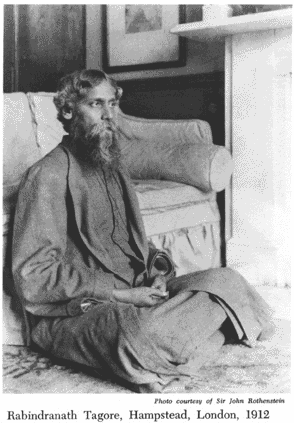
Tagore Portrait (click for full size)

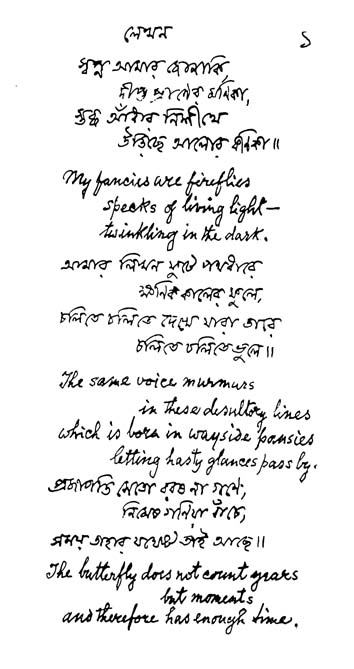
Hand written page from Gitanjali

Extra Special Treat!

For your listening pleasure- Free Download of the Audio-Book of

sadhana-the-realization-of-life


2 Comments

Filed under Free Audio Books, Free E-Books, mp3, Mystic Poetry, pictures, poetry, Spirituality

Centering (from Zen Flesh, Zen Bones/ Paul Reps)

I said I’d find it! I love this. It was my favorite part of the Paul Reps book, ZF,ZB. I started studying and practicing it when I was 9 years old. I had many wonderful experiences. Plus I became an even weirder kid than before.

(I did not find the section “10 Bulls”…maybe next time.)

here is the first part, followed by download for the whole thing.

(for the rest of this book see https://rickpdx.wordpress.com/2008/09/11/zen-flesh-zen-bones-101-zen-stories/)

Centering Practices:

112 ways to open the invisible door of consciousness.

Transcribed by Paul Reps.
From Zen Flesh, Zen Bones*


Zen is nothing new, neither is it anything old. Long before Buddha was born the search was on in India, as the present work shows.

Long after man has forgotten such words as Zen and Buddha, satori and koan, China and Japan and America – still the search will go on, still Zen will be seen even in flower, and grass-blade, before the sun.

The following is adapted from the preface to the first version in English of this ancient work.

Wandering in the ineffable beauty of Kashmir, above Srinagar I come upon the hermitage of Lakshmanjoo.

It overlooks green rice fields, the garden, of Shalimar and Nishat Bagh, lakes fringed with lotus. Water streams down from a mountaintop.

Here Lakshmanjoo – tall, full bodied, shining – welcomes me. He shares with me this ancient teaching from the Vigyan Bhairava and Sochanda Tantra, both written about four thousand years ago, and from Malini Vijaya Tantra, probably another thousand years older yet. It is an ancient teaching, copied and recopied countless times, and from it Lakshmanjoo has made the beginning of an English version. I transcribe it eleven more times to get it into the form given here.

Shiva first chanted it to his consort Devi in a language of love we have yet to learn. It is about the Immanent experience. It presents 112 ways to open the invisible door of consciousness. I see Lakshmanjoo gives his life to its practicing.

Some of the ways may appear redundant, yet each differs from any other. Some may seem simple, yet any one requires constant dedication even to test it.

Machines, ledgers, dancers, athletes balance. Just as centering or balance augments various skills, so it may awareness. As an experiment, try standing equally on both feet; then imagine you are shifting your balance slightly from foot to foot: just as balance centers, do you.

If we are conscious in part, this implies more inclusive consciousness. Have you a hand? Yes. That you know without doubt. But until asked the question were you cognizant of the hand apart?

Surely men as inspiritors, known and unknown to the world, have shared a common uncommon discovery. The Tao of Lao-tse, Nirvana of Buddha, Jehovah of Moses, the Father of Jesus, the Allah of Mohammed — all point to the experience.

No-thing-ness, spirit – once touched, the whole life clears.


DEVI SAYS:

O Shiva, what is your reality?
What is this wonder-filled universe?
What constitutes seed?
Who centers the universal wheel?
What is tbis life beyond form pervading forms?
How may we enter it fully, above space and
time, names and descriptions?
Let my doubts be cleared!

SHIVA REPLIES

[Devi, though already enlightened, has asked the foregoing questions so others through the universe might receive Shiva’s instructions. Now follow Shiva’s reply, giving the 112 ways.]

1. Radiant one, this experience may dawn between two breaths. After breath comes in (down) and just before turning up (out) — the beneficence.

2. As breath turns from down to up, and again as breath curves from up to down—through both these turns, realize.

3. Or, whenever inbreath and outbreath fuse, at this instant touch the energyless energy-filled center.

4. Or, when breath is all out (up) and stopped of itself, or all in (down) and stopped—in such universal pause, one’s small self vanishes. This is difficult only for the impure.

5. Consider your essence as light rays rising from center to center up the vertebrae, and so rises livingness in you.

6. Or in the spaces between, feel this as lightning.

7. Devi, imagine the Sanskrit letters in these honey-filled foci of awareness, first as letters, then more subtly as sounds, then as most subtle feeling. Then, leaving them aside, be free.

8. Attention between eyebrows, let mind be before thought. Let form fill with breath-essence to the top of the head, and there shower as light.

9. Or, imagine the five-colored circles of the peacock tail to be your five senses in illimitable space. Now let their beauty melt within. Similarly, at any point in space or on a wall — until the point dissolves. Then your wish for another comes true.

10. Eyes closed, see your inner being in detail. Thus see your true nature.

Here’s the download file:

centering-practices-paulreps

For the sake of dragging in a few more folks, here is some other stuff-

Poetry by Du Fu

a famous 4 part work with literal and literate translations.

Wikipedia has this to say in introduction to Du Fu:

This is a Chinese name; the family name is 杜 (Dù).
Du Fu (杜甫)

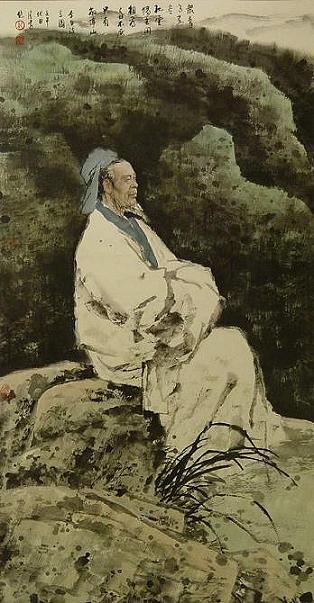
There are no contemporaneous portraits of Du Fu; this is a later artist’s impression
Born 712
Died 770
Occupation Poet

Du Fu (Chinese: 杜甫; pinyin: Dù Fǔ; Wade-Giles: Tu Fu, 712770) was a prominent Chinese poet of the Tang Dynasty. Along with Li Bai (Li Po), he is frequently called the greatest of the Chinese poets.[1] His own greatest ambition was to help his country by becoming a successful civil servant, but he proved unable to make the necessary accommodations. His life, like the whole country, was devastated by the An Lushan Rebellion of 755, and the last 15 years of his life were a time of almost constant unrest.

Initially little known, his works came to be hugely influential in both Chinese and Japanese culture. Of his poetic writing, nearly fifteen hundred poems written by Du Fu have been handed down over the ages. He has been called Poet-Historian and the Poet-Sage by Chinese critics, while the range of his work has allowed him to be introduced to Western readers as “the Chinese Virgil, Horace, Ovid, Shakespeare, Milton, Burns, Wordsworth, Béranger, Hugo or Baudelaire“.

In Abbot Zan’s Room at Dayun Temple: Four Poems (1)
Du Fu

Heart at water essence land
Clothes wet spring rain time
Penetrate gate utmost beyond step
Deep court really tranquil appointment
Reach door open again close
Hit bell vegetarian meal at here
Cream enhance develop nature
Diet give support decline
Hold arm be many days
Open heart without shame evasion
Golden oriole pass structure
Purple dove descend lattice screen
Humble think reach place suit
Flower beside go self slow
Tangxiu raise me sickness
Smile ask write poem
My heart is in a world of water and crystal,
My clothes are damp in this time of spring rains.
Through the gates I walk on to the end,
The inner court the appointed tranquil space.
I reach the doors- they open and shut again,
Now strikes the bell- the meal time has arrived.
This cream will help one’s nature strengthen and grow,
The diet gives support in my decline.
We’ve grasped each other’s arms so many days,
And opened our hearts without shame or evasion.
Golden orioles flit across the beams,
Purple doves descend from lattice screens.
Myself, I think I’ve found a place that suits,
I walk by flowers at my own slow pace.
Tangxiu lifts me from my sickly state,
And smiling, asks me to write a poem.

In Abbot Zan’s Room at Dayun Temple: Four Poems (2)

Thin soft green silk shoe
Shine bright white cotton scarf
Deep store for old elder
Fetch use for my body
Self look change without interest
Friendship how still new
Daolin talent not age
Huiyuan virtue surpass man
Rain pour dusk eaves bamboo
Wind blow green well celery
Heaven dark face picture
Most feel moist dragon scale
Fine green silk shoes,
Bright white cotton scarves,
Deep in storage for the elders,
Fetched to wear upon my body.
I see myself as old and dull,
How can our friendship stay so fresh?
Daolin’s talents exceed the age,
Huiyuan’s virtue’s superhuman.
Rain-drenched bamboo by the eaves at dusk;
Wind in green celery at the well;
The sky dark, I face a mural,
Most feeling the damp of the dragon’s scales.

In Abbot Zan’s Room at Dayun Temple: Four Poems (3)

Lamplight shine without sleep
Heart clear smell wonderful incense
Night deep hall sudden lofty
Wind move gold clank clank
Sky black obstruct spring court
Earth clear dwell secret fragrance
Jade rope revolve cut sever
Iron phoenix dark soar
Sanskrit release sometimes out temple
Bell remnant remain thunder bed
Tomorrow at fertile field
Bitter see dirt sand yellow
The lamplight shines on my sleeplessness,
My mind clear, I smell the splendid incense.
Deep in the night, the hall rears up high,
The wind stirs, and gold is heard to clank.
The black sky masks the springtime court,
To the pure earth clings a hidden fragrance.
The Jade Rope wheels round and is cut,
The iron phoenix seems about to soar.
Sanskrit sometimes flows out from the temple,
The lingering bells still thunder round my bed.
Tomorrow morning in the fertile field,
I’ll bitterly behold the yellow dirt.

In Abbot Zan’s Room at Dayun Temple: Four Poems (4)

Boy draw water well shining
Agile container rise hand
Wet sprinkle not soak earth
Sweep surpass like without broom
Bright rosy clouds shining again pavilion
Clear mist lift high window
Lean fill cover path flower
Sheet shake end steps willow
Difficulty world affair compel
Hide away right time after
Meet talk agree deep heart
How can all restrain mouth
Offer goodbye return cane riding crop
Temporary part end turn head
Vast expanse mud defile person
Listen country many dogs
Although not free yoke
Sometimes come rest rush about
Near you like white snow
Grasp hot upset how be
The boy draws shining water from the well,
He nimbly lifts the bucket to his hand.
He sprinkles water without soaking the earth,
And sweeps so well as if without a broom.
The rosy dawn again lights the pagoda,
The clearing mist lifts from the higher windows.
Leaning blossoms cover over the path,
Swaying willow leaves reach down to the steps.
I’m driven by these troublesome affairs,
Retirement from the world must be put off.
We’ve met and talked, our deepest hearts agreeing,
How can our mouths be forced completely shut?
I say goodbye and fetch my riding crop,
Parting for now, I turn my head at the last.
There’s so much mud that can defile a man,
Just listen to all the dogs throughout the land.
Although I cannot get free from this yoke,
I’ll sometimes come to rest from all the bustle.
Your presence, Abbot, acts just like white snow,
How can I be upset to grasp what’s hot?

Not enough? Wait! There’s more!

Silly pictures:

and this-

(click for full size)

or maybe…

Halloween costume for your baby:

Ah, but that’s not all! Newly recorded song I’ve posted before but hopefully this is better- it will also go on to the new music page (soon). The song- On the Wind, was conceived as God’s part of a dialogue with me regarding prayer/ meditation.

Lyrics? Chords?

Here-

On the Wind

D       Em—7   A
Reach up,       open your eyes,
Em–7                      A
feel the sky as a wheel that is turning
Em—-7               A                              Em—7                  A
Look out, see the world you have made before your eyes is burning
G                               D                            Em—7
Breathe it in slowly and breathe it out slowly again
D                              G                   A                   D
Sometimes all you can do is cast your heart upon the wind

You can cover your tracks as fine as you please
Throw out all of the things that remind you
Turn away from the heartache you fear; In the blink of an eye it will find you
Or unlock your door and just walk to the light streaming in
Release your song and let it dance upon the wind

***
G                    A                      D
You don’t even know who cares about you
G                           A                            D
The one who stands beside you night and day
G      A         D
It’s so easy to love you
G                       A                          D
and it’s so hard to watch you live this way

***

You can sit down by me; I have always been here
I have waited like the starry night
I know you aren’t ready to stay but I will hold you in the light
And I won’t hold you back, I know that’s just the place you are in
Before you go just button up your coat against the wind

The song download:

p-onthewind91208

That should cover most bases for today.

See you Sunday(or First Day, as the Friends say).

6 Comments

Filed under buddhism, Chinese poetry, comedy relief, Free Music, mp3, Music, Mystic Poetry, new music, pictures, poetry, silly, Spirituality

Classical Chinese Poetry, #1

Today is for Li Po-

I will bring in some of my other favorites later (Du Fu, Wang Wei etc.).

Taking Leave of a Friend

Blue mountains lie beyond the north wall;

Round the city’s eastern side flows the white water.

Here we part, friend, once and forever.

You go ten thousand miles, drifting away

Like an unrooted water-grass.

Oh, the floating clouds and the thoughts of a wanderer!

Oh, the sunset and the longing of an old friend!

We ride away from each other, waving our hands,

While our horses neigh softly, softly . . . .

To His Two Children

In the land of Wu the mulberry leaves are green,

And three times the silkworms have gone off to sleep.

In East Luh where my family stay,

I wonder who is sowing those fields of ours.

I cannot be back in time for the spring work,

I can help with nothing, traveling on the river.

The south wind blowing wafts my homesick spirit

And carries it up to the front of our familiar tavern.

There I see a peach tree on the east side of the house

With thick leaves and branches waving in the blue mist.

It is the tree I planted before my parting three years ago.

The peach tree has grown now as tall as the tavern roof,

While I have wandered about without returning.

Ping-yang, my pretty daughter, I see you stand

By the peach tree and pluck a flowering branch.

You pluck the flowers, but I am not there;

How your tears flow like a stream of water!

My little son, Po-chin, grown up to your sister’s shoulders,

You come out with her under the peach tree,

But who is there to pat you on the back?

When I think of these things, my senses fail,

And a sharp pain cuts my heart every day.

Now I tear off a piece of white silk to write this letter,

And send it to you with my love a long way up the river.

The Old Dust

The living is a passing traveler;

The dead, a man come home.

One brief journey between heaven and earth,

Then, alas! we are the same old dust of ten thousand ages.

The rabbit in the moon pounds the elixir in vain;

Fu-sang, the tree of immortality, has crumbled to kindling wood.

Man dies, his white bones are dumb without a word

While the green pines feel the coming of the spring.

Looking back, I sigh; looking before, I sigh again.

What is there to prize in the life’s vaporous glory?


Nefarious War

Last year we fought by the head-stream of the Sang-kan,

This year we are fighting on the Tsung-ho road.

We have washed our armor in the waves of Chiao-chi lake,

We have pastured our horses on Tien-shan’s snowy slopes.

The long, long war goes on ten thousand miles from home,

Our three armies are worn and grown old.

The barbarian does man-slaughter, not plowing;

On this yellow sand-plains nothing has been seen but

blanched skulls and bones.

Where the Chin emperor built the walls against the Tartars,

There the defenders of Han are burning beacon fires.

The beacon fires burn and never go out,

There is no end to war!—

In the battlefield men grapple each other and die;

The horses of the vanquished utter lamentable cries to heaven,

While ravens and kites peck at human entrails,

Carry them up in their flight, and hang them on the branches of dead trees.

So, men are scattered and smeared over the desert grass,

And the generals have accomplished nothing.

Oh, nefarious war! I see why arms

Were so seldom used by the benign sovereigns.

Drinking Alone with the Moon

From a pot of wine among the flowers
I drank alone.There was no one with me —
Till raising my cup, I ask the bright moon
To bring me my shadow and make us three.
Alas, the moon was unable to drink
And my shadow tagged me vacantly;
But still for a while I had these friends
To cheer me through the end of spring….
I sang. The moon encouraged me
I danced. My shadow tumbled after.
As long as I knew, we were born companions.
And then I was drunk, and we lost one another.
….Shall goodwill ever be secure?
I watch the long road of the River of Stars.


WATERFALL AT LU-SHAN

Sunlight streams on the river stones.
From high above, the river steadily plunges —

three thousand feet of sparkling water —
the Milky Way pouring down from heaven.

CLEARING AT DAWN

The fields are chill, the sparse rain has stopped;
The colours of Spring teem on every side.
With leaping fish the blue pond is full;
With singing thrushes the green boughs droop.
The flowers of the field have dabbled their powdered cheeks;
The mountain grasses are bent level at the waist.
By the bamboo stream the last fragment of cloud
Blown by the wind slowly scatters away.


SELF-ABANDONMENT

I sat srinking and did not notice the dusk,
Till falling petals filled the folds of my dress.
Drunken I rose and walked to the moonlit stream;
The birds were gone, and men also few.

TO TAN-CH’IU

My friend is lodging high in the Eastern Range,
Dearly loving the beauty of valleys and hills.
At green Spring he lies in the empty woods,
And is still asleep when the sun shines on igh.
A pine-tree wind dusts his sleeves and coat;
A peebly stream cleans his heart and ears.
I envy you, who far from strife and talk
Are high-propped on a pillow of blue cloud.

2 Comments

Filed under Chinese poetry, Mystic Poetry, pictures, poetry

Kabir, as translated by Rabindranath Tagore

Kabir: 1398-1518


Notes from other sources-

Kabir ranks among the world’s greatest poets. In India, he is perhaps the most quoted author, with the exception of Tulsidas. Kabir has criticized perhaps all existing sects in India, still he is mentioned with respect by even orthodox authors. Vaishnav author Nabhadas in his Bhakta-Mal (1585) writes:

hindU turuk pramAn ramainI sabadI sAkhI
pachchhapat nahiN bachan sabahiN ke hit kI bhAkhI

[His “ramaini” “shabda” “sakhi” (sections of his “Bijak”) are accepted by Hindus and Turks alike. He spoke without discrimination for the good of all]

He lived perhaps during 1398-1448. He is thought to have lived longer than 100 years. He had enormous influence on Indian philosophy and on Hindi poetry.

His birth and death are surrounded by legends. He grew up in a Muslim weaver family, but some say he was really son of a Brahmin widow who was adopted by a childless couple. When he died, his Hindu and Muslim followers started fighting about the last rites. The legend is that when they lifted the cloth covering his body, they found flowers instead. The Muslim followers buried their half and the Hindu cremated thier half. In Maghar, his tomb and samadhi still stand side by side.

Here I quote some of his verses from his “Bijak”, from the section called “sakhi”. My translation follows the Gurumukh TIkA by Puran Sahib done perhas a century ago. He was associated with the Kabirpanthi center at Burhanpur. Kabir’s writings can be hard to translate, not only because the language is old, but Kabir’s expressions are different from what we are used to seeing.

The verses below use the term “hira” (diamond). It should be noted that during the time of Kabir, diamonds were very rare. At that time, diamonds were found only in India and nowhere else.

Bijak/Sakhi 168:

hIrA soi srAhiye
sahai ghanan kI choT

kapaT kurangI mAnavA
parakhat nikrA khot

Admire the diamond that can bear the hits of a hammer. Many deceptive preachers, when critically examined, turn out to be false.

[Here diamond is siddhanta (the basic principles or doctrine).An experienced diamond cutter can hit the diamond using a chisel so that the chips will break off as expected. A diamond because if its crystalline structure tends to break off at specific angles. Similarly the true doctrine would come out shining when it is critically examined].

Bijak/Sakhi 170:

hIrA tahaN na kholiye
jahaN kunjroN kI hAT
sahajai gaNthI bANdhike
lagiye apni bAT

Don’t open your diamonds in a vegetable market. Tie them in bundle and keep them in your heart, and go your own way.

[Don’t discuss gyan (knowledge) with those who can not understand it].

Bijak/Sakhi 171:

hIrA parA bajAr maiN
rahA chhAr lapaTAy
ketihe murakh pachi mUye
koi pArakhi liyA uThAy

A diamond was laying in the street covered with dirt. Many fools passed by.

Someone who knew diamonds picked it up.

[Those who understand gyan-siddhanta (true knowledge/principles), pause to acquire it].


Do not go to the garden of flowers!
O friend! go not there;
In your body is the garden of flowers.
Take your seat on the thousand petals of the
lotus, and there gaze on the infinite beauty.

koi prem ki peng jhulaao re

Hang up the swing of love today!
Hang the body and the mind between the
arms of the beloved, in the ecstasy of love’s joy:
Bring the tearful streams of the rainy clouds
to your eyes, and cover your heart with
the shadow of darkness:
Bring your face nearer to his ear, and speak
of the deepest longings of your heart.

Kabir says: `Listen to me brother! bring the
vision of the Beloved in your heart.’

The following poems include some repeats from different translators:

Looking at the grinding stones,
Kabir laments
In the duel of wheels,
nothing stays intact.

Where do you search me?
I am with you
Not in pilgrimage, nor in icons
Neither in solitudes
Not in temples, nor in mosques
Neither in Kaba nor in Kailash
I am with you o man

I am with you
Not in prayers, nor in meditation
Neither in fasting
Not in yogic exercises
Neither in renunciation

Neither in the vital force nor in the body
Not even in the ethereal space
Neither in the womb of Nature
Not in the breath of the breath

Seek earnestly and discover
In but a moment of search
Says Kabir, Listen with care
Where your faith is, I am there.

O servant, where dost thou seek Me?

Lo!I am beside thee.

I am neither in temple nor in mosque:

I am neither in Kaaba nor in Kailash:

Neither am I in rites and ceremonies,

nor in Yoga and renunciation.

If thou art a true seeker, thou shalt at once see Me:

thou shalt meet Me in a moment of time.

Kabir says, “O Sadhu! God is the breath of all breath.”

*

It is needless to ask of a saint the caste to which he belongs;

For the priest, the warrior.the tradesman,

and all the thirty-six castes, alike are seeking for God.

It is but folly to ask what the caste of a saint may be;

The barber has sought God, the washerwoman, and the carpenter–

Even Raidas was a seeker after God.

The Rishi Swapacha was a tanner by caste.

Hindus and Moslems alike have achieved that End,

where remains no mark of distinction.

O friend!hope for Him whilst you live, know whilst you live,

understand whilst you live: for in life deliverance abides.

If your bonds be not broken whilst living, what hope of

deliverance in death?

It is but an empty dream, that the soul shall have union with Him

because it has passed from the body:

If He is found now, He is found then,

If not, we do but go to dwell in the City of Death.

If you have union now, you shall have it hereafter.

Bathe in the truth, know the true Guru, have faith in the trueName!

Kabir says: “It is the Spirit of the quest which helps;

I am the slave of this Spirit of the quest.”

Do not go to the garden of flowers!

O Friend! go not there;

In your body is the garden of flowers.

Take your seat on the thousand petals of the lotus,

and there gaze on the Infinite Beauty.

Tell me, Brother, how can I renounce Maya?

When I gave up the tying of ribbons, still I tied my garment about me:

When I gave up tying my garment, still I covered my body in its folds.

So, when I give up passion, I see that anger remains;

And when I renounce anger, greed is with me still;

And when greed is vanquished, pride and vainglory remain;

When the mind is detached and casts Maya away,

still it clings to the letter.

Kabir says, “Listen to me, dear Sadhu! the true path  is rarely found.”

The moon shines in my body, but my blind eyes cannot see it:

The moon is within me, and so is the sun.

The unstruck drum of Eternity is sounded within me;

but my deaf ears cannot hear it.

So long as man clamors for the [?] and the [?],

his works are as naught:

When all love of the [?] is dead, then

the work of the Lord is done.

For work has no other aim than the getting of knowledge:

When that comes, then work is put away.

The flower blooms for the fruit: when the fruit comes,

the flower withers.

The musk is in the deer, but it seeks it not within itself:

it wanders in quest of grass.

When He Himself reveals Himself,

Brahma brings into manifestation

That which can never be seen.

As the seed is in the plant, as the shade is in the tree,

as the void is in the sky, as infinite forms are in the void–

So from beyond the Infinite, the Infinite comes;

and from theInfinite the finite extends.

The creature is in Brahma, and Brahma is in the creature:

they are ever distinct, yet ever united.

He Himself is the tree, the seed, and the germ.

He Himself is the flower, the fruit, and the shade.
He Himself is the sun, the light, and the lighted.

He Himself is Brahma, creature, and Maya.

He Himself is the manifold form, the infinite space;

He is the breath, the word, and the meaning.

He Himself is the limit and the limitless:

and beyond both the limited and the limitless is He,

the Pure Being.

He is the Immanent Mind in Brahma and in the creature.

The Supreme Soul is seen within the soul,

The Point is seen within the Supreme Soul,

And within the Point, the reflection is seen again.

Kabir is blest because he has this supreme vision!

Within this earthen vessel are bowers and groves, and within it is the Creator: Within this vessel are the seven oceans and the unnumbered stars. The touchstone and the jewel-appraiser are within; And within this vessel the Eternal soundeth, and the spring wells up. Kabir says: “Listen to me, my Friend! My beloved Lord is within.” O How may I ever express that secret word? O how can I say He is not like this, and He is like that? If I say that He is within me, the universe is ashamed: If I say that He is without me, it is falsehood. He makes the inner and the outer worlds to be indivisibly one; The conscious and the unconscious, both are His footstools. He is neither manifest nor hidden, He is neither revealed nor unrevealed: There are no words to tell that which He is. To Thee Thou hast drawn my love, O Fakir! I was sleeping in my own chamber, and Thou didst awaken me; striking me with Thy voice, O Fakir! I was drowning in the deeps of the ocean of this world, and Thou didst save me: upholding me with Thine arm, O Fakir!Only one word and no second– and Thou hast made me tear off all my bonds, O Fakir! Kabir says, “Thou hast united Thy heart to my heart, O Fakir!”

I played day and night with my comrades, and now I am greatly afraid.

So high is my Lord’s palace, my heart trembles to mount its stairs: yet I must not be shy, if I would enjoy His love.

My heart must cleave to my Lover; I must withdraw my veil, and meet Him with all my body:

Mine eyes must perform the ceremony of the lamps of love.

Kabir says: “Listen to me, friend: he understands who loves.

If you feel not love’s longing for your Beloved One, it is vain to adorn your body,

vain to put unguent on your eyelids.”

Tell me, O Swan, your ancient tale.From what land do you come, O Swan?

to what shore will you fly?

Where would you take your rest, O Swan, and what do you seek?

Even this morning, O Swan, awake, arise, follow me!

There is a land where no doubt nor sorrow have rule: where the terror of Death is no more.

There the woods of spring are a-bloom, and the fragrant scent “He is I” is borne on the wind:

There the bee of the heart is deeply immersed, and desires no other joy.

O Lord Increate, who will serve Thee?

Every votary offers his worship to the God of his own creation: each day he receives service–

None seek Him, the Perfect: Brahma, the Indivisible Lord.

They believe in ten Avatars; but no Avatar can be the Infinite Spirit, for he suffers the results of his deeds:

The Supreme One must be other than this.

The Yogi, the Sanyasi, the Ascetics, are disputing one with another:

Kabir says, “O brother! he who has seen that radiance of love, he is saved.”

The river and its waves are onesurf: where is the difference between the river and its waves?

When the wave rises, it is the water; and when it falls, it is the same water again.

Tell me, Sir, where is the distinction?

Because it has been named as wave, shall it no longer be considered as water?

Within the Supreme Brahma, the worlds are being told like beads:

Look upon that rosary with the eyes of wisdom.

Where Spring, the lord of the seasons, reigneth, there the Unstruck Music sounds of itself,

There the streams of light flow in all directions;

Few are the men who can cross to that shore!

There, where millions of Krishnas stand with hands folded,

Where millions of Vishnus bow their heads,Where millions of Brahmas are reading the Vedas,

Where millions of Shivas are lost in contemplation,

Where millions of Indras dwell in the sky,

Where the demi-gods and the munis are unnumbered,

Where millions of Saraswatis, Goddess of Music, play on the vina–

There is my Lord self-revealed: and the scent of sandal and flowers dwells in those deeps.

Between the poles of the conscious and the unconscious, there has the mind made a swing:

Thereon hang all beings and all worlds, and that swing never ceases its sway.

Millions of beings are there: the sun and the moon in their courses are there:

Millions of ages pass, and the swing goes on.

All swing! the sky and the earth and the air and the water; and the Lord Himself taking form:

And the sight of this has made Kabir a servant.

The light of the sun, the moon, and the stars shines bright:

The melody of love swells forth, and the rhythm of love’s detachment beats the time.

Day and night, the chorus of music fills the heavens;

and Kabir says”My Beloved One gleams like the lightning flash in the sky.”

Do you know how the moments perform their adoration?

Waving its row of lamps, the universe sings in worship day and night,

There are the hidden banner and the secret canopy:

There the sound of the unseen bells is heard.

Kabir says: “There adoration never ceases; there the Lord of the Universe sitteth on His throne.”

The whole world does its works and commits its errors: but few are the lovers who know the Beloved.

The devout seeker is he who mingles in his heart the double currents of love and detachment,

like the mingling of the streams of Ganges and Jumna;In his heart the sacred water flows day and night;

and thus the round of births and deaths is brought to an end.

*

Behold what wonderful rest is in the Supreme Spirit!

and he enjoys it, who makes himself meet for it.

Held by the cords of love,

the swing of the Ocean of Joy sways to and fro;

and a mighty sound breaks forth in song.

See what a lotus blooms there without water!

and Kabir says “My heart’s bee drinks its nectar.”

What a wonderful lotus it is,

that blooms at the heart of the spinning wheel of the universe!

Only a few pure souls know of its true delight.

Music is all around it, and there the heart partakes of the joy

of the Infinite Sea.

Kabir says: “Dive thou into that Ocean of sweetness:

thus let all errors of life and of death flee away.”


Behold how the thirst of the five senses is quenched there!

and the three forms of misery are no more!

Kabir says: “It is the sport of the Unattainable One:

look within, and behold how the moon-beams

of that Hidden One shine in you.”

There falls the rhythmic beat of life and death:

Rapture wells forth, and all space is radiant with light.

There the Unstruck Music is sounded;

it is the music of the love of the three worlds.

There millions of lamps of sun and of moon are burning;

There the drum beats, and the lover swings in play.

There love-songs resound, and light rains in showers;

and the worshipper is entranced in the taste of the heavenly nectar.

Look upon life and death;

there is no separation between them,

The right hand and the left hand are one and the same.

Kabir says: “There the wise man is speechless;

for this truth may never be found in Vadas or in books.”

I have had my Seat on the Self-poised One,

I have drunk of the Cup of the Ineffable,

I have found the Key of the Mystery,

I have reached the Root of Union.

Travelling by no track,

I have come to the Sorrowless Land:

very easily has the mercy of the great Lord come upon me.

They have sung of Him as infinite and unattainable:

but I in my meditations have seen Him without sight.

That is indeed the sorrowless land,

and none know the path that leads there:

Only he who is on that path has surely transcended all sorrow.

Wonderful is that land of rest, to which no merit can win;

It is the wise who has seen it,

it is the wise who has sung of it.

This is the Ultimate Word:

but can any express its marvellous savour?

He who has savoured it once,

he knows what joy it can give.

Kabir says: “Knowing it, the ignorant man becomes wise,

and the wise man becomes speechless and silent,

The worshipper is utterly inebriated,

His wisdom and his detachment are made perfect;

He drinks from the cup of the inbreathings

and the outbreathings of love.”


There the whole sky is filled with sound,

and there that music is made without fingers and without strings;

There the game of pleasure and pain does not cease.

Kabir says: “If you merge your life in the Ocean of Life,

you will find your life in the Supreme Land of Bliss.”

What a frenzy of ecstasy there is in every hour! and the

worshipper is pressing out and drinking the essence of the

hours: he lives in the life of Brahma.

I speak truth, for I have accepted truth in life;

I am now attached to truth, I have swept all tinsel away.

Kabir says: “Thus is the worshipper set free from fear;

thus have all errors of life and of death left him.” There the sky is filled with music: There it rains nectar: There the harp-strings jingle, and there the drums beat. What a secret splendour is there, in the mansion of the sky! There no mention is made of the rising and the setting of the sun; In the ocean of manifestation, which is the light of love, day and night are felt to be one. Joy for ever, no sorrow,–no struggle! There have I seen joy filled to the brim, perfection of joy; No place for error is there. Kabir says: “There have I witnessed the sport of One Bliss!” I have known in my body the sport of the universe: I have escaped from the error of this world.. The inward and the outward are become as one sky, the Infinite and the finite are united: I am drunken with the sight of this All! This Light of Thine fulfils the universe: the lamp of love that burns on the salver of knowledge. Kabir says: “There error cannot enter, and the conflict of life and death is felt no more.” —

[?]= unable to transliterate Sanskrit or Arabic characters

Leave a comment

Filed under Mystic Poetry, poetry

Poetry Monday: Lao Tzu, Rumi, Tagore

Lao Tzu-

Labels

Labels
words, verbs and lines
serve to define
that which can be named
yet infinity cannot be charted
eternity cannot be corraled

uncircumferenced presence
centered everywhere, within without
cannot be defined
with the scribing of a line

bare of name
source of creation
bearing names
mothers gives birth

in the beginning one
from one to two
one becomes another
thus a mother

feeling separate
reaching outward
for union found within
reaching inward

union remains
movements still

freed of desire, fulfilled in Unity
filled with desire manifesting reality
form is defined
thought needs mind
letting go of thought
we move beyond space and time

no piece, know peace
these two are the same
through unfoldment
in appearance different

the secret Mystery
divergent unity
gateway doorway reality

***

Rumi:

    This World Which Is Made of Our Love for Emptiness

    Praise to the emptiness that blanks out existence. Existence:
    This place made from our love for that emptiness!

    Yet somehow comes emptiness,
    this existence goes.

    Praise to that happening, over and over!
    For years I pulled my own existence out of emptiness.

    Then one swoop, one swing of the arm,
    that work is over.

    Free of who I was, free of presence, free of dangerous fear, hope,
    free of mountainous wanting.

    The here-and-now mountain is a tiny piece of a piece of straw
    blown off into emptiness.

    These words I’m saying so much begin to lose meaning:
    Existence, emptiness, mountain, straw:

    Words and what they try to say swept
    out the window, down the slant of the roof.

    Un-named poem:

I died from minerality and became vegetable;

And From vegetativeness I died and became animal.

I died from animality and became man.

Then why fear disappearance through death?

Next time I shall die

Bringing forth wings and feathers like angels;

After that, soaring higher than angels –

What you cannot imagine,

I shall be that.

Ode 2180

From these depths depart towards heaven;
may your soul be happy, journey joyfully.
You have escaped from the city full of fear and trembling;
happily become a resident of the Abode of Security4 The Abode of Security seems to be an allusion to heaven which is sometimes called “the abode of peace” (dar-al salam) by Rumi as against “the abode of pride” (dar-al gorur) i.e., the world..
If the body’s image has gone, await the image-maker; if the
body is utterly ruined, become all soul.
If your face has become saffron pale through death, become a
dweller among tulip beds and Judas trees.
If the doors of repose have been barred to you, come, depart
by way of the roof and the ladder.
If you are alone from Friends and companions, by the help of
God become a saheb-qeran5 Saheb qeran is a person who is born under a happy conjunction of the planets. [lord of happy circumstance].
If you have been secluded from water and bread, like bread
become the food of the souls, and so become!

***

Tagore

Flower

Pluck this little flower and take it, delay not! I fear lest it

droop and drop into the dust.

I may not find a place in thy garland, but honour it with a touch of

pain from thy hand and pluck it. I fear lest the day end before I am

aware, and the time of offering go by.

Though its colour be not deep and its smell be faint, use this flower

in thy service and pluck it while there is time.

Fool

O Fool, try to carry thyself upon thy own shoulders!

O beggar, to come beg at thy own door!

Leave all thy burdens on his hands who can bear all,

and never look behind in regret.

Thy desire at once puts out the light from the lamp it touches with its breath.

It is unholy—take not thy gifts through its unclean hands.

Accept only what is offered by sacred love.

Leave This

Leave this chanting and singing and telling of beads!

Whom dost thou worship in this lonely dark corner of a temple with doors all shut?

Open thine eyes and see thy God is not before thee!

He is there where the tiller is tilling the hard ground

and where the pathmaker is breaking stones.

He is with them in sun and in shower,

and his garment is covered with dust.

Put off thy holy mantle and even like him come down on the dusty soil!

Deliverance?

Where is this deliverance to be found?

Our master himself has joyfully taken upon him the bonds of creation;

he is bound with us all for ever.

Come out of thy meditations and leave aside thy flowers and incense!

What harm is there if thy clothes become tattered and stained?

Meet him and stand by him in toil and in sweat of thy brow.

Journey Home

The time that my journey takes is long and the way of it long.

I came out on the chariot of the first gleam of light, and pursued my

voyage through the wildernesses of worlds leaving my track on many a star and planet.

It is the most distant course that comes nearest to thyself,

and that training is the most intricate which leads to the utter simplicity of a tune.

The traveler has to knock at every alien door to come to his own,

and one has to wander through all the outer worlds to reach the innermost shrine at the end.

My eyes strayed far and wide before I shut them and said `Here art thou!’

The question and the cry `Oh, where?’ melt into tears of a thousand

streams and deluge the world with the flood of the assurance `I am!’

Song Unsung

The song that I came to sing remains unsung to this day.

I have spent my days in stringing and in unstringing my instrument.

The time has not come true, the words have not been rightly set;

only there is the agony of wishing in my heart.

The blossom has not opened; only the wind is sighing by.

I have not seen his face, nor have I listened to his voice;

only I have heard his gentle footsteps from the road before my house.

The livelong day has passed in spreading his seat on the floor;

but the lamp has not been lit and I cannot ask him into my house.

I live in the hope of meeting with him; but this meeting is not yet.

    2 Comments

    Filed under poetry, Spirituality

    A song that I wrote about 10 years ago

    Recorded today:

    pilerrick-something_coming5

    Leave a comment

    Filed under Uncategorized

    Say I am you

    Rumi:

    I am dust particles in sunlight.
    I am the round sun.

    To the bits of dust I say, Stay.
    To the sun, Keep moving.

    I am morning mist,
    and the breathing of evening.
    I am wind in the top of a grove,
    and surf on the cliff.

    Mast, rudder, helmsman, and keel,
    I am also the coral reef they founder on.

    I am a tree with a trained parrot in its branches.
    Silence, thought, and voice.

    The musical air coming through a flute,
    a spark of stone, a flickering in metal.
    Both candle and the moth crazy around it.
    Rose, and the nightingale lost in the fragrance.

    I am all orders of being, the circling galaxy,
    the evolutionary intelligence, the lift, and the falling away.

    What is, and what isn’t.

    You who know, Jelaluddin,
    You the one in all, say who I am.
    Say I am you.

    Leave a comment

    Filed under Uncategorized

    Various news items

    First- (personal update):
    We are still unpacking but slowly finding a sense of place in our new townhome/ apartment. Several issues to deal with- mostly monetary (getting health care premiums paid, re-establishing household supplies, 2 broken vacuum cleaners…). We have a bed- donated by May T from Meeting. Food is being brought to us by strangers- nice strangers. Most animals are back- except the white cats are still at my sister’s house.

    From Common Dreams:

    Bush The Torturer, The Tyrant, The Disgrace

    by Pierre Tristam

    On Saturday, Mr. Bush vetoed a bill that would have outlawed the CIA’s use of torture in interrogations (a bill, it should be noted, John McCain, alleged opponent of torture, voted against). He had the temerity, our Dear Leader, to begin his official endorsement of torture in his radio address this morning with these words: “Good morning.” Good for him and his kind of delusional sadists, maybe. Not so good for this country, whose reputation today takes one more plunk toward the abyss of rogue and less than ordinary nations. Not so good for the rest of the world, either, whose nations have been disbelievingly howling, in Babels of translations, that most American of plaints: “Say it ain’t so.” This spring training for terrorist-interrogators (for torture is terrorism at its distilled worst), it very much is so. The United States is officially, proudly, the land of torturers. It’s true that the United States has been at this for years. But the difference here is not only that the president is endorsing torture, but that he’s doing it so openly and willfully. It isn’t arrogance anymore. It isn’t even hubris. Arrogance and hubris suggest that at least some awareness that public perceptions still matter. In Bush’s mind, perceptions are for the birds. This is pure tyranny. His statement embracing torture, a study in mendacity, is worth a line-by-line look.

    “This week,” he began, “I addressed the Department of Homeland Security on its fifth anniversary and thanked the men and women who work tirelessly to keep us safe.” Really? As of last May 1, Homeland Security, the Washington Post reported, “had 138 vacancies among its top 575 positions, with the greatest voids reported in its policy, legal and intelligence sections, as well as in immigration agencies, the Federal Emergency Management Agency and the Coast Guard.” It got so bad that a panicky report was sent to the House committee overseeing the department-the department led, as we unfortunately know, by the intrepidly dismal Michael Chertoff, who captained the agency through its finest hour: its spectatorship of Hurricane Katrina’s aftermath.

    “Because the danger remains,” Bush continued, “we need to ensure our intelligence officials have all the tools they need to stop the terrorists.” All the tools. Not the necessary tools, but all the tools. The most effective way not to worry about crossing the line into the dark side is not to have a line at all. For the Dear leader there is no question of nuance, of the difference between right and wrong. It is all right as long as he declares it so. By all means necessary (although I hate to soil Malcolm’s fine line, given its context, with the Dear Leader’s criminal intent). But by that reasoning, nuking Kandahar would be justified. Aren’t nuclear weapons also tools in the fight against “terrorism”? One day, the question may well be answered. Especially if the country insists on electing John McCain (and liberals who personally despise the black one or the bitch, as their prejudices couch them, insist on helping along the reactionaries).

    Where Bush Lies Like a Nixonian Sweat Bead

    “The bill Congress sent me would take away one of the most valuable tools in the war on terror — the CIA program to detain and question key terrorist leaders and operatives.” The bill, of course, does no such thing. It does not take away the CIA’s right to detain anyone. It does not take away the CIA’s right to question anyone. It only forbids the CIA to employ waterboarding and other forms of torture or degrading and dehumanizing treatment of inmates-inmates, we should always, always remember, who aren’t terrorists, but alleged terrorists. Until they are proven so, it is only their incarcerators who are the demonstrably proven terrorists.

    Bush then lists a series of supposed terrorist attacks the interrogations foiled. We have to trust him on that one, as several of them have never been mentioned before. Trusting Bush at this point, of course, is an exercise best left to the pathologically cretinous. One example from the plots Bush does mention-the supposed attack on the Library Tower in Los Angeles. It’s an old story, peddled by his administration since 2002. But when even the Voice of America, which is barely two radio waves removed from Radio White House, gives credence to doubts about the Dear Leader’s story, it’s time to give his fictions a chance to get sold as the latest memoir. “Micheal Scheuer, who was the leading al-Qaida expert in the CIA’s counter-terrorism center in 2002,” VOA reported in 2006, “says he is not aware of any such serious threat against the West Coast in 2002. As the man in the CIA who knew more about Osama bin Laden and al-Qaida than perhaps any other agency officer, he says it is unlikely that he would not have been kept informed on such a plot. “It could be that it was very closely held, but I think that’s unlikely,” he said. “It could be just a function of my failing memory. But this doesn’t sound like anything that I would recall as a major threat, or as a major success in stopping it.’”

    Brutality’s Euphemisms

    Bush in his radio address then moves on to euphemizing torture as “specialized interrogation procedures to question a small number of the most dangerous terrorists under careful supervision.” It’s a little disingenuous for the man who turned extraordinary renditions into a secret competitor of Disney’s Vacation Club, the man who replaced the Soviet Union’s gulags with a secret gulag of his own (using, cleverly, the Soviet Union’s old prisons in some cases, as in Poland and Romania), the man under whose careful supervision the likes of Khaled el Masri and Maher Arar were wrongly imprisoned, tortured in Afghanistan and Syria, and released without apologies long after the CIA knew they had the wrong men-it’s a little disingenuous for that man now to claim “careful supervision” in torture chambers.

    And to characterize torture as “these safe and lawful techniques.” Safe? When, by 2006, more than 100 individuals in American detention had been murdered by their captors? Lawful, when this very veto the Dear Leader is bandying about is an attempt to evade the law? But here’s his reasoning: limiting the CIA to interrogation techniques allowed only by the Army field manual would be wrong because the field manual deals with soldiers. The CIA deals with terrorists. Just as Bush on March 8 officially placed the United States as a champion of torture, Bush on this day also placed the United States as a champion of separating the race between legitimate human beings and sub-human creatures-”hardened terrorists.” The circular argument gives the appearance of perfect logic-if you’re willing to accept the notion that some human beings are not quite human beings. And isn’t that the notion once peddled in the United States about blacks-excuse me, about niggers? Isn’t that the notion peddled about Indians, at least while there were enough of them around that a distinction mattered? Isn’t that the kind of distinction some conservatives attempted to write into the Constitution with their prohibition of “oriental” immigrants at the turn of the last century?

    Some things don’t change. Once a bigoted nation, always a bigoted nation. But this goes beyond bigotry. Bush is projecting an interpretation of human beings that links up with the sort of distinctions Nazi and apartheid regimes were known for, when they, too, facilitated the torture and murder of “enemies” by dehumanizing them in the eyes of the public. This is no different. He may be speaking the language of Anglo-Saxon civilization. He may be doing so from the august rooms of the White House. What he’s saying makes him no different in these regards than the tyrants of the 20 th century. His rhetoric is another chain-link to his actions: he dehumanizes in words in order to dehumanize in deeds.

    Last month Michelle Obama was criticized for saying that finally, she can be proud of the United States, the implication being that she hadn’t been proud of it before Barack Obama’s hopeful run. She may want to rethink her newfound pride. There’s nothing to be proud of when the president reduces this country to rank criminality while calling it, of all things, a “higher responsibility” that is “keeping America safe.” No one should envy the next Americans to be taken prisoner by rogue nations and terrorists, now that we’re no better than either.

    Now for something completely different- Big Bang/ Universe Expansion diagram:

    resizenowmap.jpg

    Today’s Rumi:

    The way of love is not a subtle argument.

    The door there is devestation.

    Birds make great sky-circles of their freedom.

    How do they learn it?

    They fall, and falling

    they’re given wings.

    Check out

    Better Bees than Bears- my older son’s blog.

    http://secretvoln.blogspot.com/

    Silly animated gif:

    revolving.gif

    Leave a comment

    Filed under Uncategorized