Category Archives: Spirituality

What was I thinking?

stillness

12/09/08
Today on route to work (riding in the vanpool with seven other long-distance

commuters) I was listening on my mp3 player to a talk by the Dalai Lama on the

Heart Sutra. My mind wandered into some thoughts that arose during meeting for

worship at the Friends Meetinghouse on Sunday. These are some of the thoughts

that drifted through:


Stillness (or emptiness or balance) is the source of all things. Movement (or

content or imbalance) arises from stillness. The world of seperate things

arises from relative motion. Beauty, suffering and gladness are all produced by

the arising motion from the field of stillness.


The appearance of things is that the world is always in motion. Motion arises

from imbalance. For example: solar energy makes some parts of the atmosphere warmer,

creating an imbalance in pressure that creates wind, the engine of weather and

climate.


Using the same analogy (the living motion of the processes that support life on earth), water finds it’s level, seeks balance. Outside forces (e.g. the radiation produced by the sun or by the earth’s core) moves water from the bottom of the gravity well to the upper atmosphere where it eventually loses that energy, falling to the earth to make streams, waterfalls, rivers and springs on it’s journey back to the bottom of the gravity well. During this process water feeds and sustains life.


I have often thought about how it is imbalance/ imperfection that gives rise to

beauty. If things are in balance, there is no motion, no beauty and no

gladness. Through imbalance and the seeking of balance, come birth and death.

When the seeking ends, stillness reigns and emptiness replaces content. In

perfect balance motion does not arise and all things lose there seperateness.

blue_peace_sign 

Sometimes I feel like I’m in the middle of a stumble- like my imbalance is

propelling me forward into something unknown. I have the sensation of falling

into mystery. Sometimes it feels as though the world is a thin movie screen and

I am about to walk through it. It is as though balance, emptiness, stillness lies

just beyond the veil of appearances and any minute I will fall into it.

inner_peace_under_a_tree 

Sometimes when I close my eyes, I can feel the rush of time like a wind. I

sense that just behind that wind is timelessness, the flash of this moment in

perfect peace, the wholeness of myself and the world.

don__t_be_afraid_yellowman_by_voln

3 Comments

Filed under personal story, pictures, Spirituality

A Spiritual Canticle of the Soul

Just another book by St. John of the Cross.

stj23004

Excerpt:

XXVIII
My soul is occupied,

And all my substance in His service;

Now I guard no flock,

Nor have I any other employment: 
My sole occupation is love.

Download the e-book:
a-spiritual-canticle-of-the-soul

Leave a comment

Filed under Free E-Books, Mystic Poetry, poetry, Spirituality

The Gnostic Gospels

Jesus said, “I am the light that is over all things. I am all: from me all came forth, and to me all attained.
Split a piece of wood; I am there.
Lift up the stone, and you will find me there.”

-Gospel of Thomas

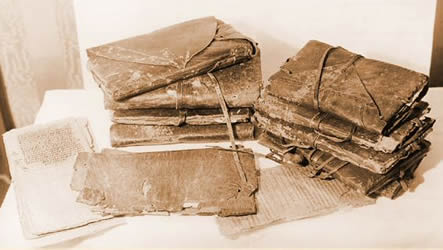
gospel-of-thomas

You can find all of this somewhere on the web- maybe not in the same place. The following document includes scriptures left out of the Christian Bible at the Council of Nicea. Multiple translations of the same text are presented here in order to see more clearly the intent of the writers.

gospelmary_2

This introduction is found at http://www.allaboutreligion.org/gnostic-gospels.htm

nag-hammadi

Some other links you may find useful for background and interpretation:

gnosticsoul

Some of the texts are incomplete. Some are repititious. Some appear contradictory or even just silly. All provide a fresh perspective on the early beliefs of the Jewish sect known as Christians.

To get the full text (507 pages- be warned):

the-gnostic-gospels-of-jesus

Interesting note: Gnostic art tends to look very much like Tibetan Mandala art-

Example A: Gnostic Tree of Life

cosmic_tree

Example B: Tibetan Wheel of Existence

tibetan_wheel_of_existence

Some Excerpts, particularly from the Gospel of Thomas:

The Thunder, Perfect Mind

Translated by George W. MacRae

I was sent forth from the power,
and I have come to those who reflect upon me,
and I have been found among those who seek after me.
Look upon me, you who reflect upon me,
and you hearers, hear me.
You who are waiting for me, take me to yourselves.
And do not banish me from your sight.
And do not make your voice hate me, nor your hearing.
Do not be ignorant of me anywhere or any time. Be on your guard!
Do not be ignorant of me.
For I am the first and the last.
I am the honored one and the scorned one.
I am the whore and the holy one.
I am the wife and the virgin.
I am <the mother> and the daughter.
I am the members of my mother.
I am the barren one
and many are her sons.
I am she whose wedding is great,
and I have not taken a husband.
I am the midwife and she who does not bear.
I am the solace of my labor pains.
I am the bride and the bridegroom,
and it is my husband who begot me.
I am the mother of my father
and the sister of my husband
and he is my offspring.
I am the slave of him who prepared me.
I am the ruler of my offspring.
But he is the one who begot me before the time on a birthday.
And he is my offspring in (due) time,
and my power is from him.
I am the staff of his power in his youth,
and he is the rod of my old age.
And whatever he wills happens to me.
I am the silence that is incomprehensible
and the idea whose remembrance is frequent.
I am the voice whose sound is manifold
and the word whose appearance is multiple.
I am the utterance of my name.
Why, you who hate me, do you love me,
and hate those who love me?
You who deny me, confess me,
and you who confess me, deny me.
You who tell the truth about me, lie about me,
and you who have lied about me, tell the truth about me.
You who know me, be ignorant of me,
and those who have not known me, let them know me.
For I am knowledge and ignorance.
I am shame and boldness.
I am shameless; I am ashamed.
I am strength and I am fear.
I am war and peace.
Give heed to me.
I am the one who is disgraced and the great one.
Give heed to my poverty and my wealth.
Do not be arrogant to me when I am cast out upon the earth,
and you will find me in those that are to come.
And do not look upon me on the dung-heap
nor go and leave me cast out,
and you will find me in the kingdoms.
And do not look upon me when I am cast out among those who
are disgraced and in the least places,
nor laugh at me.
And do not cast me out among those who are slain in violence.
But I, I am compassionate and I am cruel.
Be on your guard!
Do not hate my obedience
and do not love my self-control.
In my weakness, do not forsake me,
and do not be afraid of my power.
For why do you despise my fear
and curse my pride?
But I am she who exists in all fears
and strength in trembling.
I am she who is weak,
and I am well in a pleasant place.
I am senseless and I am wise.
Why have you hated me in your counsels?
For I shall be silent among those who are silent,
and I shall appear and speak,
Why then have you hated me, you Greeks?
Because I am a barbarian among the barbarians?
For I am the wisdom of the Greeks
and the knowledge of the barbarians.
I am the judgement of the Greeks and of the barbarians.
I am the one whose image is great in Egypt
and the one who has no image among the barbarians.
I am the one who has been hated everywhere
and who has been loved everywhere.
I am the one whom they call Life,
and you have called Death.
I am the one whom they call Law,
and you have called Lawlessness.
I am the one whom you have pursued,
and I am the one whom you have seized.
I am the one whom you have scattered,
and you have gathered me together.
I am the one before whom you have been ashamed,
and you have been shameless to me.
I am she who does not keep festival,
and I am she whose festivals are many.
I, I am godless,
and I am the one whose God is great.
I am the one whom you have reflected upon,
and you have scorned me.
I am unlearned,
and they learn from me.
I am the one that you have despised,
and you reflect upon me.
I am the one whom you have hidden from,
and you appear to me.
But whenever you hide yourselves,
I myself will appear.
For whenever you appear,
I myself will hide from you.
Those who have […] to it […] senselessly […].
Take me [… understanding] from grief.
and take me to yourselves from understanding and grief.
And take me to yourselves from places that are ugly and in ruin,
and rob from those which are good even though in ugliness.
Out of shame, take me to yourselves shamelessly;
and out of shamelessness and shame,
upbraid my members in yourselves.
And come forward to me, you who know me
and you who know my members,
and establish the great ones among the small first creatures.
Come forward to childhood,
and do not despise it because it is small and it is little.
And do not turn away greatnesses in some parts from the smallnesses,
for the smallnesses are known from the greatnesses.
Why do you curse me and honor me?
You have wounded and you have had mercy.
Do not separate me from the first ones whom you have known.
And do not cast anyone out nor turn anyone away

testing_thomas_2

The Gospel of Thomas:

Translated by Stephen Patterson and Marvin Meyer

These are the secret sayings that the living Jesus spoke and Didymos Judas Thomas recorded.
1. And he said, “Whoever discovers the interpretation of these sayings will not taste death.”
2. Jesus said, “Those who seek should not stop seeking until they find. When they find, they will be disturbed. When they are disturbed, they will marvel, and will reign over all. [And after they have reigned they will rest.]”
3. Jesus said, “If your leaders say to you, ‘Look, the (Father’s) kingdom is in the sky,’ then the birds of the sky will precede you. If they say to you, ‘It is in the sea,’ then the fish will precede you. Rather, the (Father’s) kingdom is within you and it is outside you.
When you know yourselves, then you will be known, and you will understand that you are children of the living Father. But if you do not know yourselves, then you live in poverty, and you are the poverty.”
4. Jesus said, “The person old in days won’t hesitate to ask a little child seven days old about the place of life, and that person will live.
For many of the first will be last, and will become a single one.”
5. Jesus said, “Know what is in front of your face, and what is hidden from you will be disclosed to you.
For there is nothing hidden that will not be revealed. [And there is nothing buried that will not be raised.]”
6. His disciples asked him and said to him, “Do you want us to fast? How should we pray? Should we give to charity? What diet should we observe?”
Jesus said, “Don’t lie, and don’t do what you hate, because all things are disclosed before heaven. After all, there is nothing hidden that will not be revealed, and there is nothing covered up that will remain undisclosed.”
7. Jesus said, “Lucky is the lion that the human will eat, so that the lion becomes human. And foul is the human that the lion will eat, and the lion still will become human.”
8. And he said, “The person is like a wise fisherman who cast his net into the sea and drew it up from the sea full of little fish. Among them the wise fisherman discovered a fine large fish. He threw all the little fish back into the sea, and easily chose the large fish. Anyone here with two good ears had better listen!”
9. Jesus said, “Look, the sower went out, took a handful (of seeds), and scattered (them). Some fell on the road, and the birds came and gathered them. Others fell on rock, and they didn’t take root in the soil and didn’t produce heads of grain. Others fell on thorns, and they choked the seeds and worms ate them. And others fell on good soil, and it produced a good crop: it yielded sixty per measure and one hundred twenty per measure.”
10. Jesus said, “I have cast fire upon the world, and look, I’m guarding it until it blazes.”
11. Jesus said, “This heaven will pass away, and the one above it will pass away.
The dead are not alive, and the living will not die. During the days when you ate what is dead, you made it come alive. When you are in the light, what will you do? On the day when you were one, you became two. But when you become two, what will you do?”
12. The disciples said to Jesus, “We know that you are going to leave us. Who will be our leader?”
Jesus said to them, “No matter where you are you are to go to James the Just, for whose sake heaven and earth came into being.”
13. Jesus said to his disciples, “Compare me to something and tell me what I am like.”
Simon Peter said to him, “You are like a just messenger.”
Matthew said to him, “You are like a wise philosopher.”
Thomas said to him, “Teacher, my mouth is utterly unable to say what you are like.”
Jesus said, “I am not your teacher. Because you have drunk, you have become intoxicated from the bubbling spring that I have tended.”
And he took him, and withdrew, and spoke three sayings to him. When Thomas came back to his friends they asked him, “What did Jesus say to you?”
Thomas said to them, “If I tell you one of the sayings he spoke to me, you will pick up rocks and stone me, and fire will come from the rocks and devour you.”
14. Jesus said to them, “If you fast, you will bring sin upon yourselves, and if you pray, you will be condemned, and if you give to charity, you will harm your spirits.
When you go into any region and walk about in the countryside, when people take you in, eat what they serve you and heal the sick among them.
After all, what goes into your mouth will not defile you; rather, it’s what comes out of your mouth that will defile you.”
15. Jesus said, “When you see one who was not born of woman, fall on your faces and worship. That one is your Father.”
16. Jesus said, “Perhaps people think that I have come to cast peace upon the world. They do not know that I have come to cast conflicts upon the earth: fire, sword, war.
For there will be five in a house: there’ll be three against two and two against three, father against son and son against father, and they will stand alone.”
17. Jesus said, “I will give you what no eye has seen, what no ear has heard, what no hand has touched, what has not arisen in the human heart.”
18. The disciples said to Jesus, “Tell us, how will our end come?”
Jesus said, “Have you found the beginning, then, that you are looking for the end? You see, the end will be where the beginning is.
Congratulations to the one who stands at the beginning: that one will know the end and will not taste death.”
19. Jesus said, “Congratulations to the one who came into being before coming into being.
If you become my disciples and pay attention to my sayings, these stones will serve you.
For there are five trees in Paradise for you; they do not change, summer or winter, and their leaves do not fall. Whoever knows them will not taste death.”
20. The disciples said to Jesus, “Tell us what Heaven’s kingdom is like.”
He said to them, “It’s like a mustard seed, the smallest of all seeds, but when it falls on prepared soil, it produces a large plant and becomes a shelter for birds of the sky.”
21. Mary said to Jesus, “What are your disciples like?”
He said, “They are like little children living in a field that is not theirs. When the owners of the field come, they will say, ‘Give us back our field.’ They take off their clothes in front of them in order to give it back to them, and they return their field to them.
For this reason I say, if the owners of a house know that a thief is coming, they will be on guard before the thief arrives and will not let the thief break into their house (their domain) and steal their possessions.
As for you, then, be on guard against the world. Prepare yourselves with great strength, so the robbers can’t find a way to get to you, for the trouble you expect will come.
Let there be among you a person who understands.
When the crop ripened, he came quickly carrying a sickle and harvested it. Anyone here with two good ears had better listen!”
22. Jesus saw some babies nursing. He said to his disciples, “These nursing babies are like those who enter the (Father’s) kingdom.”
They said to him, “Then shall we enter the (Father’s) kingdom as babies?”
Jesus said to them, “When you make the two into one, and when you make the inner like the outer and the outer like the inner, and the upper like the lower, and when you make male and female into a single one, so that the male will not be male nor the female be female, when you make eyes in place of an eye, a hand in place of a hand, a foot in place of a foot, an image in place of an image, then you will enter [the kingdom].”
23. Jesus said, “I shall choose you, one from a thousand and two from ten thousand, and they will stand as a single one.”
24. His disciples said, “Show us the place where you are, for we must seek it.”
He said to them, “Anyone here with two ears had better listen! There is light within a person of light, and it shines on the whole world. If it does not shine, it is dark.”
25. Jesus said, “Love your friends like your own soul, protect them like the pupil of your eye.”
26. Jesus said, “You see the sliver in your friend’s eye, but you don’t see the timber in your own eye. When you take the timber out of your own eye, then you will see well enough to remove the sliver from your friend’s eye.”
27. “If you do not fast from the world, you will not find the (Father’s) kingdom. If you do not observe the sabbath as a sabbath you will not see the Father.”
28. Jesus said, “I took my stand in the midst of the world, and in flesh I appeared to them. I found them all drunk, and I did not find any of them thirsty. My soul ached for the children of humanity, because they are blind in their hearts and do not see, for they came into the world empty, and they also seek to depart from the world empty.
But meanwhile they are drunk. When they shake off their wine, then they will change their ways.”
29. Jesus said, “If the flesh came into being because of spirit, that is a marvel, but if spirit came into being because of the body, that is a marvel of marvels.
Yet I marvel at how this great wealth has come to dwell in this poverty.”
30. Jesus said, “Where there are three deities, they are divine. Where there are two or one, I am with that one.”
31. Jesus said, “No prophet is welcome on his home turf; doctors don’t cure those who know them.”
32. Jesus said, “A city built on a high hill and fortified cannot fall, nor can it be hidden.”
33. Jesus said, “What you will hear in your ear, in the other ear proclaim from your rooftops.
After all, no one lights a lamp and puts it under a basket, nor does one put it in a hidden place. Rather, one puts it on a lampstand so that all who come and go will see its light.”
34. Jesus said, “If a blind person leads a blind person, both of them will fall into a hole.”
35. Jesus said, “One can’t enter a strong person’s house and take it by force without tying his hands. Then one can loot his house.”
36. Jesus said, “Do not fret, from morning to evening and from evening to morning, [about your food–what you’re going to eat, or about your clothing–] what you are going to wear. [You’re much better than the lilies, which neither card nor spin.
As for you, when you have no garment, what will you put on? Who might add to your stature? That very one will give you your garment.]”
37. His disciples said, “When will you appear to us, and when will we see you?”
Jesus said, “When you strip without being ashamed, and you take your clothes and put them under your feet like little children and trample then, then [you] will see the son of the living one and you will not be afraid.”
38. Jesus said, “Often you have desired to hear these sayings that I am speaking to you, and you have no one else from whom to hear them. There will be days when you will seek me and you will not find me.”
39. Jesus said, “The Pharisees and the scholars have taken the keys of knowledge and have hidden them. They have not entered nor have they allowed those who want to enter to do so.
As for you, be as sly as snakes and as simple as doves.”
40. Jesus said, “A grapevine has been planted apart from the Father. Since it is not strong, it will be pulled up by its root and will perish.”
41. Jesus said, “Whoever has something in hand will be given more, and whoever has nothing will be deprived of even the little they have.”
42. Jesus said, “Be passersby.”
43. His disciples said to him, “Who are you to say these things to us?”
“You don’t understand who I am from what I say to you.
Rather, you have become like the Judeans, for they love the tree but hate its fruit, or they love the fruit but hate the tree.”
44. Jesus said, “Whoever blasphemes against the Father will be forgiven, and whoever blasphemes against the son will be forgiven, but whoever blasphemes against the holy spirit will not be forgiven, either on earth or in heaven.”
45. Jesus said, “Grapes are not harvested from thorn trees, nor are figs gathered from thistles, for they yield no fruit.
Good persons produce good from what they’ve stored up; bad persons produce evil from the wickedness they’ve stored up in their hearts, and say evil things. For from the overflow of the heart they produce evil.”
46. Jesus said, “From Adam to John the Baptist, among those born of women, no one is so much greater than John the Baptist that his eyes should not be averted.
But I have said that whoever among you becomes a child will recognize the (Father’s) kingdom and will become greater than John.”
47. Jesus said, “A person cannot mount two horses or bend two bows.
And a slave cannot serve two masters, otherwise that slave will honor the one and offend the other.
Nobody drinks aged wine and immediately wants to drink young wine. Young wine is not poured into old wineskins, or they might break, and aged wine is not poured into a new wineskin, or it might spoil.
An old patch is not sewn onto a new garment, since it would create a tear.”
48. Jesus said, “If two make peace with each other in a single house, they will say to the mountain, ‘Move from here!’ and it will move.”
49. Jesus said, “Congratulations to those who are alone and chosen, for you will find the kingdom. For you have come from it, and you will return there again.”
50. Jesus said, “If they say to you, ‘Where have you come from?’ say to them, ‘We have come from the light, from the place where the light came into being by itself, established [itself], and appeared in their image.’
If they say to you, ‘Is it you?’ say, ‘We are its children, and we are the chosen of the living Father.’
If they ask you, ‘What is the evidence of your Father in you?’ say to them, ‘It is motion and rest.'”
51. His disciples said to him, “When will the rest for the dead take place, and when will the new world come?”
He said to them, “What you are looking forward to has come, but you don’t know it.”
52. His disciples said to him, “Twenty-four prophets have spoken in Israel, and they all spoke of you.”
He said to them, “You have disregarded the living one who is in your presence, and have spoken of the dead.”
53. His disciples said to him, “Is circumcision useful or not?”
He said to them, “If it were useful, their father would produce children already circumcised from their mother. Rather, the true circumcision in spirit has become profitable in every respect.”
54. Jesus said, “Congratulations to the poor, for to you belongs Heaven’s kingdom.”
55. Jesus said, “Whoever does not hate father and mother cannot be my disciple, and whoever does not hate brothers and sisters, and carry the cross as I do, will not be worthy of me.”
56. Jesus said, “Whoever has come to know the world has discovered a carcass, and whoever has discovered a carcass, of that person the world is not worthy.”
57 Jesus said, “The Father’s kingdom is like a person who has [good] seed. His enemy came during the night and sowed weeds among the good seed. The person did not let the workers pull up the weeds, but said to them, ‘No, otherwise you might go to pull up the weeds and pull up the wheat along with them.’ For on the day of the harvest the weeds will be conspicuous, and will be pulled up and burned.”
58. Jesus said, “Congratulations to the person who has toiled and has found life.”
59. Jesus said, “Look to the living one as long as you live, otherwise you might die and then try to see the living one, and you will be unable to see.”
60. He saw a Samaritan carrying a lamb and going to Judea. He said to his disciples, “that person … around the lamb.” They said to him, “So that he may kill it and eat it.” He said to them, “He will not eat it while it is alive, but only after he has killed it and it has become a carcass.”
They said, “Otherwise he can’t do it.”
He said to them, “So also with you, seek for yourselves a place for rest, or you might become a carcass and be eaten.”
61. Jesus said, “Two will recline on a couch; one will die, one will live.”
Salome said, “Who are you mister? You have climbed onto my couch and eaten from my table as if you are from someone.”
Jesus said to her, “I am the one who comes from what is whole. I was granted from the things of my Father.”
“I am your disciple.”
“For this reason I say, if one is whole, one will be filled with light, but if one is divided, one will be filled with darkness.”
62. Jesus said, “I disclose my mysteries to those [who are worthy] of [my] mysteries.
63. Jesus said, “There was a rich person who had a great deal of money. He said, ‘I shall invest my money so that I may sow, reap, plant, and fill my storehouses with produce, that I may lack nothing.’ These were the things he was thinking in his heart, but that very night he died. Anyone here with two ears had better listen!”
64. Jesus said, “A person was receiving guests. When he had prepared the dinner, he sent his slave to invite the guests.
The slave went to the first and said to that one, ‘My master invites you.’ That one said, ‘Some merchants owe me money; they are coming to me tonight. I have to go and give them instructions. Please excuse me from dinner.’
The slave went to another and said to that one, ‘My master has invited you.’ That one said to the slave, ‘I have bought a house, and I have been called away for a day. I shall have no time.’
The slave went to another and said to that one, ‘My master invites you.’ That one said to the slave, ‘My friend is to be married, and I am to arrange the banquet. I shall not be able to come. Please excuse me from dinner.’
The slave went to another and said to that one, ‘My master invites you.’ That one said to the slave, ‘I have bought an estate, and I am going to collect the rent. I shall not be able to come. Please excuse me.’
The slave returned and said to his master, ‘Those whom you invited to dinner have asked to be excused.’ The master said to his slave, ‘Go out on the streets and bring back whomever you find to have dinner.’
Buyers and merchants [will] not enter the places of my Father.”
65. He said, “A […] person owned a vineyard and rented it to some farmers, so they could work it and he could collect its crop from them. He sent his slave so the farmers would give him the vineyard’s crop. They grabbed him, beat him, and almost killed him, and the slave returned and told his master. His master said, ‘Perhaps he didn’t know them.’ He sent another slave, and the farmers beat that one as well. Then the master sent his son and said, ‘Perhaps they’ll show my son some respect.’ Because the farmers knew that he was the heir to the vineyard, they grabbed him and killed him. Anyone here with two ears had better listen!”
66. Jesus said, “Show me the stone that the builders rejected: that is the keystone.”
67. Jesus said, “Those who know all, but are lacking in themselves, are utterly lacking.”
68. Jesus said, “Congratulations to you when you are hated and persecuted; and no place will be found, wherever you have been persecuted.”
69. Jesus said, “Congratulations to those who have been persecuted in their hearts: they are the ones who have truly come to know the Father.
Congratulations to those who go hungry, so the stomach of the one in want may be filled.”
70. Jesus said, “If you bring forth what is within you, what you have will save you. If you do not have that within you, what you do not have within you [will] kill you.”
71. Jesus said, “I will destroy [this] house, and no one will be able to build it […].”
72. A [person said] to him, “Tell my brothers to divide my father’s possessions with me.”
He said to the person, “Mister, who made me a divider?”
He turned to his disciples and said to them, “I’m not a divider, am I?”
73. Jesus said, “The crop is huge but the workers are few, so beg the harvest boss to dispatch workers to the fields.”
74. He said, “Lord, there are many around the drinking trough, but there is nothing in the well.”
75. Jesus said, “There are many standing at the door, but those who are alone will enter the bridal suite.”
76. Jesus said, “The Father’s kingdom is like a merchant who had a supply of merchandise and found a pearl. That merchant was prudent; he sold the merchandise and bought the single pearl for himself.
So also with you, seek his treasure that is unfailing, that is enduring, where no moth comes to eat and no worm destroys.”
77. Jesus said, “I am the light that is over all things. I am all: from me all came forth, and to me all attained.
Split a piece of wood; I am there.
Lift up the stone, and you will find me there.”

emblem

1 Comment

Filed under Free E-Books, Mystic Poetry, pictures, poetry, Spirituality

Moon-Day Soup

Buddhist Video

The Wandering Mind – Andrea Fella Audio Dharma ; Insight Meditation Center ; Andrea Fella

go here.

PORTS

This from Mike’s blog, New Directions:

Peer Operated Recovery Treatment and Support (PORTS)

A Mental Health Recovery Model

Developed by Michael Hlebechuk

PORTS is a mental health self-directed care model that combines mental health brokerage services with a peer counseling/advocacy education program and a couple of evidence based practices that actually work. There are no outcome studies to demonstrate the efficacy of PORTS. It has never been implemented. I drafted it up in response to a question for a job interview. I firmly believe, however, that if implemented this model would help people along the road to recovery in ways we haven’t seen yet through a formal program. The 2 page draft that outlines PORTS is located at:

http://www.oregon.gov/DHS/mentalhealth/consumers-families/ports.pdf

Here is an excerpt from the first page of the pdf linked above:

Recovery has become a major buzzword in the mental health community. Mental health systems are
beginning to focus seriously on assisting people with psychiatric disability to recover and move on
with their lives.i Scientific research has yielded practices that have an evidence base to support their
effectiveness in helping people recover from mental illness. People with psychiatric histories have
provided valuable input into system design, pointing to new treatment methods and principles that
foster their gaining productive roles in the community and having meaning restored to their lives.
SAMHSA’s Center for Mental Health Services has investigated treatment modalities that put
control into the hands of people receiving treatment. Self-directed care, person centered planning,
and consumer operated services along with evidence based practices have become the cornerstones
to achieving the promise of transforming mental health care in America in ways that promote the
dignity, respect, and recovery of the individual. The paragraphs that follow offer an example of how
various recovery-oriented treatment approaches can operate in concert to promote people moving
on with their lives.
The Peer Operated Recovery Treatment and Support (PORTS) Project lies at the core of the
proposed treatment delivery system. PORTS is a consumer-operated service program (COSP) that
provides treatment coordination and resource brokerage services. Individual customers who have
agreed to engage in a recovery plan that includes the goal of obtaining paid or voluntary
employment are referred to PORTS by the behavioral health organization. Customers are linked
with a Peer Advocate Mentor (PAM) and a Recovery Specialist. The PAM is supervised by the
PAM Project, a third party COSP. The PAM will work with the customer to develop recovery
strategies and ensure that services are provided in a dignified and respectful manner. The Recovery
Specialist is a PORTS employee who will coordinate the customer’s mental health and resource
brokerage services.
Customers will receive a PORTS orientation within a week of being referred. During orientation
customers will hear recovery stories from individuals with similar diagnoses who have taken firm
steps to move on with their lives. They will gain hope in learning that people can and do recover
from mental illness. Customers will also learn about PORTS’ mission, self-directed care, selfdetermination
and recovery principles during this first week.
All PORTS services are delivered through a person centered planning process. Through this process
the customer develops a person centered plan with the assistance of a PORTS Recovery Specialist,
the PAM, and any individuals the customer invites to be members of the circle of support. Circles of
support are generally composed of the family members, friends, and professionals the customer
believes are most supportive. The resulting person centered plan is more than a treatment plan. It is
a life-plan; complete with the individual’s dreams and goals and steps to make them a reality. These
steps are detailed in Action Plans.
Each PORTS customer will be allotted an individual resource budget of $2,000 for the first year of
service. Through this budget customers may purchase services and supports within the community
or from a participating mental health provider to carry out an Action Plan. Take, for example, an
Action Plan with the stated goal of obtaining employment. A step toward this goal may be the
purchase of a set of clothes to wear at job interviews. The Action Plan would detail the budgeted
amount for each of these purchases. Core mental health services such as symptom monitoring,
medication management, addictions counseling, acute care and crisis services are provided by the
behavioral healthcare organization per the person centered plan and are not purchased through the
individual resource budget. Fifty percent of the funds that remain in the individual resource budget
after an annual cycle of service are carried over into next year’s budget. An additional $500 is
added to the second and subsequent year’s budgets. All brokered community services and supports
purchased through individual resource budgets must be approved by the Recovery Specialist. All
purchases over $100 must be approved by a representative of the behavioral health organization.

So, PORTS seems to be an approach to implementing person directed, brokerage style services and supports in mental health. Sounds good!

To: Members of the Oregon Consumer/Survivor Council and Interested
Parties
From: Michael Hlebechuk, Chair
Re: Meeting announcement

The next meeting of the Oregon Consumer/Survivor Council will be held
on Wednesday, October 8, from 1:00 to 4:00 PM in meeting room HSB-352
located on the 3rd floor of the Barbara Roberts Human Services
Building (DHS main office), 500 Summer St NE, Salem, OR.

Minutes of the previous meeting: csc-minutes-081308

Why has the font on my blog gotten so tiny??

From MindFreedom News:

Our soldiers deserve better than a bag of pills

With suicide rates higher than they’ve ever been, the stress of combat and long deployments, the US Military should be doing everything it can to address the mental health needs of its soldiers.

Instead, soldiers in crisis are currently being offered little more than pills.

They deserve better.

They deserve alternatives to the one-size-fits-all, pharmaceutical approach to mental health.

On October 5, 2008 MindFreedom International will delivered signatures to the campaign headquarters of both Barack Obama and John McCain.

From Beyond Meds, a recovery oriented blog found here. For the whole post, go to the source.

When I was at my acupuncturists the other day I basically collapsed on the table after pounding on her office door when I couldn’t tolerate sitting in the office. I REALLY needed to lay down. I can sit in recliner type chairs but an upright chair I can last in only so long and I had reached my limit at the health food store where I had lunch before I went to accupuncture.

I learned that it was the acupuncture that made my endometriosis pain almost non-existent. It is, after all, the reason I went to the acupuncturist in the first place but I didn’t expect such rapid results. Almost totally pain free after two treatments.  She told me that pain is usually the easiest symptom to treat and the rest of my hormonal issues and my basic poor health would probably take much longer to deal with.

Her diagnosis of my situation in the Chinese way of interpreting things is that my liver is in serious shape. Since Chinese medicine deals with the whole being I’m really being treated for everything my body is suffering from even though I presented saying I needed help balancing my hormones.

In any case, I collapsed on her table after being out for an hour—I was sick of staying in bed and so my husband took me to lunch. But that hour was really too much and as I collapsed on her table I burst into tears.

It ended up being like a therapy session. I told her I was dealing with so much anger. And rage. My circumstances so damn frustrating. Doctor after doctor mishandling me. Making me sicker. My rage is targeted mostly at my sister who doesn’t give a shit that I’m sick and at my last doctor who seems to have no interest in admitting any fault and is therefore just as bad as any drug pushing doctor. It’s also targeted at people in the recovery movement who think that their road to recovery is the only road to recovery and they seem to dare to think that if I only followed their way I would be well by now. One thing I’ve learned on this journey is that there are as many roads to recovery as there are people. My recovery stories page on this blog gives a glimpse of this—-all different methods of recovery…I borrow from many of their journeys, but ultimately I trust my gut. And so should anyone else struggling to recover…There is nothing tried and true for every person who has been labeled. No one thing. Perhaps the only necessary ingredient is believing that one can get better and all of these people have that and I do too, in spades.

In any case I have rage. It’s probably primal rage and it’s just glomming on to whoever is an attractive target right now.

How do I clear it out? How do I forgive my sister and my doctor? How do I embrace the giant egos of some of my recovered friends when they seem to condescend on my journey? (please don’t everyone assume I’m thinking of YOU…it’s just a couple of people really)

One thing is clear. I have no mental illness, but I’m very very physically sick. The drugs made me sick. The withdrawal made me sick. My prescribing psychiatrist who is watching me go through this process agrees. My husband who knows me intimately agrees. No mental illness…nope, just sickness caused by drugs and drug withdrawal.

Mad Liberation by Moonlight

The full moon is on October 14th this time. This would make the radio show happen on Friday night, 10/17/08. I have to clear this with Dan but so far, that’s the plan.

Mad Liberation

by Moonlight

Friday! On KBOO Radio 90.7 FM

1- 2 a.m. Late Friday night

(yes, I know that it is technically Saturday morning- relax, it’s just a radio show)

October 17th, 2008

This show is dedicated to Everyone

*who has ever been given a psychiatric label, *who experiences mental health challenges and of course to *anybody who has the misfortune (or good fortune) of being awake at that hour.

You can participate!

Call in at (503) 231-8187

We also hope to have some live in-studio musical

performance by CS/X performers on this show.

(Set your alarm if you aren’t usually up at that time)

Friday nights from 1 am to 2 am usually following the full-moon, will be a segment on KBOO radio (90.7 on your fm dial, to the left of NPR), also streamed on the internet on their website, http://www.kboo.fm/index.php will be time for Mad Lib by Moonlight. The program is part of the usual Friday night show, The Outside World.

Excerpt From: The Rape of the Mind

Source material- go to

http://www.ninehundred.net/control/

The Psychology of Thought Control, Menticide, and Brainwashing

by

Joost A. M. Meerloo, M.D

NOTE: This work has been long out of print, last known publication date 1956, the World Publishing Company. Of course, the technology has advanced and the techniques have been refined, but the principles remain the same.

from the Forward:

“And fear not them which kill the body, but are not able to kill the soul.” -Matthew 10:28

This book attempts to depict the strange transformation of the free human mind into an automatically responding machine a transformation which can be bought about by some of the cultural undercurrents in our present day society as well as by deliberate experiments in the service of a political ideology.

The rape of the mind and stealthy mental coercion are among the oldest crimes of mankind. They probably began back in pre historic days wheh man first discovered that he could exploit human qualities of empathy and understanding in order to exert power over his fellow men. The word “rape” is derived from the Latin word _rapere_, to snatch, but also is related to the words to rave and raven. It means to overwhelm and to enrapture, to invade, to usurp, to pillage and to steal.

The modern words “brainwashing,” “thought control,” and “menticide” serve to provide a clearer conception of the actual methods by which man’s integrity can be violated. When a concept is given its right name, it can be more easily recognized and it is with this recognition that the opportunity for systematic correction begins.

In this book the reader will find a discussion of some of the imminent dangers which threaten free cultural interplay. It emphasizes the tremendous cultural implication of the subject of enforced mental intrusion. Not only the artificial techniques of coercion are important but even more the unobtrusive intrusion into our feeling and thinking. The danger of destruction of the spirit may be compared to the threat of total physical destruction through atomic warfare. Indeed, the two are related and intertwined…..

from the first chapter:

The first part of this book is devoted to various techniques used to make man a meek conformist. In addition to actual political occurrences, attention is called to some ideas born in the laboratory and to the drug techniques that facilitate brainwashing. The last chapter deals with the subtle psychological mechanisms of mental submission.

CHAPTER ONE — YOU TOO WOULD CONFESS

A fantastic thing is happening in our world. Today a man is no longer punished only for the crimes he has in fact committed. Now he may be compelled to confess to crimes that have been conjured up by his judges, who use his confession for political purposes. It is not enough for us to damn as evil those who sit in judgment. We must understand what impels the false admission of guilt; we must take another look at the human mind in all its frailty and vulnerability.

The Enforced Confession

During the Korean War, an officer of the United States Marine Corps, Colonel Frank H. Schwable, was taken prisoner by the Chinese Communists. After months of intense psychological pressure and physical degradation, he signed a well documented “confession” that the United States was carrying on bacteriological warfare against the enemy. The confession named names, cited missions, described meetings and strategy conferences. This was a tremendously valuable propaganda tool for the totalitarians. They cabled the news all over the world: “The United States of America is fighting the peace loving people of China by dropping bombs loaded with disease spreading bacteria, in violation of international law.”

After his repatriation, Colonel Schwable issued a sworn statement repudiating his confession, and describing his long months of imprisonment. Later, he was brought before a military court of inquiry. He testified in his own defense before that court: “I was never convinced in my own mind that we in the First Marine Air Wing had used bug warfare. I knew we hadn’t, but the rest of it was real to me the conferences, the planes, and how they would go about their missions.”

“The words were mine,” the Colonel continued, “but the thoughts were theirs. That is the hardest thing I have to explain: how a man can sit down and write something he knows is false, and yet, to sense it, to feel it, to make it seem real.”

This is the way Dr. Charles W. Mayo, a leading American physician and government representative, explained brainwashig in an official statement before the United Nations: “…the tortures used…although they include many brutal physical injuries, are not like the medieval torture of the rack and the thumb screw. They are subtler, more prolonged, and intended to be more terrible in their effect. They are calculated to disintegrate the mind of an intelligent victim, to distort his sense of values, to a point where he will not simply cry out ‘I did it!’ but will become a seemingly willing accomplice to the complete disintegration of his integrity and the production of an elaborate fiction.”

The Schwable case is but one example of a defenseless prisoner being compelled to tell a big lie. If we are to survive as free men, we must face up to this problem of politically inspired mental coercion, with all its ramifications.

It is more than twenty years [in 1956] since psychologists first began to suspect that the human mind can easily fall prey to dictatorial powers. In 1933, the German Reichstag building was burned to the ground. The Nazis arrested a Dutchman, Marinus Van der Lubbe, and accused him of the crime. Van der Lubbe was known by Dutch psychiatrists to be mentally unstable. He had been a patient in a mental institution in Holland. And his weakness and lack of mental balance became apparent to the world when he appeared before the court. Wherever news of the trial reached, men wondered: “Can that foolish little fellow be a heroic revolutionary, a man who is willing to sacrifice his life to an ideal?”

During the court sessions Van der Lubbe was evasive, dull, and apathetic. Yet the reports of the Dutch psychiatrists described him as a gay, alert, unstable character, a man whose moods changed rapidly, who liked to vagabond around, and who had all kinds of fantasies about changing the world.

On the forty second day of the trial, Van der Lubbe’s behavior changed dramatically. His apathy disappeared. It became apparent that he had been quite aware of everything that had gone on during the previous sessions. He criticized the slow course of the procedure. He demanded punishment either by imprisonment or death. He spoke about his “inner voices.” He insisted that he had his moods in check. Then he fell back into apathy. We now recognize these symptoms as a combination of behavior forms which we can call a confession syndrome. In 1933 this type of behavior was unknown to psychiatrists. Unfortunately, it is very familiar today and is frequently met in cases of extreme mental coercion.

Van der Lubbe was subsequently convicted and executed. When the trial was over, the world began to realize that he had merely been a scapegoat. The Nazis themselves had burned down the Reichstag building and had staged the crime and the trial so that they could take over Germany. Still later we realized that Van der Lubbe was the victim of a diabolically clever misuse of medical knowledge and psychologic technique, through which he had been transformed into a useful, passive, meek automaton, who replied merely yes or no to his interrogators during most of the court sessions. In a few moments he threatened to jump out of his enforced role. Even at that time there were rumors that the man had been drugged into submission, though we never became sure of that.

[NOTE: The psychiatric report about the case of Van der Lubbe is published by Bonhoeffer and Zutt. Though they were unfamiliar with the “menticide syndrome,” and not briefed by their political fuehrers, they give a good description about the pathologic, apathetic behavior, and his tremendous change of moods. They deny the use of drugs.]

This is powerful reading- I encourage you to take a closer look. The book has ramifications that are very timely both in terms of geo-politics and psychiatric politics.

From my favorite mental health blogger, Ron Unger-

(his blog, Recovery from Schizofrenia-http://recoveryfromschizophrenia.org/blog/)

Guidelines for changing the mental health system

Posted by Ron Unger on October 5th, 2008

Here in Lane County Oregon, USA, a group known as the Consumer Council, working closely with MindFreedom, has been pushing to put in place official guidelines which would hopefully change the behavior of mental health professionals. Two of the important things we are asking them to do is to quit misleading and disempowering people into believing that genetic and biological explanations of “mental illness” are fact, and to let people know they may eventually be able to live successfully without medication and that help is available to them in making that transition.

So far we have gotten the local mental health system to move forward with some vague and poorly explained guidelines, though even these have gotten the professionals stirred up as they find themselves being asked to take into account consumer concerns. What follows is a copy of an email about the concerns of the “treatment team” of the county mental health department, followed by my rebuttal. I thought it might be of interest to those of you who are pushing for change in your own mental health system.

I have changed the name of the mental health worker who wrote this email, as I didn’t ask her permission to post it here.

From: Brenda
Sent: Tuesday, September 30, 2008 9:04 AM
To: LEVINE Al; *LC H&HS 2411 MLK Mental Health
Subject: RE: attached position on consummer empowerment

Hi, Al,

Sorry for the late reply. I hope this is timely enough for consideration.

Some concerns were expressed at Wednesday Treatment Team about this, both by the LMPs and by the clinicians.

Of particular concern was the paragraph on the second page requiring that “clients be correctly informed about what is known about their mental health condition and providers do not misinform clients with explanations that are disempowering (genetics, chemical imbalance).”

The problem highlighted with this wording is the assumption that information about biological factors that contribute to mental health issues is disempowering. There was a feeling voiced that this particular wording stemmed from local political pressures rather being based on empirical information.

There was also concern stated about the phrase in the third paragraph that stated that “current treatment, including medications, may be necessary for a limited time.” (Italics mine.)

Clearly, it would be misleading for anyone to tell a client that medications may be necessary only for a limited time. For many clients, that is not the case.

Finally, There was a question of what “alternative treatment” means, and an objection to the phrase “dependence on psychiatric medications.”

There is way too much in this document that seems to make specific directives without clear definition of what that entails.

Personally, I believe LCMH needs to make a position statement on consumer empowerment. I just have my doubts that policy and practice (Expressed in the Heading “Consumer Empowerment Guidelines”) should be guided by what appears to be local political pressure rather than by a broader “Memorandum of Understanding” (or some such) of what client empowerment consists of, and which LCMH takes the time and effort to draft on its own, taking into consideration an array of current policy and practice, as well as local consumer input.

If the Consumer Council wishes to make a definitive statement such as the one above, they have every right to do so and, I believe, should be encouraged to do so. However, I do not think it serves anyone well for LCMH to adopt a hybridized version that may bind practitioners to wording that could have unintended consequences down the line.

I think much better wording could be used to express a commitment to increased consumer participation in treatment and a strengths-based recovery model. My concern is that the statement as is stands is focused less on real client empowerment than on limitations placed on what providers may and may not say. I do believe that any clinical guidelines coming from LCMH need to recognize the fact that medication is certainly not the only answer in treating any mental health condition. I just don’t think this is the way to express that reality.

I refer you to the very excellent SAMHSA statement (thanks, Gina!) that answers the question: “What is Recovery?” It has a much more encompassing–and philosophically acceptable–statement on consumer empowerment.

http://mentalhealth.samhsa.gov/publications/allpubs/sma05-4129/

Thanks,
Brenda

[then what follows is my response:]

It was very interesting to read the concerns that came out of the Wednesday treatment team meeting. I understand that many of the guidelines didn’t make much sense to you, that they seemed to unnecessarily limit how providers talk about things and they seemed to you to just be based on politics, and not on any reasoned and evidence based efforts to improve mental health care. I think the fact that you got this impression points out a definite weakness in the guidelines, and that has to do with the fact that they included inadequate explanation of the reasons for their existence.

The guidelines you saw did not come directly from the Consumer Council, though they did start as a result of recommendations for guidelines that were made there. I don’t know who put all the words together as you saw them (and they have been changed more since) but it now seems clear they don’t sufficiently explain why guidelines are necessary, and the basis for them. I think that rather than weakening them till they say less and less (which seems to be happening as they go through more committees and reviews) they need to be revised to clearly explain why they are vitally necessary to protect consumers against harm imposed by the mental health system. Let me attempt to explain here.

If a woman has a physical injury which a doctor has reason to know will leave her permanently unable to walk, and the doctor informs her that she will have to depend on a wheelchair to get around for the rest of her life, the doctor is being perfectly reasonable in telling her that. It may be depressing and initially demoralizing news to her, but it helps her face reality and prepare to get on with her life.

Now let’s consider an example where a woman has a physical injury which is more ambiguous. In the history of medical observation, most people with this sort of injury have not been able to walk again, but a sizable minority have been able to walk again. Let’s consider that in this example the doctor also tells the patient that she will have to depend on a wheelchair to get around for the rest of her life. Do you see the problem with that? If the woman believes her doctor, she will not take an interest in therapy that might get her walking and spending time outside of her wheelchair, and she may well end up permanently disabled, not because of her injury, but because of misinformation from her doctor. This would properly be classified as medical system imposed disability.

In the example above, perhaps the doctor was worried about nurturing hopes that might turn out false, or perhaps the doctor was worried that if she attempted to get out of the wheelchair and walk she would further injure herself and the doctor wanted to prevent any risk of this happening. It doesn’t really matter what the motivation of the doctor was: the patient has the right to hear that there is a possibility of recovery, and the right to pursue a course of rehabilitation therapy even if there is some risk of further injury in the course of the therapy. The doctor violated her informed consent by failing to give her critically important facts about possible treatment alternatives.

I used an example from physical medicine, but the same principles can be applied to a mental health problem. Brenda’s message stated that “There was also concern stated about the phrase in the third paragraph that stated that “current treatment, including medications, may be necessary for a limited time.” (Italics mine.) Clearly, it would be misleading for anyone to tell a client that medications may be necessary only for a limited time. For many clients, that is not the case.” Following the reasoning in Brenda’s message, the doctor in the physical injury example might have stated that he could not tell his patient that she might walk again and not have to depend on a wheelchair, because clearly for many of his patients with such injuries, they were not able to do that! I hope it is obvious to all of you that the doctor’s logic would be flawed. When we say a person “may” recover and walk again, or recover and no longer need medications, that is very different from saying the person “will” recover in that way. All we need to say that a person “may” recover is examples of some people with the given condition who do recover.

(One might also ask how many of this doctor’s patients weren’t able to walk again just because they had been misled by the doctor into not trying to recover. Predictions of failure can make failure more likely, which is why it is critical not to exaggerate the likelihood of failure, or especially critical not to make it appear inevitable.)

Some of you may feel that the above example does not apply, because you are sure that some of your clients definitely have no chance of getting off medications and doing well. I would challenge you though, to find empirical evidence that shows that mental health professionals are able to reliably predict who has no chance of making such a recovery. Harding did a long term study in Vermont of the people with the worst prognosis in psychiatry, people with a diagnosis of schizophrenia who had been hospitalized for years in the so-called “back wards.” She found that decades later, a third or more of these people were off medications, showing no symptoms of schizophrenia, and living lives that involved work and relationships. Similar studies elsewhere also show many recovering (though percentages vary: a similar study in Maine showed a lower rate of recovery, probably because Maine did not offer the same assistance in rehabilitation offered in Vermont.) It seems to me that when we do not objectively know who will recover and who will not, we should just say we don’t know, and let people know they have a chance.

Some of you may claim that you know certain people cannot ever live successfully off medication, because they have already tried a number of times and failed. But the fact that a person had even multiple relapses after quitting medications is still not proof that medications will always be necessary: it is also possible to find stories of people with such multiple relapses who eventually got off the medications successfully and then had decades or the rest of their lives living successfully without any medications. So again, where we don’t have the ability to make a reliable prediction, we would do better to back off, and admit that either outcome is possible, including the possibility that the need for medication may still be for just a limited time, even though there have already been multiple relapses. (Of course, if competent help is provided to a person attempting to get off, which includes not just medical oversight in withdrawing slowly but also development of a relapse prevention plan and assistance in shifting to alternative coping, then it is much more likely that a future attempt to get off the medication will succeed, or at least not end in disaster.)

The mental health system has traditionally been afraid to tell people they might eventually not need medications, because they worry this will make clients quit medications while they are in fact still necessary for that person. But when clients are told that they will need medications for the rest of their lives, or even subtly led to believe they will always need medications just by never discussing with them the possibility that they will recover to a point where they won’t need medications, then the effect is to misinform them in a way that is disempowering (which violates the principle of informed consent). We don’t have a right to do that, and it isn’t adequate mental health treatment. It is much more honest, and it works well, to simply discuss openly the danger of quitting medications abruptly while they are still perhaps needed, and to introduce instead the option of gradually reducing medications while shifting to other forms of coping, always knowing one can resume more medications if it is decided that is necessary. This allows facing the uncertainty squarely, in an honest and transparent manner, with the consumer having a choice about how much risk to take, without the professional attempting to make that choice for the consumer.

Another problem with telling people they will always need to stay on medications, when we really don’t know for sure this is true, has to do with the risks of the medications. If we tell 100 people that they will always have to stay on medications, when in reality 10 of those people could have gotten off successfully if they knew this was possible, then we are responsible for keeping those ten people on highly risky medications for no reason whatsoever. If some of these people die early because of the effects of the medications, then we are responsible for their deaths. We might argue that, if we told all 100 people that they might be able to get off medications then lots of people might try getting off them who can’t handle it and that would cause more trouble overall than would be caused by keeping some people on medications unnecessarily, etc. But my point is, we don’t have any ethical right to make these kinds of decisions for people, or to make the 10 who could get off suffer or even die unnecessarily because it is more convenient for us to not disclose the possibility that some can get off medications successfully.

Another issue: there is also a danger of mental health system imposed disability when people are convinced of explanations of their problem which have a greater sense of permanence and which are less likely to be controllable by the person. That is, when people are convinced that they are mentally ill because of their genes, or because there is some kind of problem in their brain which is strictly biological and has nothing to do with how they are choosing to react to things, such as a “chemical imbalance,” they naturally feel less able to do anything about recovery, other than perhaps depend on taking pills for the rest of one’s life (with usually only partial success at most.) If I have a brain tumor, I’m not going to believe I can get rid of the problems it causes by changing my thoughts and behavior. I think this should be obvious enough to not require research backing, but in fact, for schizophrenia at least, there is research that shows that genetic and strictly biological explanations are disempowering and increase stigma. One article that summarizes this research is attached. [Well it’s not attached in this post, but if you post a comment and request a copy I can email it to you at the address you registered with.]

I have a friend who was in the mental health system for years, where he received both many medications including neuroleptics, as well as electroshock. He described to me how he recovered by reconsidering all his ways of thinking and processing information, in a process that took years. He is now a college professor with national recognition for his work, and of course has not taken any medication for many years. He could not have done this had he believed that he would be inevitably mentally ill due to his genes or some strictly biological process in his brain. Fortunately, he was able to reject the misinformation he got from the mental health system, but I don’t think recovery should have to depend on consumers figuring out how to reject our misinformation: they shouldn’t be misinformed to start out with.

The truth is, we don’t know that any consumer we see has even a genetic predisposition toward a mental illness, much less a genetic “cause” because there are no genetic tests. (You may believe that the evidence that genetic differences contribute to mental illness is strong – some others differ with this – but one thing that definitely doesn’t exist is evidence to show that everyone with a particular mental illness has a genetic difference. For example, there is evidence that genetic differences create a predisposition to PTSD, but for any given person with PTSD, we cannot say that there is a particular genetic difference. There could be many other reasons why that particular person has a mental health problem.) We also don’t know that any consumer we see has any specific brain difference that is causing the illness: there is no brain test for mental illness specifically because there are no brain differences that reliably always show up in people with a given diagnosis and never in people without the diagnosis (nor are there any brain differences that even come close to meeting this criteria.) This means that genetic and biological explanations are simply unproven theories. (They are also rather dubious theories if one attempts to take them as a complete explanation, because no one has ever explained how a mental illness caused by genes or a biologically based brain difference could go away over time in the cases of people who get off medication and go on to live highly successful lives.)

What is essential to maximizing chances for recovery is that consumers be given explanations that suggest a role for the consumer in his or her own recovery. (These explanations do not need to be presented as fact, but just as theories or possibilities that offer hope.) For example, consumers can be told that their mental problem may result from a reaction to life events, reactions which over time they could learn to shift. This conveys the belief that complete recovery is possible and that the consumer has a role in it, which are beliefs that are cited by those who do recover as being essential in their journey.

Just a couple more issues: I was curious about the objection to the phrase “dependence on psychiatric medications.” Was this a purely political objection, or was it based on some kind of reasoning or evidence? It seems to me that from every objective criteria, this is an appropriate use of the term “dependence.” Dependence on something is not necessarily a bad thing: for example if I had an irreparable spinal cord injury, I would happily depend on a wheelchair, and I wouldn’t object to anyone calling it a “dependence.” Clearly, when a person cannot successfully get through a week or a month without taking a bunch of psychiatric medications, they are depending on them. The use of the word “dependence” might also bring up associations with dependence on other substances that have withdrawal effects, but even then this associations cannot be successfully argued to be misleading, because all classes of psychiatric medications have been shown to have withdrawal effects, or “discontinuation syndromes” or whatever you want to call them, at least in many people.

I agree that it would be helpful for the guidelines to go into more detail about what alternatives are and which ones might be accessed through LaneCare services. I think one of the best ways that LaneCare services can actually help is in having a therapist and/or case manager or peer support person guiding people in accessing things that are already available in the community for free, but which are ordinarily not accessed by people caught up in mental health problems. This includes everything from social groups, spirituality, family support, nature, building social support networks, free educational opportunities, exercise options, dietary and substance consumption changes, and other lifestyle changes. Of course, for a consumer to even see these as relevant, they often need to see the possibility of a broader understanding of mental health problems than that which they have often learned in the mental health system.

To sum all this up: I understand very much that the proposed guidelines would just seem an encumbrance on the everyday practice of mental health workers, if the justification for them is not well known. However, I hope I have made the case that there is a very strong justification for these guidelines, in that they contain suggestions which are necessary to avoid mental health system caused disability and even unnecessary death, to fully comply with the principle of informed consent, and to create the strongest possible assistance in recovery. It’s fine to have nice definitions of recovery, such as that found in the ten principles on the SAMHSA site, but it’s also important to have guidelines to insure that mental health workers don’t unnecessarily make such recovery less likely or impossible. I hope what I’ve written here makes apparent the reasons for these guidelines, and I hope in the future we will be able to include a better explanation for the guidelines within the guidelines themselves.

In many respects, these guidelines are a companion piece to the trauma guidelines, which also attempt to make mental health providers more aware of, and avoid, the possibility of mental health system imposed harm. I think we all have a lot to gain from such guidelines. They may temporarily make our work a little more difficult as we learn new things, but what we gain is increased competence in doing what we really care about, which is helping people. That’s a goal we can all agree on.

Ron Unger

Audio Dharma-

(for more talks like this, go here.)

recorded at the

Insight Retreat Center

eugenecash_anger

Insight Meditation Center began in 1986 as a small group meditating together once a week. Today, hundreds of people participate in events at the center throughout the week. Talks are shared with a world-wide audience through the online Audio Dharma program.

(Click the picture below- it makes a nice wallpaper)

Wei Yingwu

A POEM TO A TAOIST HERMIT
CHUANJIAO MOUNTAIN


My office has grown cold today;
And I suddenly think of my mountain friend
Gathering firewood down in the valley
Or boiling white stones for potatoes in his hut….
I wish I might take him a cup of wine
To cheer him through the evening storm;
But in fallen leaves that have heaped the bare slopes,
How should I ever find his footprints!

Bye for now!

-Rick

1 Comment

Filed under animation, buddhism, Chinese poetry, CS/X movement, Links: Recovery, Mad Radio, Mental health recovery, mindfreedom news, mp3, pictures, poetry, silly, sound bite, Spirituality, wellness and systems change

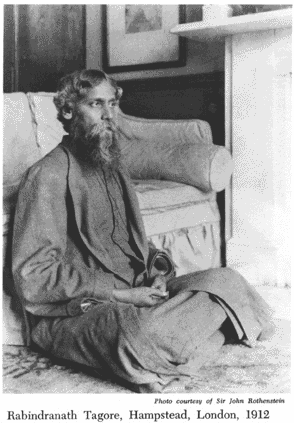
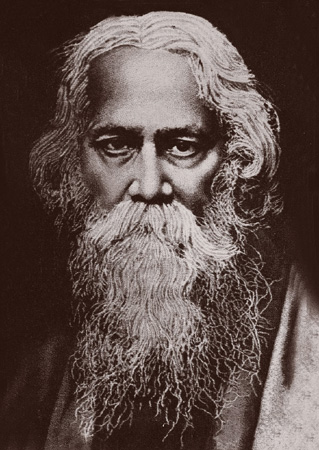
Three Books by Rabindranath Tagore

Tagore has had a profound influence on my life.

I have provided excerpts before from works by Tagore. Today I would like to offer these 3 complete books for you to download, free. These are all in the public domain since 1992. They are:

Gitanjali,

Stray Birds and

The Hungry Stones

If you are new to his work, you are in for a treat, also I am providing the following excerpts with the download for the entire book at the end of each section. I think you will want to read all of these, from the first word to the last.

(Note: I have already provided a download of the e-book Sadhana- The Realization of Life here. Also, I have included a free audio book of Sadhana at the end of this post.)

Gitanjali- Song Offerings

If thou speakest not I will fill my heart with thy silence and endure it. I will keep still and wait like the night with starry vigil and its head bent low with patience.

The morning will surely come, the darkness will vanish, and thy voice pour down in golden streams breaking through the sky.

Then thy words will take wing in songs from every one of my birds’ nests, and thy melodies will break forth in flowers in all my forest groves.

On the day when the lotus bloomed, alas, my mind was straying, and I knew it not. My basket was empty and the flower remained unheeded.

Only now and again a sadness fell upon me, and I started up from my dream and felt a sweet trace of a strange fragrance in the south wind.

That vague sweetness made my heart ache with longing and it seemed to me that is was the eager breath of the summer seeking for its completion.

I knew not then that it was so near, that it was mine, and that this perfect sweetness had blossomed in the depth of my own heart.

I must launch out my boat. The languid hours pass by on the shore—Alas for me!

The spring has done its flowering and taken leave. And now with the burden of faded futile flowers I wait and linger.

The waves have become clamorous, and upon the bank in the shady lane the yellow leaves flutter and fall.

What emptiness do you gaze upon! Do you not feel a thrill passing through the air with the notes of the far-away song floating from the other shore?

In the deep shadows of the rainy July, with secret steps, thou walkest, silent as night, eluding all watchers.

Today the morning has closed its eyes, heedless of the insistent calls of the loud east wind, and a thick veil has been drawn over the ever-wakeful blue sky.

The woodlands have hushed their songs, and doors are all shut at every house. Thou art the solitary wayfarer in this deserted street. Oh my only friend, my best beloved, the gates are open in my house—do not pass by like a dream.

Art thou abroad on this stormy night on thy journey of love, my friend? The sky groans like one in despair.

I have no sleep tonight. Ever and again I open my door and look out on the darkness, my friend!

I can see nothing before me. I wonder where lies thy path!

By what dim shore of the ink-black river, by what far edge of the frowning forest, through what mazy depth of gloom art thou threading thy course to come to me, my friend?

If the day is done, if birds sing no more, if the wind has flagged tired, then draw the veil of darkness thick upon me, even as thou hast wrapt the earth with the coverlet of sleep and tenderly closed the petals of the drooping lotus at dusk.

From the traveller, whose sack of provisions is empty before the voyage is ended, whose garment is torn and dustladen, whose strength is exhausted, remove shame and poverty, and renew his life like a flower under the cover of thy kindly night.

In the night of weariness let me give myself up to sleep without struggle, resting my trust upon thee.

Let me not force my flagging spirit into a poor preparation for thy worship.

It is thou who drawest the veil of night upon the tired eyes of the day to renew its sight in a fresher gladness of awakening.

He came and sat by my side but I woke not. What a cursed sleep it was, O miserable me!

He came when the night was still; he had his harp in his hands, and my dreams became resonant with its melodies.

Download:

gitanjali-by-rabindranath-tagore

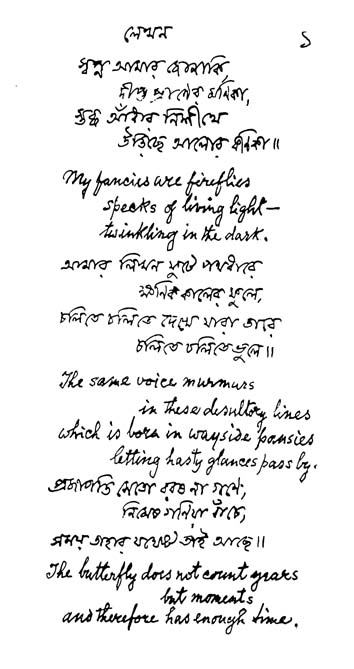
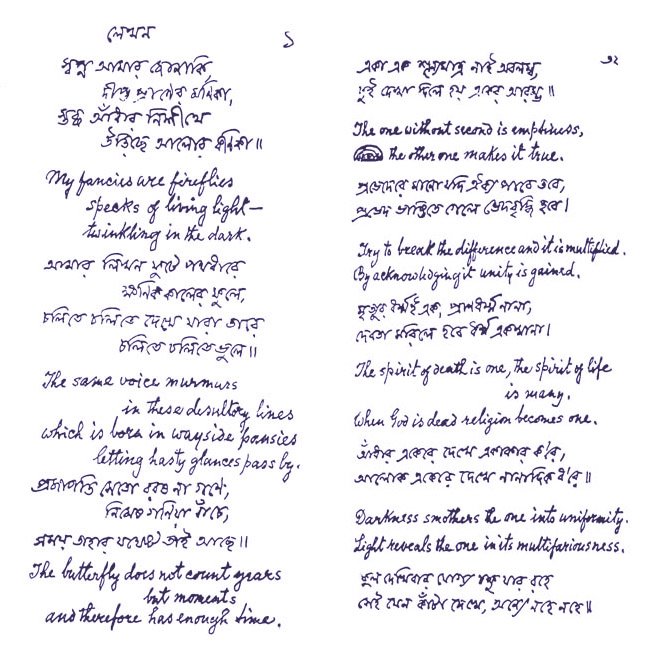
The verses in Stray Birds are short but full. Each one is a meditation. Read them slowly, savor their images and find the meaning they call out from your own heart.

Stray Birds

THE mist, like love, plays upon the heart of the hills and brings out surprises of beauty.


75

WE read the world wrong and say that it deceives us.


76

THE poet wind is out over the sea and the forest to seek his own voice.


77

EVERY child comes with the message that God is not yet discouraged of man.


78

THE grass seeks her crowd in the earth.

The tree seeks his solitude of the sky.


79

MAN barricades against himself.


80

YOUR voice, my friend, wanders in my heart, like the muffled sound of the sea among these listening pines.


81

WHAT is this unseen flame of darkness whose sparks are the stars?


82

LET life be beautiful like summer flowers and death like autumn leaves.


88

HE who wants to do good knocks at the gate; he who loves finds the gate open.


84

IN death the many becomes one; in life the one becomes many.

Download:

stray-birds-by-rabindranath-tagore

The Hungry Stones and other stories

this story is titled

THE DEVOTEE

I

AT a time, when my unpopularity with a part of my readers had reached the nadir of its glory, and my name had become the central orb of the journals, to be attended through space with a perpetual rotation of revilement, I felt the necessity to retire to some quiet place and endeavour to forget my own existence.

I have a house in the country some miles away from Calcutta, where I can remain unknown and unmolested. The villagers there have not, as yet, come to any conclusion about me. They know I am no mere holiday-maker or pleasure-seeker; for I never outrage the silence of the village nights with the riotous noises of the city. Nor do they regard me as an ascetic, because the little acquaintance they have of me carries the savour of comfort about it. I am not, to them, a traveller; for, though I am a vagabond by nature, my wandering through the village fields is aimless. They are hardly even quite certain whether I am married or single; for they have never seen me with my children. So, not being able to classify me in any animal or vegetable kingdom that they know, they have long since given me up and left me stolidly alone.

But quite lately I have come to know that there is one person in the village who is deeply interested in me. Our acquaintance began on a sultry afternoon in July. There had been rain all the morning, and the air was still wet and heavy with mist, like eyelids when weeping is over.

I sat lazily watching a dappled cow grazing on the high bank of the river. The afternoon sun was playing on her glossy hide. The simple beauty of this dress of light made me wonder idly at man’s deliberate waste of money in setting up tailors’ shops to deprive his own skin of its natural clothing.

While I was thus watching and lazily musing, a woman of middle age came and prostrated herself before me, touching the ground with her forehead. She carried in her robe some bunches of flowers, one of which she offered to me with folded hands. She said to me, as she offered it: “This is an offering to my God.”

She went away. I was so taken aback as she uttered these words, that I could hardly catch a glimpse of her before she was gone. The whole incident was entirely simple, but it left a deep impression on my mind; and as I turned back once more to look at the cattle in the field, the zest of life in the cow, who was munching the lush grass with deep breaths, while she whisked off the flies, appeared to me fraught with mystery. My readers may laugh at my foolishness, but my heart was full of adoration. I offered my worship to the pure joy of living, which is God’s own life. Then, plucking a tender shoot from the mango tree, I fed the cow with it from my own hand, and as I did this I had the satisfaction of having pleased my God.

The next year when I returned to the village it was February. The cold season still lingered on. The morning sun came into my room, and I was grateful for its warmth. I was writing, when the servant came to tell me that a devotee, of the Vishnu cult, wanted to see me. I told him, in an absent way, to bring her upstairs, and went on with my writing. The Devotee came in, and bowed to me, touching my feet. I found that she was the same woman whom I had met, for a brief moment, a year ago.

I was able now to examine her more closely. She was past that age when one asks the question whether a woman is beautiful or not. Her stature was above the ordinary height, and she was strongly built; but her body was slightly bent owing to her constant attitude of veneration. Her manner had nothing shrinking about it. The most remarkable of her features were her two eyes. They seemed to have a penetrating power which could make distance near.

With those two large eyes of hers, she seemed to push me as she entered.

“What is this?” she asked. “Why have you brought me here before your throne, my God? I used to see you among the trees; and that was much better. That was the true place to meet you.”

She must have seen me walking in the garden without my seeing her. For the last few days, however, I had suffered from a cold, and had been prevented from going out. I had, perforce, to stay indoors and pay my homage to the evening sky from my terrace. After a silent pause the Devotee said to me: “O my God, give me some words of good.”

I was quite unprepared for this abrupt request, and answered her on the spur of the moment:

Good words I neither give nor receive. I simply open my eyes and keep silence, and then I can at once both hear and see, even when no sound is uttered. Now, while I am looking at you, it is as good as listening to your voice.

The Devotee became quite excited as I spoke, and exclaimed: “God speaks to me, not only with His mouth, but with His whole body.”

I said to her: “When I am silent I can listen with my whole body. I have come away from Calcutta here to listen to that sound.”

The Devotee said: “Yes, I know that, and therefore I have come here to sit by you.”

Before taking her leave, she again bowed to me, and touched my feet. I could see that she was distressed, because my feet were covered. She wished them to be bare.

Early next morning I came out, and sat on my terrace on the roof. Beyond the line of trees southward I could see the open country chill and desolate. I could watch the sun rising over the sugar-cane in the East, beyond the clump of trees at the side of the village. Out of the deep shadow of those dark trees the village road suddenly appeared. It stretched forward, winding its way to some distant villages on the horizon, till it was lost in the grey of the mist.

That morning it was difficult to say whether the sun had risen or not. A white fog was still clinging to the tops of the trees. I saw the Devotee walking through the blurred dawn, like a mist-wraith of the morning twilight. She was singing her chant to God, and sounding her cymbals.

The thick haze lifted at last; and the sun, like the kindly grandsire of the village, took his seat amid all the work that was going on in home and field.

When I had just settled down at my writing-table, to appease the hungry appetite of my editor in Calcutta, there came a sound of footsteps on the stair, and the Devotee, humming a tune to herself, entered. and bowed before me. I lifted my head from my papers.

She said to me: “My God, yesterday I took as sacred food what was left over from your meal.”

I was startled, and asked her how she could do that.

“Oh,” she said, “I waited at your door in the evening, while you were at dinner, and took some food from your plate when it was carried out.”

This was a surprise to me, for every one in the village knew that I had been to Europe, and had eaten with Europeans. I was a vegetarian, no doubt, but the sanctity of my cook would not bear investigation, and the orthodox regarded my food as polluted.

The Devotee, noticing my sign of surprise, said: “My God, why should I come to you at all, if I could not take your food?”

I asked her what her own caste people would say. She told me she had already spread the news far and wide all over the village. The caste people had shaken their heads, but agreed that she must go her own way.

I found out that the Devotee came from a good family in the country, and that her mother was well-to-do, and desired to keep her daughter. But she preferred to be a mendicant. I asked her how she made her living. She told me that her followers had given her a piece of land, and that she begged her food from door to door. She said to me: “The food which I get by begging is divine.”

After I had thought over what she said, I understood her meaning. When we get our food precariously as alms, we remember God the giver. But when we receive our food regularly at home, as a matter of course, we are apt to regard it as ours by right.

I had a great desire to ask her about her husband. But as she never mentioned him even indirectly, I did not question her.

I found out very soon that the Devotee had no respect at all for that part of the village where the people of the higher castes lived.

“They never give,” she said, “a single farthing to God’s service; and yet they have the largest share of God’s glebe. But the poor worship and starve.”

I asked her why she did not go and live among these godless people, and help them towards a better life. “That,” I said with some unction, “would be the highest form of divine worship.”

I had heard sermons of this kind from time to time, and I am rather fond of copying them myself for the public benefit, when the chance comes.

But the Devotee was not at all impressed. She raised her big round eyes, and looked straight into mine, and said:

“You mean to say that because God is with the sinners, therefore when you do them any service you do it to God? Is that so?”

“Yes,” I replied, “that is my meaning.”

“Of course,” she answered almost impatiently, “of course, God is with them: otherwise, how could they go on living at all? But what is that to me? My God is not there. My God cannot be worshipped among them; because I do not find Him there. I seek Him where I can find Him.”

As she spoke, she made obeisance to me. What she meant to say was really this. A mere doctrine of God’s omnipresence does not help us. That God is all-pervading,–this truth may be a mere intangible abstraction, and therefore unreal to ourselves. Where I can see Him, there is His reality in my soul.

I need not explain that all the while she showered her devotion on me she did it to me not as an individual. I was simply a vehicle of her divine worship. It was not for me either to receive it or to refuse it: for it was not mine, but God’s.

When the Devotee came again, she found me once more engaged with my books and papers.

“What have you been doing,” she said, with evident vexation, “that my God should make you undertake such drudgery? Whenever I come, I find you reading and writing.”

“God keeps his useless people busy,” I answered; “otherwise they would be bound to get into mischief. They have to do all the least necessary things in life. It keeps them out of trouble.”

The Devotee told me that she could not bear the encumbrances, with which, day by day, I was surrounded. If she wanted to see me, she was not allowed by the servants to come straight upstairs. If she wanted to touch my feet in worship, there were my socks always in the way. And when she wanted to have a simple talk with me, she found my mind lost in a wilderness of letters.

This time, before she left me, she folded her hands, and said: “My God! I felt your feet in my breast this morning. Oh, how cool! And they were bare, not covered. I held them upon my head for a long time in worship. That filled my very being. Then, after that, pray what was the use of my coming to you yourself? Why did I come? My Lord, tell me truly,–wasn’t it a mere infatuation?”

There were some flowers in my vase on the table. While she was there, the gardener brought some new flowers to put in their place. The Devotee saw him changing them.

“Is that all?” she exclaimed. “Have you done with the flowers? Then give them to me.”

She held the flowers tenderly in the cup of her hands, and began to gaze at them with bent head. After a few moments’ silence she raised her head again, and said to me: “You never look at these flowers; therefore they become stale to you. If you would only look into them, then your reading and writing would go to the winds.”

She tied the flowers together in the end of her robe, and placed them, in an attitude of worship, on the top of her head, saying reverently: “Let me carry my God with me.”

While she did this, I felt that flowers in our rooms do not receive their due meed of loving care at our hands. When we stick them in vases, they are more like a row of naughty schoolboys standing on a form to be punished.

The Devotee came again the same evening, and sat by my feet on the terrace of the roof.

“I gave away those flowers,” she said, “as I went from house to house this morning, singing God’s name. Beni, the head man of our village, laughed at me for my devotion, and said: ‘Why do you waste all this devotion on Him? Don’t you know He is reviled up and down the countryside?’ Is that true, my God? Is it true that they are hard upon you?”

For a moment I shrank into myself. It was a shock to find that the stains of printers’ ink could reach so far.

The Devotee went on: “Beni imagined that he could blow out the flame of my devotion at one breath! But this is no mere tiny flame: it is a burning fire. Why do they abuse you, my God?”

I said: “Because I deserved it. I suppose in my greed I was loitering about to steal people’s hearts in secret.”

The Devotee said: “Now you see for yourself how little their hearts are worth. They are full of poison, and this will cure you of your greed.”

“When a man,” I answered, “has greed in his heart, he is always on the verge of being beaten. The greed itself supplies his enemies with poison.”

“Our merciful God,” she replied, “beats us with His own hand, and drives away all the poison. He who endures God’s beating to the end is saved.”

II

That evening the Devotee told me the story of her life. The stars of evening rose and set behind the trees, as she went on to the end of her tale.

“My husband is very simple. Some people think that he is a simpleton; but I know that those who understand simply, understand truly. In business and household management he was able to hold his own. Because his needs were small, and his wants few, he could manage carefully on what we had. He would never meddle in other matters, nor try to understand them.

“Both my husband’s parents died before we had been married long, and we were left alone. But my husband always needed some one to be over him. I am ashamed to confess that he had a sort of reverence for me, and looked upon me as his superior. But I am sure that he could understand things better than I, though I had greater powers of talking.

“Of all the people in the world he held his Guru Thakur (spiritual master) in the highest veneration. Indeed it was not veneration merely but love; and such love as his is rare.

“Guru Thakur was younger than my husband. Oh! how beautiful he was!

“My husband had played games with him when he was a boy; and from that time forward he had dedicated his heart and soul to this friend of his early days. Thakur knew how simple my husband was, and used to tease him mercilessly.

“He and his comrades would play jokes upon him for their own amusement; but he would bear them all with long-suffering.

“When I married into this family, Guru Thakur was studying at Benares. My husband used to pay all his expenses. I was eighteen years old when he returned home to our village.

“At the age of fifteen I had my child. I was so young I did not know how to take care of him. I was fond of gossip, and liked to be with my village friends for hours together. I used to get quite cross with my boy when I was compelled to stay at home and nurse him. Alas! my child-God came into my life, but His playthings were not ready for Him. He came to the mother’s heart, but the mother’s heart lagged behind. He left me in anger; and ever since I have been searching for Him up and down the world.

“The boy was the joy of his father’s life. My careless neglect used to pain my husband. But his was a mute soul. He has never been able to give expression to his pain.

“The wonderful thing was this, that in spite of my neglect the child used to love me more than any one else. He seemed to have the dread that I would one day go away and leave him. So even when I was with him, he would watch me with a restless look in his eyes. He had me very little to himself, and therefore his desire to be with me was always painfully eager. When I went each day to the river, he used to fret and stretch out his little arms to be taken with me. But the bathing ghat was my place for meeting my friends, and I did not care to burden myself with the child.

“It was an early morning in August. Fold after fold of grey clouds had wrapped the mid-day round with a wet clinging robe. I asked the maid to take care of the boy, while I went down to the river. The child cried after me as I went away.

“There was no one there at the bathing ghat when I arrived. As a swimmer, I was the best among all the village women. The river was quite full with the rains. I swam out into the middle of the stream some distance from the shore.

“Then I heard a cry from the bank, ‘Mother!’ I turned my head and saw my boy coming down the steps, calling me as he came. I shouted to him to stop, but he went on, laughing and calling. My feet and hands became cramped with fear. I shut my eyes, afraid to see. When I opened them, there, at the slippery stairs, my boy’s ripple of laughter had disappeared for ever.

“I got back to the shore. I raised him from the water. I took him in my arms, my boy, my darling, who had begged so often in vain for me to take him. I took him now, but he no more looked in my eyes and called ‘Mother.’

“My child-God had come. I had ever neglected Him. I had ever made Him cry. And now all that neglect began to beat against my own heart, blow upon blow, blow upon blow. When my boy was with me, I had left him alone. I had refused to take him with me. And now, when he is dead, his memory clings to me and never leaves me.

“God alone knows all that my husband suffered. If he had only punished me for my sin, it would have been better for us both. But he knew only how to endure in silence, not how to speak.

“When I was almost mad with grief, Guru Thakur came back. In earlier days, the relation between him and my husband had been that of boyish friendship. Now, my husband’s reverence for his sanctity and learning was unbounded. He could hardly speak in his presence, his awe of him was so great.

“My husband asked his Guru to try to give me some consolation. Guru Thakur began to read and explain to me the scriptures. But I do not think they had much effect on my mind. All their value for me lay in the voice that uttered them. God makes the draught of divine life deepest in the heart for man to drink, through the human voice. He has no better vessel in His hand than that; and He Himself drinks His divine draught out of the same vessel.

“My husband’s love and veneration for his Guru filled our house, as incense fills a temple shrine. I showed that veneration, and had peace. I saw my God in the form of that Guru. He used to come to take his meal at our house every morning. The first thought that would come to my mind on waking from sleep was that of his food as a sacred gift from God. When I prepared the things for his meal, my fingers would sing for joy.

“When my husband saw my devotion to his Guru, his respect for me greatly increased. He noticed his Guru’s eager desire to explain the scriptures to me. He used to think that he could never expect to earn any regard from his Guru himself, on account of his stupidity; but his wife had made up for it.

“Thus another five years went by happily, and my whole life would have passed like that; but beneath the surface some stealing was going on somewhere in secret. I could not detect it; but it was detected by the God of my heart. Then came a day when, in a moment our whole life was turned upside down.

“It was a morning in midsummer. I was returning home from bathing, my clothes all wet, down a shady lane. At the bend of the road, under the mango tree, I met my Guru Thakur. He had his towel on his shoulder and was repeating some Sanskrit verses as he was going to take his bath. With my wet clothes clinging all about me I was ashamed to meet him. I tried to pass by quickly, and avoid being seen. He called me by my name.

“I stopped, lowering my eyes, shrinking into myself. He fixed his gaze upon me, and said: ‘How beautiful is your body!’

“All the universe of birds seemed to break into song in the branches overhead. All the bushes in the lane seemed ablaze with flowers. It was as though the earth and sky and everything had become a riot of intoxicating joy.

“I cannot tell how I got home. I only remember that I rushed into the room where we worship God. But the room seemed empty. Only before my eyes those same gold spangles of light were dancing which had quivered in front of me in that shady lane on my way back from the river.

“Guru Thakur came to take his food that day, and asked my husband where I had gone. He searched for me, but could not find me anywhere.

“Ah! I have not the same earth now any longer. The same sunlight is not mine. I called on my God in my dismay, and He kept His face turned away from me.

“The day passed, I know not how. That night I had to meet my husband. But the night is dark and silent. It is the time when my husband’s mind comes out shining, like stars at twilight. I had heard him speak things in the dark, and I had been surprised to find how deeply he understood.

“Sometimes I am late in the evening in going to rest on account of household work. My husband waits for me, seated on the floor, without going to bed. Our talk at such times had often begun with something about our Guru.

“That night, when it was past midnight, I came to my room, and found my husband sleeping on the floor. Without disturbing him I lay down on the ground at his feet, my head towards him. Once he stretched his feet, while sleeping, and struck me on the breast. That was his last bequest.

“Next morning, when my husband woke up from his sleep, I was already sitting by him. Outside the window, over the thick foliage of the jack-fruit tree, appeared the first pale red of the dawn at the fringe of the night. It was so early that the crows had not yet begun to call.

“I bowed, and touched my husband’s feet with my forehead. He sat up, starting as if waking from a dream, and looked at my face in amazement. I said:

“‘I have made up my mind. I must leave the world. I cannot belong to you any longer. I must leave your home.’

“Perhaps my husband thought that he was still dreaming. He said not a word.

‘Ah! do hear me!’ I pleaded with infinite pain. ‘Do hear me and understand! You must marry another wife. I must take my leave.’

“My husband said: ‘What is all this wild, mad talk? Who advises you to leave the world?’

“I said: ‘My Guru Thakur.’

“My husband looked bewildered. ‘Guru Thakur!’ he cried. ‘When did he give you this advice?’

“‘In the morning,’ I answered, ‘yesterday, when I met him on my way back from the river.’

His voice trembled a little. He turned, and looked in my face, and asked me: ‘Why did he give you such a behest?’

“‘I do not know,’ I answered. ‘Ask him! He will tell you himself, if he can.’

“My husband said: ‘It is possible to leave the world, even when continuing to live in it. You need not leave my home. I will speak to my Guru about it.’

‘Your Guru,’ I said, ‘may accept your petition; but my heart will never give its consent. I must leave your home. From henceforth, the world is no more to me.’

“My husband remained silent, and we sat there on the floor in the dark. When it was light, he said to me: ‘Let us both come to him.’

“I folded my hands and said: ‘I shall never meet him again.’

“He looked into my face. I lowered my eyes. He said no more. I knew that, somehow, he had seen into my mind, and understood what was there. In this world of mine, there were only two who loved me best–my boy and my husband. That love was my God, and therefore it could brook no falsehood. One of these two left me, and I left the other. Now I must have truth, and truth alone.”

She touched the ground at my feet, rose and bowed to me, and departed.

Download:

the-hungry-stones-and-other-stories-by-rabindranath-tagore

More Tagore pictures (click small pictures for full size) –

Two pictures of Tagore with Gandhi
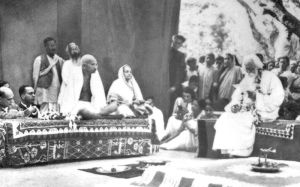
Tagore- Gandhi

Two pictures of Tagore with Albert Einstein

A letter Tagore wrote from the Netherlands
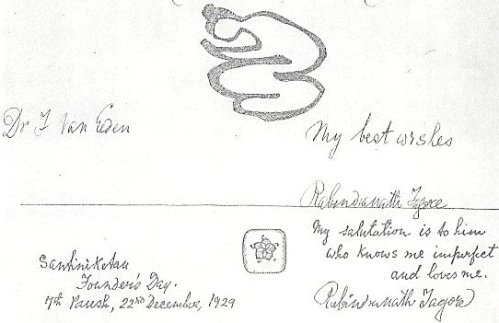
Tagore Portrait (click for full size)

Hand written page from Gitanjali
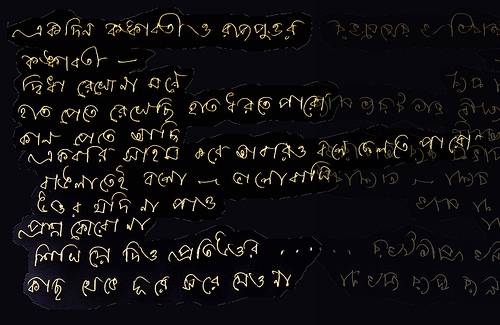
Extra Special Treat!

For your listening pleasure- Free Download of the Audio-Book of

sadhana-the-realization-of-life



2 Comments

Filed under Free Audio Books, Free E-Books, mp3, Mystic Poetry, pictures, poetry, Spirituality

Audio Visual Aids and other stuff, uncalled for

I’ll start with pictures that have caught my eye:

I love statistics-

Stool Joke:

Who doesn’t?

Bottom line: I want my socks back.

Morans-

Found on a nameless website that doesn’t exist and isn’t at all interesting anyway click if it doesn’t animate right away):

Frogs, frogs and frogs:

Info Links:

Weird Frog Facts!

Wikipedia entry

Exploratorium Page on Frogs

That’s pictures for now and Fun Frog Factoids.

Links to which you ought to have a look- see:

Ionia– an intentional community supporting mental health recovery in Alaska. I’ve met some folks from there and it appears to be a very cool and responsible pro-active response to the Public Mental Hell System. Go to their website here.

Bi-Polar Blast– shedding it’s label. Now is called Beyond Meds. It’s a featured link on my sidebar but visit now for the fresh perspective. Click here.

Law Project for Psychiatric Rights (PsychRights) is a non-profit, tax exempt 501(c)(3) public interest law firm whose mission is to mount a  strategic legal campaign against forced psychiatric drugging and electroshock in the United States akin to what Thurgood Marshall and the NAACP mounted in the 40’s and 50’s on behalf of African American civil rights.  The public mental health system is creating a huge class of chronic mental patients through forcing them to take ineffective, yet extremely harmful drugs. Go here.

Psychiatry Deconstruction Zone– Successful schizophrenia, go here.

Pendle Hill free downloads– Quaker info, not just for Friends anymore. Go here.

Protest Records! Great source for politically progressive music, all free. Includes many artists you know and some you should learn more about. Go here.

Miscellaneous Audio Downloads:

new-age-gin-and-juice

john-lennon-working-class-hero

steppenwolf-monster

tom-lehrer-proud-to-be-a-soldier

themaytals-pressure_drop

(huge file but worth it)

thisamericanlife-42907-habeous_schmabeous

pete-townsend-parvardigar

mississippi-john-hurt-nearer-my-god-to-thee

(one of my favorite “Broadway tunes”)

hair-the-flesh-failures

peter_gabriel_-_solsbury_hill

cat-stevens-trouble

jimi-hendrix-message-of-love

One more- this should be enough for today-

bob-dylan-shelter-from-the-storm-hard-rain

Bye for now- Don’t let the bastards get you down.

Leave a comment

Filed under animated gif, animation, CS/X movement, Frogs, Links: Recovery, Mental health recovery, mp3, Music, Spirituality

Centering (from Zen Flesh, Zen Bones/ Paul Reps)

I said I’d find it! I love this. It was my favorite part of the Paul Reps book, ZF,ZB. I started studying and practicing it when I was 9 years old. I had many wonderful experiences. Plus I became an even weirder kid than before.

(I did not find the section “10 Bulls”…maybe next time.)

here is the first part, followed by download for the whole thing.

(for the rest of this book see https://rickpdx.wordpress.com/2008/09/11/zen-flesh-zen-bones-101-zen-stories/)

Centering Practices:

112 ways to open the invisible door of consciousness.

Transcribed by Paul Reps.
From Zen Flesh, Zen Bones*


Zen is nothing new, neither is it anything old. Long before Buddha was born the search was on in India, as the present work shows.

Long after man has forgotten such words as Zen and Buddha, satori and koan, China and Japan and America – still the search will go on, still Zen will be seen even in flower, and grass-blade, before the sun.

The following is adapted from the preface to the first version in English of this ancient work.

Wandering in the ineffable beauty of Kashmir, above Srinagar I come upon the hermitage of Lakshmanjoo.

It overlooks green rice fields, the garden, of Shalimar and Nishat Bagh, lakes fringed with lotus. Water streams down from a mountaintop.

Here Lakshmanjoo – tall, full bodied, shining – welcomes me. He shares with me this ancient teaching from the Vigyan Bhairava and Sochanda Tantra, both written about four thousand years ago, and from Malini Vijaya Tantra, probably another thousand years older yet. It is an ancient teaching, copied and recopied countless times, and from it Lakshmanjoo has made the beginning of an English version. I transcribe it eleven more times to get it into the form given here.

Shiva first chanted it to his consort Devi in a language of love we have yet to learn. It is about the Immanent experience. It presents 112 ways to open the invisible door of consciousness. I see Lakshmanjoo gives his life to its practicing.

Some of the ways may appear redundant, yet each differs from any other. Some may seem simple, yet any one requires constant dedication even to test it.

Machines, ledgers, dancers, athletes balance. Just as centering or balance augments various skills, so it may awareness. As an experiment, try standing equally on both feet; then imagine you are shifting your balance slightly from foot to foot: just as balance centers, do you.

If we are conscious in part, this implies more inclusive consciousness. Have you a hand? Yes. That you know without doubt. But until asked the question were you cognizant of the hand apart?

Surely men as inspiritors, known and unknown to the world, have shared a common uncommon discovery. The Tao of Lao-tse, Nirvana of Buddha, Jehovah of Moses, the Father of Jesus, the Allah of Mohammed — all point to the experience.

No-thing-ness, spirit – once touched, the whole life clears.
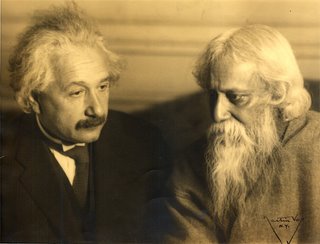

DEVI SAYS:

O Shiva, what is your reality?
What is this wonder-filled universe?
What constitutes seed?
Who centers the universal wheel?
What is tbis life beyond form pervading forms?
How may we enter it fully, above space and
time, names and descriptions?
Let my doubts be cleared!

SHIVA REPLIES

[Devi, though already enlightened, has asked the foregoing questions so others through the universe might receive Shiva’s instructions. Now follow Shiva’s reply, giving the 112 ways.]

1. Radiant one, this experience may dawn between two breaths. After breath comes in (down) and just before turning up (out) — the beneficence.

2. As breath turns from down to up, and again as breath curves from up to down—through both these turns, realize.

3. Or, whenever inbreath and outbreath fuse, at this instant touch the energyless energy-filled center.

4. Or, when breath is all out (up) and stopped of itself, or all in (down) and stopped—in such universal pause, one’s small self vanishes. This is difficult only for the impure.

5. Consider your essence as light rays rising from center to center up the vertebrae, and so rises livingness in you.

6. Or in the spaces between, feel this as lightning.

7. Devi, imagine the Sanskrit letters in these honey-filled foci of awareness, first as letters, then more subtly as sounds, then as most subtle feeling. Then, leaving them aside, be free.

8. Attention between eyebrows, let mind be before thought. Let form fill with breath-essence to the top of the head, and there shower as light.

9. Or, imagine the five-colored circles of the peacock tail to be your five senses in illimitable space. Now let their beauty melt within. Similarly, at any point in space or on a wall — until the point dissolves. Then your wish for another comes true.

10. Eyes closed, see your inner being in detail. Thus see your true nature.

Here’s the download file:

centering-practices-paulreps

For the sake of dragging in a few more folks, here is some other stuff-

Poetry by Du Fu

a famous 4 part work with literal and literate translations.

Wikipedia has this to say in introduction to Du Fu:

This is a Chinese name; the family name is 杜 (Dù).
Du Fu (杜甫)

There are no contemporaneous portraits of Du Fu; this is a later artist’s impression
Born 712
Died 770
Occupation Poet

Du Fu (Chinese: 杜甫; pinyin: Dù Fǔ; Wade-Giles: Tu Fu, 712770) was a prominent Chinese poet of the Tang Dynasty. Along with Li Bai (Li Po), he is frequently called the greatest of the Chinese poets.[1] His own greatest ambition was to help his country by becoming a successful civil servant, but he proved unable to make the necessary accommodations. His life, like the whole country, was devastated by the An Lushan Rebellion of 755, and the last 15 years of his life were a time of almost constant unrest.

Initially little known, his works came to be hugely influential in both Chinese and Japanese culture. Of his poetic writing, nearly fifteen hundred poems written by Du Fu have been handed down over the ages. He has been called Poet-Historian and the Poet-Sage by Chinese critics, while the range of his work has allowed him to be introduced to Western readers as “the Chinese Virgil, Horace, Ovid, Shakespeare, Milton, Burns, Wordsworth, Béranger, Hugo or Baudelaire“.

In Abbot Zan’s Room at Dayun Temple: Four Poems (1)
Du Fu

Heart at water essence land
Clothes wet spring rain time
Penetrate gate utmost beyond step
Deep court really tranquil appointment
Reach door open again close
Hit bell vegetarian meal at here
Cream enhance develop nature
Diet give support decline
Hold arm be many days
Open heart without shame evasion
Golden oriole pass structure
Purple dove descend lattice screen
Humble think reach place suit
Flower beside go self slow
Tangxiu raise me sickness
Smile ask write poem
My heart is in a world of water and crystal,
My clothes are damp in this time of spring rains.
Through the gates I walk on to the end,
The inner court the appointed tranquil space.
I reach the doors- they open and shut again,
Now strikes the bell- the meal time has arrived.
This cream will help one’s nature strengthen and grow,
The diet gives support in my decline.
We’ve grasped each other’s arms so many days,
And opened our hearts without shame or evasion.
Golden orioles flit across the beams,
Purple doves descend from lattice screens.
Myself, I think I’ve found a place that suits,
I walk by flowers at my own slow pace.
Tangxiu lifts me from my sickly state,
And smiling, asks me to write a poem.

In Abbot Zan’s Room at Dayun Temple: Four Poems (2)

Thin soft green silk shoe
Shine bright white cotton scarf
Deep store for old elder
Fetch use for my body
Self look change without interest
Friendship how still new
Daolin talent not age
Huiyuan virtue surpass man
Rain pour dusk eaves bamboo
Wind blow green well celery
Heaven dark face picture
Most feel moist dragon scale
Fine green silk shoes,
Bright white cotton scarves,
Deep in storage for the elders,
Fetched to wear upon my body.
I see myself as old and dull,
How can our friendship stay so fresh?
Daolin’s talents exceed the age,
Huiyuan’s virtue’s superhuman.
Rain-drenched bamboo by the eaves at dusk;
Wind in green celery at the well;
The sky dark, I face a mural,
Most feeling the damp of the dragon’s scales.

In Abbot Zan’s Room at Dayun Temple: Four Poems (3)

Lamplight shine without sleep
Heart clear smell wonderful incense
Night deep hall sudden lofty
Wind move gold clank clank
Sky black obstruct spring court
Earth clear dwell secret fragrance
Jade rope revolve cut sever
Iron phoenix dark soar
Sanskrit release sometimes out temple
Bell remnant remain thunder bed
Tomorrow at fertile field
Bitter see dirt sand yellow
The lamplight shines on my sleeplessness,
My mind clear, I smell the splendid incense.
Deep in the night, the hall rears up high,
The wind stirs, and gold is heard to clank.
The black sky masks the springtime court,
To the pure earth clings a hidden fragrance.
The Jade Rope wheels round and is cut,
The iron phoenix seems about to soar.
Sanskrit sometimes flows out from the temple,
The lingering bells still thunder round my bed.
Tomorrow morning in the fertile field,
I’ll bitterly behold the yellow dirt.

In Abbot Zan’s Room at Dayun Temple: Four Poems (4)

Boy draw water well shining
Agile container rise hand
Wet sprinkle not soak earth
Sweep surpass like without broom
Bright rosy clouds shining again pavilion
Clear mist lift high window
Lean fill cover path flower
Sheet shake end steps willow
Difficulty world affair compel
Hide away right time after
Meet talk agree deep heart
How can all restrain mouth
Offer goodbye return cane riding crop
Temporary part end turn head
Vast expanse mud defile person
Listen country many dogs
Although not free yoke
Sometimes come rest rush about
Near you like white snow
Grasp hot upset how be
The boy draws shining water from the well,
He nimbly lifts the bucket to his hand.
He sprinkles water without soaking the earth,
And sweeps so well as if without a broom.
The rosy dawn again lights the pagoda,
The clearing mist lifts from the higher windows.
Leaning blossoms cover over the path,
Swaying willow leaves reach down to the steps.
I’m driven by these troublesome affairs,
Retirement from the world must be put off.
We’ve met and talked, our deepest hearts agreeing,
How can our mouths be forced completely shut?
I say goodbye and fetch my riding crop,
Parting for now, I turn my head at the last.
There’s so much mud that can defile a man,
Just listen to all the dogs throughout the land.
Although I cannot get free from this yoke,
I’ll sometimes come to rest from all the bustle.
Your presence, Abbot, acts just like white snow,
How can I be upset to grasp what’s hot?

Not enough? Wait! There’s more!

Silly pictures:

and this-

(click for full size)

or maybe…

Halloween costume for your baby:

Ah, but that’s not all! Newly recorded song I’ve posted before but hopefully this is better- it will also go on to the new music page (soon). The song- On the Wind, was conceived as God’s part of a dialogue with me regarding prayer/ meditation.

Lyrics? Chords?

Here-

On the Wind

D       Em—7   A
Reach up,       open your eyes,
Em–7                      A
feel the sky as a wheel that is turning
Em—-7               A                              Em—7                  A
Look out, see the world you have made before your eyes is burning
G                               D                            Em—7
Breathe it in slowly and breathe it out slowly again
D                              G                   A                   D
Sometimes all you can do is cast your heart upon the wind

You can cover your tracks as fine as you please
Throw out all of the things that remind you
Turn away from the heartache you fear; In the blink of an eye it will find you
Or unlock your door and just walk to the light streaming in
Release your song and let it dance upon the wind

***
G                    A                      D
You don’t even know who cares about you
G                           A                            D
The one who stands beside you night and day
G      A         D
It’s so easy to love you
G                       A                          D
and it’s so hard to watch you live this way

***

You can sit down by me; I have always been here
I have waited like the starry night
I know you aren’t ready to stay but I will hold you in the light
And I won’t hold you back, I know that’s just the place you are in
Before you go just button up your coat against the wind

The song download:

p-onthewind91208

That should cover most bases for today.

See you Sunday(or First Day, as the Friends say).

6 Comments

Filed under buddhism, Chinese poetry, comedy relief, Free Music, mp3, Music, Mystic Poetry, new music, pictures, poetry, silly, Spirituality

Zen Flesh, Zen Bones- 101 Zen Stories

When I was about 8 I started reading everything I could find in the religion section at the downtown Multnomah County library. I was looking for explanations for things I was experiencing and for tools for greater understanding. The first Buddhist oriented book I read was the Dhammapada, which is kind of like the “Dick & Jane” of the Pali Canon. Zen Flesh, Zen Bones, compiled by Paul Reps, was one of my first non-scriptural Buddhist texts I encountered and had a profound influence on my thinking as a kid-adult.

ZFZB is actually 4 books- My favorite section is and was the one titled “Centering” which I haven’t been able to find yet on the net. So, my second choice must be the best- 101 Zen Stories. I’ve posted the first 10 here and made a link at the end where you can download the whole thing (this section, anyway). As an added bonus, I’ve added The Gateless Gate- Zen Koans used for meditation. When I find a web copy of Centering, I’ll share it, too.

101 Zen Stories

A Cup of Tea

Nan-in, a Japanese master during the Meiji era (1868-1912) received a university professor who came to inquire about Zen. Nan-in saved tea. He poured his visitor’s cup full, and then kept on pouring. The professor watched the overflow until he no longer could restrain himself. ‘It is overfull. No more will go in!’ ‘Like this cup,’ Nan-in said. ‘You are full of your own opinions and speculations. How can I show you Zen unless you first empty your cup? ‘

2. Finding a Diamond on a Muddy Road
Gudo was the emperor’s teacher of his time. Nevertheless, he used to travel done as a wandering mendicant. Once when he was on his way to Edo, the cultural and political center of the shogunate, he approached a little village mad Takenaka. It was evening and a heavy rain was falling. Gudo was thoroughly wet. His straw sandals were in pieces. At a farmhouse near the village he noticed four or five pairs of sandals in the window and decided to buy some dry ones. The woman who offered him the sandals seeing how wet he was invited him to remain for the night in her home. Gudo accepted, thanking her. He entered and recited a sutra before the family shrine. He then was introduced to the woman’s mother, and to her children. Observing that the entire family was depressed Gudo asked what was wrong.

‘My husband is a gambler and a drunkard,’ the housewife told him. ‘When he happens to win he drinks and becomes abusive. When he losses he borrows money from others. Sometimes when becomes thoroughly drunk he does not come home at all. What can I do? ‘I will help him,’ said Gudo. ‘Here is some money. Get me a gallon of fine wine and something good to eat. Then you may retire. I will meditate before the shrine.’ When the man of the house returned about midnight, quite drunk; he bellowed: ‘Hey, wife I am home. Have you something for me eat?’ I have something for you: said Gudo. ‘I happened to be caught in the rain and your wife kindly asked me to remain here for the night. In return I have bought some wine and fish. You might as well have them.’ The man was delighted. He drank the wine at once and laid himself down on the floor. Gudo sat in mediation beside him. In the morning when the husband awoke he had forgotten about the previous night. ‘Who are you? Where do yon come from?’ he asked Gudo, who still was meditating. ‘I am Gudo of Kyoto and I am going on to Edo,’ replied the Zen master. The man was utterly ashamed He apologized profusely to the teacher of his emperor. Gudo smiled. ‘Everything in this life is impermanent’ he explained. ‘Life is very brief. If you keep on gambling and drinking yon will have no time left to accomplish anything else, and you will cause your family to suffer too.’ The perception of the husband awoke as if from a dream. ‘You are right,’ he declared. ‘How can I ever repay you for this wonderful teaching! Let me see you off and carry your things a little way.’ ‘If you wish,’ assented Gudo. The two started out. After they had gone three miles Gudo told him to return. ‘Just another five miles,’ he begged Gudo. They continued on. You may return now,’ suggested Gudo.

‘After another ten miles,’ the man replied. ‘Return now,’ said Gudo, when the ten miles had been passed. ‘I am going to follow you all the rest of my life,’ declared the man. Modern Zen teachers in Japan spring from the lineage of a famous master who was the successor of Gudo. His name was Mu-nan, the man who never returned back.

3. Is That So?
The Zen master Hakuin was praised by his neighbors as one living a pure life. A beautiful Japanese girl whose parents owned a food store lived near him. Suddenly, without any warning her parents discovered she was with child. This made her parents angry. She would not confess who the man was, but after much harassment at last named Hakuin. In great anger the parents went to the master. ‘Is that so?’ was all he would say. After the child was born it was brought to Hakuin. By this time he had lost his reputation, which did not trouble him, but he took very good care of the child. He obtained milk from his neighbors and everything else the little one needed. A year later the girl-mother could stand it no longer. She told her parents the truth – that the real father of the child was a young man who worked in the fish market. The mother and father of the girl at once went to Hakuin to ask his forgiveness, to apologize at length, and to get the child back again. Hakuin was willing. In yielding the child, all he said was, ‘Is that so?’

4. Obedience
The master Bankei’s talks were attended not only by Zen students but by persons of all ranks and sects. He never quoted sutras nor indulged in scholastic dissertations. Instead his words were spoken directly from his heart to the harts of his listeners. His large audiences angered a priest of the Nichiren sect because the adherents had left to hear about Zen. The selfcentered Nichiren priest came to the temple determined to debate with Bankei. ‘Hey, Zen teacher,’ he called out. ‘Wait a minute. Whoever respects you will obey what you say, but a man like myself does not respect you. Can you make me obey yon?’ ‘Come up beside me and I will show you,’ said Bankei. Proudly the priest pushed his way through the crowd to the teacher. Bankei smiled. ‘Come over to my left side.’ The priest obeyed. ‘No,’ said Bankei, ‘we may talk better if you are on the right side. Step over here.’ The priest proudly stepped over to the right. ‘You see,’ observed Bankei, ‘you are obeying me and I think you are a very gentle person. Now sit down and listen.’

5. If You Love, Love Openly
Twenty monks and one nun, who was named Eshun, were practicing meditation with a certain Zen master. Eshun was very pretty even though her head was shaved and her dress plain. Several monks secretly fell in love with her.

One of them wrote her a love letter, insisting upon a private meeting. Eshun did not reply. The following day the master gave a lecture to the group, and when it was over, Eshun arose. Addressing the one who had written her, she said: ‘If you really love me so much, come and embrace me now.’

6. No Loving-Kindness
There was an old woman in China who had supported a monk for over twenty years. She had built a little hut for him and fed him while he was meditating. Finally she wondered just what progress he had made in all this time. To find out, she obtained the help of a girl rich in desire. ‘Go and embrace him,’ she told her;’ and then ask him suddenly: “What now?” The girl called upon the monk and without much ado caressed him, asking him what he was going to do about it. ‘An old tree grows on a cold rock in winter,’ replied the monk somewhat poetically. ‘Nowhere is there any warmth.’ The girl returned and related what he had said. ‘To think I fed that fellow for twenty years!’ exclaimed the old woman in anger.’ He showed no consideration for your need, no disposition to explain your condition. He need not have responded to passion, but at last he should have evidenced some compassion.’ She at once went to the hut of the monk and burned it down.

7. Announcement
Tanzan wrote sixty postal cards on the last day of his life, and asked an attendant to mail them. Then he passed away. The cards read:

I am departing from this world. This is my last announcement. Tanzan 27 July 1892.

8. Great Waves
In the early days of the Meiji era there lived a well-known wrestler called O-nami, Great Waves. O-nami was immensely strong and knew the art of wrestling. In his private bouts he defeated even his teacher, but in public he was so bashful that his own pupils threw him. O-nami felt he should go to a Zen master for help. Hakuju, a wandering teacher, was stopping in a little temple nearby, so O-nami went to see him and told him of his trouble. ‘Great Waves is your name,’ the teacher advised,’ so stay in this temple tonight. Imagine that you are those billows. You are no longer a wrestler who is afraid. You are those huge waves sweeping everything before them, swallowing all in their path. Do this and you will be the greatest wrestler in the land.’ The teacher retired. O-nami sat in meditation trying to imagine himself as waves. He thought of many different things. Then gradually he turned more and more to the feelings of the waves. As the night advanced the waves became larger and larger. They swept away the flowers in their vases. Even the Buddha in the shrine was inundated. Before dawn the temple was nothing but the ebb and flow of an immense sea. In the morning the teacher found O-nami meditating, a faint smile on his face. He patted the wrestlers shoulder. ‘Now nothing can disturb you.’ he said. ‘You are the waves. You will sweep everything before you.’ The same day O-nami entered the wrestling contests and won. After that, no one in Japan was able to defeat him.

9. The Moon cannot be Stolen
Ryokan, a Zen master, lived the simplest kind of life in a little hut at the foot of a mountain. One evening a thief visited the hut only to discover there was nothing in it to stea1. Ryokan returned and caught him. ‘You may have come a long way to visit me,’ he told the prowler, ‘and you should not return empty-handed. Please take my clothes as a gift.’ The thief was bewildered. He took the clothes and slunk away. Ryokan sat naked, watching the moon. ‘Poor fellow,’ he mused, ‘I wish I could give him this beautiful moon.’

10. The Last Poem of Hoshin
The Zen master Hoshin lived in China many years. Then he returned to the northeastern part of Japan, where he taught his disciples. When he was getting very old, he told them a story he had heard in China. This is the story: One year on the twenty-fifth of December, Tokufu, who was very old, said to his disciples: I am not going to-be alive next year so you fellows should treat me well this year.’ The pupils thought he was joking, but since he was a great-hearted teacher each of them in turn treated him to a feast on succeeding days of the departing year. On the eve of the New Year, Tokufu concluded: ‘You have been good to me. I shall leave you tomorrow afternoon when the snow has stopped.’ The disciples laughed, thinking he was aging and talking nonsense since the night was clear and without snow. But at midnight snow began to fall, and the next day they did not find their teacher about. They went to the meditation hall.

There he had passed on. Hoshin, who related this story, told his disciples: ‘It is not necessary for a Zen master to predict his passing, but if he really wishes to do so, he can.’ ‘Can you?’ someone asked. ‘Yes,’ answered Hoshin. ‘I will show you what I can do seven days from now. None of the disciple’s believed him, and most of them had even forgotten the conversation when Hoshin next called them together. ‘Seven days ago,’ he remarked, ‘I said I was going to leave you. It is customary to write a farewell poem, but I am neither poet nor calligrapher. Let one of you inscribe my last words.’ His followers thought he was joking, but one of them started to write. ‘Are you ready?’ Hoshin asked. ‘Yes, sir,’ replied the writer. Then Hoshin dictated: I came from brilliancy And return to brilliancy. What is this? The poem was one line short of the customary four, so, the disciple said: ‘Master, we are one line short.’ Hoshin, with the roar of a conquering lion, shouted ‘Kaa!’ and was gone.

Download 101 Zen Stories with forward:

101zensories-wforwardbypaulreps

Download The Gateless Gate:

the-gateless-gate

Let’s not forget this version (click for full size):

6 Comments

Filed under buddhism, pictures, silly, Spirituality

Darkness, Light and First Day Thoughts

At meeting for worship this morning (Multnomah Meeting, Friends), I had some things I was pondering. As usual, I dd not want to speak and held my tongue, letting the need build up. Usually when I do speak it’s because the internal pressure of my “leading” (as Friends say) becomes too much to hold back; my heart shakes, then I speak. My inner voice was speaking about what I have learned from Light.

Today it happened that the first half hour was deep and silent. There were perhaps 60 or so people gathered in the meeting hall. Then there was a period in which several people spoke at a fairly regular but respectful series of intervals.  It began with one of the meeting’s elders who spoke about a trip to Nicaragua this summer to visit family and encounters she had both with Quakers there and being witness to some Really Fucked Up Shit (not her words). The upshot was that world has people who do good and people who do evil. The ministry that followed, other people who spoke, including the one very Christo-centric guy who tends to quote the bible, all seemed to be addressing my topic from different angles. Darkness and light somehow was the topic of the day. (And, like good Quakers, no-one was speaking in response to the others; it felt like light addressing light.)

I never spoke. Each moment I thought I might have to stand, someone else stood and said something that illuminated my own meditation in a way that changed it. Then Meeting ended, there were introductions, announcements and other business. I decided to try and capture something of what I didn’t say here. I already know that this is not going to work the way I intended but I’m doing it anyway.

I have been learning from light for a long time. As far back as I can remember, as a child, I listened to light. When I was initiated into meditation as a teenager I was taught a meditation using clear white light. When I was given a Sanskrit name as part of an additional lesson, I was called Surendra- another “light connection”. Since then I have always come back to light as a device for focus and an inner place of calm awareness. I am a student of light, I guess.

So, Everything I Ever Needed to Know I Learned from Light.

One of the first things I learned from light was something I’ll call “steadiness”. It could also be called “peace” or “equanimity”. I learned from light that there was a space inside of me that was steady. Like a tree with branches waving in the wind, I was also a trunk that remained still. Throughout various passages of my life, even when everything seemed to be chaos, even when I felt suicide was my only living option, part of me knew with absolute certainty that there was a space of stillness; clear, vast and without shadow; (even) inside of my (broken) heart.

Another lesson from light is what I’ll call “open”. Also could be called compassion or connection. I learned that the deepest space within me was connected to everything else and that every pain was my pain, every joy was my joy. I learned that I couldn’t just be “steady”- as the near enemy of equanimity is indifference; as part of the tapestry of this world I can’t deny the feeling, perception and sensation that comes with life. I can’t deny suffering- within me and without me.

Quakers refer to the “ocean of darkness” and “the ocean of light”. George Fox, in his journals, says that his awakening included both, but that the ocean of light was “over the ocean of darkness”. Also, because of his time and place, he called that ocean of light “Christ” and he found that it was everywhere and within all beings. It was for this reason that one of the first things Quakers did to upset the order of things was to refuse to participate in violence, war or anything that debased orinjured anyone, because “all were filled with Christ”, filled with light.

Thinking about these things I also thought about CS Lewis and how in his theological books he called this world “the shadowlands”. His realization included the notion that the things we see with our eyes are just shadows of reality. Hmmm… Shadows- Where does a shadow come from? Shadows are the direct result of light.

Sometimes I see this world like it’s a movie screen- one with the projector behind it. It is a thin, sheer veil that barely separates us from an “ocean of light”. Sometimes I feel as though my very next step will take me through the screen and into the light. Sometimes this whole world looks transparent- that the crazy kaleidoscope of things, color, beings and activity is like a joke pasted over the not-very-well-hidden clear, white light.

Sometimes I know all these things and more. Always I know that when I try to speak it, I will fail.

As noted in the Tao Te Ching:

verse 1

the tao that can be told
is not the eternal tao
the name that can be named
is not the eternal name

the unnamable is the eternally real
naming is the origin
of all particular things

free from desire, you realize the mystery
caught in desire, you see only manifestations

yet mystery and manifestations
arise from the same source
this source is called darkness

darkness within darkness
the gateway to all understanding

Leave a comment

Filed under Chinese poetry, Mystic Poetry, Spirituality, Uncategorized

SADHANA The Realization of Life by R. Tagore

To download the entire book in DOC format (I can't get
the uploader to insert any other formats),
click on the link at the bottom of this excerpt.
This is one of the top 3 most inspiring and influential
books I have ever read.
This translation is by the author.
This is a public domain work- save a tree and read it online.


Bio: 

Rabindranath Tagore(1861-1941)

Greatest writer in modern Indian literature, Bengali poet, novelist, educator, and an early advocate of Independence for India. Tagore won the Nobel Prize for Literature in 1913. Two years later he was awarded the knighthood, but he surrendered it in 1919 as a protest against the Massacre of Amritsar, where British troops killed some 400 Indian demonstrators. Tagore’s influence over Gandhi and the founders of modern India was enormous, but his reputation in the West as a mystic has perhaps mislead his Western readers to ignore his role as a reformer and critic of colonialism.

“When one knows thee, then alien there is none, then no door is shut. Oh, grant me my prayer that I may never lose touch of the one in the play of the many.” (from Gitanjali)

Rabindranath Tagore was born in Calcutta into a wealthy and prominent family. His father was Maharishi Debendranath Tagore, a religious reformer and scholar. His mother, Sarada Devi, died when Tagore was very young – he realized that she will never come back was when her body was carried through a gate to a place where it was burned. Tagore’s grandfather had established a huge financial empire for himself. He helped a number of public projects, such as Calcutta Medical College.

The Tagores tried to combine traditional Indian culture with Western ideas; all the children contributed significantly to Bengali literature and culture. However, in My Reminiscences Tagore mentions that it was not until the age of ten when he started to use socks and shoes. And servants beat the children regularly. Tagore, the youngest, started to compose poems at the age of eight. Tagore’s first book, a collection of poems, appeared when he was 17; it was published by Tagore’s friend who wanted to surprise him.

Tagore received his early education first from tutors and then at a variety of schools. Among them were Bengal Academy where he studied history and culture. At University College, London, he studied law but left after a year – he did not like the weather. Once he gave a beggar a cold coin – it was more than the beggar had expected and he returned it. In England Tagore started to compose the poem ‘Bhagna Hridaj’ (a broken heart).

In 1883 Tagore married Mrinalini Devi Raichaudhuri, with whom he had two sons and three daughters. In 1890 Tagore moved to East Bengal (now Bangladesh), where he collected local legends and folklore. Between 1893 and 1900 he wrote seven volumes of poetry, including SONAR TARI (The Golden Boat), 1894 and KHANIKA, 1900. This was highly productive period in Tagore’s life, and earned him the rather misleading epitaph ‘The Bengali Shelley.’ More important was that Tagore wrote in the common language of the people. This also was something that was hard to accept among his critics and scholars.

Tagore was the first Indian to bring an element of psychological realism to his novels. Among his early major prose works are CHOCHER BALI (1903, Eyesore) and NASHTANIR (1901, The Broken Nest), published first serially. Between 1891 and 1895 he published forty-four short stories in Bengali periodical, most of them in the monthly journal Sadhana.

Especially Tagore’s short stories influenced deeply Indian Literature. ‘Punishment’, a much anthologized work, was set in a rural village. It describes the oppression of women through the tragedy of the low-caste Rui family. Chandara is a proud, beautiful woman, “buxom, well-rounded, compact and sturdy,” her husband, Chidam, is a farm-laborer, who works in the fields with his brother Dukhiram. One day when they return home after whole day of toil and humiliation, Dukhiram kills in anger his sloppy and slovenly wife because his food was not ready. To help his brother, Chidam’s tells to police that his wife struck her sister-in-law with the farm-knife. Chandara takes the blame on to herself. ‘In her thoughts, Chandara was saying to her husband, “I shall give my youth to the gallows instead of you. My final ties in this life will be with them.”‘ Afterwards both Chidam and Dukhiram try to confess that they were quilty but Chandara is convicted. Just before the hanging, the doctor says that her husband wants to see her. “To hell with him,” says Chandara.

In 1901 Tagore founded a school outside Calcutta, Visva-Bharati, which was dedicated to emerging Western and Indian philosophy and education. It become a university in 1921. He produced poems, novels, stories, a history of India, textbooks, and treatises on pedagogy. Tagore’s wife died in 1902, next year one of his daughters died, and in 1907 Tagore lost his younger son.

Tagore’s reputation as a writer was established in the United States and in England after the publication of GITANJALI: SONG OFFERINGS, about divine and human love. The poems were translated into English by the author himself. In the introduction from 1912 William Butler Yates wrote: “These lyrics – which are in the original, my Indians tell me, full of subtlety of rhythm, of untranslatable delicacies of colour, of metrical invention – display in their thought a world I have dreamed of all my life long.” Tagore’s poems were also praised by Ezra Pound, and drew the attention of the Nobel Prize committee. “There is in him the stillness of nature. The poems do not seem to have been produced by storm or by ignition, but seem to show the normal habit of his mind. He is at one with nature, and finds no contradictions. And this is in sharp contrast with the Western mode, where man must be shown attempting to master nature if we are to have “great drama.” (Ezra Pound in Fortnightly Review, 1 March 1913) However, Tagore also experimented with poetic forms and these works have lost much in translations into other languages.

Much of Tagore’s ideology come from the teaching of the Upahishads and from his own beliefs that God can be found through personal purity and service to others. He stressed the need for new world order based on transnational values and ideas, the “unity consciousness.” “The soil, in return for her service, keeps the tree tied to her; the sky asks nothing and leaves it free.” Politically active in India, Tagore was a supporter of Gandhi, but warned of the dangers of nationalistic thought. Unable to gain ideological support to his views, he retired into relative solitude. Between the years 1916 and 1934 he travelled widely. From his journey to Japan in 1916 he produced articles and books. In 1927 he toured in Southeast Asia. Letters from Java, which first was serialized in Vichitra, was issued as a book, JATRI, in 1929. His Majesty, Riza Shah Pahlavi, invited Tagore to Iran in 1932. On his journeys and lecture tours Tagore attempted to spread the ideal of uniting East and West. While in Japan he wrote: “The Japanese do not waste their energy in useless screaming and quarreling, and because there is no waste of energy it is not found wanting when required. This calmness and fortitude of body and mind is part of their national self-realization.”

Tagore wrote his most important works in Bengali, but he often translated his poems into English. At the age of 70 Tagore took up painting. He was also a composer, settings hundreds of poems to music. Many of his poems are actually songs, and inseparable from their music. Tagore’s ‘Our Golden Bengal’ became the national anthem of Bangladesh. Only hours before he died on August 7, in 1941, Tagore dictated his last poem. His written production, still not completely collected, fills nearly 30 substantial volumes. Tagore remained a well-known and popular author in the West until the end of the 1920s, but nowadays he is not so much read.

SADHANA

THE REALISATION OF LIFE

By

Rabindranath Tagore

Author of 'Gitanjali'

1916

To

Ernest Rhys

Author's Preface

Perhaps it is well for me to explain that the subject-matter of
the papers published in this book has not been philosophically
treated, nor has it been approached from the scholar's point of
view.  The writer has been brought up in a family where texts of
the Upanishads are used in daily worship; and he has had before
him the example of his father, who lived his long life in the
closest communion with God, while not neglecting his duties to
the world, or allowing his keen interest in all human affairs to
suffer any abatement.  So in these papers, it may be hoped,
western readers will have an opportunity of coming into touch
with the ancient spirit of India as revealed in our sacred texts
and manifested in the life of to-day.

All the great utterances of man have to be judged not by the
letter but by the spirit--the spirit which unfolds itself with
the growth of life in history.  We get to know the real meaning
of Christianity by observing its living aspect at the present
moment--however different that may be, even in important
respects, from the Christianity of earlier periods.

For western scholars the great religious scriptures of India seem
to possess merely a retrospective and archaelogical interest; but
to us they are of living importance, and we cannot help thinking
that they lose their significance when exhibited in labelled
cases--mummied specimens of human thought and aspiration,
preserved for all time in the wrappings of erudition.

The meaning of the living words that come out of the experiences
of great hearts can never be exhausted by any one system of
logical interpretation.  They have to be endlessly explained by
the commentaries of individual lives, and they gain an added
mystery in each new revelation.  To me the verses of the
Upanishads and the teachings of Buddha have ever been things of
the spirit, and therefore endowed with boundless vital growth;
and I have used them, both in my own life and in my preaching, as
being instinct with individual meaning for me, as for others, and
awaiting for their confirmation, my own special testimony, which
must have its value because of its individuality.

I should add perhaps that these papers embody in a connected
form, suited to this publication, ideas which have been culled
from several of the Bengali discourses which I am in the habit of
giving to my students in my school at Bolpur in Bengal; and I
have used here and there translations of passages from these done
by my friends, Babu Satish Chandra Roy and Babu Ajit Kumar
Chakravarti.  The last paper of this series, "Realisation in
Action," has been translated from my Bengali discourse on "Karma-
yoga" by my nephew, Babu Surendra Nath Tagore.

I take this opportunity of expressing my gratitude to Professor
James H. Woods, of Harvard University, for his generous
appreciation which encouraged me to complete this series of
papers and read most of them before the Harvard University.  And
I offer my thanks to Mr. Ernest Rhys for his kindness in helping
me with suggestions and revisions, and in going through the
proofs.

A word may be added about the pronouncing of Sadhana: the accent
falls decisively on the first a, which has the broad sound of the
letter.

CONTENTS

I. THE RELATION OF THE INDIVIDUAL TO THE UNIVERSE
II. SOUL CONSCIOUSNESS
III. THE PROBLEM OF EVIL
IV. THE PROBLEM OF SELF
V. REALISATION IN LOVE
VI. REALISATION IN ACTION
VII. THE REALISATION OF BEAUTY
VIII. THE REALISATION OF THE INFINITE

I

THE RELATION OF THE INDIVIDUAL TO THE UNIVERSE

The civilisation of ancient Greece was nurtured within city
walls.  In fact, all the modern civilisations have their cradles
of brick and mortar.

These walls leave their mark deep in the minds of men.  They set
up a principle of "divide and rule" in our mental outlook, which
begets in us a habit of securing all our conquests by fortifying
them and separating them from one another.  We divide nation and
nation, knowledge and knowledge, man and nature.  It breeds in us
a strong suspicion of whatever is beyond the barriers we have
built, and everything has to fight hard for its entrance into our
recognition.

When the first Aryan invaders appeared in India it was a vast
land of forests, and the new-comers rapidly took advantage of
them.  These forests afforded them shelter from the fierce heat
of the sun and the ravages of tropical storms, pastures for
cattle, fuel for sacrificial fire, and materials for building
cottages.  And the different Aryan clans with their patriarchal
heads settled in the different forest tracts which had some
special advantage of natural protection, and food and water in
plenty.

Thus in India it was in the forests that our civilisation had its
birth, and it took a distinct character from this origin and
environment.  It was surrounded by the vast life of nature, was
fed and clothed by her, and had the closest and most constant
intercourse with her varying aspects.

Such a life, it may be thought, tends to have the effect of
dulling human intelligence and dwarfing the incentives to
progress by lowering the standards of existence.  But in ancient
India we find that the circumstances of forest life did not
overcome man's mind, and did not enfeeble the current of his
energies, but only gave to it a particular direction.  Having
been in constant contact with the living growth of nature, his
mind was free from the desire to extend his dominion by erecting
boundary walls around his acquisitions.  His aim was not to
acquire but to realise, to enlarge his consciousness by growing
with and growing into his surroundings.  He felt that truth is
all-comprehensive, that there is no such thing as absolute
isolation in existence, and the only way of attaining truth is
through the interpenetration of our being into all objects.  To
realise this great harmony between man's spirit and the spirit of
the world was the endeavour of the forest-dwelling sages of
ancient India.

In later days there came a time when these primeval forests gave
way to cultivated fields, and wealthy cities sprang up on all
sides.  Mighty kingdoms were established, which had
communications with all the great powers of the world.  But even
in the heyday of its material prosperity the heart of India ever
looked back with adoration upon the early ideal of strenuous
self-realisation, and the dignity of the simple life of the
forest hermitage, and drew its best inspiration from the wisdom
stored there.

The west seems to take a pride in thinking that it is subduing
nature; as if we are living in a hostile world where we have to
wrest everything we want from an unwilling and alien arrangement
of things.  This sentiment is the product of the city-wall habit
and training of mind.  For in the city life man naturally directs
the concentrated light of his mental vision upon his own life and
works, and this creates an artificial dissociation between
himself and the Universal Nature within whose bosom he lies.

But in India the point of view was different; it included the
world with the man as one great truth.  India put all her
emphasis on the harmony that exists between the individual and
the universal.  She felt we could have no communication whatever
with our surroundings if they were absolutely foreign to us.
Man's complaint against nature is that he has to acquire most of
his necessaries by his own efforts.  Yes, but his efforts are not
in vain; he is reaping success every day, and that shows there is
a rational connection between him and nature, for we never can
make anything our own except that which is truly related to us.

We can look upon a road from two different points of view.  One
regards it as dividing us from the object of our desire; in that
case we count every step of our journey over it as something
attained by force in the face of obstruction.  The other sees it
as the road which leads us to our destination; and as such it is
part of our goal.  It is already the beginning of our attainment,
and by journeying over it we can only gain that which in itself
it offers to us.  This last point of view is that of India with
regard to nature.  For her, the great fact is that we are in
harmony with nature; that man can think because his thoughts are
in harmony with things; that he can use the forces of nature for
his own purpose only because his power is in harmony with the
power which is universal, and that in the long run his purpose
never can knock against the purpose which works through nature.

In the west the prevalent feeling is that nature belongs
exclusively to inanimate things and to beasts, that there is a
sudden unaccountable break where human-nature begins.  According
to it, everything that is low in the scale of beings is merely
nature, and whatever has the stamp of perfection on it,
intellectual or moral, is human-nature.  It is like dividing the
bud and the blossom into two separate categories, and putting
their grace to the credit of two different and antithetical
principles.  But the Indian mind never has any hesitation in
acknowledging its kinship with nature, its unbroken relation with
all.

The fundamental unity of creation was not simply a philosophical
speculation for India; it was her life-object to realise this
great harmony in feeling and in action.  With mediation and
service, with a regulation of life, she cultivated her
consciousness in such a way that everything had a spiritual
meaning to her.  The earth, water and light, fruits and flowers,
to her were not merely physical phenomena to be turned to use and
then left aside.  They were necessary to her in the attainment of
her ideal of perfection, as every note is necessary to the
completeness of the symphony.  India intuitively felt that the
essential fact of this world has a vital meaning for us; we have
to be fully alive to it and establish a conscious relation with
it, not merely impelled by scientific curiosity or greed of
material advantage, but realising it in the spirit of sympathy,
with a large feeling of joy and peace.

The man of science knows, in one aspect, that the world is not
merely what it appears to be to our senses; he knows that earth
and water are really the play of forces that manifest themselves
to us as earth and water--how, we can but partially apprehend.
Likewise the man who has his spiritual eyes open knows that the
ultimate truth about earth and water lies in our apprehension of
the eternal will which works in time and takes shape in the
forces we realise under those aspects.  This is not mere
knowledge, as science is, but it is a preception of the soul by
the soul.  This does not lead us to power, as knowledge does, but
it gives us joy, which is the product of the union of kindred
things.  The man whose acquaintance with the world does not lead
him deeper than science leads him, will never understand what it
is that the man with the spiritual vision finds in these natural
phenomena.  The water does not merely cleanse his limbs, but it
purifies his heart; for it touches his soul.  The earth does not
merely hold his body, but it gladdens his mind; for its contact
is more than a physical contact--it is a living presence.  When a
man does not realise his kinship with the world, he lives in a
prison-house whose walls are alien to him.  When he meets the
eternal spirit in all objects, then is he emancipated, for then
he discovers the fullest significance of the world into which he
is born; then he finds himself in perfect truth, and his harmony
with the all is established.  In India men are enjoined to be
fully awake to the fact that they are in the closest relation to
things around them, body and soul, and that they are to hail the
morning sun, the flowing water, the fruitful earth, as the
manifestation of the same living truth which holds them in its
embrace.  Thus the text of our everyday meditation is the
_Gayathri_, a verse which is considered to be the epitome of all
the Vedas.  By its help we try to realise the essential unity of
the world with the conscious soul of man; we learn to perceive
the unity held together by the one Eternal Spirit, whose power
creates the earth, the sky, and the stars, and at the same time
irradiates our minds with the light of a consciousness that moves
and exists in unbroken continuity with the outer world.

It is not true that India has tried to ignore differences of
value in different things, for she knows that would make life
impossible.  The sense of the superiority of man in the scale of
creation has not been absent from her mind.  But she has had her
own idea as to that in which his superiority really consists.  It
is not in the power of possession but in the power of union.
Therefore India chose her places of pilgrimage wherever there was
in nature some special grandeur or beauty, so that her mind could
come out of its world of narrow necessities and realise its place
in the infinite.  This was the reason why in India a whole
people who once were meat-eaters gave up taking animal food to
cultivate the sentiment of universal sympathy for life, an event
unique in the history of mankind.

India knew that when by physical and mental barriers we violently
detach ourselves from the inexhaustible life of nature; when we
become merely man, but not man-in-the-universe, we create
bewildering problems, and having shut off the source of their
solution, we try all kinds of artificial methods each of which
brings its own crop of interminable difficulties.  When man
leaves his resting-place in universal nature, when he walks on
the single rope of humanity, it means either a dance or a fall
for him, he has ceaselessly to strain every nerve and muscle to
keep his balance at each step, and then, in the intervals of his
weariness, he fulminates against Providence and feels a secret
pride and satisfaction in thinking that he has been unfairly
dealt with by the whole scheme of things.

But this cannot go on for ever.  Man must realise the wholeness
of his existence, his place in the infinite; he must know that
hard as he may strive he can never create his honey within the
cells of his hive; for the perennial supply of his life food is
outside their walls.  He must know that when man shuts himself
out from the vitalising and purifying touch of the infinite, and
falls back upon himself for his sustenance and his healing, then
he goads himself into madness, tears himself into shreds, and
eats his own substance.  Deprived of the background of the whole,
his poverty loses its one great quality, which is simplicity, and
becomes squalid and shamefaced.  His wealth is no longer
magnanimous; it grows merely extravagant.  His appetites do not
minister to his life, keeping to the limits of their purpose;
they become an end in themselves and set fire to his life and
play the fiddle in the lurid light of the conflagration.  Then it
is that in our self-expression we try to startle and not to
attract; in art we strive for originality and lose sight of truth
which is old and yet ever new; in literature we miss the complete
view of man which is simple and yet great, but he appears as a
psychological problem or the embodiment of a passion that is
intense because abnormal and because exhibited in the glare of a
fiercely emphatic light which is artificial.  When man's
consciousness is restricted only to the immediate vicinity of his
human self, the deeper roots of his nature do not find their
permanent soil, his spirit is ever on the brink of starvation,
and in the place of healthful strength he substitutes rounds of
stimulation.  Then it is that man misses his inner perspective
and measures his greatness by its bulk and not by its vital link
with the infinite, judges his activity by its movement and not by
the repose of perfection--the repose which is in the starry
heavens, in the ever-flowing rhythmic dance of creation.

Like this so far> Read the rest. You won't be disappointed.

All of Sadhana in DOC format
sadhana-the-realization-of-life-by-r-tagore-english

While Tagore was primarily known for his writing and music, in his
later years he became an accomplished artists. Most of his paintings
were considered to be abstract.

A couple reproductions I could find- and one more portrait:


A sample of his writing-


Bye for now,
Rick

1 Comment

Filed under Mental health recovery, Mystic Poetry, pictures, poetry, Spirituality, Uncategorized