
Download, share:
art-of-happiness-dalai-lama-1of-2-share-me-self-help-audio-book1
art-of-happiness-dalai-lama-2-of-2-share-me-self-help-audio-book
Download, share:
art-of-happiness-dalai-lama-1of-2-share-me-self-help-audio-book1
art-of-happiness-dalai-lama-2-of-2-share-me-self-help-audio-book
Filed under buddhism, Free Audio Books, mp3, Spirituality, wellness and systems change
I’ve talked myself into doing chunks of this that have some commonality. Today I’ve culled poems attributed to Han Shan, poet-mystic of the early T’ang. First, excerpts from the wikipedia article about Han Shan (for the full article go here):
Hanshan (Chinese: 寒山; pinyin: Hánshān; literally “Cold Mountain”, fl. 9th century) was a legendary figure associated with a collection of poems from the Chinese Tang Dynasty in the Taoist and Chan tradition. He is honored as an incarnation of the Bodhisattva -figure Manjusri in Zen lore. In Japanese and Chinese paintings he is often depicted together with his sidekick ShideFenggan another monk with legendary attributes.
—
The collection of poems attributed to Hanshan may span the entire Tang Dynasty as Edwin G. Pulleyblank asserts in his study Linguistic Evidence for the Date of Hanshan.[1] identifies him as the monk Chiyan (智岩, 577 – 654), but that has been disputed by Paul Demiéville among others. The Encyclopedia of China gives his date as around 712 and after 793. Jia Jinhua came to the conclusion, after a study of Chan phrases in some 50 of the poems, that this particular group of poems may be attributable to the Chan monk Caoshan Benji (840-901).
Personally, I think a great place to start is the collection of Cold Mountain Poems by Gary Snyder, one of the great beatnik era poets often associated with other poets and writers of that cultural phenomenon. Snyder was a very complimentary voice to bring Han Shan to America. Without further ado, I’ll just insert the Snyder Cold Mountain Poems here:
HAN SHAN, THE COLD MOUNTAIN POEMS, tr. Gary Snyder
Preface to the Poems of Han-shan
by Lu Ch’iu-yin, Governor of T’ai Prefecture
No one knows what sort of man Han-shan was. There are old people who knew him: they say he was a poor man, a crazy character. He lived alone seventy Li (23 miles) west of the T’ang-hsing district of T’ien-t’ai at a place called Cold Mountain. He often went down to the Kuo-ch’ing Temple. At the temple lived Shih’te, who ran the dining hall. He sometimes saved leftovers for Han-shan, hiding them in a bamboo tube. Han-shan would come and carry it away; walking the long veranda, calling and shouting happily, talking and laughing to himself. Once the monks followed him, caught him, and made fun of him. He stopped, clapped his hands, and laughed greatly – Ha Ha! – for a spell, then left.
He looked like a tramp. His body and face were old and beat. Yet in every word he breathed was a meaning in line with the subtle principles of things, if only you thought of it deeply. Everything he said had a feeling of Tao in it, profound and arcane secrets. His hat was made of birch bark, his clothes were ragged and worn out, and his shoes were wood. Thus men who have made it hide their tracks: unifying categories and interpenetrating things. On that long veranda calling and singing, in his words of reply Ha Ha! – the three worlds revolve. Sometimes at the villages and farms he laughed and sang with cowherds. Sometimes intractable, sometimes agreeable, his nature was happy of itself. But how could a person without wisdom recognize him?
I once received a position as a petty official at Tan-ch’iu. The day I was to depart, I had a bad headache. I called a doctor, but he couldn’t cure me and it turned worse. Then I met a Buddhist Master named Feng-kan, who said he came from the Kuo-ch’ing Temple of T’ien-t’ai especially to visit me. I asked him to rescue me from my illness. He smiled and said, “The four realms are within the body; sickness comes from illusion. If you want to do away with it, you need pure water.” Someone brought water to the Master, who spat it on me. In a moment the disease was rooted out. He then said, “There are miasmas in T’ai prefecture, when you get there take care of yourself.” I asked him, “Are there any wise men in your area I could look on as Master?” He replied, “When you see him you don’t recognize him, when you recognize him you don’t see him. If you want to see him, you can’t rely on appearances. Then you can see him. Han-shan is a Manjusri (one who has attained enlightenment and, in a future incarnation, will become Buddha) hiding at Kuo-sh’ing. Shih-te is a Samantabbhadra (Bodhisattva of love). They look like poor fellows and act like madmen. Sometimes they go and sometimes they come. They work in the kitchen of the Kuo-ch’ing dining hall, tending the fire.” When he was done talking he left.
I proceeded on my journey to my job at T’ai-chou, not forgetting this affair. I arrived three days later, immediately went to a temple, and questioned an old monk. It seemed the Master had been truthful, so I gave orders to see if T’ang-hsing really contained a Han-shan and Shih-te. The District Magistrate reported to me: “In this district, seventy li west, is a mountain. People used to see a poor man heading from the cliffs to stay awhile at Kuo-ch’ing. At the temple dining hall is a similar man named Shih-te.” I made a bow, and went to Kuo-ch’ing. I asked some people around the temple, “There used to be a Master named Feng-kan here, Where is his place? And where can Han-shan and Shih-te be seen?” A monk named T’ao-ch’iao spoke up: “Feng-kan the Master lived in back of the library. Nowadays nobody lives there; a tiger often comes and roars. Han-shan and Shih-te are in the kitchen.” The monk led me to Feng-kan’s yard. Then he opened the gate: all we saw was tiger tracks. I asked the monks Tao-ch’iao and Pao-te, “When Feng-kan was here, what was his job?” The monks said, :He pounded and hulled rice. At night he sang songs to amuse himself.” Then we went to the kitchen, before the stoves. Two men were facing the fire, laughing loudly. I made a bow. The two shouted Ho! at me. They struck their hands together -Ha Ha! – great laughter. They shouted. Then they said, “Feng-kan – loose-tounged, loose-tounged. You don’t recognize Amitabha, (the Bodhisattva of mercy) why be courteous to us?” The monks gathered round, surprise going through them. “”Why has a big official bowed to a pair of clowns?” The two men grabbed hands and ran out of the temple. I cried, “Catch them” – but they quickly ran away. Han-shan returned to Cold Mountain. I asked the monks, “Would those two men be willing to settle down at this temple?” I ordered them to find a house, and to ask Han-shan and Shih-te to return and live at the temple.
I returned to my district and had two sets of clean clothes made, got some incense and such, and sent it to the temple – but the two men didn’t return. So I had it carried up to Cold Mountain. The packer saw Han-shan, who called in a loud voice, “Thief! Thief!” and retreated into a mountain cave. He shouted, “I tell you man, strive hard” – entered the cave and was gone. The cave closed of itself and they weren’t able to follow. Shih-te’s tracks disappeared completely..
I ordered Tao-ch’iao and the other monks to find out how they had lived, to hunt up the poems written on bamboo, wood, stones, and cliffs – and also to collect those written on the walls of people’s houses. There were more than three hundred. On the wall of the Earth-shrine Shih-te had written some gatha (Buddhist verse or song). It was all brought together and made into a book.
I hold to the principle of the Buddha-mind. It is fortunate to meet with men of Tao, so I have made this eulogy.
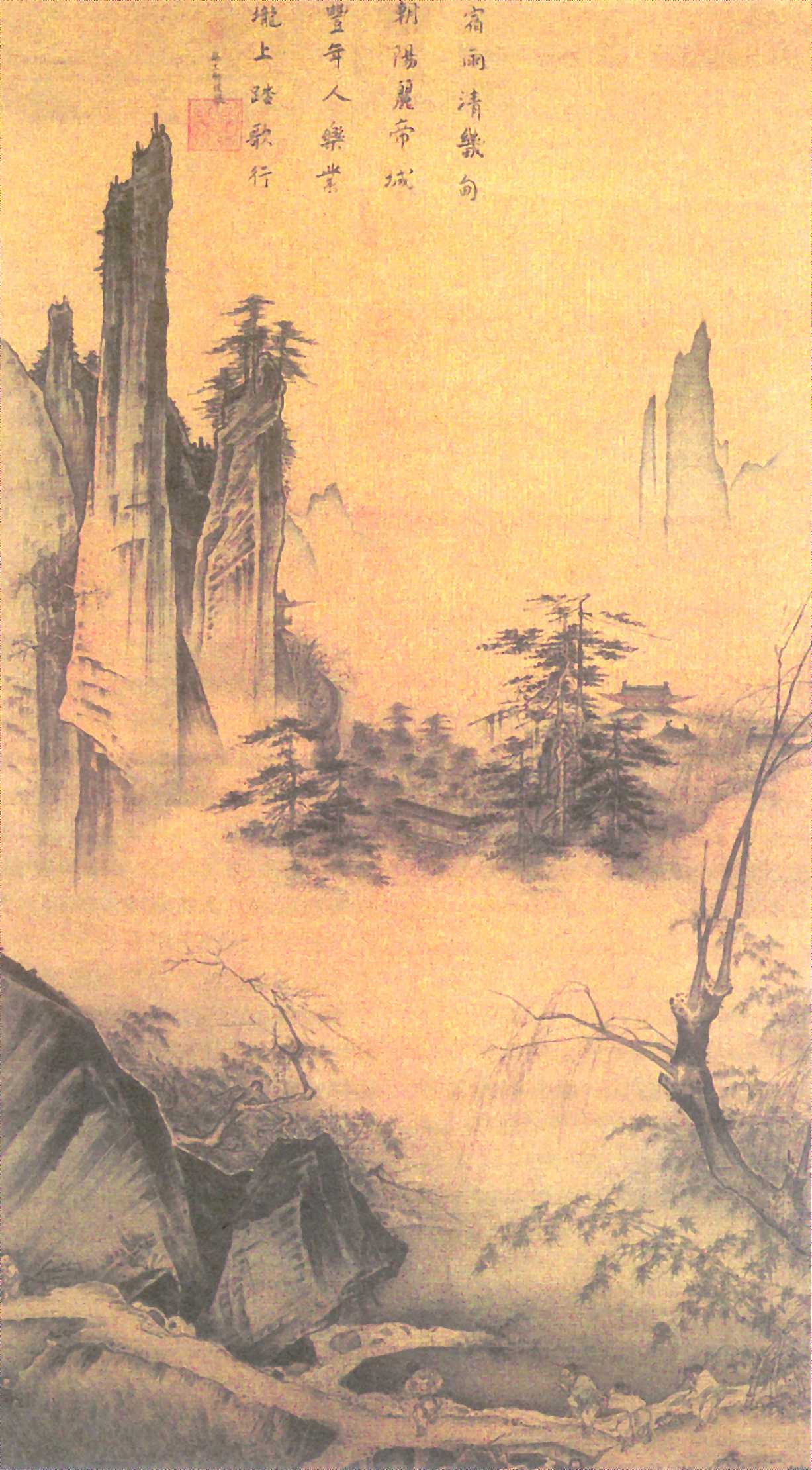
(big picture- click for full size)
THE COLD MOUNTAIN POEMS, tr. Gary Snyder
1
The path to Han-shan’s place is laughable,
A path, but no sign of cart or horse.
Converging gorges – hard to trace their twists
Jumbled cliffs – unbelievably rugged.
A thousand grasses bend with dew,
A hill of pines hums in the wind.
And now I’ve lost the shortcut home,
Body asking shadow, how do you keep up?
2
In a tangle of cliffs, I chose a place –
Bird paths, but no trails for me.
What’s beyond the yard?
White clouds clinging to vague rocks.
Now I’ve lived here – how many years –
Again and again, spring and winter pass.
Go tell families with silverware and cars
“What’s the use of all that noise and money?”
3
In the mountains it’s cold.
Always been cold, not just this year.
Jagged scarps forever snowed in
Woods in the dark ravines spitting mist.
Grass is still sprouting at the end of June,
Leaves begin to fall in early August.
And here I am, high on mountains,
Peering and peering, but I can’t even see the sky.
4
I spur my horse through the wrecked town,
The wrecked town sinks my spirit.
High, low, old parapet walls
Big, small, the aging tombs.
I waggle my shadow, all alone;
Not even the crack of a shrinking coffin is heard.
I pity all those ordinary bones,
In the books of the Immortals they are nameless.
5
I wanted a good place to settle:
Cold Mountain would be safe.
Light wind in a hidden pine –
Listen close – the sound gets better.
Under it a gray haired man
Mumbles along reading Huang and Lao.
For ten years I havn’t gone back home
I’ve even forgotten the way by which I came.
6
Men ask the way to Cold Mountain
Cold Mountain: there’s no through trail.
In summer, ice doesn’t melt
The rising sun blurs in swirling fog.
How did I make it?
My heart’s not the same as yours.
If your heart was like mine
You’d get it and be right here.
7
I settled at Cold Mountain long ago,
Already it seems like years and years.
Freely drifting, I prowl the woods and streams
And linger watching things themselves.
Men don’t get this far into the mountains,
White clouds gather and billow.
Thin grass does for a mattress,
The blue sky makes a good quilt.
Happy with a stone under head
Let heaven and earth go about their changes.
8
Clambering up the Cold Mountain path,
The Cold Mountain trail goes on and on:
The long gorge choked with scree and boulders,
The wide creek, the mist blurred grass.
The moss is slippery, though there’s been no rain
The pine sings, but there’s no wind.
Who can leap the word’s ties
And sit with me among the white clouds?
9
Rough and dark – the Cold Mountain trail,
Sharp cobbles – the icy creek bank.
Yammering, chirping – always birds
Bleak, alone, not even a lone hiker.
Whip, whip – the wind slaps my face
Whirled and tumbled – snow piles on my back.
Morning after morning I don’t see the sun
Year after year, not a sign of spring.
10
I have lived at Cold Mountain
These thirty long years.
Yesterday I called on friends and family:
More than half had gone to the Yellow Springs.
Slowly consumed, like fire down a candle;
Forever flowing, like a passing river.
Now, morning, I face my lone shadow:
Suddenly my eyes are bleared with tears.
11
Spring water in the green creek is clear
Moonlight on Cold Mountain is white
Silent knowledge – the spirit is enlightened of itself
Contemplate the void: this world exceeds stillness.
12
In my first thirty years of life
I roamed hundreds and thousands of miles.
Walked by rivers through deep green grass
Entered cities of boiling red dust.
Tried drugs, but couldn’t make Immortal;
Read books and wrote poems on history.
Today I’m back at Cold Mountain:
I’ll sleep by the creek and purify my ears.
13
I can’t stand these bird songs
Now I’ll go rest in my straw shack.
The cherry flowers are scarlet
The willow shoots up feathery.
Morning sun drives over blue peaks
Bright clouds wash green ponds.
Who knows that I’m out of the dusty world
Climbing the southern slope of Cold Mountain?
14
Cold Mountain has many hidden wonders,
People who climb here are always getting scared.
When the moon shines, water sparkles clear
When the wind blows, grass swishes and rattles.
On the bare plum, flowers of snow
On the dead stump, leaves of mist.
At the touch of rain it all turns fresh and live
At the wrong season you can’t ford the creeks.
15
There’s a naked bug at Cold Mountain
With a white body and a black head.
His hand holds two book scrolls,
One the Way and one its Power.
His shack’s got no pots or oven,
He goes for a long walk with his shirt and pants askew.
But he always carries the sword of wisdom:
He means to cut down sensless craving.
16
Cold Mountain is a house
Without beans or walls.
The six doors left and right are open
The hall is sky blue.
The rooms all vacant and vague
The east wall beats on the west wall
At the center nothing.
Borrowers don’t bother me
In the cold I build a little fire
When I’m hungry I boil up some greens.
I’ve got no use for the kulak
With hs big barn and pasture –
He just sets uo a prison for himself.
Once in he can’t get out.
Think it over –
You know it might happen to you.
17
If I hide out at Cold Mountain
Living off mountain plants and berries –
All my lifetime, why worry?
One follows his karma through.
Days and months slip by like water,
Time is like sparks knocked off flint.
Go ahead and let the world change –
I’m happy to sit among these cliffs.
18
Most T’ien-t’ai men
Don’t know Han-shan
Don’t know his real thought
And call it silly talk.
19
Once at Cold Mountain, troubles cease –
No more tangled, hung up mind.
I idly scribble poems on the rock cliff,
Taking whatever comes, like a drifting boat.
20
Some critic tried to put me down –
“Your poems lack the Basic Truth of Tao.”
And I recall the old timers
Who were poor and didn’t care.
I have to laugh at him,
He misses the point entirely,
Men like that
Ought to stick to making money.
21
I’ve lived at Cold Mountain – how many autumns.
Alone, I hum a song – utterly without regret.
Hungry, I eat one grain of Immortal medicine
Mind solid and sharp; leaning on a stone.
22
On top of Cold Mountain the lone round moon
Lights the whole clear cloudless sky.
Honor this priceless natural treasure
Concealed in five shadows, sunk deep in the flesh.
23
My home was at Cold Mountain from the start,
Rambling among the hills, far from trouble.
Gone, and a million things leave no trace
Loosed, and it flows through galaxies
A fountain of light, into the very mind –
Not a thing, and yet it appears before me:
Now I know the pearl of the Buddha nature
Know its use: a boundless perfect sphere.
24
When men see Han-shan
They all say he’s crazy
And not much to look at –
Dressed in rags and hides.
They don’t get what I say
And I don’t talk their language.
All I can say to those I meet:
“Try and make it to Cold Mountain.”
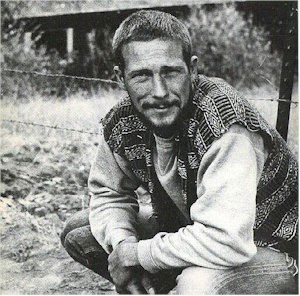
Next, here are some different translations, some have slight differences from the same ones translated by Snyder. You can decide what resonates the most for you. I’m not sure where I found these and can’t identify the translator. Maybe somebody will sue me and I’ll know then.
Introduction
Han-shan, the Master of Cold Mountain, and his friend Shi-te, lived in the late-eighth to early-ninth century AD, in the sacred T’ien-t’ai Mountains of Chekiang Province, south of the bay of Hangchow. The two laughing friends, holding hands, come and go, but mostly go, dashing into the wild, careless of others’ reality, secure in their own. As Han-shan himself says, his Zen is not in the poems. Zen is in the mind.
The Poems
1.
Don’t you know the poems of Han-shan?
They’re better for you than scripture-reading.
Cut them out and paste them on a screen,
Then you can gaze at them from time to time.

2.
Where’s the trail to Cold Mountain?
Cold Mountain? There’s no clear way.
Ice, in summer, is still frozen.
Bright sun shines through thick fog.
You won’t get there following me.
Your heart and mine are not the same.
If your heart was like mine,
You’d have made it, and be there!
3.
Cold Mountain’s full of strange sights.
Men who go there end by being scared.
Water glints and gleams in the moon,
Grasses sigh and sing in the wind.
The bare plum blooms again with snow,
Naked branches have clouds for leaves.
When it rains, the mountain shines –
In bad weather you’ll not make this climb.
4.
A thousand clouds, ten thousand streams,
Here I live, an idle man,
Roaming green peaks by day,
Back to sleep by cliffs at night.
One by one, springs and autumns go,
Free of heat and dust, my mind.
Sweet to know there’s nothing I need,
Silent as the autumn river’s flood.

5.
High, high, the summit peak,
Boundless the world to sight!
No one knows I am here,
Lone moon in the freezing stream.
In the stream, where’s the moon?
The moon’s always in the sky.
I write this poem: and yet,
In this poem there is no Zen.
6
Thirty years in this world
I wandered ten thousand miles,
By rivers, buried deep in grass,
In borderlands, where red dust flies.
Tasted drugs, still not Immortal,
Read books, wrote histories.
Now I’m back at Cold Mountain,
Head in the stream, cleanse my ears.
7.
Bird-song drowns me in feeling.
Back to my shack of straw to sleep.
Cherry-branches burn with crimson flower,
Willow-boughs delicately trail.
Morning sun flares between blue peaks,
Bright clouds soak in green ponds.
Who guessed I’d leave that dusty world,
Climbing the south slope of Cold Mountain?
8.
I travelled to Cold Mountain:
Stayed here for thirty years.
Yesterday looked for family and friends.
More than half had gone to Yellow Springs.
Slow-burning, life dies like a flame,
Never resting, passes like a river.
Today I face my lone shadow.
Suddenly, the tears flow down.
9.
Alive in the mountains, not at rest,
My mind cries for passing years.
Gathering herbs to find long life,
Still I’ve not achieved Immortal.
My field’s deep, and veiled in cloud,
But the wood’s bright, the moon’s full.
Why am I here? Can’t I go?
Heart still tied to enchanted pines!
10.
If there’s something good, delight!
Seize the moment while it flies!
Though life can last a hundred years,
Who’s seen their thirty thousand days?
Just an instant then you’re gone.
Why sit whining over things?
When you’ve read the Classics through,
You’ll know quite enough of death.
11.
The peach petals would like to stay,
But moon and wind blow them on.
You won’t find those ancient men,
Those dynasties are dead and gone.
Day by day the blossoms fall,
Year by year the people go.
Where the dust blows through these heights,
There once shone a silent sea.
12.
Men who see the Master
Of Cold Mountain, say he’s mad.
A nothing face,
Body clothed in rags.
Who dare say what he says?
When he speaks we can’t understand.
Just one word to you who pass –
Take the trail to Cold Mountain!
13.
Han-shan has his critics too:
‘Your poems, there’s nothing in them!’
I think of men of ancient times,
Poor, humble, but not ashamed.
Let him laugh at me and say:
‘It’s all foolishness, your work!’
Let him go on as he is,
All his life lost making money.
14.
Cold Mountain holds a naked bug,
Its body’s white, its head is black.
In its hands a pair of scrolls,
One the Way and one its Power.
It needs no pots or stove.
Without clothes it wanders on,
But it carries Wisdom’s blade,
To cut down mindless craving.
15.
I’m on the trail to Cold Mountain.
Cold Mountain trail never ends.
Long clefts thick with rock and stones,
Wide streams buried in dense grass.
Slippery moss, but there’s been no rain,
Pine trees sigh, but there’s no wind.
Who can leap the world’s net,
Sit here in the white clouds with me?
16.
Men ask the way through the clouds,
The cloud way’s dark, without a sign.
High summits are of naked rock.
In deep valleys sun never shines.
Behind you green peaks, and in front,
To east the white clouds, and to west –
Want to know where the cloud way lies?
It’s there, in the centre of the Void!
17.
Sitting alone by folded rocks,
Mist swirling even at noon,
Here, inside my room, it’s dark.
Mind is bright, clear of sound.
Through the shining gate in dream.
Back by the stone bridge, mind returns.
Where now the things that troubled me?
Wind-blown gourd rattling in the tree.
18.
Far-off is the place I chose to live.
High hills make for silent tongues.
Gibbons screech in valley cold
My gate of grass blends with the cliff.
A roof of thatch among the pines,
I dig a pool, feed it from the stream.
No time now to think about the world,
The years go by, shredding ferns.
19.
Level after level, falls and hills,
Blue-green mist clasped by clouds.
Fog wets my flimsy cap,
Dew soaks my coat of straw.
A pilgrim’s sandals on my feet,
An old stick grasped in my hand.
Gazing down towards the land of dust,
What is that world of dreams to me?
20.
What a road the Cold Mountain road!
Not a sign of horse or cart.
Winding gorges, tricky to trace.
Massive cliffs, who knows how high?
Where the thousand grasses drip with dew,
Where the pine trees hum in the wind.
Now the path’s lost, now it’s time
For body to ask shadow: ‘Which way home?’
21.
Always it’s cold on this mountain!
Every year, and not just this.
Dense peaks, thick with snow.
Black pine-trees breathing mist.
It’s summer before the grass grows,
Not yet autumn when the leaves fall.
Full of illusions, I roam here,
Gaze and gaze, but can’t see the sky.
22.
No knowing how far it is,
This place where I spend my days.
Tangled vines move without a breeze,
Bamboo in the light shows dark.
Streams down-valley sob for whom?
Mists cling together, who knows why?
Sitting in my hut at noon,
Suddenly, I see the sun has risen.
23.
The everyday mind: that is the way.
Buried in vines and rock-bound caves,
Here it’s wild, here I am free,
Idling with the white clouds, my friends.
Tracks here never reach the world;
No-mind, so what can shift my thought?
I sit the night through on a bed of stone,
While the moon climbs Cold Mountain.
24.
I was off to the Eastern Cliff.
Planned that trip for how long?
Dragged myself up by hanging vines,
Stopped halfway, by wind and fog.
Thorn snatched my arm on narrow tracks,
Moss so deep it drowned my feet,
So I stopped, under this red pine.
Head among the clouds, I’ll sleep.
25.
Bright water shimmers like crystal,
Translucent to the furthest depth.
Mind is free of every thought
Unmoved by the myriad things.
Since it can never be stirred
It will always stay like this.
Knowing, this way, you can see,
There is no within, no without.
26.
Are you looking for a place to rest?
Cold Mountain’s good for many a day.
Wind sings here in the black pines,
Closer you are, the better it sounds.
There’s an old man sitting by a tree,
Muttering about the things of Tao.
Ten years now, it’s been so long
This one’s forgotten his way home.
27.
Cold rock, no one takes this road.
The deeper you go, the finer it is.
White clouds hang on high crags.
On Green Peak a lone gibbon’s cry.
What friends do I need?
I do what pleases me, and grow old.
Let face and body alter with the years,
I’ll hold to the bright path of mind.
A few more, various translators. I ask myself: What is the true heart of Han Shan? I studies Chinese to get a better idea but it only made me more confused. These other poets do a much better job of reading than I do.
Birth and Death. Day and Night.
Running water, stagnant pool.
Bud and fading flower.
Can I find the point at which they change
From one into the other?
Can my nostrils turn upwards?
When the mind keeps tumbling
How can vision be anything but blurred?
Stop the mind even for a moment
And all becomes transparently clear!
The moving mind is polishing mud bricks.
In stillness find the mirror!
– Han Shan Te’-Ch’ing, 1600
Selected Poems by Han-Shan (Silly Mountain)
I laugh at my failing strength in old age,
Yet still dote on pines and crags, to wander there in solitude.
How I regret that in all these past years until today,
I’ve let things run their course like an unanchored boat.
– Shih-te, 750
Translated by James Hargett
after late spring rain the falling petals swirl
weightlessly celestial scent covers my patched robe
a simple vacant mind has no place to go
resting on the peak I watch the clouds return
– Han Shan Te’-Ch’ing, 1600
Translated by Red Pine
Echoes of Eternity
Thirty years ago I was born into the world.
A thousand, ten thousand miles I’ve roamed,
By rivers where the green grass lies thick,
Beyond the border where the red sands fly.
I brewed potions in a vain search for life everlasting,
I read books, I sang songs of history,
And today I’ve come home to Cold Mountain
To pillow my head on the stream and wash my ears.
– Han Shan, 750
Translated by Burton Watson
Cold Mountain: One Hundred Poems
Mountains in China
I think of the past twenty years,
When I used to walk home quietly from the Kuo-ch’ing;
All the people in the Kuo-ch’ing monastery-
They say, “Han-shan is an idiot.”
“Am I really an idiot:” I reflect.
But my reflections fail to solve the question:
for I myself do not know who the self is,
And how can others know who I am?
– Han Shan, 750
Translated by D. T. Suzuki
Essays in Zen Buddhism, Third Series, 1953
Great accomplishments are composed of minute details.
Those who succeed in attaining the Whole
have attended carefully to each tiny part.
Those who fail have ignored or taken too lightly
what they deemed to be insignificant.
The enlightened person overlooks nothing.
– Han Shan Te’-ch’ing, 1600
The Maxims of Master Han Shan Te’-Ch’ing
Translated by Grandmaster Jy Din Shakya
Ha ha ha.
If I show joy and ease my troubled mind,
Worldly troubles into joy transform.
Worry for others–it does no good in the end.
The great Dao, all amid joy, is reborn.
In a joyous state, ruler and subject accord,
In a joyous home, father and son get along.
If brothers increase their joy, the world will flourish.
If husband and wife have joy, it’s worthy of song.
What guest and host can bear a lack of joy?
Both high and low, in joy, lose their woe before long.
Ha ha ha.
– Han Shan, 750
Translated by Mary Jacob
outside my door
blue mountains bouquet
before the window
yellow leaves rustle
I sit in meditation
without the least word
and look back to see
my illusions completely gone
– Han Shan Te’-Ch’ing, 1600
Translated by J. P. Seaton
Mountain Living
Hanshan came specially to see me,
Shihte too, a rare visitor.
We spoke unaffectedly and with without reserve
of the Mind,
How vast and free the Great Emptinesss,
How boundless the universe,
Each thing containing within itself all things.
– Feng Kan (Big Stick), 750
Translated by R. H. Blyth
Zen and Zen Classics, p 131
This is my resting place;
Now that I know the best retreat.
The breeze blows through the pines,
Sounding better the nearer it is.
Under a tree I’m reading
Lao-tzu, quietly perusing.
Ten years not returning,
I forgot the way I had come.
– Han Shan, 750
Translated by Katsuki Sekida
Kyozan asked a monk,
“Where are you from?”
“Cold Mountain,” answered the monk.
“Have you reached the Five Peaks of Cold Mountain?”
“No, not yet,” said the monk.
Kyozan said, “You are not from Cold Mountain.”
Later, Ummon said, “This talk of Kyozan was
falling into the weeds,
all out of kindness.”
Setcho’s Verse:
Falling or not falling, who can tell?
White clouds piling up,
Bright sun shining down,
Faultless the left, mature the right.
Don’t you know Han Shan?
He went very fast;
Ten years not returning,
He forgot the way he had come.
– The Blue Cliff Records, Case 34
Two Zen Classics: Mumonkan and Hekiganroku (1977)
Translated by Katsuki Sekida
 _
_
good night
Filed under buddhism, Chinese poetry, Mystic Poetry, pictures, poetry, Spirituality
Buddhist Video
The Wandering Mind – Andrea Fella Audio Dharma ; Insight Meditation Center ; Andrea Fella
go here.
PORTS
This from Mike’s blog, New Directions:
Peer Operated Recovery Treatment and Support (PORTS)
A Mental Health Recovery Model
Developed by Michael Hlebechuk
PORTS is a mental health self-directed care model that combines mental health brokerage services with a peer counseling/advocacy education program and a couple of evidence based practices that actually work. There are no outcome studies to demonstrate the efficacy of PORTS. It has never been implemented. I drafted it up in response to a question for a job interview. I firmly believe, however, that if implemented this model would help people along the road to recovery in ways we haven’t seen yet through a formal program. The 2 page draft that outlines PORTS is located at:
http://www.oregon.gov/DHS/mentalhealth/consumers-families/ports.pdf

Here is an excerpt from the first page of the pdf linked above:
Recovery has become a major buzzword in the mental health community. Mental health systems are
beginning to focus seriously on assisting people with psychiatric disability to recover and move on
with their lives.i Scientific research has yielded practices that have an evidence base to support their
effectiveness in helping people recover from mental illness. People with psychiatric histories have
provided valuable input into system design, pointing to new treatment methods and principles that
foster their gaining productive roles in the community and having meaning restored to their lives.
SAMHSA’s Center for Mental Health Services has investigated treatment modalities that put
control into the hands of people receiving treatment. Self-directed care, person centered planning,
and consumer operated services along with evidence based practices have become the cornerstones
to achieving the promise of transforming mental health care in America in ways that promote the
dignity, respect, and recovery of the individual. The paragraphs that follow offer an example of how
various recovery-oriented treatment approaches can operate in concert to promote people moving
on with their lives.
The Peer Operated Recovery Treatment and Support (PORTS) Project lies at the core of the
proposed treatment delivery system. PORTS is a consumer-operated service program (COSP) that
provides treatment coordination and resource brokerage services. Individual customers who have
agreed to engage in a recovery plan that includes the goal of obtaining paid or voluntary
employment are referred to PORTS by the behavioral health organization. Customers are linked
with a Peer Advocate Mentor (PAM) and a Recovery Specialist. The PAM is supervised by the
PAM Project, a third party COSP. The PAM will work with the customer to develop recovery
strategies and ensure that services are provided in a dignified and respectful manner. The Recovery
Specialist is a PORTS employee who will coordinate the customer’s mental health and resource
brokerage services.
Customers will receive a PORTS orientation within a week of being referred. During orientation
customers will hear recovery stories from individuals with similar diagnoses who have taken firm
steps to move on with their lives. They will gain hope in learning that people can and do recover
from mental illness. Customers will also learn about PORTS’ mission, self-directed care, selfdetermination
and recovery principles during this first week.
All PORTS services are delivered through a person centered planning process. Through this process
the customer develops a person centered plan with the assistance of a PORTS Recovery Specialist,
the PAM, and any individuals the customer invites to be members of the circle of support. Circles of
support are generally composed of the family members, friends, and professionals the customer
believes are most supportive. The resulting person centered plan is more than a treatment plan. It is
a life-plan; complete with the individual’s dreams and goals and steps to make them a reality. These
steps are detailed in Action Plans.
Each PORTS customer will be allotted an individual resource budget of $2,000 for the first year of
service. Through this budget customers may purchase services and supports within the community
or from a participating mental health provider to carry out an Action Plan. Take, for example, an
Action Plan with the stated goal of obtaining employment. A step toward this goal may be the
purchase of a set of clothes to wear at job interviews. The Action Plan would detail the budgeted
amount for each of these purchases. Core mental health services such as symptom monitoring,
medication management, addictions counseling, acute care and crisis services are provided by the
behavioral healthcare organization per the person centered plan and are not purchased through the
individual resource budget. Fifty percent of the funds that remain in the individual resource budget
after an annual cycle of service are carried over into next year’s budget. An additional $500 is
added to the second and subsequent year’s budgets. All brokered community services and supports
purchased through individual resource budgets must be approved by the Recovery Specialist. All
purchases over $100 must be approved by a representative of the behavioral health organization.
So, PORTS seems to be an approach to implementing person directed, brokerage style services and supports in mental health. Sounds good!

To: Members of the Oregon Consumer/Survivor Council and Interested
Parties
From: Michael Hlebechuk, Chair
Re: Meeting announcement
The next meeting of the Oregon Consumer/Survivor Council will be held
on Wednesday, October 8, from 1:00 to 4:00 PM in meeting room HSB-352
located on the 3rd floor of the Barbara Roberts Human Services
Building (DHS main office), 500 Summer St NE, Salem, OR.
Minutes of the previous meeting: csc-minutes-081308

Why has the font on my blog gotten so tiny??
With suicide rates higher than they’ve ever been, the stress of combat and long deployments, the US Military should be doing everything it can to address the mental health needs of its soldiers.
Instead, soldiers in crisis are currently being offered little more than pills.
They deserve better.
They deserve alternatives to the one-size-fits-all, pharmaceutical approach to mental health.
On October 5, 2008 MindFreedom International will delivered signatures to the campaign headquarters of both Barack Obama and John McCain.

From Beyond Meds, a recovery oriented blog found here. For the whole post, go to the source.
When I was at my acupuncturists the other day I basically collapsed on the table after pounding on her office door when I couldn’t tolerate sitting in the office. I REALLY needed to lay down. I can sit in recliner type chairs but an upright chair I can last in only so long and I had reached my limit at the health food store where I had lunch before I went to accupuncture.
I learned that it was the acupuncture that made my endometriosis pain almost non-existent. It is, after all, the reason I went to the acupuncturist in the first place but I didn’t expect such rapid results. Almost totally pain free after two treatments. She told me that pain is usually the easiest symptom to treat and the rest of my hormonal issues and my basic poor health would probably take much longer to deal with.
Her diagnosis of my situation in the Chinese way of interpreting things is that my liver is in serious shape. Since Chinese medicine deals with the whole being I’m really being treated for everything my body is suffering from even though I presented saying I needed help balancing my hormones.
In any case, I collapsed on her table after being out for an hour—I was sick of staying in bed and so my husband took me to lunch. But that hour was really too much and as I collapsed on her table I burst into tears.
It ended up being like a therapy session. I told her I was dealing with so much anger. And rage. My circumstances so damn frustrating. Doctor after doctor mishandling me. Making me sicker. My rage is targeted mostly at my sister who doesn’t give a shit that I’m sick and at my last doctor who seems to have no interest in admitting any fault and is therefore just as bad as any drug pushing doctor. It’s also targeted at people in the recovery movement who think that their road to recovery is the only road to recovery and they seem to dare to think that if I only followed their way I would be well by now. One thing I’ve learned on this journey is that there are as many roads to recovery as there are people. My recovery stories page on this blog gives a glimpse of this—-all different methods of recovery…I borrow from many of their journeys, but ultimately I trust my gut. And so should anyone else struggling to recover…There is nothing tried and true for every person who has been labeled. No one thing. Perhaps the only necessary ingredient is believing that one can get better and all of these people have that and I do too, in spades.
In any case I have rage. It’s probably primal rage and it’s just glomming on to whoever is an attractive target right now.
How do I clear it out? How do I forgive my sister and my doctor? How do I embrace the giant egos of some of my recovered friends when they seem to condescend on my journey? (please don’t everyone assume I’m thinking of YOU…it’s just a couple of people really)
One thing is clear. I have no mental illness, but I’m very very physically sick. The drugs made me sick. The withdrawal made me sick. My prescribing psychiatrist who is watching me go through this process agrees. My husband who knows me intimately agrees. No mental illness…nope, just sickness caused by drugs and drug withdrawal.
Mad Liberation by Moonlight
The full moon is on October 14th this time. This would make the radio show happen on Friday night, 10/17/08. I have to clear this with Dan but so far, that’s the plan.
Mad Liberation
by Moonlight
Friday! On KBOO Radio 90.7 FM
1- 2 a.m. Late Friday night
(yes, I know that it is technically Saturday morning- relax, it’s just a radio show)
October 17th, 2008
This show is dedicated to Everyone
*who has ever been given a psychiatric label, *who experiences mental health challenges and of course to *anybody who has the misfortune (or good fortune) of being awake at that hour.
You can participate!
Call in at (503) 231-8187
We also hope to have some live in-studio musical
performance by CS/X performers on this show.
(Set your alarm if you aren’t usually up at that time)
Friday nights from 1 am to 2 am usually following the full-moon, will be a segment on KBOO radio (90.7 on your fm dial, to the left of NPR), also streamed on the internet on their website, http://www.kboo.fm/index.php will be time for Mad Lib by Moonlight. The program is part of the usual Friday night show, The Outside World.

Excerpt From: The Rape of the Mind
Source material- go to
http://www.ninehundred.net/control/
The Psychology of Thought Control, Menticide, and Brainwashing
by
Joost A. M. Meerloo, M.D
NOTE: This work has been long out of print, last known publication date 1956, the World Publishing Company. Of course, the technology has advanced and the techniques have been refined, but the principles remain the same.
from the Forward:
“And fear not them which kill the body, but are not able to kill the soul.” -Matthew 10:28
This book attempts to depict the strange transformation of the free human mind into an automatically responding machine a transformation which can be bought about by some of the cultural undercurrents in our present day society as well as by deliberate experiments in the service of a political ideology.
The rape of the mind and stealthy mental coercion are among the oldest crimes of mankind. They probably began back in pre historic days wheh man first discovered that he could exploit human qualities of empathy and understanding in order to exert power over his fellow men. The word “rape” is derived from the Latin word _rapere_, to snatch, but also is related to the words to rave and raven. It means to overwhelm and to enrapture, to invade, to usurp, to pillage and to steal.
The modern words “brainwashing,” “thought control,” and “menticide” serve to provide a clearer conception of the actual methods by which man’s integrity can be violated. When a concept is given its right name, it can be more easily recognized and it is with this recognition that the opportunity for systematic correction begins.
In this book the reader will find a discussion of some of the imminent dangers which threaten free cultural interplay. It emphasizes the tremendous cultural implication of the subject of enforced mental intrusion. Not only the artificial techniques of coercion are important but even more the unobtrusive intrusion into our feeling and thinking. The danger of destruction of the spirit may be compared to the threat of total physical destruction through atomic warfare. Indeed, the two are related and intertwined…..
from the first chapter:
The first part of this book is devoted to various techniques used to make man a meek conformist. In addition to actual political occurrences, attention is called to some ideas born in the laboratory and to the drug techniques that facilitate brainwashing. The last chapter deals with the subtle psychological mechanisms of mental submission.
CHAPTER ONE — YOU TOO WOULD CONFESS
A fantastic thing is happening in our world. Today a man is no longer punished only for the crimes he has in fact committed. Now he may be compelled to confess to crimes that have been conjured up by his judges, who use his confession for political purposes. It is not enough for us to damn as evil those who sit in judgment. We must understand what impels the false admission of guilt; we must take another look at the human mind in all its frailty and vulnerability.
The Enforced Confession
During the Korean War, an officer of the United States Marine Corps, Colonel Frank H. Schwable, was taken prisoner by the Chinese Communists. After months of intense psychological pressure and physical degradation, he signed a well documented “confession” that the United States was carrying on bacteriological warfare against the enemy. The confession named names, cited missions, described meetings and strategy conferences. This was a tremendously valuable propaganda tool for the totalitarians. They cabled the news all over the world: “The United States of America is fighting the peace loving people of China by dropping bombs loaded with disease spreading bacteria, in violation of international law.”
After his repatriation, Colonel Schwable issued a sworn statement repudiating his confession, and describing his long months of imprisonment. Later, he was brought before a military court of inquiry. He testified in his own defense before that court: “I was never convinced in my own mind that we in the First Marine Air Wing had used bug warfare. I knew we hadn’t, but the rest of it was real to me the conferences, the planes, and how they would go about their missions.”
“The words were mine,” the Colonel continued, “but the thoughts were theirs. That is the hardest thing I have to explain: how a man can sit down and write something he knows is false, and yet, to sense it, to feel it, to make it seem real.”
This is the way Dr. Charles W. Mayo, a leading American physician and government representative, explained brainwashig in an official statement before the United Nations: “…the tortures used…although they include many brutal physical injuries, are not like the medieval torture of the rack and the thumb screw. They are subtler, more prolonged, and intended to be more terrible in their effect. They are calculated to disintegrate the mind of an intelligent victim, to distort his sense of values, to a point where he will not simply cry out ‘I did it!’ but will become a seemingly willing accomplice to the complete disintegration of his integrity and the production of an elaborate fiction.”
The Schwable case is but one example of a defenseless prisoner being compelled to tell a big lie. If we are to survive as free men, we must face up to this problem of politically inspired mental coercion, with all its ramifications.
It is more than twenty years [in 1956] since psychologists first began to suspect that the human mind can easily fall prey to dictatorial powers. In 1933, the German Reichstag building was burned to the ground. The Nazis arrested a Dutchman, Marinus Van der Lubbe, and accused him of the crime. Van der Lubbe was known by Dutch psychiatrists to be mentally unstable. He had been a patient in a mental institution in Holland. And his weakness and lack of mental balance became apparent to the world when he appeared before the court. Wherever news of the trial reached, men wondered: “Can that foolish little fellow be a heroic revolutionary, a man who is willing to sacrifice his life to an ideal?”
During the court sessions Van der Lubbe was evasive, dull, and apathetic. Yet the reports of the Dutch psychiatrists described him as a gay, alert, unstable character, a man whose moods changed rapidly, who liked to vagabond around, and who had all kinds of fantasies about changing the world.
On the forty second day of the trial, Van der Lubbe’s behavior changed dramatically. His apathy disappeared. It became apparent that he had been quite aware of everything that had gone on during the previous sessions. He criticized the slow course of the procedure. He demanded punishment either by imprisonment or death. He spoke about his “inner voices.” He insisted that he had his moods in check. Then he fell back into apathy. We now recognize these symptoms as a combination of behavior forms which we can call a confession syndrome. In 1933 this type of behavior was unknown to psychiatrists. Unfortunately, it is very familiar today and is frequently met in cases of extreme mental coercion.
Van der Lubbe was subsequently convicted and executed. When the trial was over, the world began to realize that he had merely been a scapegoat. The Nazis themselves had burned down the Reichstag building and had staged the crime and the trial so that they could take over Germany. Still later we realized that Van der Lubbe was the victim of a diabolically clever misuse of medical knowledge and psychologic technique, through which he had been transformed into a useful, passive, meek automaton, who replied merely yes or no to his interrogators during most of the court sessions. In a few moments he threatened to jump out of his enforced role. Even at that time there were rumors that the man had been drugged into submission, though we never became sure of that.
[NOTE: The psychiatric report about the case of Van der Lubbe is published by Bonhoeffer and Zutt. Though they were unfamiliar with the “menticide syndrome,” and not briefed by their political fuehrers, they give a good description about the pathologic, apathetic behavior, and his tremendous change of moods. They deny the use of drugs.]
This is powerful reading- I encourage you to take a closer look. The book has ramifications that are very timely both in terms of geo-politics and psychiatric politics.

From my favorite mental health blogger, Ron Unger-
(his blog, Recovery from Schizofrenia-http://recoveryfromschizophrenia.org/blog/)
Posted by Ron Unger on October 5th, 2008
Here in Lane County Oregon, USA, a group known as the Consumer Council, working closely with MindFreedom, has been pushing to put in place official guidelines which would hopefully change the behavior of mental health professionals. Two of the important things we are asking them to do is to quit misleading and disempowering people into believing that genetic and biological explanations of “mental illness” are fact, and to let people know they may eventually be able to live successfully without medication and that help is available to them in making that transition.
So far we have gotten the local mental health system to move forward with some vague and poorly explained guidelines, though even these have gotten the professionals stirred up as they find themselves being asked to take into account consumer concerns. What follows is a copy of an email about the concerns of the “treatment team” of the county mental health department, followed by my rebuttal. I thought it might be of interest to those of you who are pushing for change in your own mental health system.
I have changed the name of the mental health worker who wrote this email, as I didn’t ask her permission to post it here.
From: Brenda
Sent: Tuesday, September 30, 2008 9:04 AM
To: LEVINE Al; *LC H&HS 2411 MLK Mental Health
Subject: RE: attached position on consummer empowerment
Hi, Al,
Sorry for the late reply. I hope this is timely enough for consideration.
Some concerns were expressed at Wednesday Treatment Team about this, both by the LMPs and by the clinicians.
Of particular concern was the paragraph on the second page requiring that “clients be correctly informed about what is known about their mental health condition and providers do not misinform clients with explanations that are disempowering (genetics, chemical imbalance).”
The problem highlighted with this wording is the assumption that information about biological factors that contribute to mental health issues is disempowering. There was a feeling voiced that this particular wording stemmed from local political pressures rather being based on empirical information.
There was also concern stated about the phrase in the third paragraph that stated that “current treatment, including medications, may be necessary for a limited time.” (Italics mine.)
Clearly, it would be misleading for anyone to tell a client that medications may be necessary only for a limited time. For many clients, that is not the case.
Finally, There was a question of what “alternative treatment” means, and an objection to the phrase “dependence on psychiatric medications.”
There is way too much in this document that seems to make specific directives without clear definition of what that entails.
Personally, I believe LCMH needs to make a position statement on consumer empowerment. I just have my doubts that policy and practice (Expressed in the Heading “Consumer Empowerment Guidelines”) should be guided by what appears to be local political pressure rather than by a broader “Memorandum of Understanding” (or some such) of what client empowerment consists of, and which LCMH takes the time and effort to draft on its own, taking into consideration an array of current policy and practice, as well as local consumer input.
If the Consumer Council wishes to make a definitive statement such as the one above, they have every right to do so and, I believe, should be encouraged to do so. However, I do not think it serves anyone well for LCMH to adopt a hybridized version that may bind practitioners to wording that could have unintended consequences down the line.
I think much better wording could be used to express a commitment to increased consumer participation in treatment and a strengths-based recovery model. My concern is that the statement as is stands is focused less on real client empowerment than on limitations placed on what providers may and may not say. I do believe that any clinical guidelines coming from LCMH need to recognize the fact that medication is certainly not the only answer in treating any mental health condition. I just don’t think this is the way to express that reality.
I refer you to the very excellent SAMHSA statement (thanks, Gina!) that answers the question: “What is Recovery?” It has a much more encompassing–and philosophically acceptable–statement on consumer empowerment.
http://mentalhealth.samhsa.gov/publications/allpubs/sma05-4129/
Thanks,
Brenda
[then what follows is my response:]
It was very interesting to read the concerns that came out of the Wednesday treatment team meeting. I understand that many of the guidelines didn’t make much sense to you, that they seemed to unnecessarily limit how providers talk about things and they seemed to you to just be based on politics, and not on any reasoned and evidence based efforts to improve mental health care. I think the fact that you got this impression points out a definite weakness in the guidelines, and that has to do with the fact that they included inadequate explanation of the reasons for their existence.
The guidelines you saw did not come directly from the Consumer Council, though they did start as a result of recommendations for guidelines that were made there. I don’t know who put all the words together as you saw them (and they have been changed more since) but it now seems clear they don’t sufficiently explain why guidelines are necessary, and the basis for them. I think that rather than weakening them till they say less and less (which seems to be happening as they go through more committees and reviews) they need to be revised to clearly explain why they are vitally necessary to protect consumers against harm imposed by the mental health system. Let me attempt to explain here.
If a woman has a physical injury which a doctor has reason to know will leave her permanently unable to walk, and the doctor informs her that she will have to depend on a wheelchair to get around for the rest of her life, the doctor is being perfectly reasonable in telling her that. It may be depressing and initially demoralizing news to her, but it helps her face reality and prepare to get on with her life.
Now let’s consider an example where a woman has a physical injury which is more ambiguous. In the history of medical observation, most people with this sort of injury have not been able to walk again, but a sizable minority have been able to walk again. Let’s consider that in this example the doctor also tells the patient that she will have to depend on a wheelchair to get around for the rest of her life. Do you see the problem with that? If the woman believes her doctor, she will not take an interest in therapy that might get her walking and spending time outside of her wheelchair, and she may well end up permanently disabled, not because of her injury, but because of misinformation from her doctor. This would properly be classified as medical system imposed disability.
In the example above, perhaps the doctor was worried about nurturing hopes that might turn out false, or perhaps the doctor was worried that if she attempted to get out of the wheelchair and walk she would further injure herself and the doctor wanted to prevent any risk of this happening. It doesn’t really matter what the motivation of the doctor was: the patient has the right to hear that there is a possibility of recovery, and the right to pursue a course of rehabilitation therapy even if there is some risk of further injury in the course of the therapy. The doctor violated her informed consent by failing to give her critically important facts about possible treatment alternatives.
I used an example from physical medicine, but the same principles can be applied to a mental health problem. Brenda’s message stated that “There was also concern stated about the phrase in the third paragraph that stated that “current treatment, including medications, may be necessary for a limited time.” (Italics mine.) Clearly, it would be misleading for anyone to tell a client that medications may be necessary only for a limited time. For many clients, that is not the case.” Following the reasoning in Brenda’s message, the doctor in the physical injury example might have stated that he could not tell his patient that she might walk again and not have to depend on a wheelchair, because clearly for many of his patients with such injuries, they were not able to do that! I hope it is obvious to all of you that the doctor’s logic would be flawed. When we say a person “may” recover and walk again, or recover and no longer need medications, that is very different from saying the person “will” recover in that way. All we need to say that a person “may” recover is examples of some people with the given condition who do recover.
(One might also ask how many of this doctor’s patients weren’t able to walk again just because they had been misled by the doctor into not trying to recover. Predictions of failure can make failure more likely, which is why it is critical not to exaggerate the likelihood of failure, or especially critical not to make it appear inevitable.)
Some of you may feel that the above example does not apply, because you are sure that some of your clients definitely have no chance of getting off medications and doing well. I would challenge you though, to find empirical evidence that shows that mental health professionals are able to reliably predict who has no chance of making such a recovery. Harding did a long term study in Vermont of the people with the worst prognosis in psychiatry, people with a diagnosis of schizophrenia who had been hospitalized for years in the so-called “back wards.” She found that decades later, a third or more of these people were off medications, showing no symptoms of schizophrenia, and living lives that involved work and relationships. Similar studies elsewhere also show many recovering (though percentages vary: a similar study in Maine showed a lower rate of recovery, probably because Maine did not offer the same assistance in rehabilitation offered in Vermont.) It seems to me that when we do not objectively know who will recover and who will not, we should just say we don’t know, and let people know they have a chance.
Some of you may claim that you know certain people cannot ever live successfully off medication, because they have already tried a number of times and failed. But the fact that a person had even multiple relapses after quitting medications is still not proof that medications will always be necessary: it is also possible to find stories of people with such multiple relapses who eventually got off the medications successfully and then had decades or the rest of their lives living successfully without any medications. So again, where we don’t have the ability to make a reliable prediction, we would do better to back off, and admit that either outcome is possible, including the possibility that the need for medication may still be for just a limited time, even though there have already been multiple relapses. (Of course, if competent help is provided to a person attempting to get off, which includes not just medical oversight in withdrawing slowly but also development of a relapse prevention plan and assistance in shifting to alternative coping, then it is much more likely that a future attempt to get off the medication will succeed, or at least not end in disaster.)
The mental health system has traditionally been afraid to tell people they might eventually not need medications, because they worry this will make clients quit medications while they are in fact still necessary for that person. But when clients are told that they will need medications for the rest of their lives, or even subtly led to believe they will always need medications just by never discussing with them the possibility that they will recover to a point where they won’t need medications, then the effect is to misinform them in a way that is disempowering (which violates the principle of informed consent). We don’t have a right to do that, and it isn’t adequate mental health treatment. It is much more honest, and it works well, to simply discuss openly the danger of quitting medications abruptly while they are still perhaps needed, and to introduce instead the option of gradually reducing medications while shifting to other forms of coping, always knowing one can resume more medications if it is decided that is necessary. This allows facing the uncertainty squarely, in an honest and transparent manner, with the consumer having a choice about how much risk to take, without the professional attempting to make that choice for the consumer.
Another problem with telling people they will always need to stay on medications, when we really don’t know for sure this is true, has to do with the risks of the medications. If we tell 100 people that they will always have to stay on medications, when in reality 10 of those people could have gotten off successfully if they knew this was possible, then we are responsible for keeping those ten people on highly risky medications for no reason whatsoever. If some of these people die early because of the effects of the medications, then we are responsible for their deaths. We might argue that, if we told all 100 people that they might be able to get off medications then lots of people might try getting off them who can’t handle it and that would cause more trouble overall than would be caused by keeping some people on medications unnecessarily, etc. But my point is, we don’t have any ethical right to make these kinds of decisions for people, or to make the 10 who could get off suffer or even die unnecessarily because it is more convenient for us to not disclose the possibility that some can get off medications successfully.
Another issue: there is also a danger of mental health system imposed disability when people are convinced of explanations of their problem which have a greater sense of permanence and which are less likely to be controllable by the person. That is, when people are convinced that they are mentally ill because of their genes, or because there is some kind of problem in their brain which is strictly biological and has nothing to do with how they are choosing to react to things, such as a “chemical imbalance,” they naturally feel less able to do anything about recovery, other than perhaps depend on taking pills for the rest of one’s life (with usually only partial success at most.) If I have a brain tumor, I’m not going to believe I can get rid of the problems it causes by changing my thoughts and behavior. I think this should be obvious enough to not require research backing, but in fact, for schizophrenia at least, there is research that shows that genetic and strictly biological explanations are disempowering and increase stigma. One article that summarizes this research is attached. [Well it’s not attached in this post, but if you post a comment and request a copy I can email it to you at the address you registered with.]
I have a friend who was in the mental health system for years, where he received both many medications including neuroleptics, as well as electroshock. He described to me how he recovered by reconsidering all his ways of thinking and processing information, in a process that took years. He is now a college professor with national recognition for his work, and of course has not taken any medication for many years. He could not have done this had he believed that he would be inevitably mentally ill due to his genes or some strictly biological process in his brain. Fortunately, he was able to reject the misinformation he got from the mental health system, but I don’t think recovery should have to depend on consumers figuring out how to reject our misinformation: they shouldn’t be misinformed to start out with.
The truth is, we don’t know that any consumer we see has even a genetic predisposition toward a mental illness, much less a genetic “cause” because there are no genetic tests. (You may believe that the evidence that genetic differences contribute to mental illness is strong – some others differ with this – but one thing that definitely doesn’t exist is evidence to show that everyone with a particular mental illness has a genetic difference. For example, there is evidence that genetic differences create a predisposition to PTSD, but for any given person with PTSD, we cannot say that there is a particular genetic difference. There could be many other reasons why that particular person has a mental health problem.) We also don’t know that any consumer we see has any specific brain difference that is causing the illness: there is no brain test for mental illness specifically because there are no brain differences that reliably always show up in people with a given diagnosis and never in people without the diagnosis (nor are there any brain differences that even come close to meeting this criteria.) This means that genetic and biological explanations are simply unproven theories. (They are also rather dubious theories if one attempts to take them as a complete explanation, because no one has ever explained how a mental illness caused by genes or a biologically based brain difference could go away over time in the cases of people who get off medication and go on to live highly successful lives.)
What is essential to maximizing chances for recovery is that consumers be given explanations that suggest a role for the consumer in his or her own recovery. (These explanations do not need to be presented as fact, but just as theories or possibilities that offer hope.) For example, consumers can be told that their mental problem may result from a reaction to life events, reactions which over time they could learn to shift. This conveys the belief that complete recovery is possible and that the consumer has a role in it, which are beliefs that are cited by those who do recover as being essential in their journey.
Just a couple more issues: I was curious about the objection to the phrase “dependence on psychiatric medications.” Was this a purely political objection, or was it based on some kind of reasoning or evidence? It seems to me that from every objective criteria, this is an appropriate use of the term “dependence.” Dependence on something is not necessarily a bad thing: for example if I had an irreparable spinal cord injury, I would happily depend on a wheelchair, and I wouldn’t object to anyone calling it a “dependence.” Clearly, when a person cannot successfully get through a week or a month without taking a bunch of psychiatric medications, they are depending on them. The use of the word “dependence” might also bring up associations with dependence on other substances that have withdrawal effects, but even then this associations cannot be successfully argued to be misleading, because all classes of psychiatric medications have been shown to have withdrawal effects, or “discontinuation syndromes” or whatever you want to call them, at least in many people.
I agree that it would be helpful for the guidelines to go into more detail about what alternatives are and which ones might be accessed through LaneCare services. I think one of the best ways that LaneCare services can actually help is in having a therapist and/or case manager or peer support person guiding people in accessing things that are already available in the community for free, but which are ordinarily not accessed by people caught up in mental health problems. This includes everything from social groups, spirituality, family support, nature, building social support networks, free educational opportunities, exercise options, dietary and substance consumption changes, and other lifestyle changes. Of course, for a consumer to even see these as relevant, they often need to see the possibility of a broader understanding of mental health problems than that which they have often learned in the mental health system.
To sum all this up: I understand very much that the proposed guidelines would just seem an encumbrance on the everyday practice of mental health workers, if the justification for them is not well known. However, I hope I have made the case that there is a very strong justification for these guidelines, in that they contain suggestions which are necessary to avoid mental health system caused disability and even unnecessary death, to fully comply with the principle of informed consent, and to create the strongest possible assistance in recovery. It’s fine to have nice definitions of recovery, such as that found in the ten principles on the SAMHSA site, but it’s also important to have guidelines to insure that mental health workers don’t unnecessarily make such recovery less likely or impossible. I hope what I’ve written here makes apparent the reasons for these guidelines, and I hope in the future we will be able to include a better explanation for the guidelines within the guidelines themselves.
In many respects, these guidelines are a companion piece to the trauma guidelines, which also attempt to make mental health providers more aware of, and avoid, the possibility of mental health system imposed harm. I think we all have a lot to gain from such guidelines. They may temporarily make our work a little more difficult as we learn new things, but what we gain is increased competence in doing what we really care about, which is helping people. That’s a goal we can all agree on.
Ron Unger
Audio Dharma-
(for more talks like this, go here.)
recorded at the
Insight Retreat Center
Insight Meditation Center began in 1986 as a small group meditating together once a week. Today, hundreds of people participate in events at the center throughout the week. Talks are shared with a world-wide audience through the online Audio Dharma program.
(Click the picture below- it makes a nice wallpaper)

Wei Yingwu
A POEM TO A TAOIST HERMIT
CHUANJIAO MOUNTAIN
My office has grown cold today;
And I suddenly think of my mountain friend
Gathering firewood down in the valley
Or boiling white stones for potatoes in his hut….
I wish I might take him a cup of wine
To cheer him through the evening storm;
But in fallen leaves that have heaped the bare slopes,
How should I ever find his footprints!
Bye for now!
-Rick
Gone Beyond
This is a song I wrote in 1993 a year after my father died. The chorus is borrowed from “The mantra which releives all suffering”- Gate gate pāragate pārasamgate bodhi svāhā (for more info about the mantra go here). The English translation- Gone Gone, Gone Beyond Beyond, Hail the Goer (or something like that).
Here’s what the mantra looks like:

My relationship with my dad was complicated. I really didn’t like him for a long time, and not because he was a bad guy. He was a good man, a spiritual man, who went through some heavy stuff. When I was a teenager (and before) his alcoholism was at full swing. He attempted suicide a few times around then, when I was, oh, 15-16. My older brothers and sisters had long before moved out, I became the main witness, besides my mom, of his self-loathing.
He was never unkind to anyone, no matter how drunk he was. All of his meanness was directed at himself.
He also had developed diabetes and sometimes when he drank he would have a severe reaction and become unconscious. On more than one occasion, I came home from school to find him on the floor of the entry way. I couldn’t tell if he was alive or dead (remember, he was also sharing with me his suicide plans on a daily basis). I would step over his body, without checking for a pulse and go to my room, hating him.
After a few hospital stays and some frightening situations with a gun (one that left a hole in our kitchen floor and almost killed both my parents), my dad quit drinking. For years I had a combination of respect and disgust to do with my dad. As years went by I grew to respect him more and the disgust faded away. I didn’t talk with him much but I liked him. I know he was filled with guilt about his alcoholism even so many years later- I don’t know if he ever forgave himself. I don’t believe so.
He was diagnosed with lung cancer several weeks before he died. His doctor had neglected to review his chest x-rays, which he had annually because of emphysema (and asbestos exposure in the navy). The x-rays sat for 3 months until he called his doctor to ask why he hadn’t received the usual report. This prompted the physician to check the images and he found what looked like a small tumor and he had my dad come in for a follow-up. At the follow-up they saw the the small tumor had become very large. My dad was told that with chemo and radiation they could extend his life for up to a year.
One thing I wanted to tell him was that he was a great Grandpa. He loved my kids and they loved him. Not much of a dad, but a really good Grandpa.
He lasted almost a month and a half. What actually killed him was congestive heart failure brought on my a reaction to a dye injection he was given (for a test checking the advance of the tumor). On his last day his legs and feet swelled up so much he couldn’t walk. He was denied hospitalization when my mom took him in to Kaiser emergency. They sent him home and said he should rest. He was dead before morning.
A year and a few months later I was still processing. I felt like I somehow hadn’t succeeded in making for the years I hated him. I decided to go to the beach- Short Sands, below Cannon Beach, for any of you familiar with the Oregon coast. Short Sands beach had a small camp ground reachable only by trail- no RV’s, tent/ back-pack camping only.
While there I spent a lot of time meditating and watching the ocean. I also talked to my father. He has a sailor most of his life and I felt it appropriate to have this out with him at the ocean. I wrote this song on my last morning there. It was a real high- my heart seemed open, a burden lifted from my soul (if that doesn’t seem too corny). I went home to my family. I slept well,with no dreams.
The following morning I walked into my daughter’s room to find her dead by her own hand. That is a different story (and many different songs).
So, first, here are the lyrics to the song:
Gone Beyond
At the end of the day, by the side of the road in the cool of the breeze
I am knowing
Rest like the weary, peace as the river in the rush of the
water flowing
On the dark of the road I open my heart to the light on the path
you are showing
Deep and silent my source that I strain to perceive- hidden by all my doing
and going
Chorus:
Gone Gone, Gone Beyond Beyond-
Hail the Goer (X2)
I’ve walked in the storm, my face to the wind until I could not tell
raindrops from tears
Or I’ve stood on the mountain, my arms in the sky, rejoiced in the spirit
as it appears
Early in the day it was whispered that we must act as our stories unfold follow the mystery
until it clears
Now my heart is so still I am reduced to a breath- I will go to the dawn
as it nears
(chorus)
In this moment of life, for this flash of a breath, through the songs of our laughter
and crying
Miraculous heart, mysterious soul, barely seen through desire
and trying
In an instant we’re free- as on the wings of a dream- through sky and through clouds
we go flying
Where we stand at the edge of the world that we know- wonder where do we go
when we’re dying
(chorus)
This is the song:
I’m also adding it to the music page.

Filed under buddhism, mp3, Music, personal story
I said I’d find it! I love this. It was my favorite part of the Paul Reps book, ZF,ZB. I started studying and practicing it when I was 9 years old. I had many wonderful experiences. Plus I became an even weirder kid than before.
(I did not find the section “10 Bulls”…maybe next time.)
here is the first part, followed by download for the whole thing.
(for the rest of this book see https://rickpdx.wordpress.com/2008/09/11/zen-flesh-zen-bones-101-zen-stories/)
Transcribed by Paul Reps.
From Zen Flesh, Zen Bones*
Zen is nothing new, neither is it anything old. Long before Buddha was born the search was on in India, as the present work shows.
Long after man has forgotten such words as Zen and Buddha, satori and koan, China and Japan and America – still the search will go on, still Zen will be seen even in flower, and grass-blade, before the sun.
The following is adapted from the preface to the first version in English of this ancient work.
Wandering in the ineffable beauty of Kashmir, above Srinagar I come upon the hermitage of Lakshmanjoo.
It overlooks green rice fields, the garden, of Shalimar and Nishat Bagh, lakes fringed with lotus. Water streams down from a mountaintop.
Here Lakshmanjoo – tall, full bodied, shining – welcomes me. He shares with me this ancient teaching from the Vigyan Bhairava and Sochanda Tantra, both written about four thousand years ago, and from Malini Vijaya Tantra, probably another thousand years older yet. It is an ancient teaching, copied and recopied countless times, and from it Lakshmanjoo has made the beginning of an English version. I transcribe it eleven more times to get it into the form given here.
Shiva first chanted it to his consort Devi in a language of love we have yet to learn. It is about the Immanent experience. It presents 112 ways to open the invisible door of consciousness. I see Lakshmanjoo gives his life to its practicing.
Some of the ways may appear redundant, yet each differs from any other. Some may seem simple, yet any one requires constant dedication even to test it.
Machines, ledgers, dancers, athletes balance. Just as centering or balance augments various skills, so it may awareness. As an experiment, try standing equally on both feet; then imagine you are shifting your balance slightly from foot to foot: just as balance centers, do you.
If we are conscious in part, this implies more inclusive consciousness. Have you a hand? Yes. That you know without doubt. But until asked the question were you cognizant of the hand apart?
Surely men as inspiritors, known and unknown to the world, have shared a common uncommon discovery. The Tao of Lao-tse, Nirvana of Buddha, Jehovah of Moses, the Father of Jesus, the Allah of Mohammed — all point to the experience.
No-thing-ness, spirit – once touched, the whole life clears.
DEVI SAYS:
O Shiva, what is your reality?
What is this wonder-filled universe?
What constitutes seed?
Who centers the universal wheel?
What is tbis life beyond form pervading forms?
How may we enter it fully, above space and
time, names and descriptions?
Let my doubts be cleared!
SHIVA REPLIES
[Devi, though already enlightened, has asked the foregoing questions so others through the universe might receive Shiva’s instructions. Now follow Shiva’s reply, giving the 112 ways.]
1. Radiant one, this experience may dawn between two breaths. After breath comes in (down) and just before turning up (out) — the beneficence.
2. As breath turns from down to up, and again as breath curves from up to down—through both these turns, realize.
3. Or, whenever inbreath and outbreath fuse, at this instant touch the energyless energy-filled center.
4. Or, when breath is all out (up) and stopped of itself, or all in (down) and stopped—in such universal pause, one’s small self vanishes. This is difficult only for the impure.
5. Consider your essence as light rays rising from center to center up the vertebrae, and so rises livingness in you.
6. Or in the spaces between, feel this as lightning.
7. Devi, imagine the Sanskrit letters in these honey-filled foci of awareness, first as letters, then more subtly as sounds, then as most subtle feeling. Then, leaving them aside, be free.
8. Attention between eyebrows, let mind be before thought. Let form fill with breath-essence to the top of the head, and there shower as light.
9. Or, imagine the five-colored circles of the peacock tail to be your five senses in illimitable space. Now let their beauty melt within. Similarly, at any point in space or on a wall — until the point dissolves. Then your wish for another comes true.
10. Eyes closed, see your inner being in detail. Thus see your true nature.
Here’s the download file:
For the sake of dragging in a few more folks, here is some other stuff-
Poetry by Du Fu
a famous 4 part work with literal and literate translations.
Wikipedia has this to say in introduction to Du Fu:
| Du Fu (杜甫) | |
|---|---|
 There are no contemporaneous portraits of Du Fu; this is a later artist’s impression |
|
| Born | 712 |
| Died | 770 |
| Occupation | Poet |
Du Fu (Chinese: 杜甫; pinyin: Dù Fǔ; Wade-Giles: Tu Fu, 712–770) was a prominent Chinese poet of the Tang Dynasty. Along with Li Bai (Li Po), he is frequently called the greatest of the Chinese poets.[1] His own greatest ambition was to help his country by becoming a successful civil servant, but he proved unable to make the necessary accommodations. His life, like the whole country, was devastated by the An Lushan Rebellion of 755, and the last 15 years of his life were a time of almost constant unrest.
Initially little known, his works came to be hugely influential in both Chinese and Japanese culture. Of his poetic writing, nearly fifteen hundred poems written by Du Fu have been handed down over the ages. He has been called Poet-Historian and the Poet-Sage by Chinese critics, while the range of his work has allowed him to be introduced to Western readers as “the Chinese Virgil, Horace, Ovid, Shakespeare, Milton, Burns, Wordsworth, Béranger, Hugo or Baudelaire“.

| Heart at water essence land Clothes wet spring rain time Penetrate gate utmost beyond step Deep court really tranquil appointment Reach door open again close Hit bell vegetarian meal at here Cream enhance develop nature Diet give support decline Hold arm be many days Open heart without shame evasion Golden oriole pass structure Purple dove descend lattice screen Humble think reach place suit Flower beside go self slow Tangxiu raise me sickness Smile ask write poem |
My heart is in a world of water and crystal, My clothes are damp in this time of spring rains. Through the gates I walk on to the end, The inner court the appointed tranquil space. I reach the doors- they open and shut again, Now strikes the bell- the meal time has arrived. This cream will help one’s nature strengthen and grow, The diet gives support in my decline. We’ve grasped each other’s arms so many days, And opened our hearts without shame or evasion. Golden orioles flit across the beams, Purple doves descend from lattice screens. Myself, I think I’ve found a place that suits, I walk by flowers at my own slow pace. Tangxiu lifts me from my sickly state, And smiling, asks me to write a poem.
|

| Thin soft green silk shoe Shine bright white cotton scarf Deep store for old elder Fetch use for my body Self look change without interest Friendship how still new Daolin talent not age Huiyuan virtue surpass man Rain pour dusk eaves bamboo Wind blow green well celery Heaven dark face picture Most feel moist dragon scale |
Fine green silk shoes, Bright white cotton scarves, Deep in storage for the elders, Fetched to wear upon my body. I see myself as old and dull, How can our friendship stay so fresh? Daolin’s talents exceed the age, Huiyuan’s virtue’s superhuman. Rain-drenched bamboo by the eaves at dusk; Wind in green celery at the well; The sky dark, I face a mural, Most feeling the damp of the dragon’s scales. |

| Lamplight shine without sleep Heart clear smell wonderful incense Night deep hall sudden lofty Wind move gold clank clank Sky black obstruct spring court Earth clear dwell secret fragrance Jade rope revolve cut sever Iron phoenix dark soar Sanskrit release sometimes out temple Bell remnant remain thunder bed Tomorrow at fertile field Bitter see dirt sand yellow |
The lamplight shines on my sleeplessness, My mind clear, I smell the splendid incense. Deep in the night, the hall rears up high, The wind stirs, and gold is heard to clank. The black sky masks the springtime court, To the pure earth clings a hidden fragrance. The Jade Rope wheels round and is cut, The iron phoenix seems about to soar. Sanskrit sometimes flows out from the temple, The lingering bells still thunder round my bed. Tomorrow morning in the fertile field, I’ll bitterly behold the yellow dirt. |

| Boy draw water well shining Agile container rise hand Wet sprinkle not soak earth Sweep surpass like without broom Bright rosy clouds shining again pavilion Clear mist lift high window Lean fill cover path flower Sheet shake end steps willow Difficulty world affair compel Hide away right time after Meet talk agree deep heart How can all restrain mouth Offer goodbye return cane riding crop Temporary part end turn head Vast expanse mud defile person Listen country many dogs Although not free yoke Sometimes come rest rush about Near you like white snow Grasp hot upset how be |
The boy draws shining water from the well, He nimbly lifts the bucket to his hand. He sprinkles water without soaking the earth, And sweeps so well as if without a broom. The rosy dawn again lights the pagoda, The clearing mist lifts from the higher windows. Leaning blossoms cover over the path, Swaying willow leaves reach down to the steps. I’m driven by these troublesome affairs, Retirement from the world must be put off. We’ve met and talked, our deepest hearts agreeing, How can our mouths be forced completely shut? I say goodbye and fetch my riding crop, Parting for now, I turn my head at the last. There’s so much mud that can defile a man, Just listen to all the dogs throughout the land. Although I cannot get free from this yoke, I’ll sometimes come to rest from all the bustle. Your presence, Abbot, acts just like white snow, How can I be upset to grasp what’s hot? |
Not enough? Wait! There’s more!
Silly pictures:

and this-
 (click for full size)
or maybe…

Halloween costume for your baby:

Ah, but that’s not all! Newly recorded song I’ve posted before but hopefully this is better- it will also go on to the new music page (soon). The song- On the Wind, was conceived as God’s part of a dialogue with me regarding prayer/ meditation.
Lyrics? Chords?
Here-
On the Wind
D Em—7 A
Reach up, open your eyes,
Em–7 A
feel the sky as a wheel that is turning
Em—-7 A Em—7 A
Look out, see the world you have made before your eyes is burning
G D Em—7
Breathe it in slowly and breathe it out slowly again
D G A D
Sometimes all you can do is cast your heart upon the wind
You can cover your tracks as fine as you please
Throw out all of the things that remind you
Turn away from the heartache you fear; In the blink of an eye it will find you
Or unlock your door and just walk to the light streaming in
Release your song and let it dance upon the wind
***
G A D
You don’t even know who cares about you
G A D
The one who stands beside you night and day
G A D
It’s so easy to love you
G A D
and it’s so hard to watch you live this way
***
You can sit down by me; I have always been here
I have waited like the starry night
I know you aren’t ready to stay but I will hold you in the light
And I won’t hold you back, I know that’s just the place you are in
Before you go just button up your coat against the wind
The song download:
That should cover most bases for today.
See you Sunday(or First Day, as the Friends say).
Filed under buddhism, Chinese poetry, comedy relief, Free Music, mp3, Music, Mystic Poetry, new music, pictures, poetry, silly, Spirituality
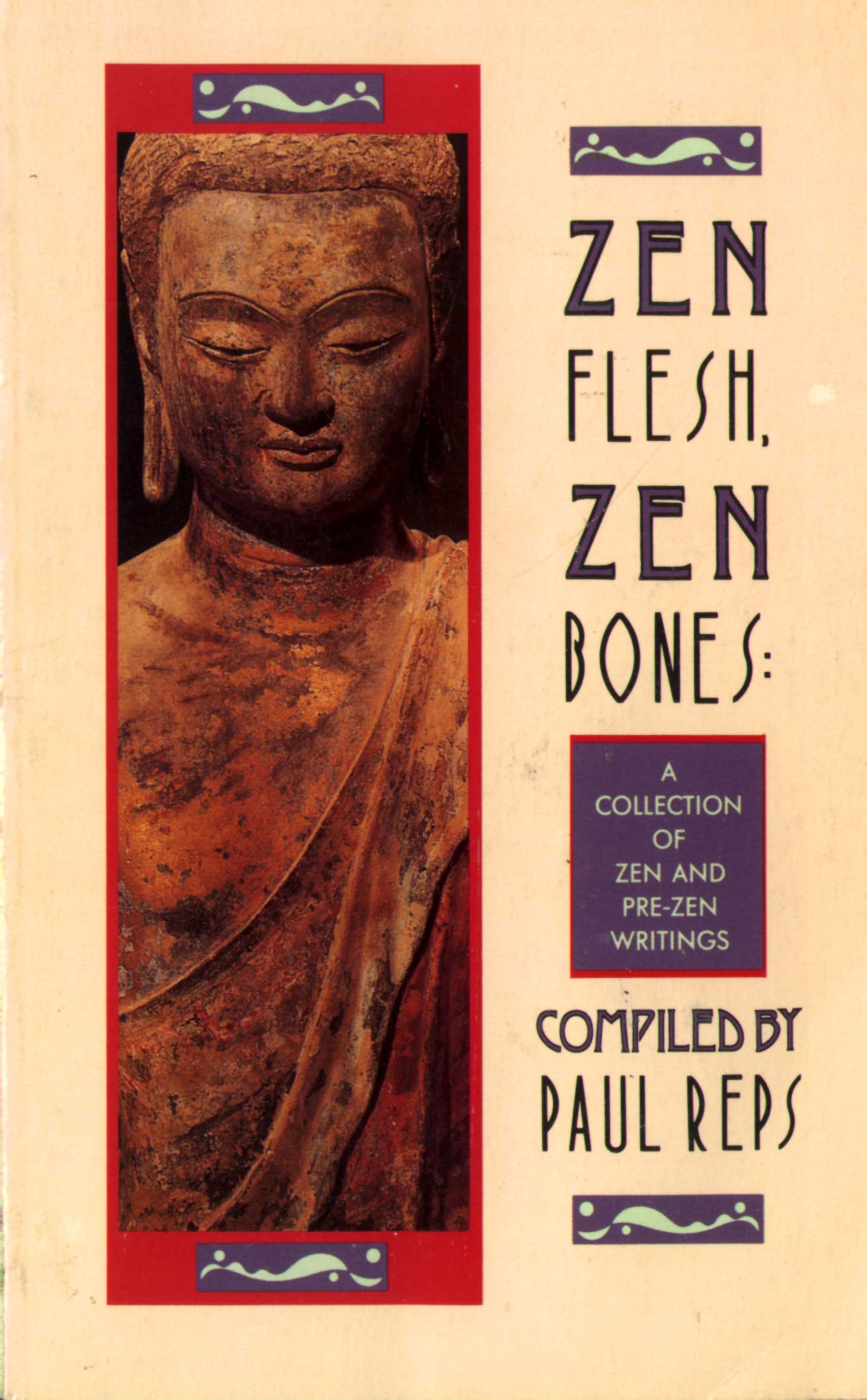
When I was about 8 I started reading everything I could find in the religion section at the downtown Multnomah County library. I was looking for explanations for things I was experiencing and for tools for greater understanding. The first Buddhist oriented book I read was the Dhammapada, which is kind of like the “Dick & Jane” of the Pali Canon. Zen Flesh, Zen Bones, compiled by Paul Reps, was one of my first non-scriptural Buddhist texts I encountered and had a profound influence on my thinking as a kid-adult.
ZFZB is actually 4 books- My favorite section is and was the one titled “Centering” which I haven’t been able to find yet on the net. So, my second choice must be the best- 101 Zen Stories. I’ve posted the first 10 here and made a link at the end where you can download the whole thing (this section, anyway). As an added bonus, I’ve added The Gateless Gate- Zen Koans used for meditation. When I find a web copy of Centering, I’ll share it, too.
101 Zen Stories
A Cup of Tea
Nan-in, a Japanese master during the Meiji era (1868-1912) received a university professor who came to inquire about Zen. Nan-in saved tea. He poured his visitor’s cup full, and then kept on pouring. The professor watched the overflow until he no longer could restrain himself. ‘It is overfull. No more will go in!’ ‘Like this cup,’ Nan-in said. ‘You are full of your own opinions and speculations. How can I show you Zen unless you first empty your cup? ‘
2. Finding a Diamond on a Muddy Road
Gudo was the emperor’s teacher of his time. Nevertheless, he used to travel done as a wandering mendicant. Once when he was on his way to Edo, the cultural and political center of the shogunate, he approached a little village mad Takenaka. It was evening and a heavy rain was falling. Gudo was thoroughly wet. His straw sandals were in pieces. At a farmhouse near the village he noticed four or five pairs of sandals in the window and decided to buy some dry ones. The woman who offered him the sandals seeing how wet he was invited him to remain for the night in her home. Gudo accepted, thanking her. He entered and recited a sutra before the family shrine. He then was introduced to the woman’s mother, and to her children. Observing that the entire family was depressed Gudo asked what was wrong.
‘My husband is a gambler and a drunkard,’ the housewife told him. ‘When he happens to win he drinks and becomes abusive. When he losses he borrows money from others. Sometimes when becomes thoroughly drunk he does not come home at all. What can I do? ‘I will help him,’ said Gudo. ‘Here is some money. Get me a gallon of fine wine and something good to eat. Then you may retire. I will meditate before the shrine.’ When the man of the house returned about midnight, quite drunk; he bellowed: ‘Hey, wife I am home. Have you something for me eat?’ I have something for you: said Gudo. ‘I happened to be caught in the rain and your wife kindly asked me to remain here for the night. In return I have bought some wine and fish. You might as well have them.’ The man was delighted. He drank the wine at once and laid himself down on the floor. Gudo sat in mediation beside him. In the morning when the husband awoke he had forgotten about the previous night. ‘Who are you? Where do yon come from?’ he asked Gudo, who still was meditating. ‘I am Gudo of Kyoto and I am going on to Edo,’ replied the Zen master. The man was utterly ashamed He apologized profusely to the teacher of his emperor. Gudo smiled. ‘Everything in this life is impermanent’ he explained. ‘Life is very brief. If you keep on gambling and drinking yon will have no time left to accomplish anything else, and you will cause your family to suffer too.’ The perception of the husband awoke as if from a dream. ‘You are right,’ he declared. ‘How can I ever repay you for this wonderful teaching! Let me see you off and carry your things a little way.’ ‘If you wish,’ assented Gudo. The two started out. After they had gone three miles Gudo told him to return. ‘Just another five miles,’ he begged Gudo. They continued on. You may return now,’ suggested Gudo.
‘After another ten miles,’ the man replied. ‘Return now,’ said Gudo, when the ten miles had been passed. ‘I am going to follow you all the rest of my life,’ declared the man. Modern Zen teachers in Japan spring from the lineage of a famous master who was the successor of Gudo. His name was Mu-nan, the man who never returned back.
3. Is That So?
The Zen master Hakuin was praised by his neighbors as one living a pure life. A beautiful Japanese girl whose parents owned a food store lived near him. Suddenly, without any warning her parents discovered she was with child. This made her parents angry. She would not confess who the man was, but after much harassment at last named Hakuin. In great anger the parents went to the master. ‘Is that so?’ was all he would say. After the child was born it was brought to Hakuin. By this time he had lost his reputation, which did not trouble him, but he took very good care of the child. He obtained milk from his neighbors and everything else the little one needed. A year later the girl-mother could stand it no longer. She told her parents the truth – that the real father of the child was a young man who worked in the fish market. The mother and father of the girl at once went to Hakuin to ask his forgiveness, to apologize at length, and to get the child back again. Hakuin was willing. In yielding the child, all he said was, ‘Is that so?’
4. Obedience
The master Bankei’s talks were attended not only by Zen students but by persons of all ranks and sects. He never quoted sutras nor indulged in scholastic dissertations. Instead his words were spoken directly from his heart to the harts of his listeners. His large audiences angered a priest of the Nichiren sect because the adherents had left to hear about Zen. The selfcentered Nichiren priest came to the temple determined to debate with Bankei. ‘Hey, Zen teacher,’ he called out. ‘Wait a minute. Whoever respects you will obey what you say, but a man like myself does not respect you. Can you make me obey yon?’ ‘Come up beside me and I will show you,’ said Bankei. Proudly the priest pushed his way through the crowd to the teacher. Bankei smiled. ‘Come over to my left side.’ The priest obeyed. ‘No,’ said Bankei, ‘we may talk better if you are on the right side. Step over here.’ The priest proudly stepped over to the right. ‘You see,’ observed Bankei, ‘you are obeying me and I think you are a very gentle person. Now sit down and listen.’
5. If You Love, Love Openly
Twenty monks and one nun, who was named Eshun, were practicing meditation with a certain Zen master. Eshun was very pretty even though her head was shaved and her dress plain. Several monks secretly fell in love with her.
One of them wrote her a love letter, insisting upon a private meeting. Eshun did not reply. The following day the master gave a lecture to the group, and when it was over, Eshun arose. Addressing the one who had written her, she said: ‘If you really love me so much, come and embrace me now.’
6. No Loving-Kindness
There was an old woman in China who had supported a monk for over twenty years. She had built a little hut for him and fed him while he was meditating. Finally she wondered just what progress he had made in all this time. To find out, she obtained the help of a girl rich in desire. ‘Go and embrace him,’ she told her;’ and then ask him suddenly: “What now?” The girl called upon the monk and without much ado caressed him, asking him what he was going to do about it. ‘An old tree grows on a cold rock in winter,’ replied the monk somewhat poetically. ‘Nowhere is there any warmth.’ The girl returned and related what he had said. ‘To think I fed that fellow for twenty years!’ exclaimed the old woman in anger.’ He showed no consideration for your need, no disposition to explain your condition. He need not have responded to passion, but at last he should have evidenced some compassion.’ She at once went to the hut of the monk and burned it down.
7. Announcement
Tanzan wrote sixty postal cards on the last day of his life, and asked an attendant to mail them. Then he passed away. The cards read:
I am departing from this world. This is my last announcement. Tanzan 27 July 1892.
8. Great Waves
In the early days of the Meiji era there lived a well-known wrestler called O-nami, Great Waves. O-nami was immensely strong and knew the art of wrestling. In his private bouts he defeated even his teacher, but in public he was so bashful that his own pupils threw him. O-nami felt he should go to a Zen master for help. Hakuju, a wandering teacher, was stopping in a little temple nearby, so O-nami went to see him and told him of his trouble. ‘Great Waves is your name,’ the teacher advised,’ so stay in this temple tonight. Imagine that you are those billows. You are no longer a wrestler who is afraid. You are those huge waves sweeping everything before them, swallowing all in their path. Do this and you will be the greatest wrestler in the land.’ The teacher retired. O-nami sat in meditation trying to imagine himself as waves. He thought of many different things. Then gradually he turned more and more to the feelings of the waves. As the night advanced the waves became larger and larger. They swept away the flowers in their vases. Even the Buddha in the shrine was inundated. Before dawn the temple was nothing but the ebb and flow of an immense sea. In the morning the teacher found O-nami meditating, a faint smile on his face. He patted the wrestlers shoulder. ‘Now nothing can disturb you.’ he said. ‘You are the waves. You will sweep everything before you.’ The same day O-nami entered the wrestling contests and won. After that, no one in Japan was able to defeat him.
9. The Moon cannot be Stolen
Ryokan, a Zen master, lived the simplest kind of life in a little hut at the foot of a mountain. One evening a thief visited the hut only to discover there was nothing in it to stea1. Ryokan returned and caught him. ‘You may have come a long way to visit me,’ he told the prowler, ‘and you should not return empty-handed. Please take my clothes as a gift.’ The thief was bewildered. He took the clothes and slunk away. Ryokan sat naked, watching the moon. ‘Poor fellow,’ he mused, ‘I wish I could give him this beautiful moon.’
10. The Last Poem of Hoshin
The Zen master Hoshin lived in China many years. Then he returned to the northeastern part of Japan, where he taught his disciples. When he was getting very old, he told them a story he had heard in China. This is the story: One year on the twenty-fifth of December, Tokufu, who was very old, said to his disciples: I am not going to-be alive next year so you fellows should treat me well this year.’ The pupils thought he was joking, but since he was a great-hearted teacher each of them in turn treated him to a feast on succeeding days of the departing year. On the eve of the New Year, Tokufu concluded: ‘You have been good to me. I shall leave you tomorrow afternoon when the snow has stopped.’ The disciples laughed, thinking he was aging and talking nonsense since the night was clear and without snow. But at midnight snow began to fall, and the next day they did not find their teacher about. They went to the meditation hall.
There he had passed on. Hoshin, who related this story, told his disciples: ‘It is not necessary for a Zen master to predict his passing, but if he really wishes to do so, he can.’ ‘Can you?’ someone asked. ‘Yes,’ answered Hoshin. ‘I will show you what I can do seven days from now. None of the disciple’s believed him, and most of them had even forgotten the conversation when Hoshin next called them together. ‘Seven days ago,’ he remarked, ‘I said I was going to leave you. It is customary to write a farewell poem, but I am neither poet nor calligrapher. Let one of you inscribe my last words.’ His followers thought he was joking, but one of them started to write. ‘Are you ready?’ Hoshin asked. ‘Yes, sir,’ replied the writer. Then Hoshin dictated: I came from brilliancy And return to brilliancy. What is this? The poem was one line short of the customary four, so, the disciple said: ‘Master, we are one line short.’ Hoshin, with the roar of a conquering lion, shouted ‘Kaa!’ and was gone.
Download 101 Zen Stories with forward:
101zensories-wforwardbypaulreps
Download The Gateless Gate:
Let’s not forget this version (click for full size):

Filed under buddhism, pictures, silly, Spirituality
Try this Automatic Flatterer, feel better:
http://www.cse.unsw.edu.au/~geoffo/humour/flattery.html
Give a Listen:
Cat Power-
Allen Ginsberg-
Lewis Black- TV Pilot-
Take a look:




Think about these things (links):
free buddhist audio-
http://www.freebuddhistaudio.com/
Tao-
Ron Unger’ssite-
http://recoveryfromschizophrenia.org/blog/
Tomorrows news today-
http://public.web.cern.ch/public/en/LHC/LHC-en.html

Filed under animated gif, animation, buddhism, CS/X movement, Free Music, Links: Recovery, Music, silly, Spirituality, Uncategorized
I’m sure we should all be as happy as kings.
I digress….
had to post this picture:

Mental Health and Mortality
Per our last post, we reported that in Oregon one-third of people treated for mental health diagnosis die before age 50. If you add “co-occurring disorders”, 89 percent of people treated for both mental
illness and substance abuse die before age 50. These numbers are in line with but also in excess of the national data regarding mortality and mental health.
It’s important to note that the figures are based on people who are receiving treatment. It’s also key to point out that these mortality statistics are getting worse not better. Add to these findings the fact that the most significant factor involved in recovery from mental illness is the length of time one has received treatment; that is to say that the longer one receives treatment, the less likely they are to recover.
What conclusions can be drawn?
Is anybody listening? Not much, it would appear. In Oregon we are building a new state hospital system at a cost of half a billion dollars. Our mental health treatment centers and support agencies are stuck in a time warp, oblivious to the facts, ignorant of the potential for recovery and blindly pushing the drugs that are killing us at a rate unprecedented for any other major public health issue.
(Note on the incredibly simpleminded continued reliance on large public institutions: I am of the opinion that as long as we have a system that believes that “some people just have to kept in institutions”, we will have a system that incarcerates a large number of people in these settings. It is only when we say that “no one should be treated this way” that we will begin the to take meaningful steps toward an effective community approach to treatment and support. The state hospitals will continue to suck up the majority of the resources at the expense of real treatment, real recovery and real self-determination. The old arguments that we need these places because of “court mandated patients”, “public safety” and the less acknowledged factor of state employees’ unions who resist the shift to community agencies and settings are are all red herrings and scare tactics with no real value in the discussion. Between 1987 and 1999, with fits and starts, the state dismantled it’s large public institutions for people with developmental disabilities (Fairview Hospital and Training Center/ FHTC, the last and largest). The biggest factor in the process taking so long was the repeated arguments mentioned above. In the end, these all turned out to be empty threats that had no value other than their ability to slow things down. Meaningful, secure and recovery based supports can be engineered in the community. Oregon has already done it before. Some of you may say that their is no correlation or equivalence between these populations but that is also just a lie perpetrated by those who would hold back the future. Fairview held hundreds of individuals with mental illness, hundreds who were court-mandated and thousands of unionized staff. It was once a small city; It is now a field of weeds and grass. I was there. I worked at part-time Fairview in the 1970s and was involved throughout the process of it’s closure.)
The institution is not the only problem. Existing community services are often mismanaged, poorly staffed read the Annapolis Coalition report or in Oregon, the Governor’s report) and typically way behind in their acceptance of recovery and self-directed supports (compare your local clinic with the National Statement on Mental Health Recovery).
Are there any silver linings?
We have a consumer/ survivor movement that is gradually learning to work together and spread our collective wings. We have tiny (microscopic in a national sense) new programs that are consumer directed. use peer supports or embrace self-directed service models. We also have a growing emphasis (in Oregon) on “wellness” as a focus and recovery as a real possibility for all people facing mental health challenges (see: http://www.oregon.gov/DHS/mentalhealth/index.shtml).
Gradually, the public mental health system is becoming aware of the impact of trauma in the lives of people with mental health issues. While some studies show that as much as 95% of persons with a mental health diagnosis are trauma survivors, our treatment programs are remarkable for their tendency to re-traumatize the afflicted. Effective treatment for trauma has come a long way but is still not widely used. At the same time we are seeing the long term effects of mal-treatment that ignores the trauma factor and leads to greater and greater difficulty in the individual’s ability to recover.
New thoughts are emerging and new ideas slowly joining the mainstream. This from a publication from SAMHSA:
Today’s mental health system has failed to facilitate recovery of most people labeled with severe mental illnesses, leading to increasing expressions of dissatisfaction by people using services, their families, and administrators. Only a fundamental change of the very culture of the system will ensure that the changes made in policy, training, services, and research will lead to genuine recovery. In accordance with the President’s New Freedom Commission on Mental Health report, mental health consumers and survivors, representing diverse cultural backgrounds, should play a leading role in designing and implementing the transformation to a recovery-based mental health system.
This paper provides an outline of how consumers/survivors can catalyze a transformation of the mental health system from one based on an institutional culture of control and exclusion to one based on a recovery culture of self-determination and community participation. At the national policy level, this paper recommends that consumers develop and implement a National Recovery Initiative. At the State and local policy levels, State and local recovery initiatives are recommended. On the direct service level, the paper provides a road map for developing services, financing, and supports that are based on self-determination and recovery.
A recovery-based mental health system would embrace the following values:
Changing the mental health system to one that is based on the principles of recovery will require a concerted effort of consumers and allies working to bring about changes in beliefs and practices at every level of the system. The building of these alliances will require the practice of recovery principles of trust, understanding, and respect by all parties involved.
(The full article re: above can be found at http://mentalhealth.samhsa.gov/publications/allpubs/NMH05-0193/default.asp)
Another positive sign is the increasing clinical and scholarly acknowledgement of the role of spirituality in the recovery process (see: http://www.wiley.com/WileyCDA/WileyTitle/productCd-0787947083.html, http://akmhcweb.org/recovery/rec.htm, http://www.mentalhealthworld.org/34ddnspirit.html, http://www.spiritualcompetency.com/recovery/lesson1.html to name a few resources).
Peer delivered services are supposed to be rolled out in Oregon during the coming year. The state has made necessary changes in it’s Medicaid Waiver to allow billing for peer mentors and service providers.
While the overall system seems to be riding a hand basket to hell, the growing awareness, solidarity and action emerging from the Consumer/ Survivor/ Ex Patient movement is on a collision course with the system that is, was and wishes to always be. It is either a slow motion train wreck or the harbinger of a revolution in mental health treatment.
Things are on the cusp of a change. Part of that change may need to be the collapse of the current system (including our current, mostly pitiful, community service models) under the weight of it’s own silliness. If it happens, this will not be a bad thing.
If all the case managers, therapists, pills and hospitals for treatment of mental illness disappeared over night…
On balance, would we be better or worse off?
On a completely different note:
Pictures I’ve found interesting lately-

windshield grime-art:






 I has a cleaning…
Prince says “hai”




Always remember
To check the music page for new stuff.
BTW- I’d love to hear from you about your own music. Do you have any home recordings I can post? Please, no professional quality shite.
Finally,for today, a little video
Avalokiteshvara – Treasury of Compassion
 | Marcus on Update |
 | andtiggertoo on Visual |
 | Luf on Red light runner |
 | rick s on The world is so full of a numb… |
 | Whitney Decker on The world is so full of a numb… |























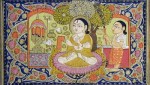












 moon soup