
He is posting more cartoons and artwork on the blog these days than on deviantart. So I’m adding it to the list.
http://secretvoln.blogspot.com/
Better Bees Than Bears. Makes sense to me.
He is posting more cartoons and artwork on the blog these days than on deviantart. So I’m adding it to the list.
http://secretvoln.blogspot.com/
Better Bees Than Bears. Makes sense to me.
Filed under Uncategorized
First of all, some mental health consumer oriented blogs. I’m adding them to the links bar as well but am including the descriptions below:
http://www.furiousseasons.com/
Furious Seasons is authored by a journalist/patient Philip Dawdy who was diganosed with bipolar disorder and who seeks to hold the mental health industry accountable. The author is opposed to outpatient commitment and forced electroshock treatments.
http://pistachiopress.blogspot.com/
A variety of news items and opinions on a web log run by Patricia Lefave of Ontario, Canada “expressing the alternative views of those who are dissatisfied with the current state of the mental health system around the world and current and growing powers of bio-psychiatry and the psychiatric establishment”
http://bipolarblast.wordpress.com/
From the blogger: “I was diagnosed with bipolar disorder in 1985 at age 19. I was medicated off and on from 1985 to 1988 and then medicated in 1992 to the present after having the daylights scared out of me by what I now see as ignorant doctors. About three years ago I started questioning the heavy drugging of my symptoms as well as the diagnosis itself. I began the slow and difficult process of withdrawing from my psych meds. I hope to share with the readers of this blog this journey as it continues. This journey includes my ultimate disillusionment of psychiatry and the pharmaceutical industry.”
http://recoveryfromschizophrenia.org/blog/
Ron Unger is a full-time therapist in Eugene, Oregon and Coordinator of MindFreedom Lane County. From Ron’s blog description: According to what has been called the medical model, people who have been diagnosed with “schizophrenia” and with “psychosis” in general, have a brain disease or chemical imbalance… While the medical model can easily be criticized for lacking evidence, a perhaps more important criticism of it is that it lacks any model for how people recover! If people have a brain disease today, how could they go on to have highly successful lives later? And why is it that most of those who are doing best have all long ago quit their “medical” treatment, psychiatric drugs? (I’ve talked with Ron and he’s a wonderful resource.)
http://www.stir-crazy.org/
“Shaking a stick at the state of mental health,” the stir-crazy blog is based in Minnesota. From the site: “stir-crazy.org is hosted and written by Christin. Additional posts are written by other participants in the Icarus Project – Minneapolis discussion group, but the opinions expressed therein are the respective author’s and not necessarily those of the group or the national Icarus Project. The Icarus Project – Minneapolis is also hosted by stir-crazy.org.”
This just from Spitzer News, related to disability rights I suppose:
NASA UNVEILS COSMIC IMAGES BOOK IN BRAILLE FOR BLIND READERS
At a ceremony held today at the National Federation of the Blind,
NASA unveiled a new book that brings majestic images taken by its
Great Observatories to the fingertips of the blind. The Great
Observatories include NASA‘s Hubble, Chandra and Spitzer space
telescopes.
“Touch the Invisible Sky” is a 60-page book with color images of
nebulae, stars, galaxies and some of the telescopes that captured the
original pictures. Each image is embossed with lines, bumps and other
textures. These raised patterns translate colors, shapes and other
intricate details of the cosmic objects, allowing visually impaired
people to experience them. Braille and large-print descriptions
accompany each of the book’s 28 photographs, making the book’s design
accessible to readers of all visual abilities.
The book contains spectacular images from the Great Observatories and
powerful ground-based telescopes. The celestial objects are presented
as they appear through visible-light telescopes and different
spectral regions invisible to the naked eye, from radio to infrared,
visible, ultraviolet and X-ray light.
The book introduces the concept of light and the spectrum and
explains how the different observatories complement each others’
findings. Readers take a cosmic journey beginning with images of the
sun, and travel out into the galaxy to visit relics of exploding and
dying stars, as well as the Whirlpool galaxy and colliding Antennae
galaxies.
“Touch the Invisible Sky” was written by astronomy educator and
accessibility specialist Noreen Grice of You Can Do Astronomy LLC and
the Museum of Science, Boston, with authors Simon Steel, an
astronomer with the Harvard-Smithsonian Center for Astrophysics in
Cambridge, Mass., and Doris Daou, an astronomer at NASA Headquarters,
Washington.
“About 10 million visually impaired people live in the United
States,” Grice said. “I hope this book will be a unique resource for
people who are sighted or blind to better understand the part of the
universe that is invisible to all of us.”
The book will be available to the public through a wide variety of
sources, including the National Federation of the Blind, Library of
Congress repositories, schools for the blind, libraries, museums,
science centers and Ozone Publishing.
“We wanted to show that the beauty and complexity of the universe
goes far beyond what we can see with our eyes!” Daou said.
“The study of the universe is a detective story, a cosmic ‘CSI,’
where clues to the inner workings of the universe are revealed by the
amazing technology of modern telescopes,” Steel said. “This book
invites everyone to join in the quest to unlock the secrets of the
cosmos.”
“One of the greatest challenges faced by blind students who are
interested in scientific study is that certain kinds of information
are not available to them in a non-visual form,” said Marc Maurer,
president of the National Federation of the Blind. “Books like this
one are an invaluable resource because they allow the blind access to
information that is normally presented through visual observation and
media. Given access to this information, blind students can study and
compete in scientific fields as well as their sighted peers.”
The prototype for this book was funded by an education grant from the
Chandra mission, and production was a collaborative effort by the
NASA space science missions, which provide the images, and other
agency sources.
NASA’s Jet Propulsion Laboratory, Pasadena, Calif., manages the
Spitzer Space Telescope mission for NASA’s Science Mission
Directorate, Washington. Science operations are conducted at the
Spitzer Science Center at the California Institute of Technology,
also in Pasadena. Caltech manages JPL for NASA.
I’m also adding the Spitzer site to my link list.
The Icarus Project Harm Reduction Guide for Comng Off of Psychiatric Drugs
The Icarus Project and Freedom Center’s 40-page guide gathers the best information we’ve come across and the most valuable lessons we’ve learned about reducing and coming off psychiatric medication. Includes info on mood stabilizers, anti-psychotics, anti-depressants, anti-anxiety drugs, risks, benefits, wellness tools, withdrawal, information for people staying on their medications, detailed Resource section, and much more. Written by Will Hall, with a 14-member health professional Advisory Board providing research assistance and 24 other collaborators involved in developing and editing. The guide has photographs and art throughout, and a beautiful original cover painting by Ashley McNamara.
Go here:
Filed under Uncategorized
The picture is of a weightless/ parabolic flight he took in April of last year.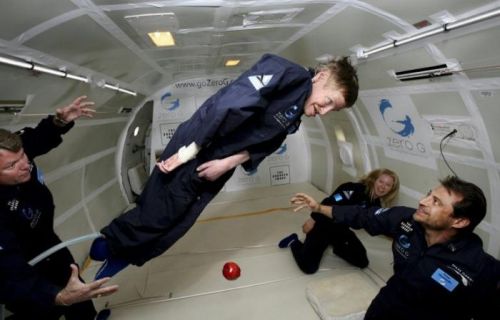
Filed under Uncategorized
But I found a cool image that I would like to share. It’s found at

You see, I don’t know how to stick a link in my post. So I’m just saying.
It’s a very closeup image of a sunspot. The picture was made using the Swedish Solar Telescope in its first year (2002) of operation on the Canary Island of La Palma. Along with features described as hairs and canals are dark cores visible within the bright filaments that extend into the sunspot, representing previously unknown and unexplored solar phenomena. The filaments’ newly revealed dark cores are seen to be thousands of kilometers long but only about 100 kilometers wide. Resolving features 100 kilometers wide or less is a milestone in solar astronomy and has been achieved here using adaptive optics, digital image stacking, and processing techniques to counter the blurring effect of Earth’s atmosphere.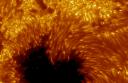
Filed under Uncategorized
I remember my father talking about things that were done by the Japanese to American prisoners during the Second World War (he was a career navy man, enlisted in 1937 and retired in 1960 or thereabouts; he had also been stationed at Pearl Harbor at the time of the 1941 air attack- he had a lot of stories). One of the things he talked about was “the water cure”. He had said that key officers in the Japanese military were executed after the war based particularly on the use of this technique.
I didn’t know what the “water cure” was. In my mind it was something like the “Chinese Water Torture” talked about in connection with the Korean War. And I had no idea what that meant either.
I heard someone on the radio today talking about waterboarding and the historical context. So I looked for more information.
Here is some of what I found:
After World War II, we convicted several Japanese soldiers for waterboarding American and Allied prisoners of war. At the trial of his captors, then-Lt. Chase J. Nielsen, one of the 1942 Army Air Forces officers who flew in the Doolittle Raid and was captured by the Japanese, testified: “I was given several types of torture. . . . I was given what they call the water cure.” He was asked what he felt when the Japanese soldiers poured the water. “Well, I felt more or less like I was drowning,” he replied, “just gasping between life and death.”
Nielsen’s experience was not unique. Nor was the prosecution of his captors. After Japan surrendered, the United States organized and participated in the International Military Tribunal for the Far East, generally called the Tokyo War Crimes Trials. Leading members of Japan’s military and government elite were charged, among their many other crimes, with torturing Allied military personnel and civilians. The principal proof upon which their torture convictions were based was conduct that we would now call waterboarding.
In this case from the tribunal’s records, the victim was a prisoner in the Japanese-occupied Dutch East Indies:
A towel was fixed under the chin and down over the face. Then many buckets of water were poured into the towel so that the water gradually reached the mouth and rising further eventually also the nostrils, which resulted in his becoming unconscious and collapsing like a person drowned. This procedure was sometimes repeated 5-6 times in succession.
Here’s the testimony of two Americans imprisoned by the Japanese:
They would lash me to a stretcher then prop me up against a table with my head down. They would then pour about two gallons of water from a pitcher into my nose and mouth until I lost consciousness.
And from the second prisoner: They laid me out on a stretcher and strapped me on. The stretcher was then stood on end with my head almost touching the floor and my feet in the air. . . . They then began pouring water over my face and at times it was almost impossible for me to breathe without sucking in water.
As a result of such accounts, a number of Japanese prison-camp officers and guards were convicted of torture that clearly violated the laws of war. They were not the only defendants convicted in such cases. As far back as the U.S. occupation of the Philippines after the 1898 Spanish-American War, U.S. soldiers were court-martialed for using the “water cure” to question Filipino guerrillas.
—
The bottom line is that when “water treatment” was practiced against our side, it was called a war crime. That was the ruling against the Japanese after the Second World War by the International Military Tribunal for the Far East and by the military courts that tried what were called in the Far East, the “B” and ”C” level war criminals.
When the leaders of Japan were found guilty of multiple and horrific war crimes, one of them was the “water treatment.” Those who actually did the “water treatment” – the officers who directed torture (B level) and those who carried it out (C level) were guilty of war crimes. Some were executed.
—
So, who’s right? Is waterboarding torture, or is it merely a stressful psychological technique?
Interestingly, the United States has long since answered that question. Following the end of the Second World War we prosecuted a number of Japanese military and civilian officials for war crimes. including the torture of captured Allied personnel. At one of those trials, United States v. Sawada, here’s how Captain Chase Nielsen, a crew member in the 1942 Doolittle Raid on Japan, described his treatment, when he was captured, (and later tried for alleged war crimes by a Japanese military commission):
Q: What other physical treatment was administered to you at that time?
A: Well, I was given what they call the water cure.
Q: Explain to the Commission what that was.
A: Well, I was put on my back on the floor with my arms and legs stretched out, one guard holding each limb. The towel was wrapped around my face and put across my face and water was poured on. They poured water on this towel until I was almost unconscious from strangulation, then they would let me up until I’d get my breath, then they’d start over again.
Q: When you regained consciousness would they keep asking you questions?
A: Yes sir they did.
Q: How long did this treatment continue?
A: About twenty minutes.
Q: What was your sensation when they were pouring water on the towel, what did you physically feel?
A: Well, I felt more or less like I was drowning, just gasping between life and death.
The prosecutor in that case was vehement in arguing that the captured Doolittle fliers had been wrongfully convicted by the Japanese tribunal, in part because they were convicted based on evidence obtained through torture. “The untrustworthiness of any admissions or confessions made under torture,” he said, “would clearly vitiate a conviction based thereon.”
At the end of the Tokyo War Crimes Trial, the International Military Tribunal for the Far East of which the United States was a leading member (the Tribunal was established by Douglas MacArthur) convicted former Japanese Prime Minister Tojo and numerous other generals and admirals of a panoply of war crimes. Among them was torture:
—
Historical uses
Spanish Inquisition
A form of torture similar to waterboarding called toca, along with garrucha (or strappado) and the most frequently used potro (or the rack), was used (though infrequently) during the trial portion of the Spanish Inquisition process. “The toca, also called tortura del agua, consisted of introducing a cloth into the mouth of the victim, and forcing them to ingest water spilled from a jar so that they had the impression of drowning.” One source has claimed that the use of water as a form of torture also had profound religious significance to the Inquisitors.
Colonial times
Agents of the Dutch East India Company used a precursor to waterboarding during the Amboyna massacre, which took place on the island of Amboyna in the Molucca Islands in 1623. At that time, it consisted of wrapping cloth around a victim’s head, after which the torturers “poured the water softly upon his head until the cloth was full, up to the mouth and nostrils, and somewhat higher, so that he could not draw breath but he must suck in all the water.” In one case, the torturer applied water three or four times successively until the victim’s “body was swollen twice or thrice as big as before, his cheeks like great bladders, and his eyes staring and strutting out beyond his forehead.”
World War II
During World War II, Japanese troops, especially the Kempeitai, as well the Gestapo, the German secret police, used waterboarding as a method of torture. The German technique was called the German equivalent of “u-boat”. During the Double Tenth Incident, waterboarding consisted of binding or holding down the victim on his back, placing a cloth over his mouth and nose, and pouring water onto the cloth. In this version, interrogation continued during the torture, with the interrogators beating the victim if he did not reply and the victim swallowing water if he opened his mouth to answer or breathe. When the victim could ingest no more water, the interrogators would beat or jump on his distended stomach.
Algerian War
The technique was also used during the Algerian War (1954-1962). The French journalist Henri Alleg, who was subjected to waterboarding by French paratroopers in Algeria in 1957, is one of only a few people to have described in writing the first-hand experience of being waterboarded. His book The Question, published in 1958 with a preface by Jean-Paul Sartre (and subsequently banned in France until the end of the Algerian War in 1962) discusses the experience of being strapped to a plank, having his head wrapped in cloth and positioned beneath a running tap:
The rag was soaked rapidly. Water flowed everywhere: in my mouth, in my nose, all over my face. But for a while I could still breathe in some small gulps of air. I tried, by contracting my throat, to take in as little water as possible and to resist suffocation by keeping air in my lungs for as long as I could. But I couldn’t hold on for more than a few moments. I had the impression of drowning, and a terrible agony, that of death itself, took possession of me. In spite of myself, all the muscles of my body struggled uselessly to save me from suffocation. In spite of myself, the fingers of both my hands shook uncontrollably. “That’s it! He’s going to talk,” said a voice.
The water stopped running and they took away the rag. I was able to breathe. In the gloom, I saw the lieutenants and the captain, who, with a cigarette between his lips, was hitting my stomach with his fist to make me throw out the water I had swallowed.
Alleg has stated that the incidence of “accidental” death of prisoners being subjected to waterboarding in Algeria was “very frequent.”
Vietnam War
Water boarding was designated as illegal by U.S. generals in the Vietnam War. On January 21, 1968, The Washington Post published a controversial photograph of an American soldier supervising the waterboarding of a North Vietnamese POW near Da Nang.photo. The article described the practice as “fairly common.” The photograph led to the soldier being court-martialled by a U.S. military court within one month of its publication, and he was thrown out of the army. Another waterboarding photograph of the same scene is also exhibited in the War Remnants Museum at Ho Chi Minh City.
Khmer Rouge
The Khmer Rouge at the Tuol Sleng prison in Phnom Penh, Cambodia, used waterboarding as a method of torture between 1975 and 1979.
—
We have certainly come a long way.
For so many reasons, I can’t understand why George W. Bush has not been impeached.
Filed under Uncategorized
Luke-Dorf has offered me a position on their supported employment program. Orientation is on 1/7/08 and I start work the following week. Woot!
Filed under Uncategorized
This morning I went to a second interview with Luke-Dorf Behavioral Health services. It seems that their biggest concerns about hiring me have to do with:
1) Am I too qualified to stay?
2) Is my background too “cutting edge” to be happy there?
3) Will I be helpful in training my supervisor to do job development?
I believe I responded appropriately to their questions but one never knows when it comes to interviewing. They indicated that I received high praise from the reference they have contacted.
My other best prospect is a temporary job in Vancouver. They are waiting for my name to appear on the Washington Registered Counselor Pending list.
Filed under Uncategorized
I intend to post at least weekly, hopefully more often than that. And my intention is also to include information that is useful, amusing or otherwise worthwhile.
With that in mind, I would like to share some news- This just in from Michael Hlebechuck:
I have created a blog on self-directed care (SDC) in mental health. Topics will include advocacy; alternatives to the current system; mental health recovery; shaking up the system and challenging the status quo; and of course SDC. You are invited to participate by following this link:
—
Thank you Michael! I will try and fiigure out a way to include a link to this and other pages of interest soon!
Filed under Uncategorized
 | Marcus on Update |
 | andtiggertoo on Visual |
 | Luf on Red light runner |
 | rick s on The world is so full of a numb… |
 | Whitney Decker on The world is so full of a numb… |
































 moon soup