Tag Archives: The Great Love

Sadhana- The Realization of Life by Rabindranath Tagore

rabindranath_tagore

At long last, I’ve come across an audio of

Sadhana- The Realization of Life

by Rabindranath Tagore

(the most popular post ever on this blog-

go here for the complete e-book download).

Now, I have the LibriVox, public domain audio book-

easier to read than a computer monitor.

sadhana_01_tagore

sadhana_02_tagore

sadhana_03_tagore

sadhana_04_tagore

sadhana_05_tagore

sadhana_06_tagore

sadhana_07_tagore

sadhana_08_tagore

Special Bonus! Multi-lingual Tagore Poetry Jam!

bengali_banshi_tagore

rabi140028viLook around on this site- I have many complete downloads of Tagore’s work-

including Gitanjali, my personal favorite poetry collection.

rabtagore

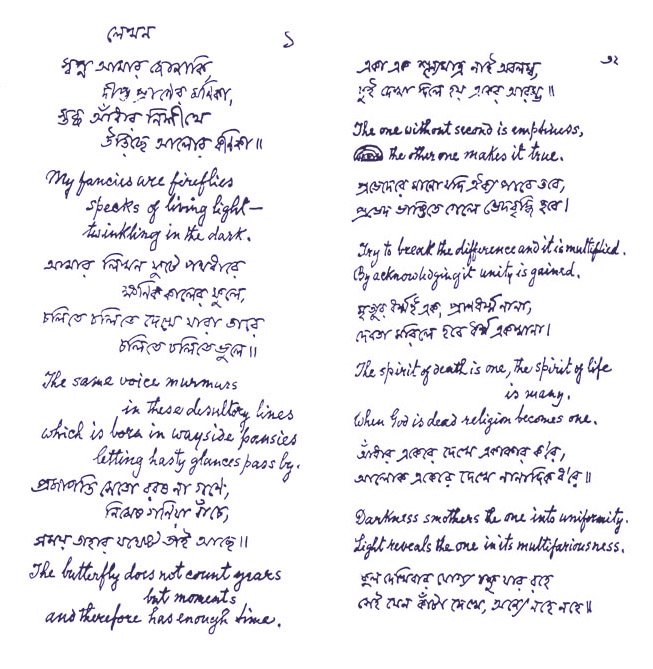
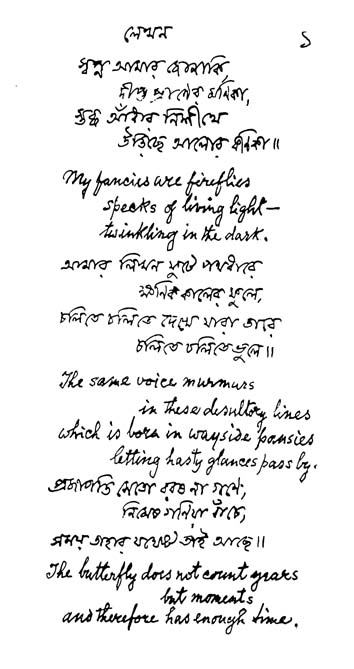
tagore-straybirds(above- Stray Birds poem in the author’s hand. Stray Birds is available elsewhere on this site)

tagore2

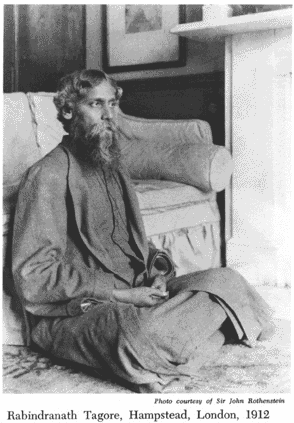
tagore1912

tagore-and-ghandi

tagore_einstien

tagoreletterfront

5 Comments

Filed under Free Audio Books, Free E-Books, mp3, Mystic Poetry, pictures, poetry, Spirituality

Not Dalai Lama- Maha Mrityunjaya Mantra

It has been brought to my attention- a comment below is re-printed here- that this is not Dalai Lama. So, ignore all reference to Dalai Lama. The rest is okay, I think.

Michael Robinson

Sorry to say, but this was not the Dalai Lama chanting, but was a recording done by a Dutch performer called Hein Braat, and the original can be bought as a CD. It’s an urban myth which has been doing the tour for 20 years (but you’re by all means not alone in believing it!).

That doesn’t take away from just how special a piece of music it is, but the chant is from the Veda, which is not buddhist, but hindu. Tri-ambaka-m is the three-eyed one e.g. Lord Shiva.

The original recording by Hein Braat can be heard at the following link. Credit where it’s due, as he has an amazing voice.

http://heinbraat.com/27/discography-cds/

Instructions:

Close your eyes, listen. Feel your heart beating,

your breath rising and falling. Do nothing.

dahli-lama-maha-mrityunjaya-mantra

cygnus_a_by_keck


Maha Mritvuniava Mantra

Om Tryambakam yajamah

Sugandhim pushti vardhanam

Urvarukamiva bondhanan

Mrityor mukshiya mamritat


Translation: I meditate on, and surrender myself to, the Divine Being who embodies the power of will, the power of knowledge, and the power of action. I pray to the Divine Being who manifests in the form of fragrance in the flower of life and is the eternal nourisher of the plant of life. like a skillful gardener, may the Lord of Life disentangle me from the binding forces of my physical, psychological, and spiritual foes. May the lord of Immortality residing within me free me from death, decay and sickness and unite me with immortality.


Explanation: This is a healing and nourishing mantra and is in a sense, “the Heart of Vedas.” The healing force awakened by this mantra sends forth its

ripples from body to psyche and from psyche to soul. It strengthens our powers of will, knowledge and action, thus unblocking the flow of enthusiasm, courage and determination. The vibration of this mantra awakens the internal healing force while attracting nature’s healing agents, creating an environment where the forces from both origins converge. This mantra connects us to the healer within and helps us receive the full nourishment from food, herbs, or any discipline undertaken for our total well being.

12 Comments

Filed under Free Music, mp3, Spirituality

Don Berry and the Darsana Mala

First, maybe you should stop reading this

and go directly to Don Berry’s website here.

Who is Don Berry? From Wikipedia:

Don Berry (1931-2001) was an American artist and author best known for his historical novels early settlers in the Oregon Country.

He was born in Minnesota but moved to Oregon as a young man and came to think of himself as a native of that state. He attended Reed College in Portland, Oregon. During college his housemates included the poet Gary Snyder, who shared Berry’s interest in Eastern metaphysics.

In 1960 he published Trask, a historical novel about Elbridge Trask, an Oregon settler in the 1840s who was the first white homesteader on Tillamook Bay. It was followed by two sequels, Moontrap and To Build a Ship. The novels have collectively become known as the “Trask novels.” His other works include A Majority of Scoundrels, a history of the fur trade in the Rocky Mountains. Besides writing, his lifelong artistic pursuits included bronze sculpture, sumi painting, and blues guitar playing.

Berry was also an early adopter of the use of the Internet for writing, creating a large body of literature that exists only in cyberspace.

berry1

My experience of Don Berry was limited to enjoying his 3 published novels set in the Oregon Territory, books he wrote early in his career. My favorite was the book Trask- a very moving and spiritually stimulating story based on the life of an Oregon trader who opened up the the area now known as Tillamook to white trade with the native people there. Grab that book and read it.

I was pleased to find recently that Berry, before he died a few years back, put up a website with all of his later work, all available for free. It is a treasure trove. To get you hooked on Berry I am going to re-print a portion of his translation of Darsana Mala- a mystical poem from India previously unavailable in the west. Berry’s rendition is beautiful, stunning and goes straight to the heart.

The poem is also a clear explanation of the philosophy of Tantra Yoga, very similar to what I was taught as a young man initiated into meditation. It resonates with me and with the teachings I received when I was 16-28 years old.

What follows is first the section titled Provenance- which explains his interest in the poem and some background. Next I will share the first 3 chapters. For more you have to go to Berry’s site, the link at the top of this post.

The Darsana Mala, or Garland of Visions, was one of the last major works of Narayana Guru, dictated about 1916. His disciple, Swami Vidyananda, transcribed the dictation and made a short commentary on each verse. The commentary was read to, and corrected by, Narayana himself, though he characterized it as being “for children.”

The original dictation was in Sanskrit, but the work was published only in the Malayalam language of Kerala State, S. India, Narayana’s home. In 1976 an English translation was included in AN ANTHOLOGY OF THE POEMS OF NARAYANA GURU, published by the Narayana Gurukula in Kerala.

natarajaguru

Narayana Guru’s successor was Nataraja Guru. At Narayana’s instigation, Nataraja received a Western education at the Sorbonne as well as his training in the ancient wisdom-school represented by Narayana himself. in 1948-49 Nataraja Guru undertook the translation of the Darsana Mala into English, and it was this translation included in the ANTHOLOGY. Nataraja Guru also made the Darsana Mala the philosophical frame-work for his own monumental work, the three- volume INTEGRATED SCIENCE OF THE ABSOLUTE, which he completed in 1968. At this writing one volume has been published in Kerala, and the other two are in preparation.

Shortly after Nataraja Guru’s death in 1973, four notebooks were discovered in his quarters at the Ooty Gurukula in the Nilgiri Hills of Tamilnadu. Nos. II & III were his working notes from 1948-49, and contained all the trial translations and corrections of the Darsana Mala, except for the first seven stanzas of Chapter VI, the Karma Darsana. These notebooks were edited and put into typescript by Mark and Judy Albert. They contain anywhere from two to fifteen variations on each stanza.

Sources used in preparing these English prose renderings were: Vol. I, INTEGRATED SCIENCE OF THE ABSOLUTE, containing word-notes, translation, and the Vidyananda Commentary on Chapters I-III. THE PSYCHOLOGY OF THE DARSANA MALA, (manuscript) by Guru Nitya Chaitanya Yati, successor to Nataraja Guru and current Guru of the Narayana Gurukula, for translation, word-notes and commentary on Chapters IV & V. For Chapters VI & VII, word-notes and translations in Nataraja’s hand, written on the back of academic papers in 1948-49. A typescript of the Vidyananda Commentary with word-notes for Chapters VIII-X. For the complete work, the Nataraja Notebooks, v. II & III as noted above.

For the most part these source materials were obtained for me through the kindness of the American sadhu/ scholar Johnny Stallings, long time student and companion to both Nataraja Guru anatarajaguruandfriendsnd Guru Nitya.

For many years I have been indebted to Guru Nitya for his unfailing friendship and generosity in making available to me his own works, as well as those of his predecessors in the parampara. My deepest gratitude to him.

These renderings were made by Don Berry in the Fall of 1979 for the meditation of his son, Duncan.


AUM TAT SAT

CHAPTER ONE

Adhyaropa Darsana / Metaphors of Creation

1

At its origin this world

existed as nothingness, dreamlike.

Thereafter the Absolute Being created

everything existent by willing.

2

At its origin this world

existed as latent function.

Thereafter the Absolute Being created everything

through his own power of MAYA,

like a magician creating an illusion.

3

At its origin this world

was latent in the Absolute Being

as a sprout is latent in a seed.

Thereafter it manifested itself of its own power.

4

This power is to be known as two kinds,

brightness and heaviness. As in the case of light and dark,

they are polar opposites,and there is no co-existence.

5

At its origin this world

was like a picture in the mind.

Thereafter the Absolute Being realized it

in all its variety, like an artist.

6

At its origin this world existed as PRAKRITI, the matrix of possibility.

Thereafter the Absolute Being worked out its powers like a Yogi.

7

When knowledge of the Absolute Self is veiled, AVIDYA (ignorance)

arises. Then the name-and-form world looms ghostlike.

8

This world is emptiness, like some ghostly city.

Thus did the Absolute Being create

this whole universe — a marvel!

9

If this world evolved in a series of stages

from the sun, then it is not at all from the Supreme Self.

But everything was manifested at a single stroke,

of its own inner vitality, as though

the universe were waking from sleep.

10

That from which all this world

is manifested like a fig tree from a seed,

That is Brahma, That is Siva, That is Vishnu.

That is the Transcendent.

Indeed, everything is That alone.

CHAPTER TWO

Apavada Darsana / Logic of Causality

1

This world, material, non-material and spiritual,

has all come to be in and from living intelligence.

When existent, everything is Real as Being (SAT).

When non-existent, everything remains Real as Intelligence (CIT).

2

An effect cannot have existence independent of its cause.

Therefore, how can there be an origination of non-Being?

And how can there be re-absorption

of something un-originated?

3

That which is not subject to origin and re-absorption

is the transcendent Absolute alone.

The idea of origin and re-absorption as present in the Self

is the veiling effect of MAYA.

4

As the effect is non-different from its cause,

how can Being arise? And in the same way,

how can there be non-Being for the cause itself?

5

Because it is an effect, this world

does not have primary reality.

The Absolute alone, as cause, is Real.

Unclear minds mistake it as un-Real.

6

The One Alone is the Real.

Where can another exist?

If we say “in existence,” it is a tautology.

If we say “in non-existence,” it is a contradiction.

7

Having carefully analyzed the component parts of existence,

one sees that the whole world is not other

than the Intelligence of the Absolute.

It is as if MAYA had been banished.

8

Pure Intelligence alone shines.

There is nothing whatever beyond Pure Intelligence.

That which does not shine is un-Real,

and that which is un-Real does not shine.

9

ANANDA indeed is the Real, and nothing else.

The whole world is of the form of ANANDA.

Apart from ANANDA, nothing else exists.

10

Indeed, everything is SAT-CIT-ANANDA.

(Being, Intelligence, Value.)

There is not a trace of plurality in this.

He who sees this as if pluralistic,

goes from death to death.

CHAPTER THREE

Asatya Darsana / The Illusion of the un-Real

1

This world is all mind-maya.

But the mind is not in any specific place.

The world is seen in the Self

as the blue is seen in the sky.

2

This apparent world is an image, created in the mind

by AVIDYA, the veiling ignorance.

When this is re-absorbed by VIDYA, the clear knowledge,

it is as though the whole world were a mere configuration.

3

To a coward, the ghost looming in the darkness seems real.

To the wise man, the wakeful state is seen

as such a dream-world.

4

This world is seen as willed images.

It is seen only when willing is present,

as when a rope is mistaken for a snake.

5

There is no difference whatever

between the willed images and the mind.

That AVIDYA-darkness state (which is the mind),

is a marvel like Indra’s magic.

6

To the wise man, this world shines in the Self like a mirage.

To an infant, by confusion, even a reflection

may seem real.

7

As milk remains milk even when churned,

The Absolute Self does not change into some other form.

Therefore, the whole world exists only as an image in the Self,

as if created by Indra’s magic. (Indriyas = the senses.)

8

MAYA herself is the fundamental cause of the apparent world.

Everything here is only the maya-maker

creating with magical, un-Real effects.

9

To the mature mind, this universe

seems like a sky-forest mirage in the Self.

But a child sees even a puppet-form as real.

10

One alone is Real, not a second.

What is un-Real seems indeed to be Real.

But the Siva-lingam is stone only,

not a second made by the mason.

2 Comments

Filed under Mystic Poetry, poetry, Spirituality

Autobiography of a Friend

gfox2
Today’s free book: The Autobiography of George Fox, founder of the Religious Society of Friends (Quakers). And he doesn’t look at all klike the guy on the cereal box. Just who are these Quakers anyway?
Wikipedia says:  The Religious Society of Friends, also known as The Quakers, is a movement that began in England in the 17th century.The word “Quaker” means to tremble in the way of the Lord. In its early days it faced opposition and persecution; however, it continued to expand, extending into many parts of the world, especially the Americas and Africa.The Society of Friends has been influential in the history of the world. The state of Pennsylvania, in the United States, was founded by William Penn, as a safe place for Quakers to live and practice their faith. Quakers have been a significant part of the movements to abolishslavery, acknowledge the equal rights of women, and end warfare. They have also promoted education and the humane treatment of prisoners and the mentally ill, through the founding or reforming of various institutions.

During the 19th century Friends in the United States suffered a number of separations. These separations have resulted in the formation of different branches of the Society of Friends. Despite the separations, Friends remain united in their commitment to discover truth and promote it. There are perhaps 400,000 Quakers in the world today, the overwhelming majority of them Evangelicals in Africa and Latin America.

How about this George Fox character? What’s his deal? The following excerpt is from William Penn’s preface to the Autobiography of George Fox (the full preface is included with this e-book):


The blessed instrument of and in this day of God, and of whom I am now about to write, was George Fox, distinguished from another of that name, by that other’s addition of younger to his name in all his writings; not that he was so in years, but that he was so in the truth; but he was also a worthy man, witness and servant of God in his time.


……….

but, in general, when he was somewhat above twenty, he left his friends, and visited the most retired and religious people, and some there were at that time in this nation, especially in those parts, who waited for the consolation of Israel night and day, as Zacharias, Anna, and good old Simeon did of old time. To these he was sent, and these he sought out in the neighboring countries, and among them he sojourned till his more ample ministry came upon him.

At this time he taught and was an example of silence, endeavouring to bring people from self-performances, testifying and turning to the light of Christ within them, and encouraging them to wait in patience to feel the power of it to stir in their hearts, that their knowledge and worship of God might stand in the power of an endless life, which was to be found in the Light, as it was obeyed in the manifestation of it in man. “For in the Word was life, and that life was the light of men.” Life in the Word, light in men, and life too, as the light is obeyed; the children of the light living by the life of the Word, by which the Word begets them again to God, which is the regeneration and new birth, without which there is no coming unto the kingdom of God; and which, whoever comes to, is greater than John, that is, than John’s ministry which was not that of the kingdom, but the consummation of the legal, and opening of the gospel-dispensation. Accordingly, several meetings were gathered in those parts; and thus his time was employed for some years.

In 1652, he being in his usual retirement to the Lord upon a very high mountain, in some of the hither parts of Yorkshire, as I take it, his mind exercised towards the Lord, he had a vision of the great work of God in the earth, and of the way that he was to go forth to begin it. He saw people as thick as motes in the sun, that should in time be brought home to the Lord, that there might be but one Shepherd and one sheepfold in all the earth. There his eye was directed northward, beholding a great people that should receive him and his message in those parts. Upon this mountain he was moved of the Lord to sound out his great and notable day, as if he had been in a great auditory, and from thence went north, as the Lord had shewn him: and in every place where he came, if not before he came to it, he had his particular exercise and service shewn to him, so that the Lord was his leader indeed; for it was not in vain that he travelled, God in most places sealing his commission with the convincement of some of all sorts, as well publicans as sober professors of religion.

william_penn

Again from Wikipedia:

The Quakers began in England in the early 1650s as a Nonconformist movement separate from other such movements, from Anglicanism and from Roman Catholicism. Some would say that it was not precisely a “break” from any of these, but was organized outside of them. Traditionally George Fox has been taken to be the founder or at least the most important early figure, but modern scholarship suggests a more complicated picture. Most likely, a number of radical Puritans, among them Fox, James Nayler and Edward Burrough, independently came to similar positions, eventually came into contact with one another, and then began to coordinate their preaching. However, since Fox outlived most of what some Quakers have called the Valiant Sixty—a group of early Quaker evangelists—his account of the early days as recorded in his Journal, while it may exaggerate his role, is the most detailed one available.
The Valiant Sixty believed that direct experience with God was available to all people, without any mediation (e.g. through a pastor, or through sacraments). Friends have often expressed this belief by referring to “that of God in Everyone”, “inner light“, “inward Christ”, “the spirit of Christ within”, and many other terms.
Modern day Friends (as we call ourselves) are best known for their devotion to peace and consistent opposition to war. If people only knew! The Society of Friends is so different from most modern churches or sects that it can barely (if at all) be described as “organized religion. Without ministers, bishops or other religious hierarchy, the common threads of belief are referred to as “testimony”. Quakers don’t have dogma per se, but generally adhere to the principles of peace, justice, simplicity and community.
Quakers (past and present) tend to be social activists. Friends have been instrumental in the formation of many non-sectarian organizations (e.g. Oxfam, Greenpeace and Amnesty International).

Quaker meetings (called Meeting for Worship) are unprogrammed, last about an hour and consist primarily of silence, interupted only when an individual is “moved to speak”. Here’s a quote about Meeting for Worship:


“A Friend’s meeting, however silent, is at the very lowest a witness that worship is something other and deeper than words, and that it is to the unseen and eternal things that we desire to give the first place in our lives. And when the meeting…is awake and looking upwards, there is much more in it than this. In the united stillness of a truly ‘gathered’ meeting, there is a power known only by experience, and mysterious even when most familiar.” Caroline Stephen, (1908).

So, without further fuss, here is the book download- The Autobiography of George Fox:


georgefoxautobiography

Leave a comment

Filed under Free E-Books, pictures, Spirituality

Three Books by Rabindranath Tagore

Tagore has had a profound influence on my life.

I have provided excerpts before from works by Tagore. Today I would like to offer these 3 complete books for you to download, free. These are all in the public domain since 1992. They are:

Gitanjali,

Stray Birds and

The Hungry Stones

If you are new to his work, you are in for a treat, also I am providing the following excerpts with the download for the entire book at the end of each section. I think you will want to read all of these, from the first word to the last.

(Note: I have already provided a download of the e-book Sadhana- The Realization of Life here. Also, I have included a free audio book of Sadhana at the end of this post.)

Gitanjali- Song Offerings

If thou speakest not I will fill my heart with thy silence and endure it. I will keep still and wait like the night with starry vigil and its head bent low with patience.

The morning will surely come, the darkness will vanish, and thy voice pour down in golden streams breaking through the sky.

Then thy words will take wing in songs from every one of my birds’ nests, and thy melodies will break forth in flowers in all my forest groves.

On the day when the lotus bloomed, alas, my mind was straying, and I knew it not. My basket was empty and the flower remained unheeded.

Only now and again a sadness fell upon me, and I started up from my dream and felt a sweet trace of a strange fragrance in the south wind.

That vague sweetness made my heart ache with longing and it seemed to me that is was the eager breath of the summer seeking for its completion.

I knew not then that it was so near, that it was mine, and that this perfect sweetness had blossomed in the depth of my own heart.

I must launch out my boat. The languid hours pass by on the shore—Alas for me!

The spring has done its flowering and taken leave. And now with the burden of faded futile flowers I wait and linger.

The waves have become clamorous, and upon the bank in the shady lane the yellow leaves flutter and fall.

What emptiness do you gaze upon! Do you not feel a thrill passing through the air with the notes of the far-away song floating from the other shore?

In the deep shadows of the rainy July, with secret steps, thou walkest, silent as night, eluding all watchers.

Today the morning has closed its eyes, heedless of the insistent calls of the loud east wind, and a thick veil has been drawn over the ever-wakeful blue sky.

The woodlands have hushed their songs, and doors are all shut at every house. Thou art the solitary wayfarer in this deserted street. Oh my only friend, my best beloved, the gates are open in my house—do not pass by like a dream.

Art thou abroad on this stormy night on thy journey of love, my friend? The sky groans like one in despair.

I have no sleep tonight. Ever and again I open my door and look out on the darkness, my friend!

I can see nothing before me. I wonder where lies thy path!

By what dim shore of the ink-black river, by what far edge of the frowning forest, through what mazy depth of gloom art thou threading thy course to come to me, my friend?

If the day is done, if birds sing no more, if the wind has flagged tired, then draw the veil of darkness thick upon me, even as thou hast wrapt the earth with the coverlet of sleep and tenderly closed the petals of the drooping lotus at dusk.

From the traveller, whose sack of provisions is empty before the voyage is ended, whose garment is torn and dustladen, whose strength is exhausted, remove shame and poverty, and renew his life like a flower under the cover of thy kindly night.

In the night of weariness let me give myself up to sleep without struggle, resting my trust upon thee.

Let me not force my flagging spirit into a poor preparation for thy worship.

It is thou who drawest the veil of night upon the tired eyes of the day to renew its sight in a fresher gladness of awakening.

He came and sat by my side but I woke not. What a cursed sleep it was, O miserable me!

He came when the night was still; he had his harp in his hands, and my dreams became resonant with its melodies.

Download:

gitanjali-by-rabindranath-tagore

The verses in Stray Birds are short but full. Each one is a meditation. Read them slowly, savor their images and find the meaning they call out from your own heart.

Stray Birds

THE mist, like love, plays upon the heart of the hills and brings out surprises of beauty.


75

WE read the world wrong and say that it deceives us.


76

THE poet wind is out over the sea and the forest to seek his own voice.


77

EVERY child comes with the message that God is not yet discouraged of man.


78

THE grass seeks her crowd in the earth.

The tree seeks his solitude of the sky.


79

MAN barricades against himself.


80

YOUR voice, my friend, wanders in my heart, like the muffled sound of the sea among these listening pines.


81

WHAT is this unseen flame of darkness whose sparks are the stars?


82

LET life be beautiful like summer flowers and death like autumn leaves.


88

HE who wants to do good knocks at the gate; he who loves finds the gate open.


84

IN death the many becomes one; in life the one becomes many.

Download:

stray-birds-by-rabindranath-tagore

The Hungry Stones and other stories

this story is titled

THE DEVOTEE

I

AT a time, when my unpopularity with a part of my readers had reached the nadir of its glory, and my name had become the central orb of the journals, to be attended through space with a perpetual rotation of revilement, I felt the necessity to retire to some quiet place and endeavour to forget my own existence.

I have a house in the country some miles away from Calcutta, where I can remain unknown and unmolested. The villagers there have not, as yet, come to any conclusion about me. They know I am no mere holiday-maker or pleasure-seeker; for I never outrage the silence of the village nights with the riotous noises of the city. Nor do they regard me as an ascetic, because the little acquaintance they have of me carries the savour of comfort about it. I am not, to them, a traveller; for, though I am a vagabond by nature, my wandering through the village fields is aimless. They are hardly even quite certain whether I am married or single; for they have never seen me with my children. So, not being able to classify me in any animal or vegetable kingdom that they know, they have long since given me up and left me stolidly alone.

But quite lately I have come to know that there is one person in the village who is deeply interested in me. Our acquaintance began on a sultry afternoon in July. There had been rain all the morning, and the air was still wet and heavy with mist, like eyelids when weeping is over.

I sat lazily watching a dappled cow grazing on the high bank of the river. The afternoon sun was playing on her glossy hide. The simple beauty of this dress of light made me wonder idly at man’s deliberate waste of money in setting up tailors’ shops to deprive his own skin of its natural clothing.

While I was thus watching and lazily musing, a woman of middle age came and prostrated herself before me, touching the ground with her forehead. She carried in her robe some bunches of flowers, one of which she offered to me with folded hands. She said to me, as she offered it: “This is an offering to my God.”

She went away. I was so taken aback as she uttered these words, that I could hardly catch a glimpse of her before she was gone. The whole incident was entirely simple, but it left a deep impression on my mind; and as I turned back once more to look at the cattle in the field, the zest of life in the cow, who was munching the lush grass with deep breaths, while she whisked off the flies, appeared to me fraught with mystery. My readers may laugh at my foolishness, but my heart was full of adoration. I offered my worship to the pure joy of living, which is God’s own life. Then, plucking a tender shoot from the mango tree, I fed the cow with it from my own hand, and as I did this I had the satisfaction of having pleased my God.

The next year when I returned to the village it was February. The cold season still lingered on. The morning sun came into my room, and I was grateful for its warmth. I was writing, when the servant came to tell me that a devotee, of the Vishnu cult, wanted to see me. I told him, in an absent way, to bring her upstairs, and went on with my writing. The Devotee came in, and bowed to me, touching my feet. I found that she was the same woman whom I had met, for a brief moment, a year ago.

I was able now to examine her more closely. She was past that age when one asks the question whether a woman is beautiful or not. Her stature was above the ordinary height, and she was strongly built; but her body was slightly bent owing to her constant attitude of veneration. Her manner had nothing shrinking about it. The most remarkable of her features were her two eyes. They seemed to have a penetrating power which could make distance near.

With those two large eyes of hers, she seemed to push me as she entered.

“What is this?” she asked. “Why have you brought me here before your throne, my God? I used to see you among the trees; and that was much better. That was the true place to meet you.”

She must have seen me walking in the garden without my seeing her. For the last few days, however, I had suffered from a cold, and had been prevented from going out. I had, perforce, to stay indoors and pay my homage to the evening sky from my terrace. After a silent pause the Devotee said to me: “O my God, give me some words of good.”

I was quite unprepared for this abrupt request, and answered her on the spur of the moment:

Good words I neither give nor receive. I simply open my eyes and keep silence, and then I can at once both hear and see, even when no sound is uttered. Now, while I am looking at you, it is as good as listening to your voice.

The Devotee became quite excited as I spoke, and exclaimed: “God speaks to me, not only with His mouth, but with His whole body.”

I said to her: “When I am silent I can listen with my whole body. I have come away from Calcutta here to listen to that sound.”

The Devotee said: “Yes, I know that, and therefore I have come here to sit by you.”

Before taking her leave, she again bowed to me, and touched my feet. I could see that she was distressed, because my feet were covered. She wished them to be bare.

Early next morning I came out, and sat on my terrace on the roof. Beyond the line of trees southward I could see the open country chill and desolate. I could watch the sun rising over the sugar-cane in the East, beyond the clump of trees at the side of the village. Out of the deep shadow of those dark trees the village road suddenly appeared. It stretched forward, winding its way to some distant villages on the horizon, till it was lost in the grey of the mist.

That morning it was difficult to say whether the sun had risen or not. A white fog was still clinging to the tops of the trees. I saw the Devotee walking through the blurred dawn, like a mist-wraith of the morning twilight. She was singing her chant to God, and sounding her cymbals.

The thick haze lifted at last; and the sun, like the kindly grandsire of the village, took his seat amid all the work that was going on in home and field.

When I had just settled down at my writing-table, to appease the hungry appetite of my editor in Calcutta, there came a sound of footsteps on the stair, and the Devotee, humming a tune to herself, entered. and bowed before me. I lifted my head from my papers.

She said to me: “My God, yesterday I took as sacred food what was left over from your meal.”

I was startled, and asked her how she could do that.

“Oh,” she said, “I waited at your door in the evening, while you were at dinner, and took some food from your plate when it was carried out.”

This was a surprise to me, for every one in the village knew that I had been to Europe, and had eaten with Europeans. I was a vegetarian, no doubt, but the sanctity of my cook would not bear investigation, and the orthodox regarded my food as polluted.

The Devotee, noticing my sign of surprise, said: “My God, why should I come to you at all, if I could not take your food?”

I asked her what her own caste people would say. She told me she had already spread the news far and wide all over the village. The caste people had shaken their heads, but agreed that she must go her own way.

I found out that the Devotee came from a good family in the country, and that her mother was well-to-do, and desired to keep her daughter. But she preferred to be a mendicant. I asked her how she made her living. She told me that her followers had given her a piece of land, and that she begged her food from door to door. She said to me: “The food which I get by begging is divine.”

After I had thought over what she said, I understood her meaning. When we get our food precariously as alms, we remember God the giver. But when we receive our food regularly at home, as a matter of course, we are apt to regard it as ours by right.

I had a great desire to ask her about her husband. But as she never mentioned him even indirectly, I did not question her.

I found out very soon that the Devotee had no respect at all for that part of the village where the people of the higher castes lived.

“They never give,” she said, “a single farthing to God’s service; and yet they have the largest share of God’s glebe. But the poor worship and starve.”

I asked her why she did not go and live among these godless people, and help them towards a better life. “That,” I said with some unction, “would be the highest form of divine worship.”

I had heard sermons of this kind from time to time, and I am rather fond of copying them myself for the public benefit, when the chance comes.

But the Devotee was not at all impressed. She raised her big round eyes, and looked straight into mine, and said:

“You mean to say that because God is with the sinners, therefore when you do them any service you do it to God? Is that so?”

“Yes,” I replied, “that is my meaning.”

“Of course,” she answered almost impatiently, “of course, God is with them: otherwise, how could they go on living at all? But what is that to me? My God is not there. My God cannot be worshipped among them; because I do not find Him there. I seek Him where I can find Him.”

As she spoke, she made obeisance to me. What she meant to say was really this. A mere doctrine of God’s omnipresence does not help us. That God is all-pervading,–this truth may be a mere intangible abstraction, and therefore unreal to ourselves. Where I can see Him, there is His reality in my soul.

I need not explain that all the while she showered her devotion on me she did it to me not as an individual. I was simply a vehicle of her divine worship. It was not for me either to receive it or to refuse it: for it was not mine, but God’s.

When the Devotee came again, she found me once more engaged with my books and papers.

“What have you been doing,” she said, with evident vexation, “that my God should make you undertake such drudgery? Whenever I come, I find you reading and writing.”

“God keeps his useless people busy,” I answered; “otherwise they would be bound to get into mischief. They have to do all the least necessary things in life. It keeps them out of trouble.”

The Devotee told me that she could not bear the encumbrances, with which, day by day, I was surrounded. If she wanted to see me, she was not allowed by the servants to come straight upstairs. If she wanted to touch my feet in worship, there were my socks always in the way. And when she wanted to have a simple talk with me, she found my mind lost in a wilderness of letters.

This time, before she left me, she folded her hands, and said: “My God! I felt your feet in my breast this morning. Oh, how cool! And they were bare, not covered. I held them upon my head for a long time in worship. That filled my very being. Then, after that, pray what was the use of my coming to you yourself? Why did I come? My Lord, tell me truly,–wasn’t it a mere infatuation?”

There were some flowers in my vase on the table. While she was there, the gardener brought some new flowers to put in their place. The Devotee saw him changing them.

“Is that all?” she exclaimed. “Have you done with the flowers? Then give them to me.”

She held the flowers tenderly in the cup of her hands, and began to gaze at them with bent head. After a few moments’ silence she raised her head again, and said to me: “You never look at these flowers; therefore they become stale to you. If you would only look into them, then your reading and writing would go to the winds.”

She tied the flowers together in the end of her robe, and placed them, in an attitude of worship, on the top of her head, saying reverently: “Let me carry my God with me.”

While she did this, I felt that flowers in our rooms do not receive their due meed of loving care at our hands. When we stick them in vases, they are more like a row of naughty schoolboys standing on a form to be punished.

The Devotee came again the same evening, and sat by my feet on the terrace of the roof.

“I gave away those flowers,” she said, “as I went from house to house this morning, singing God’s name. Beni, the head man of our village, laughed at me for my devotion, and said: ‘Why do you waste all this devotion on Him? Don’t you know He is reviled up and down the countryside?’ Is that true, my God? Is it true that they are hard upon you?”

For a moment I shrank into myself. It was a shock to find that the stains of printers’ ink could reach so far.

The Devotee went on: “Beni imagined that he could blow out the flame of my devotion at one breath! But this is no mere tiny flame: it is a burning fire. Why do they abuse you, my God?”

I said: “Because I deserved it. I suppose in my greed I was loitering about to steal people’s hearts in secret.”

The Devotee said: “Now you see for yourself how little their hearts are worth. They are full of poison, and this will cure you of your greed.”

“When a man,” I answered, “has greed in his heart, he is always on the verge of being beaten. The greed itself supplies his enemies with poison.”

“Our merciful God,” she replied, “beats us with His own hand, and drives away all the poison. He who endures God’s beating to the end is saved.”

II

That evening the Devotee told me the story of her life. The stars of evening rose and set behind the trees, as she went on to the end of her tale.

“My husband is very simple. Some people think that he is a simpleton; but I know that those who understand simply, understand truly. In business and household management he was able to hold his own. Because his needs were small, and his wants few, he could manage carefully on what we had. He would never meddle in other matters, nor try to understand them.

“Both my husband’s parents died before we had been married long, and we were left alone. But my husband always needed some one to be over him. I am ashamed to confess that he had a sort of reverence for me, and looked upon me as his superior. But I am sure that he could understand things better than I, though I had greater powers of talking.

“Of all the people in the world he held his Guru Thakur (spiritual master) in the highest veneration. Indeed it was not veneration merely but love; and such love as his is rare.

“Guru Thakur was younger than my husband. Oh! how beautiful he was!

“My husband had played games with him when he was a boy; and from that time forward he had dedicated his heart and soul to this friend of his early days. Thakur knew how simple my husband was, and used to tease him mercilessly.

“He and his comrades would play jokes upon him for their own amusement; but he would bear them all with long-suffering.

“When I married into this family, Guru Thakur was studying at Benares. My husband used to pay all his expenses. I was eighteen years old when he returned home to our village.

“At the age of fifteen I had my child. I was so young I did not know how to take care of him. I was fond of gossip, and liked to be with my village friends for hours together. I used to get quite cross with my boy when I was compelled to stay at home and nurse him. Alas! my child-God came into my life, but His playthings were not ready for Him. He came to the mother’s heart, but the mother’s heart lagged behind. He left me in anger; and ever since I have been searching for Him up and down the world.

“The boy was the joy of his father’s life. My careless neglect used to pain my husband. But his was a mute soul. He has never been able to give expression to his pain.

“The wonderful thing was this, that in spite of my neglect the child used to love me more than any one else. He seemed to have the dread that I would one day go away and leave him. So even when I was with him, he would watch me with a restless look in his eyes. He had me very little to himself, and therefore his desire to be with me was always painfully eager. When I went each day to the river, he used to fret and stretch out his little arms to be taken with me. But the bathing ghat was my place for meeting my friends, and I did not care to burden myself with the child.

“It was an early morning in August. Fold after fold of grey clouds had wrapped the mid-day round with a wet clinging robe. I asked the maid to take care of the boy, while I went down to the river. The child cried after me as I went away.

“There was no one there at the bathing ghat when I arrived. As a swimmer, I was the best among all the village women. The river was quite full with the rains. I swam out into the middle of the stream some distance from the shore.

“Then I heard a cry from the bank, ‘Mother!’ I turned my head and saw my boy coming down the steps, calling me as he came. I shouted to him to stop, but he went on, laughing and calling. My feet and hands became cramped with fear. I shut my eyes, afraid to see. When I opened them, there, at the slippery stairs, my boy’s ripple of laughter had disappeared for ever.

“I got back to the shore. I raised him from the water. I took him in my arms, my boy, my darling, who had begged so often in vain for me to take him. I took him now, but he no more looked in my eyes and called ‘Mother.’

“My child-God had come. I had ever neglected Him. I had ever made Him cry. And now all that neglect began to beat against my own heart, blow upon blow, blow upon blow. When my boy was with me, I had left him alone. I had refused to take him with me. And now, when he is dead, his memory clings to me and never leaves me.

“God alone knows all that my husband suffered. If he had only punished me for my sin, it would have been better for us both. But he knew only how to endure in silence, not how to speak.

“When I was almost mad with grief, Guru Thakur came back. In earlier days, the relation between him and my husband had been that of boyish friendship. Now, my husband’s reverence for his sanctity and learning was unbounded. He could hardly speak in his presence, his awe of him was so great.

“My husband asked his Guru to try to give me some consolation. Guru Thakur began to read and explain to me the scriptures. But I do not think they had much effect on my mind. All their value for me lay in the voice that uttered them. God makes the draught of divine life deepest in the heart for man to drink, through the human voice. He has no better vessel in His hand than that; and He Himself drinks His divine draught out of the same vessel.

“My husband’s love and veneration for his Guru filled our house, as incense fills a temple shrine. I showed that veneration, and had peace. I saw my God in the form of that Guru. He used to come to take his meal at our house every morning. The first thought that would come to my mind on waking from sleep was that of his food as a sacred gift from God. When I prepared the things for his meal, my fingers would sing for joy.

“When my husband saw my devotion to his Guru, his respect for me greatly increased. He noticed his Guru’s eager desire to explain the scriptures to me. He used to think that he could never expect to earn any regard from his Guru himself, on account of his stupidity; but his wife had made up for it.

“Thus another five years went by happily, and my whole life would have passed like that; but beneath the surface some stealing was going on somewhere in secret. I could not detect it; but it was detected by the God of my heart. Then came a day when, in a moment our whole life was turned upside down.

“It was a morning in midsummer. I was returning home from bathing, my clothes all wet, down a shady lane. At the bend of the road, under the mango tree, I met my Guru Thakur. He had his towel on his shoulder and was repeating some Sanskrit verses as he was going to take his bath. With my wet clothes clinging all about me I was ashamed to meet him. I tried to pass by quickly, and avoid being seen. He called me by my name.

“I stopped, lowering my eyes, shrinking into myself. He fixed his gaze upon me, and said: ‘How beautiful is your body!’

“All the universe of birds seemed to break into song in the branches overhead. All the bushes in the lane seemed ablaze with flowers. It was as though the earth and sky and everything had become a riot of intoxicating joy.

“I cannot tell how I got home. I only remember that I rushed into the room where we worship God. But the room seemed empty. Only before my eyes those same gold spangles of light were dancing which had quivered in front of me in that shady lane on my way back from the river.

“Guru Thakur came to take his food that day, and asked my husband where I had gone. He searched for me, but could not find me anywhere.

“Ah! I have not the same earth now any longer. The same sunlight is not mine. I called on my God in my dismay, and He kept His face turned away from me.

“The day passed, I know not how. That night I had to meet my husband. But the night is dark and silent. It is the time when my husband’s mind comes out shining, like stars at twilight. I had heard him speak things in the dark, and I had been surprised to find how deeply he understood.

“Sometimes I am late in the evening in going to rest on account of household work. My husband waits for me, seated on the floor, without going to bed. Our talk at such times had often begun with something about our Guru.

“That night, when it was past midnight, I came to my room, and found my husband sleeping on the floor. Without disturbing him I lay down on the ground at his feet, my head towards him. Once he stretched his feet, while sleeping, and struck me on the breast. That was his last bequest.

“Next morning, when my husband woke up from his sleep, I was already sitting by him. Outside the window, over the thick foliage of the jack-fruit tree, appeared the first pale red of the dawn at the fringe of the night. It was so early that the crows had not yet begun to call.

“I bowed, and touched my husband’s feet with my forehead. He sat up, starting as if waking from a dream, and looked at my face in amazement. I said:

“‘I have made up my mind. I must leave the world. I cannot belong to you any longer. I must leave your home.’

“Perhaps my husband thought that he was still dreaming. He said not a word.

‘Ah! do hear me!’ I pleaded with infinite pain. ‘Do hear me and understand! You must marry another wife. I must take my leave.’

“My husband said: ‘What is all this wild, mad talk? Who advises you to leave the world?’

“I said: ‘My Guru Thakur.’

“My husband looked bewildered. ‘Guru Thakur!’ he cried. ‘When did he give you this advice?’

“‘In the morning,’ I answered, ‘yesterday, when I met him on my way back from the river.’

His voice trembled a little. He turned, and looked in my face, and asked me: ‘Why did he give you such a behest?’

“‘I do not know,’ I answered. ‘Ask him! He will tell you himself, if he can.’

“My husband said: ‘It is possible to leave the world, even when continuing to live in it. You need not leave my home. I will speak to my Guru about it.’

‘Your Guru,’ I said, ‘may accept your petition; but my heart will never give its consent. I must leave your home. From henceforth, the world is no more to me.’

“My husband remained silent, and we sat there on the floor in the dark. When it was light, he said to me: ‘Let us both come to him.’

“I folded my hands and said: ‘I shall never meet him again.’

“He looked into my face. I lowered my eyes. He said no more. I knew that, somehow, he had seen into my mind, and understood what was there. In this world of mine, there were only two who loved me best–my boy and my husband. That love was my God, and therefore it could brook no falsehood. One of these two left me, and I left the other. Now I must have truth, and truth alone.”

She touched the ground at my feet, rose and bowed to me, and departed.

Download:

the-hungry-stones-and-other-stories-by-rabindranath-tagore

More Tagore pictures (click small pictures for full size) –

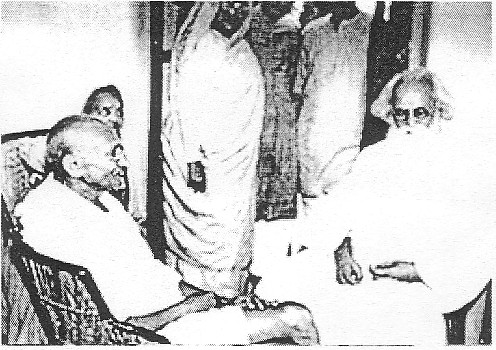
Two pictures of Tagore with Gandhi

Tagore- Gandhi

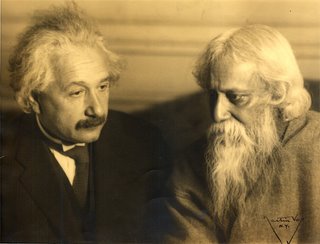
Two pictures of Tagore with Albert Einstein

A letter Tagore wrote from the Netherlands

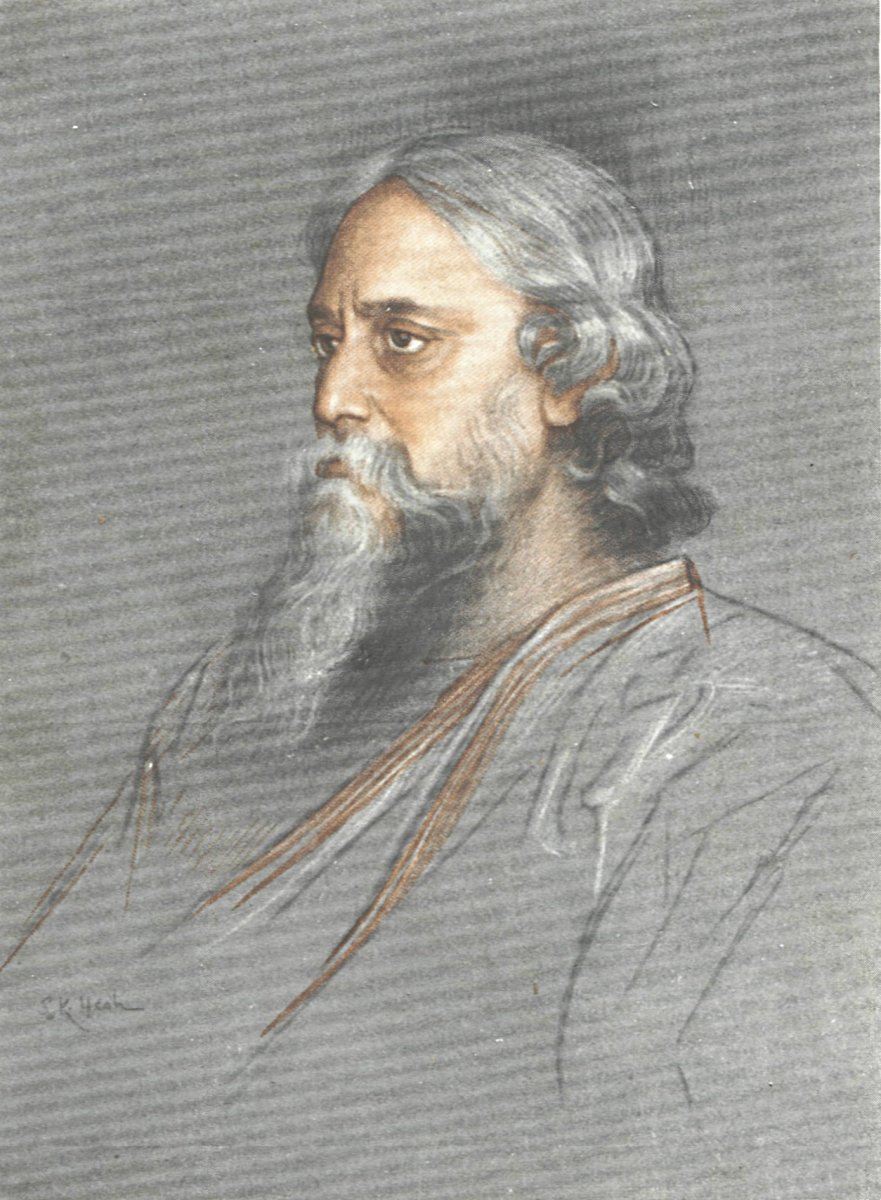
Tagore Portrait (click for full size)

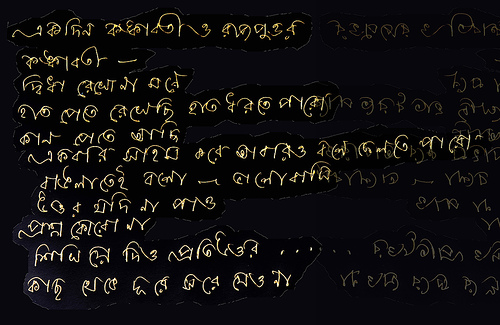
Hand written page from Gitanjali

Extra Special Treat!

For your listening pleasure- Free Download of the Audio-Book of

sadhana-the-realization-of-life


2 Comments

Filed under Free Audio Books, Free E-Books, mp3, Mystic Poetry, pictures, poetry, Spirituality

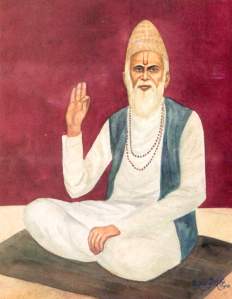
Kabir, as translated by Rabindranath Tagore

Kabir: 1398-1518


Notes from other sources-

Kabir ranks among the world’s greatest poets. In India, he is perhaps the most quoted author, with the exception of Tulsidas. Kabir has criticized perhaps all existing sects in India, still he is mentioned with respect by even orthodox authors. Vaishnav author Nabhadas in his Bhakta-Mal (1585) writes:

hindU turuk pramAn ramainI sabadI sAkhI
pachchhapat nahiN bachan sabahiN ke hit kI bhAkhI

[His “ramaini” “shabda” “sakhi” (sections of his “Bijak”) are accepted by Hindus and Turks alike. He spoke without discrimination for the good of all]

He lived perhaps during 1398-1448. He is thought to have lived longer than 100 years. He had enormous influence on Indian philosophy and on Hindi poetry.

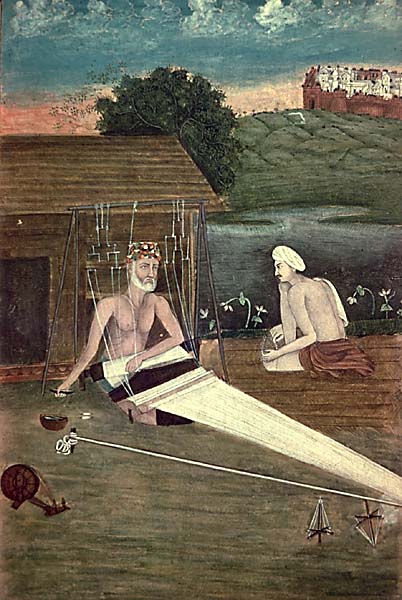
His birth and death are surrounded by legends. He grew up in a Muslim weaver family, but some say he was really son of a Brahmin widow who was adopted by a childless couple. When he died, his Hindu and Muslim followers started fighting about the last rites. The legend is that when they lifted the cloth covering his body, they found flowers instead. The Muslim followers buried their half and the Hindu cremated thier half. In Maghar, his tomb and samadhi still stand side by side.

Here I quote some of his verses from his “Bijak”, from the section called “sakhi”. My translation follows the Gurumukh TIkA by Puran Sahib done perhas a century ago. He was associated with the Kabirpanthi center at Burhanpur. Kabir’s writings can be hard to translate, not only because the language is old, but Kabir’s expressions are different from what we are used to seeing.

The verses below use the term “hira” (diamond). It should be noted that during the time of Kabir, diamonds were very rare. At that time, diamonds were found only in India and nowhere else.

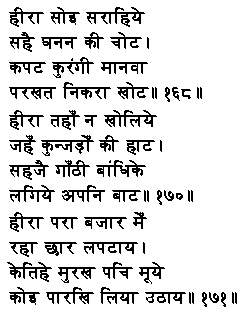
Bijak/Sakhi 168:

hIrA soi srAhiye
sahai ghanan kI choT

kapaT kurangI mAnavA
parakhat nikrA khot

Admire the diamond that can bear the hits of a hammer. Many deceptive preachers, when critically examined, turn out to be false.

[Here diamond is siddhanta (the basic principles or doctrine).An experienced diamond cutter can hit the diamond using a chisel so that the chips will break off as expected. A diamond because if its crystalline structure tends to break off at specific angles. Similarly the true doctrine would come out shining when it is critically examined].

Bijak/Sakhi 170:

hIrA tahaN na kholiye
jahaN kunjroN kI hAT
sahajai gaNthI bANdhike
lagiye apni bAT

Don’t open your diamonds in a vegetable market. Tie them in bundle and keep them in your heart, and go your own way.

[Don’t discuss gyan (knowledge) with those who can not understand it].

Bijak/Sakhi 171:

hIrA parA bajAr maiN
rahA chhAr lapaTAy
ketihe murakh pachi mUye
koi pArakhi liyA uThAy

A diamond was laying in the street covered with dirt. Many fools passed by.

Someone who knew diamonds picked it up.

[Those who understand gyan-siddhanta (true knowledge/principles), pause to acquire it].


Do not go to the garden of flowers!
O friend! go not there;
In your body is the garden of flowers.
Take your seat on the thousand petals of the
lotus, and there gaze on the infinite beauty.

koi prem ki peng jhulaao re

Hang up the swing of love today!
Hang the body and the mind between the
arms of the beloved, in the ecstasy of love’s joy:
Bring the tearful streams of the rainy clouds
to your eyes, and cover your heart with
the shadow of darkness:
Bring your face nearer to his ear, and speak
of the deepest longings of your heart.

Kabir says: `Listen to me brother! bring the
vision of the Beloved in your heart.’

The following poems include some repeats from different translators:

Looking at the grinding stones,
Kabir laments
In the duel of wheels,
nothing stays intact.

Where do you search me?
I am with you
Not in pilgrimage, nor in icons
Neither in solitudes
Not in temples, nor in mosques
Neither in Kaba nor in Kailash
I am with you o man

I am with you
Not in prayers, nor in meditation
Neither in fasting
Not in yogic exercises
Neither in renunciation

Neither in the vital force nor in the body
Not even in the ethereal space
Neither in the womb of Nature
Not in the breath of the breath

Seek earnestly and discover
In but a moment of search
Says Kabir, Listen with care
Where your faith is, I am there.

O servant, where dost thou seek Me?

Lo!I am beside thee.

I am neither in temple nor in mosque:

I am neither in Kaaba nor in Kailash:

Neither am I in rites and ceremonies,

nor in Yoga and renunciation.

If thou art a true seeker, thou shalt at once see Me:

thou shalt meet Me in a moment of time.

Kabir says, “O Sadhu! God is the breath of all breath.”

*

It is needless to ask of a saint the caste to which he belongs;

For the priest, the warrior.the tradesman,

and all the thirty-six castes, alike are seeking for God.

It is but folly to ask what the caste of a saint may be;

The barber has sought God, the washerwoman, and the carpenter–

Even Raidas was a seeker after God.

The Rishi Swapacha was a tanner by caste.

Hindus and Moslems alike have achieved that End,

where remains no mark of distinction.

O friend!hope for Him whilst you live, know whilst you live,

understand whilst you live: for in life deliverance abides.

If your bonds be not broken whilst living, what hope of

deliverance in death?

It is but an empty dream, that the soul shall have union with Him

because it has passed from the body:

If He is found now, He is found then,

If not, we do but go to dwell in the City of Death.

If you have union now, you shall have it hereafter.

Bathe in the truth, know the true Guru, have faith in the trueName!

Kabir says: “It is the Spirit of the quest which helps;

I am the slave of this Spirit of the quest.”

Do not go to the garden of flowers!

O Friend! go not there;

In your body is the garden of flowers.

Take your seat on the thousand petals of the lotus,

and there gaze on the Infinite Beauty.

Tell me, Brother, how can I renounce Maya?

When I gave up the tying of ribbons, still I tied my garment about me:

When I gave up tying my garment, still I covered my body in its folds.

So, when I give up passion, I see that anger remains;

And when I renounce anger, greed is with me still;

And when greed is vanquished, pride and vainglory remain;

When the mind is detached and casts Maya away,

still it clings to the letter.

Kabir says, “Listen to me, dear Sadhu! the true path  is rarely found.”

The moon shines in my body, but my blind eyes cannot see it:

The moon is within me, and so is the sun.

The unstruck drum of Eternity is sounded within me;

but my deaf ears cannot hear it.

So long as man clamors for the [?] and the [?],

his works are as naught:

When all love of the [?] is dead, then

the work of the Lord is done.

For work has no other aim than the getting of knowledge:

When that comes, then work is put away.

The flower blooms for the fruit: when the fruit comes,

the flower withers.

The musk is in the deer, but it seeks it not within itself:

it wanders in quest of grass.

When He Himself reveals Himself,

Brahma brings into manifestation

That which can never be seen.

As the seed is in the plant, as the shade is in the tree,

as the void is in the sky, as infinite forms are in the void–

So from beyond the Infinite, the Infinite comes;

and from theInfinite the finite extends.

The creature is in Brahma, and Brahma is in the creature:

they are ever distinct, yet ever united.

He Himself is the tree, the seed, and the germ.

He Himself is the flower, the fruit, and the shade.

He Himself is the sun, the light, and the lighted.

He Himself is Brahma, creature, and Maya.

He Himself is the manifold form, the infinite space;

He is the breath, the word, and the meaning.

He Himself is the limit and the limitless:

and beyond both the limited and the limitless is He,

the Pure Being.

He is the Immanent Mind in Brahma and in the creature.

The Supreme Soul is seen within the soul,

The Point is seen within the Supreme Soul,

And within the Point, the reflection is seen again.

Kabir is blest because he has this supreme vision!

Within this earthen vessel are bowers and groves, and within it is the Creator: Within this vessel are the seven oceans and the unnumbered stars. The touchstone and the jewel-appraiser are within; And within this vessel the Eternal soundeth, and the spring wells up. Kabir says: “Listen to me, my Friend! My beloved Lord is within.” O How may I ever express that secret word? O how can I say He is not like this, and He is like that? If I say that He is within me, the universe is ashamed: If I say that He is without me, it is falsehood. He makes the inner and the outer worlds to be indivisibly one; The conscious and the unconscious, both are His footstools. He is neither manifest nor hidden, He is neither revealed nor unrevealed: There are no words to tell that which He is. To Thee Thou hast drawn my love, O Fakir! I was sleeping in my own chamber, and Thou didst awaken me; striking me with Thy voice, O Fakir! I was drowning in the deeps of the ocean of this world, and Thou didst save me: upholding me with Thine arm, O Fakir!Only one word and no second– and Thou hast made me tear off all my bonds, O Fakir! Kabir says, “Thou hast united Thy heart to my heart, O Fakir!”

I played day and night with my comrades, and now I am greatly afraid.

So high is my Lord’s palace, my heart trembles to mount its stairs: yet I must not be shy, if I would enjoy His love.

My heart must cleave to my Lover; I must withdraw my veil, and meet Him with all my body:

Mine eyes must perform the ceremony of the lamps of love.

Kabir says: “Listen to me, friend: he understands who loves.

If you feel not love’s longing for your Beloved One, it is vain to adorn your body,

vain to put unguent on your eyelids.”

Tell me, O Swan, your ancient tale.From what land do you come, O Swan?

to what shore will you fly?

Where would you take your rest, O Swan, and what do you seek?

Even this morning, O Swan, awake, arise, follow me!

There is a land where no doubt nor sorrow have rule: where the terror of Death is no more.

There the woods of spring are a-bloom, and the fragrant scent “He is I” is borne on the wind:

There the bee of the heart is deeply immersed, and desires no other joy.

O Lord Increate, who will serve Thee?

Every votary offers his worship to the God of his own creation: each day he receives service–

None seek Him, the Perfect: Brahma, the Indivisible Lord.

They believe in ten Avatars; but no Avatar can be the Infinite Spirit, for he suffers the results of his deeds:

The Supreme One must be other than this.

The Yogi, the Sanyasi, the Ascetics, are disputing one with another:

Kabir says, “O brother! he who has seen that radiance of love, he is saved.”

The river and its waves are onesurf: where is the difference between the river and its waves?

When the wave rises, it is the water; and when it falls, it is the same water again.

Tell me, Sir, where is the distinction?

Because it has been named as wave, shall it no longer be considered as water?

Within the Supreme Brahma, the worlds are being told like beads:

Look upon that rosary with the eyes of wisdom.

Where Spring, the lord of the seasons, reigneth, there the Unstruck Music sounds of itself,

There the streams of light flow in all directions;

Few are the men who can cross to that shore!

There, where millions of Krishnas stand with hands folded,

Where millions of Vishnus bow their heads,Where millions of Brahmas are reading the Vedas,

Where millions of Shivas are lost in contemplation,

Where millions of Indras dwell in the sky,

Where the demi-gods and the munis are unnumbered,

Where millions of Saraswatis, Goddess of Music, play on the vina–

There is my Lord self-revealed: and the scent of sandal and flowers dwells in those deeps.

Between the poles of the conscious and the unconscious, there has the mind made a swing:

Thereon hang all beings and all worlds, and that swing never ceases its sway.

Millions of beings are there: the sun and the moon in their courses are there:

Millions of ages pass, and the swing goes on.

All swing! the sky and the earth and the air and the water; and the Lord Himself taking form:

And the sight of this has made Kabir a servant.

The light of the sun, the moon, and the stars shines bright:

The melody of love swells forth, and the rhythm of love’s detachment beats the time.

Day and night, the chorus of music fills the heavens;

and Kabir says”My Beloved One gleams like the lightning flash in the sky.”

Do you know how the moments perform their adoration?

Waving its row of lamps, the universe sings in worship day and night,

There are the hidden banner and the secret canopy:

There the sound of the unseen bells is heard.

Kabir says: “There adoration never ceases; there the Lord of the Universe sitteth on His throne.”

The whole world does its works and commits its errors: but few are the lovers who know the Beloved.

The devout seeker is he who mingles in his heart the double currents of love and detachment,

like the mingling of the streams of Ganges and Jumna;In his heart the sacred water flows day and night;

and thus the round of births and deaths is brought to an end.

*

Behold what wonderful rest is in the Supreme Spirit!

and he enjoys it, who makes himself meet for it.

Held by the cords of love,

the swing of the Ocean of Joy sways to and fro;

and a mighty sound breaks forth in song.

See what a lotus blooms there without water!

and Kabir says “My heart’s bee drinks its nectar.”

What a wonderful lotus it is,

that blooms at the heart of the spinning wheel of the universe!

Only a few pure souls know of its true delight.

Music is all around it, and there the heart partakes of the joy

of the Infinite Sea.

Kabir says: “Dive thou into that Ocean of sweetness:

thus let all errors of life and of death flee away.”


Behold how the thirst of the five senses is quenched there!

and the three forms of misery are no more!

Kabir says: “It is the sport of the Unattainable One:

look within, and behold how the moon-beams

of that Hidden One shine in you.”

There falls the rhythmic beat of life and death:

Rapture wells forth, and all space is radiant with light.

There the Unstruck Music is sounded;

it is the music of the love of the three worlds.

There millions of lamps of sun and of moon are burning;

There the drum beats, and the lover swings in play.

There love-songs resound, and light rains in showers;

and the worshipper is entranced in the taste of the heavenly nectar.

Look upon life and death;

there is no separation between them,

The right hand and the left hand are one and the same.

Kabir says: “There the wise man is speechless;

for this truth may never be found in Vadas or in books.”
I have had my Seat on the Self-poised One,

I have drunk of the Cup of the Ineffable,

I have found the Key of the Mystery,

I have reached the Root of Union.

Travelling by no track,

I have come to the Sorrowless Land:

very easily has the mercy of the great Lord come upon me.

They have sung of Him as infinite and unattainable:

but I in my meditations have seen Him without sight.

That is indeed the sorrowless land,

and none know the path that leads there:

Only he who is on that path has surely transcended all sorrow.

Wonderful is that land of rest, to which no merit can win;

It is the wise who has seen it,

it is the wise who has sung of it.

This is the Ultimate Word:

but can any express its marvellous savour?

He who has savoured it once,

he knows what joy it can give.

Kabir says: “Knowing it, the ignorant man becomes wise,

and the wise man becomes speechless and silent,

The worshipper is utterly inebriated,

His wisdom and his detachment are made perfect;

He drinks from the cup of the inbreathings

and the outbreathings of love.”


There the whole sky is filled with sound,

and there that music is made without fingers and without strings;

There the game of pleasure and pain does not cease.

Kabir says: “If you merge your life in the Ocean of Life,

you will find your life in the Supreme Land of Bliss.”

What a frenzy of ecstasy there is in every hour! and the

worshipper is pressing out and drinking the essence of the

hours: he lives in the life of Brahma.

I speak truth, for I have accepted truth in life;

I am now attached to truth, I have swept all tinsel away.

Kabir says: “Thus is the worshipper set free from fear;

thus have all errors of life and of death left him.” There the sky is filled with music: There it rains nectar: There the harp-strings jingle, and there the drums beat. What a secret splendour is there, in the mansion of the sky! There no mention is made of the rising and the setting of the sun; In the ocean of manifestation, which is the light of love, day and night are felt to be one. Joy for ever, no sorrow,–no struggle! There have I seen joy filled to the brim, perfection of joy; No place for error is there. Kabir says: “There have I witnessed the sport of One Bliss!” I have known in my body the sport of the universe: I have escaped from the error of this world.. The inward and the outward are become as one sky, the Infinite and the finite are united: I am drunken with the sight of this All! This Light of Thine fulfils the universe: the lamp of love that burns on the salver of knowledge. Kabir says: “There error cannot enter, and the conflict of life and death is felt no more.” —

[?]= unable to transliterate Sanskrit or Arabic characters

Leave a comment

Filed under Mystic Poetry, poetry

Saturday Soup

When I was growing up, when my father was alive, we could count on at least one thing (other than that my parents would be drunk). All of the leftovers from the week’s dinners would go into a pot, be heated to boiling and called Saturday Soup. Because my folks were not particularly creative about what they made for dinner, the soup usually amounted to the same basic ingredients, in varying proportions depending on our appetites for particular meals. The main ingredient was spaghetti and meatballs. This was a meal my dad made that was always made in such quantity that there were leftovers, without fail, even on Saturday (quite a thing really- my brother and I generally ate the leftover spaghetti for breakfast and snacks). Another common ingredient was stew. This was made in smaller amounts because it involved buying “real meat”. Another weekly staple was navy bean soup (cheap to make and my dad was in the navy for 23 years). Some items that made it into the soup less dependably but maybe alternating week-to-week included corned beef and cabbage, pork chops, meatloaf, sloppy joes and sometimes things that my folks brought home in “doggie bags” when they went out to dinner (this could be anything from chop suey to steak.

I always like Saturday Soup.

So, today is kind of a Saturday Soup- odds and ends from the past week. Working my way back through time…

Tadpole/ frog habitat reconnaissance

Yesterday I walked quite a bit along the Springwater Corridor and on Powell Butte (near my home) to check on the status of the annual spawning in marginal habitat. Summary:

  • Many wetland/ swampy areas I had identified a few weeks back on the south side of Powell Butte along the Springwater Corridor were already dry, including some spots where I had previously seen plenty of frogs eggs. So much for these guys- there’s always quite a bit of this going on. The frogs don’t seem to have any idea of whether or not the place they spawn will be viable for tadpole maturation. On the other hand, I found several places where the new habitat restoration project in the Johnson/ Kelly Creek watershed had created what look like great spawning places. Some of which has heavy foliage cover for shade and protection from birds. I even saw some baby fish (I was surprised- I thought that it would take many more years for fish to return to this mangled area). For more info on the wetlands restoration project, see my archives or just go to: https://rickpdx.wordpress.com/?s=Kelly+Creek&submit=Search or to

http://www.portlandonline.com/BES/index.cfm?a=106235&c=33213

  • On Powell Butte I concentrated on the primary northside drainage system (there is also a pond on the southside that is always healthy and I don’t worry about it). Somebody, I’m thinking the park caretaker or maybe volunteers or just some frog nut like me, had earlier in the spring placed debris and rocks at intervals in the (leaky) concrete lined ditch. A really good idea and I wondered why I hadn’t though of it before. I have been worried about the ditch especially this year because of a less rainy spring and unseasonably hot weather. Even though some of the ditch inflow has dried up, there is still a thriving community of tadpoles, more eggs and algae (for food- before they morph, the babies eat the algae).
    We are still, today, having very hot weather for this time of year. I am hoping that we get some rain soon because the ditch will dry up sooner than usual if this keeps up.
  • There are always a large percentage of the frog babies that don’t make it. Typically, the ditch dries completely by the end of Portland Rose Festival (around the second week of August). At that time I will find almost a solid layer of dried/ dead tadpoles at the bottom of the ditch. My annual effort is to save as many of these as possible before they “croak”. I gather generally a hundred or more at the last possible moment, take them home and grow them in an outdoor tank until they’re mature enough to climb out of the tank and go out into the world. Our current location is close to other wetlands and good basic tree-frog habitat.
  • The trick will be knowing when to gather them. I don’t want to do it too soon because it’s best for them to grow up in the place where they were born. If I’m too late, though, the little guys won’t make it.
  • If you are up at Powell Butte and you see some guy capturing tadpoles (against park regulations), don’t report me or throw rocks. I’m a friend to amphibians.

Mad Liberation Radio

Last night was supposed to be the monthly Mad Liberation by Moonlight show on KBOO but I opted towait 2 more weeks because I had forgotten to publicize it. So, the show will be the last friday night in May, 1 a.m. I will post more info at some later date. I hope to have a dynamite show with several guests.

I’m still looking for work

Enough said. Let me know if you have any leads.

Interactive Theater

We did a presentation this past Tuesday at the First Unitarian Church Downtown and it went well. This Spring’s production is mental Health, Family and Work and is called “A Day at the Office”. There are some more performances but I don’t have a flyer handy so I’ll post them at another time. I believe the next one is June 1st at PSU but I could be wrong.

If you are unfamiliar with Interactive Theater/ Theater of the Oppressed, it is based on the work of Augusto Boal who developed the concept in Brazil as a way of getting urban dwellers and peasants to work together to solve social problems. The way it works is that we present a short play that consists of a series of conflicts that have increasingly bad outcomes. After one performance where we just follow the script, in the second time through the audience is invited to stop the play at any point and take the place of one of the actors to see if they can change the outcome. They are encouraged to avoid taking the place of the “oppressor” in the scene (because in real life you don’t just have that person suddenly have a change of heart and solve the issue as if by magic). They are encouraged to take the place of potential allies (who are present in each scene but who don’t act in a way that helps). We let them take any part they wish, though, because there are always things to learn. The challenge to the actors is to ad lib based on their understanding of their character. (We spend a lot of time in the rehearsal phase doing things to develop the underlying aspects of each character, to understand their thinking and their unspoken reactions to events.

It’s loads of fun for the actors and the audience. And it really does help educate the public and generate creative responses to situations of oppression. Our little group is called From the Inside Out and we are running on a shoestring with individual donations. The actors/ director etc. are all people with a mental health diagnosis and are volunteers. (We’d love to get some money for our expenses, travel and time but we don’t have enough financial support yet.)

Short article: Self-help and recovery by Joann Lutz

My experience with spiritual emergency and recovery has taught me the need to grow beyond cultural conditioning, beyond other’s expectations, to discover what ideas and behaviors are truly life-affirming and growthful for me. My recovery was based around the practice of yoga. It gave me validation for the profound changes which I experienced which were pathologized in the mental health system, such as early morning awakening, fasting, and vegetarianism, which lowered my anxiety level; self-esteem which I cultivated through the slow mastery of the yoga postures; peace of mind from the calming effects of the breathing practices; and an expanded view of who I really am, separate from my personality and its constant ups and downs.

I also experienced the healing power of dance; re-experiencing myself moving through the developmental stages as an infant, toddler, playful child; accelerating my feelings of aliveness; feeling energy moving through my body which was more compelling than the thought patterns which I had falsely identified as myself.

I learned about the value of regular exercise, of a daily spiritual practice, wholesome eating, positive relationships, solid emotional support, inspiring thoughts, connection to the natural world, awareness of body sensations and deep relaxation, in building health.

What I was doing, essentially, was creating my own world, keeping what was positive and staying away from what was not. My yoga teacher, Swami Satchidananda, talks about thinking of our body and mind as a country protected by border guards which will not let anything harmful in. For me, that meant staying away from violent movies, from watching TV. indiscriminately, from overeating, from cigarette smoke, and from negative-thinking people. As time went on, it became easier and easier to build this positive world. I began to see my spiritual emergency as an opportunity for transforming my life rather than as a disability and my feelings of inferiority dropped away.

Joann Lutz, L.I.C.S.W., is a psychiatric survivor currently working as a licensed, holistically-trained psychotherapist and stress-reduction teacher in Northampton, MA and Brattleboro Vt. She can be reached at 413-586-6384.

This is great! Olberman rant on MSNBC re Bush: “Shut up!”

http://www.huffingtonpost.com/2008/05/14/olbermann-to-bush-this-wa_n_101831.html

I love it. You can almost feel the spit hit you from the monitor listening to this.

Miscellaneous items for your amusement

Pictures, animation, whatever.

This is me above…

Below, some songs I recorded, wrote many years ago:

pilerrick-end_of_days

lullabyby-me

I didn’t write this. Yoko Ono. Suprisingly melodic, enjoyable. Don’t be afraid, just listen-

yoko-ono-i-felt-like-smashing-my-face-in-a-clear-glass-window

First in a series: The Great Love- Listen to the rest at http://www.freebuddhistaudio.com/talks/details?num=OM690&c=p

That’s enough for now.

Have a great weekend.

Leave a comment

Filed under Uncategorized