Category Archives: Uncategorized

Ron Unger Presents-

This information is forwrded from MindFreedom International. Ron Unger is a a therapist in Oregon who embraces the CS/X movement and teaches cognitive approaches to recovery from serious mental health issues.

-Rick

MindFreedom Oregon – 12 May 2008
http://www.mindfreedom.org – human rights in mental health

FORWARDED PUBLIC SERVICE ANNOUNCEMENT

~~~~~~~

Oregon alternative treatment in mental health seminar:

Ron Unger is a longtime MindFreedom member, and coordinator of
MindFreedom Lane County, who advocates for a treatment alternative
called “cognitive therapy for psychosis.”

This therapy might sound like common sense to many of us: noticing
that people who sound “crazy” can really be understood if we try,
noticing that their problems aren’t that much different than anyone
else’s, and finding the story of how the problems got going and
looking for practical ways to shrink the problem.

However, this therapy is revolutionary in a mental health system that
insists that “psychosis” is a biological brain disorder that can only
be treated with medications!

Details on the seminar are below: this seminar is very affordable to
mental health workers who need CEU credit, and is free to consumers
who might be interested.

************************************

Cognitive Therapy for Psychosis: an evidence-based psychological
approach for delusions, hallucinations, and paranoia

A Seminar In Corvallis, Oregon, on Friday June 27, 2008

Learn to:

– Conceptualize psychosis as an understandable reaction to life events

– Use proven cognitive methods to reduce psychotic thinking

– Help clients recover by activating their own rational and self-
organizing process

– Offer an effective alternative to people who receive limited
benefit from medications or who prefer less dependence on medications

Most current treatment approaches frame psychotic experiences as non-
understandable, address them only with medication, and then ask
clients to resign themselves to living with the symptoms medication
does not control.

Cognitive therapy for psychosis, developed mostly in the UK and still
little known in the US, is an evidence-based method with a different
perspective. In this seminar, you will gain insight into the
connections between everyday psychological difficulties and the more
extreme ones we call psychosis. You will become able to track the
story of how psychosis develops and how people became trapped in it.

Then, by hearing about basic cognitive therapy principles,
participating in exercises, and exploring case examples, you will
learn how to collaborate with clients in exploring evidence and
explanations for experiences, and in testing coping ideas. This
process works to restore the client’s role as an active problem
solver capable of making decisions that reduce psychotic symptoms,
and as an active partner in a journey toward recovery.

Speaker:

Ron Unger, LCSW, is a therapist specializing in cognitive therapy for
psychosis. He has given numerous seminars about cognitive therapy and
other psychosocial approaches to psychosis, and on trauma and the
relationship between trauma and psychosis. His presentations
emphasize simple, practical, and humanistic ways of understanding and
relating to human difficulties that can too easily be perceived as
being “beyond understanding.”

Objectives:

* Refute misconceptions that have often discouraged professionals
from attempting psychotherapy for schizophrenia or other psychotic
disorders

* Learn about research showing that medical model explanations
actually increase stigma, and identify a better approach

* Understand psychotic symptoms as existing on a continuum with other
human reactions to distressing circumstances

* Utilize the style and the essential steps of cognitive therapy for
psychosis.

* Explore a variety of case examples that illustrate effective
strategies

* Identify 3 ways to integrate this psychological approach with
existing treatment methods

*Outline:*

*Introduction

A cognitive perspective on psychosis

Continuum from “normal” to “psychotic”

Inter and intra-personal dialogue and its breakdown

Nonlinear causality in psychosis

Stress and trauma as factors

Limits of biological explanations

Multi-factorial understanding and hope for recovery

*Therapeutic Style

Relationship considerations always primary

Goals structured around client concerns

Balance between confrontation and collusion

Collaborative Empiricism

Drawing out client’s rationality

Empathy even when it is challenging

Self disclosure of unusual experiences by therapist

*Two Key Procedures

“Normalizing” psychotic experiences

Developing a formulation

*Approaches for specific issues

Delusions

Hallucinations and voices

Paranoia

Thought disorder

Negative symptoms

*Putting it into practice

Case examples

Difficulties and possible solutions

Three levels of integration with the existing system

Target audience:

Counselors, Social Workers, Psychologists, Psychotherapists, Case
Managers, Addiction Counselors, and other mental health professionals.

Cancellation Policy:

If you contact us before the seminar date, you can receive a tuition
refund, less a $30 cancellation fee.

Seminar Schedule for Friday, June 27, 2008:

8:00 Check in/Continental Breakfast

8:30 Program Begins

11:50-1:00 Lunch /(on your own)/

4:30 Program ends

Questions? Call 541-513-1811, or email ronunger@efn.org

Credit Information: 6.25 NASW CEU credits approved – attendees
registering for CEUs must attend the full seminar.

Guarantee: If the quality of this seminar does not meet your
expectations, simply explain the reasons for your dissatisfaction, by
mail or email, and you will receive a full refund.

Call early with your ADA needs!

Seminar Location Details:

LaSells Stewart Center

875 SW 26th Street, Corvallis

541-737-2402

http://oregonstate.edu/lasells/gettinghere.html for more details on
finding the site, and on parking. Note that while the website says
parking costs $5, it is actually free the day of the seminar due to
OSU being out of session.

Include the book listed below with your seminar registration and save!

*Cognitive Therapy of Schizophrenia (Guides to Individualized
Evidence-Based Treatment) (Paperback)*
by David G. Kingdon and Douglas Turkington

Drawing on the authors’ decades of influential work in the field,
this highly practical volume presents an evidence-based cognitive
therapy approach for clients with schizophrenia. Guidelines are
provided for collaborative assessment and case formulation that
enable the clinician to build a strong therapeutic relationship,
establish reasonable goals, and tailor treatment to each client’s
needs. Described in thorough, step-by-step detail are effective
techniques for working with delusional beliefs, voices, visions,
thought disorders, and negative symptoms; integrating cognitive
therapy with other forms of treatment; reducing relapse risks; and
enhancing client motivation. Special features include reproducible
client handouts and assessment tools. List Price $25: available with
this seminar for just $20!

To Register, please complete entire form (to notify you of any
seminar changes):

Name_________________________Profession__________________________

Employer Name_________________________________

Address___________________________Dep/Floor/Suite__________________

City______________________________State______Zip__________________

Home/Cell Ph ( )______________Dept. Ph ( )___________________

Email address______________________________

To register together with another person: send both registrations in
at the same time, and write in the name of the other person(s) here:

______________________________________________________________

Please note: Confirmation/receipts are sent only via email.

Please return entire registration form

Register by Fax: 541-686-2440

Register by Phone: 888-214-3263

Register by Mail:

Ron Unger LCSW

1257 High St. Suite 7

Eugene, OR 97401

Check tuition (includes refreshments)

_____ $99 single registration postmarked three weeks prior to seminar
date

_____ $79 per person for 2 or more pre-registering together
postmarked three weeks prior to seminar date

_____ $89 per person for 2 or more pre-registering together if *not
*postmarked three weeks prior to seminar date

_____ $109 Standard

_____ Scholarship (free attendance for consumer/survivors and family
members who want to learn more about this approach)

_____ $20 to purchase the book */Cognitive Therapy for Schizophrenia /
*(See below for a description of this book. It will be distributed at
the seminar – saves you $5 plus shipping costs!)

Indicate method of payment (All registrations must be prepaid):

_____ Check enclosed payable to Ron Unger LCSW

_____ MC (16 digits)

_____ VISA (13-16 digits)

_____ AE (15 digits)

_____ Discover Novus (16 digits)

Card #______________________________ Card Exp. ______________________

Signature:______________________________________________

V-Code #*: ________________

(MC/VISA/Discover: last 3 digit # on signature panel on back of card.
American Express: 4-digit # on face of card.)

Registrations due one week in advance of the seminar! Walk-in
registrations at the seminar are welcome, but admission cannot be
guaranteed.


Leave a comment

Filed under Uncategorized

Homemade music

Today I thought I’d just post/ repost some of the songs I’ve recorded. The recordings are poor quality- I’m doing this on my own with a cheap mike and a PC and I haven’t the foggiest notion of how to do it correctly. Bear with me.

This Lullaby I wrote as a comfort to myself:

lullaby-by-rick

This is an open letter to god- I was a bit angry at the time. I haven’t included all of the lyrics in this version. Most people are ready to stop listening before I get to the end:

rick-erins_ghost

This is a song my family sings before meals. The primary lyrics are traditional, the overlay words are mine as as is the music.

rick-may_you_dwell_in_the_heart

A song I wrote for Erin when she was 2 years old (I have songs that I wrote for all my kids; sometime I’ll try to record them; sometime I’ll try to do a better recording of this one, too):

rick-frogy_girl_ok

On a completely different note-

An update from David Oaks re the Oregon Consumer/ Survivor Coalition:

Hi OCSC Talk,

I just got off phone after long and, I feel, productive discussion
with Erinn Kelley-Siel, who is advisor in Governor Kulongoski’s
office about human services.

Some of the main points:

* Erinn absolutely agrees to a meeting with OCSC representatives
personally herself, fairly soon. Because more than one board member
of OCSC is right in Salem, this would seem to be do-able! And I think
it can be helpful. I’ve let Mark (as volunteer on communications for
OCSC) and Tracey (as board president) know.

* Erinn agrees she will RECOMMEND that the Governor meet with
representatives of OCSC. Of course, standard disclaimers apply: She
can’t speak for Governor, he has extremely limited timeline, but she
feels such a meeting would be a good idea. I argued that this issue
is beyond money… that it would be helpful for the Governor to send
a signal that Oregonians with mental health issues are citizens, too,
with a voice, and that he supports a new paradigm.

* We both agreed that (a) the constituency we are working for is
extremely disempowered, (b) Oregon is behind on supporting the state-
wide voice of this constituency, (c) moving forward will be a two-way
street: it will take advocacy by elected officials, and also work by
OCSC.

* We agreed that “a new day” has dawned here in Oregon, with
increasing strength of consumer/survivor movement, the depth of
leadership and activity. I brought up names of several leaders whose
names she recognized, and we both agreed these leaders are good
example of this effort: Becky, Rollin, David R., Tracey, and others.

* I was surprised she hadn’t heard about the great work of
Empowerment Initiatives, and I told her about that. Same thing with
Dan Fisher’s work — she hadn’t heard about that. Dan, it would be
great for you to get a packet of your info to her! You and anyone
else is welcome to get her info. Here’s her contact info: Erinn
Kelley-Siel, Human Services Policy Advisor,Office of Governor Ted
Kulongoski, 900 Court Street, Room 160, Salem, OR 97301, ph:
503-378-6549, 503-378-6827 – Fax. E-mail: Erinn.L.Kelley-
Siel@state.or.us

* She can’t guarantee on any budget item of course, but she said she
would do what she could to support budget for consumer/survivor voice.

* A key personal concern for her right now is the placement of
housing in community people convicted of crimes — folks under PSRB.
She said there is intense opposition from community groups. We agreed
that mental health client groups — by putting human face on consumer/
survivors — played a key role in responding. And that these are
difficult issues, but a first step should be VOICE of consumer/
survivors in such efforts. I pointed out this needed to be beyond
tokenism. She said there are some meetings about PSRB coming up, and
she personally would like support from people in those, she said
she’d keep me in touch about them.

* She pointed out that just because Bob Nikkel supports consumer/
survivor voice, it may not get into Governor’s budget. She estimates
that out of 100 items that Bob asked for he got 13. I don’t know how
accurate this, but even if that’s at all close to the truth, it is a
big challenge.

All in all, I think it was a constructive meeting. If anything, we’re
certainly doing the right thing by reaching out, creating dialogue.

Consider: As I’ve said, both USA Senators from Oregon (Smith & Wyden)
are extremely passionate about mental health issues. But neither have
ever met with representatives of a state-wide coalition of mental
health consumers/psychiatric survivors. We can’t blame them for that
— such a coalition has not existed until now! I think there’s a
reasonable chance both would agree if asked and the timing is right.
But even if they don’t agree, at least by ASKING the ball is in their
court.

Clearly, now, with the Governor’s office — the ball is in their
court… an indirect benefit of the launch of OCSC already….

David

Electroshock news, etc.:

Information about electroshock, also called electroconvulsive therapy.

Stop New York State from Forcibly Shocking Simone D!

Info and alerts to resist the State of New York order for even more forced electroshock of Simone D., who has experienced more than 200 involuntary electroshocks (also known as electroconvulsive therapy or ECT).

http://www.mindfreedom.org/kb/mental-health-abuse/electroshock/simone-d/

News Analysis

Electroshock in India: News Analysis

by David W. Oaks — 2007-04-22 07:41

On 1 April 2007 — April Fools Day — in the city of Pune in India, a mental health center held a major event promoting electroshock. The organizers of the promotion covered up hazards about electroshock and gave false information. MindFreedom has a sponsor group in Pune, Center for Advocacy in Mental Health, a project of Bapu Trust. Advocates from Bapu Trust attended the shock promotion event, and here is their news analysis.

http://www.mindfreedom.org/kb/mental-health-abuse/electroshock/pune-india/

New, Free Web Book

The Electroshock Quotationary: New, Free Web Book

by David W. Oaks — 2006-11-25 16:04

Leonard Roy Frank is a survivor of forced electroshock, a long-time human rights activist, an expert editor of quotations, and a passionate MindFreedom supporter. Here is Leonard’s news release about his new book of quotations available online for free.

http://www.mindfreedom.org/kb/mental-health-abuse/electroshock/the-electroshock-quotationary-new-free-web-book/

Download Free PDF of Leonard Roy Frank Electroshock Quotationery

An Electroshock Quotationary edited by psychiatric survivor Leonard Roy Frank is available as a free PDF download.

http://www.mindfreedom.org/kb/mental-health-abuse/electroshock/frank-electroshock-quotationery.pdf

A Mind to End Shock Therapy

A newspaper article in the Toronto Star in Canada quotes several electroshock activists about the idea of ending electroshock.

http://www.mindfreedom.org/kb/mental-health-abuse/electroshock/toronto-star/

A writer on electroshock

A writer reflects on how electroshock has impacted memory. This anonymous piece was posted on the excellent blog by Philip Dawdy, called Furious Seasons.

http://www.mindfreedom.org/kb/mental-health-abuse/electroshock/writer-reflects/

Evidence of Electroshock Harm

This is a YouTube link to a video with Steven Wittenberg speaking on how ECT harmed his wife Sue.

http://www.mindfreedom.org/kb/mental-health-abuse/electroshock/ect-harm/

Call for ECT to be Banned

This is a link to a YouTube video by MindFreedom member Sue Clark-Wittenberg who says ECT should be banned.

http://www.mindfreedom.org/kb/mental-health-abuse/electroshock/call-for-ect-ban/

NY State New Guidelines on Forced Electroshock

Apparently in response to the state-wide outrage following MindFreedom human rights alerts about two individuals slated for forced electroshock, NY State has issued new “guidelines” about use of involuntary electroshock over the wishes of the subject. MindFreedom’s response: No Means No.

http://www.mindfreedom.org/kb/mental-health-abuse/electroshock/ny-state-guidelines/

Flyer: “Electroshock = Permanent Brain Damage”

A one page flyer, available in both PDF and Powerpoint format, highlighting the link between electroconvulsive therapy and brain damage.

http://www.mindfreedom.org/kb/mental-health-abuse/electroshock/mfi-ect-flyer-2007/

Psychiatrist tries to silence forced electroshock survivor

In New Zealand, a psychiatrist, Stephanie du Fresne, was administering involuntary electroshock (also known as electroconvulsive therapy). During an outing the recipient of the electroshock went to a TV station and got on national television about her human rights abuse. Dr. du Fresne filed a complaint against the television station, claiming the TV station was violating the right of her allegedly-insane patient to “informed consent” about appearing on national television. On 7 February 2008, a New Zealand High Court “quashed” the psychiatrist’s attempt to stifle free speech.

http://www.mindfreedom.org/kb/mental-health-abuse/electroshock/new-zealand-du-fresne/

Gathering in Montreal to Ban ECT

Place Emilie-Gamelin (metro Berri-UQAM), from 2008-05-10 11:00 to 2008-05-10 13:00

The Quebec Committee to ban ECT is honoring Mother’s Day with a gathering to say NO to ECT.

http://www.mindfreedom.org/kb/mental-health-abuse/electroshock/montreal-gathering-2008/

Leave a comment

Filed under Uncategorized

Another MindFreedom news release from lazy blogger

Hi,

This is for everyone in Oregon

In case you missed any of these news items, here is a link to April
2008 alerts about changing Oregon’s mental health system:

http://www.intenex.net/pipermail/mindfreedom-oregon-news/2008-April/
date.html

If that link is too long for your browser, try clicking on this link:

http://tinyurl.com/4nlef3

The big picture for April 2008?

As you may know by now, Oregon’s mental health system has two unusual
honors in the USA in 2008:

1) MONEY FOR BRICKS

Oregon is one of the FEW USA states that is actually BUILDING new
huge psychiatric institutions. That’s right, the last legislative
session found $500,000,000 (half a billion) for the bricks, concrete
and energy for this. Whatever your stand is on replacing Earthquake-
prone buildings, consider:

2) NO MONEY FOR VOICE

Oregon is one of the FEW states to continue to have ZERO funds for
the state-wide voice of mental health consumers and psychiatric
survivors. For five years Oregon has had no funding for a state-wide
newsletter, state-wide advocacy, state-wide conference, office of
consumer affairs, etc. for mental health consumer/survivors.

Five years! Not a cut-back, zero!

Well, more and more Oregonians are *doing* something about it!

So check out the April 2008 news re-cap!

You’ll find out…

**** HOW *you* can easily ask Governor Kulongoski and his
administration “Why zero? Why zero for five years for the state-wide
voice of mental health consumers and psychiatric survivors?”
MindFreedom Oregon has determined that Governor Kulongoski’s office
itself is one of the top obstacles, since there is widespread support
in the legislature, and within the Governor’s own bureaucracy!

You can attend remaining public hearings by Oregon Dept. of Human
Services in Portland, Wednesday, April 30; Salem, Tuesday, May 6, 9
a.m. – noon; Wednesday, May 7, 8:30 – 11:30 a.m.; Eastern Oregon
interactive teleconference, Thursday, May 8, 10 a.m.

**** READ the front-page article in Willamette Week about an
Oregonian blowing the whistle on psychiatric drug industry fraud.

**** READ a news story in Street Roots about the launch of a state-
wide coalition by and for mental health consumers and psychiatric
survivors. Read how Oregon’ Mental Health Division Deputy Assistant
Director Madeline Olson claims their choice was between funding a new
psychiatric institution, or funding voice for consumer/survivor
voice. (Really? But why ZERO? Not a cut-back: Zero?)

**** SEE theater in Portland in May & June exploring mental health
issues.

**** FIND OUT about a job opening in an Oregon empowering alternative
in mental health care, Empowerment Initiatives.

**** WITNESS the launch of the Oregon Mental Health Consumer/
Psychiatric Survivor Coalition.

Again, all the above April 2008 news items are here:

http://www.intenex.net/pipermail/mindfreedom-oregon-news/2008-April/
date.html

If that link is too long for your browser, try clicking on this link:

http://tinyurl.com/4nlef3

Other news:

REMEMBER, Tuesday, 29 April 2008 is the last day to register so you
may vote in the Oregon election — including presidential primary —
on 20 May.

PARTICIPATE IN “THE NORMATHON” — A free skit on challenging the
power of the psychiatric drug industry (watch for our Big Giant
Pill), to take place in Eugene, Oregon, Saturday, 17 May 2008, at 4 pm:

For info on the Normathon see:

http://www.mindfreedom.org/norm

More about activism to change mental health care in Oregon is here:

http://www.mindfreedom.org/as/act/us/or

Join MindFreedom International here:

http://www.mindfreedom.org/join-donate

Check out an all-new Mad Market of books and DVD’s on changing mental
health system, proceeds fund MFI human rights campaigns, here:

http://www.mindfreedom.org/join-donate

Please forward this news to appropriate places on and off Internet!

Thanks!

David

David W. Oaks, Executive Director
MindFreedom International
454 Willamette, Suite 216 – POB 11284
Eugene, OR 97440-3484 USA

web: http://www.mindfreedom.org
email: oaks@mindfreedom.org
office phone: (541) 345-9106
fax: (541) 345-3737
member services toll free in USA: 1-877-MAD-PRID[e] or 1-877-623-7743

United Independent Action for Human Rights in Mental Health!

MindFreedom International is an non-profit coalition with a vision of
a non-violent revolution in mental health. Accredited by the United
Nations
as a Non-Governmental Organization (NGO) with Consultative
Roster Status.

Join now! http://www.mindfreedom.org/join-donate

3 Comments

Filed under Uncategorized

Oregon Consumer/ Survivor Coalition

NEWS RELEASE – 23 April 2008 – PLEASE FORWARD!
http://www.mindfreedom.org/as/act/us/or/ocsc

New Oregon state-wide coalition of groups representing
mental health consumers & psychiatric survivors launches.

First board of directors and assembly of organization
representatives of “OCSC” officially begins.

Board unanimously elects Tracey Dumas, PhD first President.

Yesterday, 22 April 2008 was Earth Day. And there was some Earth-
shaking news for the future of mental health care in Oregon.

Yesterday, the state-wide voice in Oregon for mental health consumers
and psychiatric survivors became a little stronger. And if their
plans go well, that voice may become a lot stronger.

After a year of planning and development, a state-wide teleconference
facilitated by nonprofit attorney David Atkin launched the board of
directors and assembly of organization representatives for the new
alliance in Oregon.

For short, the name of the group is OCSC which stands for “Oregon
Consumer/Survivor Coalition.”

The longer name is Oregon Mental Health Consumer and Psychiatric
Survivor Coalition. Incorporation was on 31 August 2007 via a grant
from McKenzie River Gathering Foundation through MindFreedom Oregon
to supply technical assistance, and after months of preparation and
discussion of principles, mission, bylaws, the first board officially
began yesterday afternoon Tuesday, 22 April 2008.

The start-up board of directors resides in all five regions of Oregon
identified by the start-up committee, which felt that geographic
diversity in the large State was a high priority:

OCSC BOARD OF DIRECTORS

Tracey Dumas – President
Rebecca Edens – Chair
Rebecca Eichorn – Vice President
Mark Fisher
David Oaks
Erik Palmer
Beth Quinn – Secretary
Rollin Shelton
Nancy Snider – Treasurer
Amy Zulich

Tracey Dumas of Eugene, Oregon, OCSC’s first board president,
experienced involuntary electroshock at the age of 19, and yet went
on to win her PhD in sociology from the University of Oregon. Tracey
is a well-respected leader of mental health clients, and is widely
admired in Oregon and nationally.

For a Register-Guard newspaper article about Tracey’s work
challenging psychiatric drug company abuse, including a photo of
Tracey, see:

http://www.mindfreedom.org/kb/psych-drug-corp/eli-lilly/reconsidering-
psychiatric-drugs

or if that link doesn’t work go to:

http://tinyurl.com/6rrczm

Also made official yesterday were the 14 initial sponsor
organizations in the coalition. Each group of mental health consumers/
psychiatric survivors in the coalition has a representative on an
“assembly” to hear throughout the year from the grassroots and —
after this start-up — to elect future board of directors. More
groups are welcome to invited to join:

OCSC ASSEMBLY

# Safe Inc. – representative: Donalee Smith, Springfield

# MindFreedom Oregon – representative: David Oaks, Eugene

# State of Oregon Mental Health Consumer/Psychiatric Survivor
Advisory COUNCIL – representative: Rebecca Eichorn, Salem

# BEARS – representative: Marie Parcell, Corvallis

# Project ABLE – representative: Nancy Snider, Salem

# OCTA-Peer LiNC Oregon – representative: Rollin Shelton, Portland

# Empowerment Initiatives, Inc. – representative: Rick Snook, Portland

# Rainbow Clubhouse – representative: Beth Quinn, Bend

# ShelterCare Consumer Council – representative: Tracey Dumas, Eugene

# Oasis of Klamath County – representative: Pam Speaker

# GOBHI Consumer Caucus ? Baker Co – representative: Erik Palmer

# Lane County Mental Health Consumer/Psychiatric Survivor Advisory
Council – representative: Joyce Ann Findley

# The Union Drop-In Center in Grants Pass – representative: Mark Fisher

# A Place of Our Own – representative: Rebecca Edens, Tillamook

OREGON COALITION APPLIES TO JOIN USA COALITION

In their first order of business, the new OCSC board voted
unanimously to apply to become one of the sponsors in The National
Coalition of Mental Health Consumer/Survivor Organizations (NCMHCSO),
which unites state-wide organizations in the USA representing people
diagnosed with psychiatric disabilities. For info about NCMHCSO see:

http://www.ncmhcso.org

Most USA State governments provide some level of support for the
state-wide voice of mental health consumers and psychiatric
survivors, such as a state-wide conference, newsletter, office of
mental health consumer affairs, etc.

Oregon is one of the minority of USA States to provide no funding at
all for such state-wide activity since that budget item was totally
eliminated in 2003. In the words of Oregon’s official State motto,
the historic beginning OCSC “flies with her own wings.”

For a newspaper article in _Street Roots_ about the OCSC launch see:

http://www.streetroots.org/past_issues/2008/04_01/
news_mental_health.shtml

or use this web address:

http://tinyurl.com/5rs45b

Leave a comment

Filed under Uncategorized

We sing this song as a dinner prayer at my house

rick-may_you_dwell_in_the_heart

Leave a comment

Filed under Uncategorized

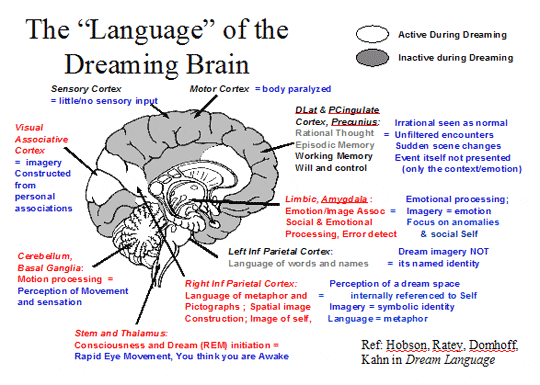
Serial dreams anyone?

I’ve been looking for information about something I call “serial dreams (or nightmares)”. I usually experience this phenomenon in the form of a nightmare but the basic thing is this:
You are having a dream . You wake up. You go back to sleep and the dream continues just as if it hadn’t been interrupted.
Does anybody else experience these? I can’t find anything about it.
Typically, for me, this comes in the shape of a nightmare. Usually it’s hard to wake from. When you finally manage to pull yourself out and wake up, the nightmare starts right back up as soon as you fall asleep. Eventually I (you?) give up and force myself to stay awake because I know I can’t get any peace. The series can have 3 to 7 or more iterations depending on when I give up.
This morning I had a dream. It wasn’t scary- it was even kind of pleasant from the start. In the dream my wife Julie had given me a birthday present that was a train trip to the Canadial Rockies (from southeast Oregon- weird since we live in Portland, the northwest section of the state). I was traveling alone. At least at the beginning. (It was a great birthday ptresent, though I usually ask for either socks or 3-way sex with another woman.)


By the way- the inside of the train was huge. It was more like a cruise ship than a train. From the outside it looked like a regular train.
Another passenger I was talking to asked me about my kids. I told them that my oldest had just turned 23 (which happened yesterday). I woke up.
“That’s interesting”, I thought. “Kind of pleasant.”
I went back to sleep. I was back on the train. Same deal- big place. But now I wasn’t traveling alone. My traveling companion was my daughter Erin who died many years ago. She would be 28 now. I was really happy to see her. We talked and she mostly griped about the food. I went looking for the person who I had told that my oldest was 23 to correct myself. I woke up.


I felt pretty happy. I was glad to see Erin, even though she was kind of a snot.
I went back to sleep. I was on the train with Erin again. I was still really happy to see her. She was still grumpy. I had to get off the train to mail a letter home. I woke up.
I couldn’t wait to fall back asleep. I was awake but I felt certain that I needed to hurry up and get back on the train.


I fell asleep. I was thumbing a ride to meet the train at the next town. I got a ride, got back on the train. Hung out with Erin. Ate shrimp cocktail. It was great. Then I woke up.


I don’t know how many times this happened but it finally got to be 5:15 am and I had to get to take my son Andrew to the airport (PDX) because he had an early flight back to San Francisco.


The one thing I know for sure is that if I could, I would havbe spent all day dreaming about being on that train. I was so happy to see her. I wasn’t depressed about waking up, though. I felt like I had enjoyed a very special time and was grateful even when it was over.

This is a picture of Erin holding my son who just turned 23:

Leave a comment

Filed under Uncategorized

Revolution in mental health services

Some stuff from Street Roots and the Oregon Consumer/ Survivor Coalition:

Published in _Street Roots_ newspaper, Portland, Oregon, USA:

4 April 4 2008 — News

New mental health coalition organizes survivors for reform

By Mara Grunbaum, Staff Writer

As far as David Oaks is concerned, it’s no coincidence that “One Flew
Over the Cuckoo’s Nest,” Ken Kesey’s novel about the dark side of the
psychiatric system, takes place in Oregon. Forty-six years after the
book’s publication, Oaks – who was himself institutionalized and
involuntarily medicated in the 1970s – has serious reservations about
Oregon’s public mental health system. He isn’t the only one with
concerns, but the state, he says, isn’t listening.

Oaks heads up MindFreedom Oregon, a Eugene-based advocacy group whose
several hundred members are mostly “mental health consumers and
psychiatric survivors” – people who partake in mental health
services, and people who feel the psychiatric system has harmed them.

“We are an extremely disempowered constituency,” Oaks said, despite
the fact that more people now have psychiatric diagnoses than ever
before. Oaks contends that decisions affecting mental health
consumers are made without adequate input from those who will be
affected most. For example, he said, instead of letting politicians
argue over how to best help the homeless population, “Let’s hear from
homeless and ex-homeless people who’ve been through the mental health
system about what helps them.”

In 2007, the McKenzie River Foundation granted MindFreedom $8,000 to
set up the Oregon Consumer/Survivor Coalition. The coalition, which
officially kicks off April 22, will unite 14 consumer/survivor groups
statewide. Oaks and other members of the coalition’s steering
committee hope that by banding together, they can consult with
thousands of mental health consumers across Oregon and push for
reforms that people using the system actually want.

The Oregon Department of Human Services treats between 70,000 and
75,000 people with mental health issues each year, and they’re
currently meeting less than half the need for publicly-funded
services, according Addictions and Mental Health Division Deputy
Assistant Director Madeline Olson.

The state used to fund an Office of Consumer/Survivor Technical
Assistance (OCTA), whose small staff served as a liaison between
mental health consumers and the government, kept track of programs
statewide, and provided technical assistance to consumer/survivor
groups looking to expand their services. The office’s director,
Rollin Shelton – who says he received public psychiatric services in
California in the 1980s – advised state committees on consumer
concerns and regularly helped inform decisions on mental health
programs. When a revenue shortfall forced the state to make budget
cutbacks in 2003, OCTA was one casualty, and Oregon has not paid for
a comparable entity since.

The consumer perspective is important, Olson said, and DHS has
supported several attempts to reestablish an office like OCTA, but
each failed to win funding from the legislature.

“There are never sufficient revenues in this state to fund everything
that people need, let alone everything that people would like,” Olson
said. She cited the $458 million project to replace the aging Oregon
State Hospital as one thing that has taken precedence over funding a
consumer affairs office. “There’s a lot of value in a dedicated
office, but if I had to trade between continuing to treat people in a
building that was built in 1883 or building that office, I would
elect to have a safer treatment space for those people.”

Oaks isn’t convinced. If the state can find nearly half a billion
dollars to build new institutions, he said, they should be able to
devote some money to an organized consumer voice.

Shelton, the former OCTA director, is now the executive director of
Mental Health America of Oregon/PeerLinc Oregon, which provides
training and technical assistance to people with mental health issues
and consumer/survivor groups. He is also on the new coalition’s
steering committee.

Without statewide coordination, Shelton said, the mental health
system operates in many “different little fiefdoms.” While some
counties improve mental health services, others are still “in the
dark ages,” and little information is shared between them. “As a
result, folks all over the state are again and again and again in the
position of having to reinvent a wheel that someone else has already
invented,” he said.

The Oregon Consumer/Survivor Coalition will represent a wide variety
of viewpoints, Shelton explained, from those who vehemently oppose
chemical treatment of mental health issues to “folks who believe with
equal strength of conviction that without their psychiatric
medication, they’d be lost.”

Oregon has taken some steps to include the mental health consumer
perspective in its decision making. A senate bill passed in 2007
requires at least one fifth of the members of any government-formed
mental health advisory group to be consumers of mental health
services. Olson also said that DHS has added staff at the state
hospitals who are trained to respond to consumer concerns. “I think
we’ve tried to compensate,” she said, athough “it’s not quite the
same thing as having an everyday voice at the state,” which OCTA
provided.

The level of consumer representation at the state is “still sort of a
token,” said Amy Zulich of Empowerment Initiatives, another Portland
group involved in the coalition. Empowerment Initiatives gives 25
individuals a year grants of $3000, which they use as part of a self-
directed mental health plan. Grant recipients might spend the money
on clothes, art supplies, or a personal skills coach, depending on
what they determine would help them reach their goals.

Zulich hopes the coalition can give mental health consumers wider
access to these “brokerage” programs and other community tools.
Shelton would like to expand peer-delivered services, where people
who have experienced mental health issues are paid to assist others
facing similar challenges. Oaks wants to put an end to involuntary
psychiatric treatment, which is court-ordered for about 800 adults
every year. All three advocates emphasize that what they really want
is to hear from as wide a range as possible of mental health
consumers and to bring those voices into the public process.

“Nothing about us without us,” Oaks stressed. “If we’re talking about
mental health.. Let’s have people who’ve been at the sharp end of the
needle. Let’s have them at the table.”

My 2 cents:

A little while ago I had a chance to talk with Karl R. at my house- he’s semi-retired from Oregon AMH- and brought up the hospital issue. He said, “Well, this seems to have way too much momentum for us to do anything about it at this point.” I said,”You and I both know better. There is no possible excuse for this- the state has learned this lesson before.” (Karl was instrumental in the downsizing and eventual closure of the state’s large DD institution- “Fairview Hospital and Training Center”. The same arguments were made. Some people just had to be kept in such a place. The court mandates require it. We can’t serve these people in the community. You know the drill- it’s the same now as then. Both Karl and I had a lot to do with proving all of these things wrong.) I said, “What did you think of when you heard about the Federal inspection fiasco at the Sate Hospital- Deja-Vu?” (the beginning of the end of Fairview was a federal inspection that ended up de-funding the institution for nearly a year, creating a major state funding crisis. I was at Fairview the week of the inspection and was sitting in a resident cafe building when Karl came in with the federal report and a big grin on his face.) Karl said, “Well, there may be some things creeping forward through the attorney general’s office that could create a similar scenario soon.”

A few things happened as a result of the Fairview closure other than the elimination of a great evil (believe me, Fairview was a great evil):

  • The people who came out into the community were served at rates far and above those available to people who had not been institutionalized. A back-log waitlist of 5000 disabled people (folks who had stayed in the community, many at least as disabled as those leaving Fairview were outraged. The waitlist was a dead end. The rate of people being added far outstripped the number of people leaving the list. The only way you could get new services was if every family member who could care for you died. Even then you couldn’t get the level of services being given to the former Fairview residents.
  • The waitlist people sued the state- called the “Staley Lawsuit”- and won; resulting in the “Staley Settlement”. (I was instrumental in implementing the Staley Settlement when I created the first new self-directed supports brokerage to meet the demand for services- Inclusion Inc.)
  • The settlement demanded that everyone be served- no exceptions- and that the mode of service was to be self-directed supports. (I’m sure that Karl had a hand in that, too- he’s a really great guy). The waitlist was abolished. Down the road the bureaucracy found ways to limit the the self-directed elements of the program but it’s still a national model for best practice. Real self-determination throws pies in the face of any and all bureaucracies. It is the true revolution that is needed in all social services. Still, it is now a fact that everyone in the state with a developmental disability has access to $9000 or more per year for services that they select through person centered planning. (No coincidence that Karl was a big part of creating Oregon’s Mental Health Brokerage- Empowerment Initiatives- still the only program of it’s kind in the country. But EI is extremely small, can only serve a small handful of people annually, the funding is precarious and amounts to a token gesture on the part of the state.)


Maybe the state’s real nightmare is- what if the same thing happens in mental health? What if we demand self-directed services for all? What if we demand real parity?

A more important question in my mind is, “Why are we still so far behind as a consumer movement? Why are we still licking the crumbs from the table of social services?”

One answer is that we have a history of not working together effectively. Tell me if I’m wrong. I can see no other reason for us to be in the pathetic situation of being at least 20 years behind developmental disabilities advocates. (Oh, you can bring up stigma- certainly we are not seen in as warm and fuzzy a light as someone with a developmental disability- but again- how long are we going to blame others for where we’re at. The challenge is not just at the doorstep of the State. The challenge is and has been at our own doorstep. We need to stop our petty squabbles and unite to demand self-determination and substantial access to support for everyone that has a mental health diagnosis. And we have to actively and aggressively work to change our public face. There is no excuse.

Years ago when I was first in therapy I learned and remembered the damage that was done to me in childhood and how that has effected my life. But I am 53 years old now and I am so past blaming my poor, ancient, 88 year old mom for my problems. I am responsible for making my life into what I want it to be. To the extent that I ruminate on my childhood as the cause of all my problems today I can not move forward. Responsibility, intention and determination are what I need to move forward.

Here we are stuck in a decrepit throw-back system that crumbles even as it tries to provide meager services to a few in need. It doesn’t need fixing- it needs to be burned to the ground. In a recent meeting David Oaks used the term non-violent revolution. A revolution does not “tinker” with the old system.

What are we going to do to change the status-quo? This is our fight. The outcome is on our shoulders.

We know what we need to do.

Our path is the path of liberation.

4 Comments

Filed under Uncategorized

Scouting for frog habitat/ spawning grounds

Unintended findings-

(Typical local tree-frog that spawns around Powell Butte- they range in color from green, striped to mud-brown)

Today I went exploring the south side of Powell Butte- near the Springwater Corridor- to look for alternate access to the nature preserve. What I found was some excellent swamp/wetlands/ ponds already, in some cases, filled with frog-egg-scum. Nearby there was a sign announcing that the area had been part of the Kelly Creek Restoration and Flood Mitigation Project.

The area is around where Kelly Creek flows into Johnson Creek. I have know since I was a kid that this was a neighborhood plagued by floods. In fact, from looking at the surroundings of Kelly Creek and it’s larger friend, Johnson, you can see that part of the trouble is that wetland, swamps and ponds have been filled in order to build homes and yards. Our forefathers in their “wisdom” thought that they could replace the natural wetlands with houses and get away with it by building concrete walls around the creeks and/ or shunting them into underground pipes. The nearly annual flooding of these areas is nature’s response.

And, of course, elimination of salmon and other aquatic life is the result as well.

Somebody a couple years ago got the idea that they might be able to move this particular clock backward. This is from an article written by “Interfluve”- a company that conducts habitat restoration in wetlands:

More than 70 years ago, the confluence
of Kelley Creek and Johnson
Creek in Southeast Portland was a natural
habitat that thrived. A project in the
1930s to move flood waters through the
basin more quickly straightened and
lined the creeks with rock walls and
severely degraded the habitat and water
quality in both creeks.

So the project aimed to restore creek-fed swamps and ponds while taking out the concrete barriers and re-building the creek-beds. Also:

Crews also create(d) two backwater
channels along Johnson Creek and one
along Kelley Creek. These channels will
provide wetland habitat, more high and
fast flow refuge for fish and floodwater
storage.
“Old channel scars fill up during storm
events like a bathtub and drain as flow
decreases,” said Corsale.“This creates more
of a refuge (for fish) from high flows and
fast flows.”
Crews (have) also (placed) a lot of large,
woody debris into the channels to create
pools and cover for fish, and they are optimizing
the slope of the creek for a spawning
channel. At the same time, Greenworks
PC is working on a watershed re-vegetation
program and will create four different plant
communities.

Since the project is completed (as far as current funds allow) a good deal of improvement is already visible. I didn’t have my camera today but I saw many areas where aquatic habitat is flourishing. The following pictures are archival.

I rescue tadpoles from drying puddles every year and raise them into frogs and set them loose. This is an attempted scan of a tadpole about halfway turned into a frog (poor quality):

Better picture of tadpoles typical of the ones I find in the Powell Butte drainage ditches:

Sometimes we find newt tadpoles- they start out a little bigger, are more colorful and quickly develop these gills you see in the picture below:

Then they grow stubby legs and don’t look at all like frogs.

27 Comments

Filed under Uncategorized

Miscellaneous Nonsense

Drinky Crow (not my work)

Something I made- but I’m not proud of it

(it’s an argoyle sock)

My favorite Jaguar

Remember Hal?

take_a_stress_pill

A Goopy animation:

What I think about the stupid paperclip:

Some pictures (click for full size)

Oh- and this:

freddy-mercury-and-cliff-richard-its-in-everyone-of-us

Leave a comment

Filed under Uncategorized

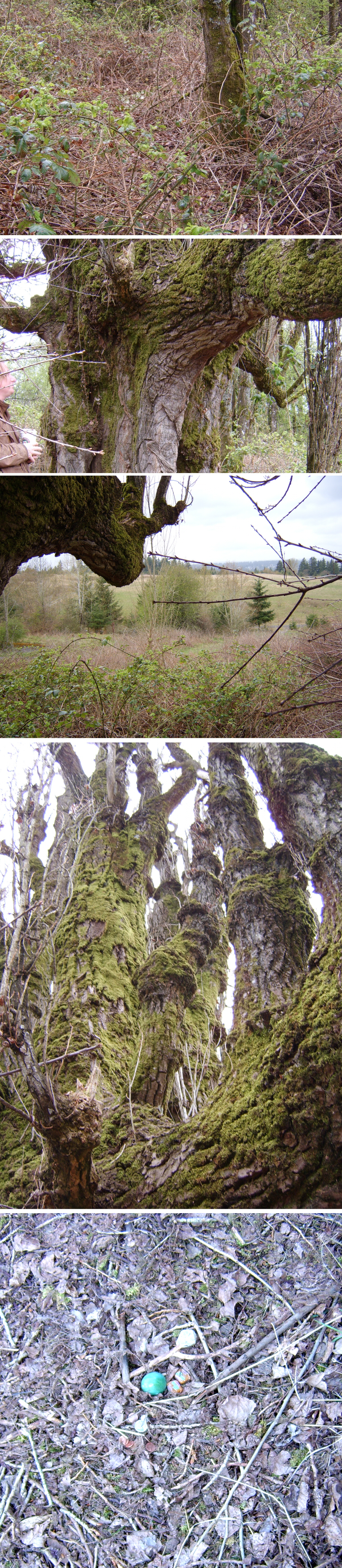
Today- The tree at Erin’s Rest

Includes (not necessarily in this order):
the path I cut through blackberries yesterday
the trunk of the tree
the view from the tree today (overcast)
a look up through the branches
stuff we left there today
(click for full size)

Leave a comment

Filed under Uncategorized